
The roar of the student section, the squeak of sneakers on hardwood, and the sheer chaos of March Madness make NCAA basketball one of the most electric sports in the world. But for the sharp bettor, the excitement doesn't start in March - it starts in November. College basketball betting offers a unique landscape defined by high variance and, consequently, high opportunity.
While the NBA features 30 teams with the best players in the world, NCAA Division I basketball boasts over 360 teams ranging from future NBA lottery picks to scrappy mid-major squads playing in high school-sized gyms. This massive disparity creates a market that is nearly impossible for oddsmakers to price perfectly every single night. For the crypto bettor, this volume of games is a goldmine.
This guide will walk you through the fundamentals of CBB wagering, helping you navigate the chaotic waters of collegiate athletics. We will explore how to use cryptocurrency to maximize your edge, how to identify value in lower-tier conferences, and how to manage the inevitable swings of betting on 19 and 20-year-old athletes.
Why College Basketball is the Bettor's Paradise
If you are accustomed to betting on the NFL or the NBA, you are used to efficient markets. In those leagues, every injury is known, every stat is scrutinized, and lines are razor-sharp. NCAA basketball is different.
The sheer volume of inventory is the bettor's greatest advantage. On a busy Saturday in January, there might be 150 games taking place. Even the best sportsbooks in the world cannot dedicate the same resources to the matchup between The Citadel and VMI as they do to Duke vs. North Carolina.
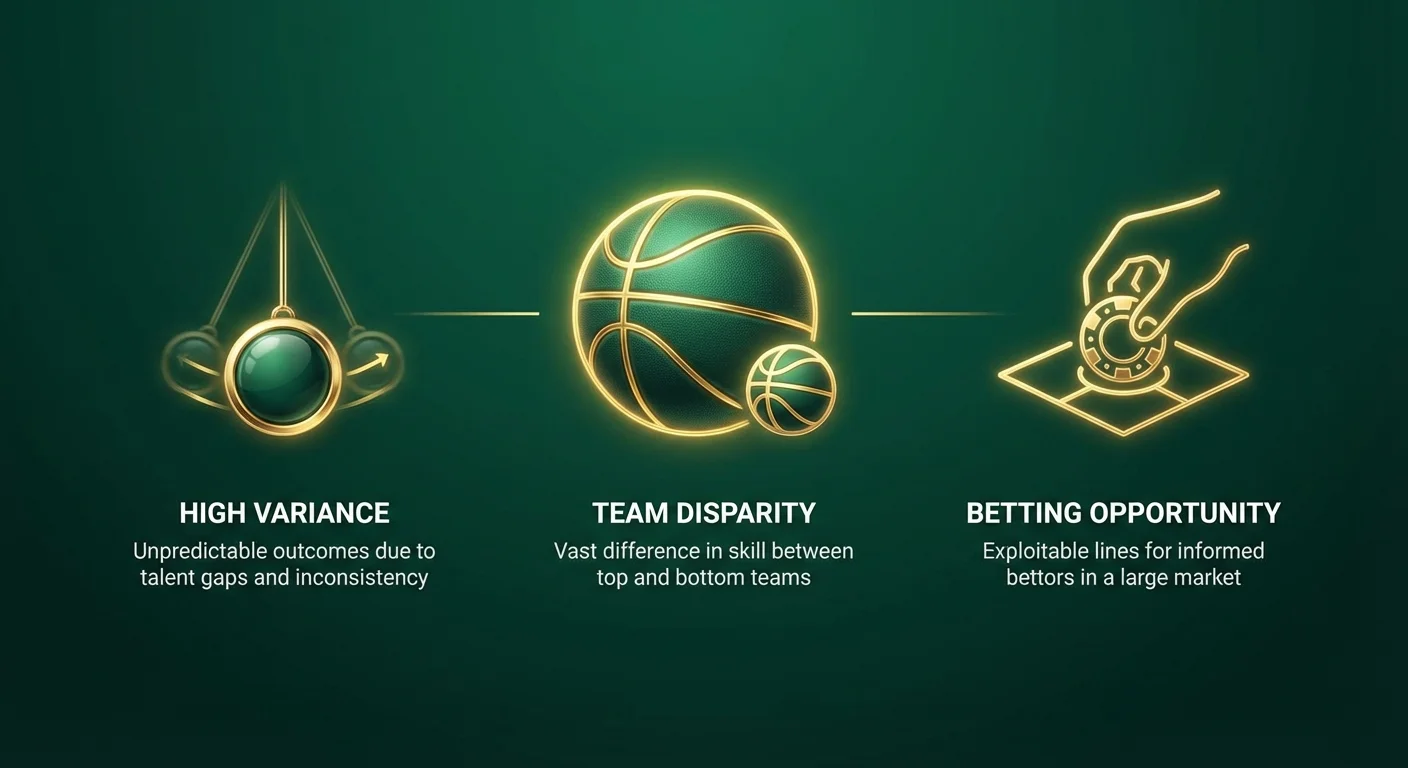
The Variance Factor
"Variance" is a statistical term representing the spread between expected results and actual results. In college basketball, variance is high. Why?
- Talent Disparity: The gap between the best team and the worst team is massive.
- Inconsistency: You are betting on young adults who are prone to emotional swings, pressure, and mistakes.
- Home Court Advantage: Unlike the pros, college crowds (especially student sections) can actively disrupt a game, influencing momentum and officiating.
High variance means the best team doesn't always win (or cover). While this can be frustrating, it is also where the profit lies. If you can predict the spots where variance is likely to occur - identifying an upset or a blowout before the market does - you can secure significant returns.
Crypto Advantage in CBB Wagering
Before diving into strategy, it is essential to understand why you should be using cryptocurrency for your CBB wagering. The intersection of crypto and sports betting solves several legacy problems found in traditional banking methods.
1. Speed is King
In college basketball, lines move fast. A piece of injury news regarding a star player at a small school can shift a line by 4 or 5 points in minutes.
- Instant Deposits: Bitcoin, Litecoin, and USDT deposits typically clear in minutes, allowing you to jump on a line before the "steam" (heavy betting volume) moves it.
- Live Betting: CBB is a game of runs. Crypto allows for rapid account funding to hedge bets or double down during a timeout.
2. Higher Limits and Anonymity
If you find an edge in the Metro Atlantic Athletic Conference (MAAC), you want to maximize it. Traditional fiat books often limit winning players quickly. Crypto-exclusive sportsbooks generally offer higher betting ceilings and do not report your activity to credit bureaus or banks, keeping your hobby private.
3. Reduced Fees
When you are grinding out a profit over a season of hundreds of bets, transaction fees eat into your ROI (Return on Investment). Crypto networks (especially Litecoin or USDT on Tron) have negligible fees compared to credit card processing fees or international wire costs.
Understanding the Lines: The Big Three
To bet successfully, you must master the three primary bet types. While these are standard across sports, they function differently in the NCAA context.
The Point Spread
This is the great equalizer. The sportsbook predicts the margin of victory.
- Example: Kansas (-14.5) vs. Iowa State.
- The Nuance: In the NBA, a 15-point spread is rare. In NCAA basketball, you will see spreads of -25 or even -30 in non-conference play.
- Strategy: Be wary of massive favorites. Coaches often pull starters late in blowout games, leading to a "backdoor cover" by the underdog.
The Moneyline
Simply picking the winner.
- Favorites: Betting a -800 favorite in CBB is risky due to high variance. One bad shooting night, and your bankroll takes a hit.
- Underdogs: This is where the magic happens. Because of the volatility of college sports, underdogs ranging from +150 to +400 hit more frequently than the general public expects, especially in conference play.
The Total (Over/Under)
Betting on the combined score of both teams.
- Pace of Play: This is the most critical factor. Some teams (like Virginia historically) play a deliberate, slow style. Others play "run and gun."
- Rule Differences: Remember, college halves are 20 minutes (40 minutes total), and the shot clock is 30 seconds. This results in lower scores than the NBA generally, but variations are wild.
Comparison: NBA vs. NCAA Basketball Betting
| Feature | NBA Betting | NCAA Basketball Betting |
|---|---|---|
| Number of Teams | 30 | 363 (Division I) |
| Schedule Density | Daily games | Heaviest on Sat/Wed/Thu |
| Talent Gap | Small (All pros) | Massive (Pros vs. Future Accountants) |
| Line Efficiency | Very High (Hard to beat) | Moderate to Low (Exploitable) |
| Home Court | Minimal impact | Massive impact |
| Possessions | High (Fast pace) | Varies wildly by system |
Developing a Winning Strategy
You cannot bet on all 363 teams. The most successful college basketball betting strategy involves narrowing your focus and becoming an expert in a specific area.
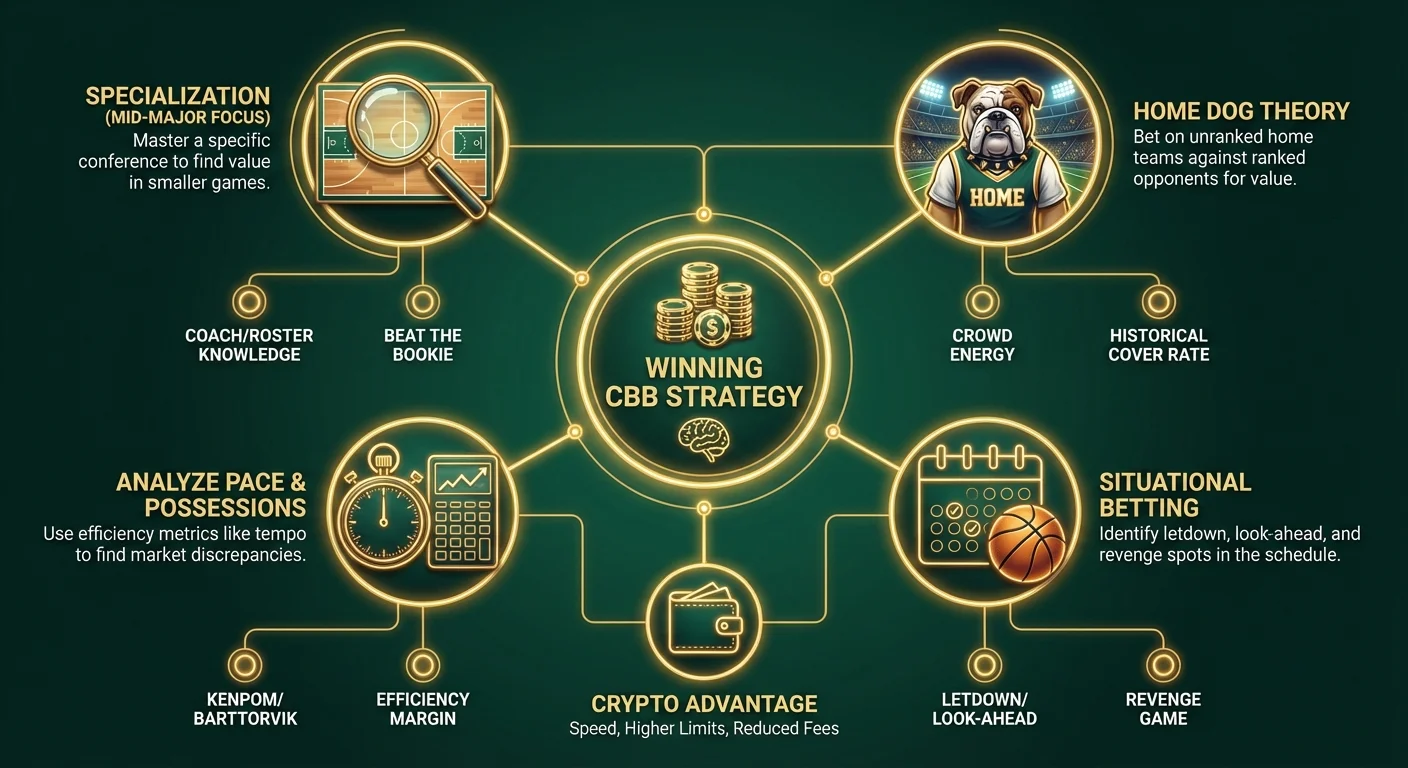
1. Specialization: The Conference Method
Instead of trying to follow the Top 25, pick one or two "Mid-Major" conferences (e.g., The Horizon League, The Sun Belt, or The WCC).
- Become the Expert: Learn the coaches, the playing styles, and the rosters of those 10-12 teams.
- Beat the Bookie: You might know that a certain team travels poorly on Thursday nights, or that a star player has the flu, before the oddsmakers adjust the lines for these smaller games. The value is often found in the games that aren't on national TV.
2. The "Home Dog" Theory
Home court advantage is significantly undervalued in college hoops. When an unranked team plays a ranked conference rival at home, the crowd energy can elevate their performance.
- The Strategy: Look for unranked home teams getting points (Underdogs) against ranked opponents. These teams cover the spread at a historically high rate. The "Home Dog" fights harder, fueled by the adrenaline of the student section.
3. Analyze Pace and Possessions (KenPom)
You don't need to be a mathematician, but you should use resources like KenPom.com or BartTorvik. These sites rank teams based on efficiency rather than just wins and losses. This is critical for building your predictive model.
- Tempo: If a team that plays incredibly fast (high tempo) meets a team that plays incredibly slow, the "Under" often holds value because the slower team controls the game flow to limit possessions.
- Efficiency Margin: Look for discrepancies. If a team is ranked 50th in the AP Poll but 20th in KenPom efficiency, they are likely undervalued by the betting public.
4. Situational Betting: The Schedule Spot
College athletes are students. They have exams, holidays, and travel fatigue.
- The Letdown Spot: Did a team just win a massive, emotional game against a rival? Fade them in the next game. They are likely to come out flat emotionally.
- The Look-Ahead: Is a team playing a weak opponent today, but has a match against the #1 team in the country in three days? They might overlook today's opponent, failing to cover the spread.
- The Revenge Game: College rivalries run deep. If Team A embarrassed Team B earlier in the season, Team B will be highly motivated in the rematch, especially if playing at home.
Navigating the Seasons of CBB
NCAA basketball is not a monolith; it has three distinct seasons, and your betting strategy must change for each.
Non-Conference (November - December)
- The Dynamic: Powerhouses play "cupcakes" (small schools) to pad stats, or play in neutral-site tournaments (like Maui or Atlantis).
- The Trap: Spreads are massive. It's hard to predict if a team will win by 20 or 40.
- Strategy: Focus on neutral-site tournaments. Since neither team has a home court, talent and coaching usually prevail. Watch for fatigue in tournaments where teams play 3 games in 3 days.
Conference Play (January - Early March)
- The Dynamic: Teams know each other well. Defenses tighten up. Rivals play twice a year.
- The Opportunity: This is where the "Home Underdog" strategy shines. Scores often drop as familiarity breeds better defense.
- Strategy: Bet on coaching mismatches and home courts. Pay attention to injuries, as depth becomes an issue mid-season.
March Madness (The Postseason)
- The Dynamic: The most public-heavy betting event of the year. Casual fans flood the market based on bracket logic.
- The Trap: Public money distorts the lines. Popular teams (Duke, Kentucky, Gonzaga) become overvalued.
- Strategy: Fade the public. If 80% of the public is betting on a favorite, the value is almost always on the underdog. Look for teams with senior guards; experienced guard play is the most predictive metric for tournament success.
Practical Tips for the Crypto Punter
Now that you have the strategy, how do you execute it effectively?
Bankroll Management
Because CBB is high variance, you will experience losing streaks. It is mathematically guaranteed. Focus on Bankroll Management Essentials to ensure discipline.
- Unit Sizing: Never bet more than 1-2% of your total bankroll on a single game.
- Don't Chase: If you lose the early games (noon tip-off), do not double your bet on the late games (10 PM tip-off) to "make it back." This is the fastest way to lose your crypto stack.
Shopping for Lines
Since you are using crypto, you can easily move funds between different sportsbooks.
- The Half-Point Hook: Book A might have Villanova at -4. Book B has them at -3.5. That 0.5 difference is massive. If Villanova wins by 4, Book A pushes (ties), but Book B wins. Always take the best number.
Live Betting Opportunities
NCAA games are defined by "runs." A team might go on a 12-0 run, then go cold for 5 minutes.
- The Middle: If you bet a favorite at -10 pre-game, and they go up by 20, you might live bet the underdog at +20. This gives you a window where you can win both bets (e.g., if the favorite wins by 15).
Common Pitfalls to Avoid
Even experienced bettors fall into these traps during the long college season.
- Ranking Bias: Just because a team is ranked #15 and they are playing an unranked team, it doesn't mean they are a lock. The unranked team might actually be favored by Vegas (a sign that the "smart money" knows the unranked team is better than their record). Always trust the line over the media ranking.
- Ignoring Injuries: In the NBA, if a star sits, the line moves 5 points. In CBB, if a key player is out, the line might move, but the impact is often greater because college teams lack depth. Always check Twitter/X for lineup news before locking in a bet.
- Betting with the Heart: Do not bet on your Alma Mater. You cannot be objective about the school you attended. You will overestimate their strengths and ignore their weaknesses.
Advanced Metric Glossary
To maximize your CBB wagering success, familiarize yourself with these terms. You don't need to calculate them, but you should know what they mean when reading analysis.
- eFG% (Effective Field Goal Percentage): Adjusts for the fact that a 3-pointer is worth more than a 2-pointer. A much better stat than standard FG%.
- Turnover Percentage: How often a team turns the ball over per 100 possessions. Teams that protect the ball cover spreads.
- Offensive Rebounding %: Measures how often a team gets a second chance. High offensive rebounding teams are great for "Over" bets because they get extra shots.
- AdjD (Adjusted Defense): How many points a team allows per 100 possessions, adjusted for the quality of opponents they have played.
Summary: Your Game Plan
College basketball offers a wild ride of buzzer-beaters, upsets, and massive point swings. It is a market where the informed bettor can actually hold an edge over the house, provided they are disciplined and strategic.
Key Takeaways:
- Embrace Variance: Accept that the best team won't always win. Play the probabilities.
- Use Crypto: Leverage the speed of Bitcoin and stablecoins to hit lines instantly and withdraw profits securely.
- Niche Down: Master a small conference rather than trying to bet the whole board.
- Respect the Spot: Schedule dynamics (travel, revenge, look-aheads) are just as important as stats.
- Shop Lines: A half-point difference can change your season's ROI.
By treating college basketball betting as an investment rather than a lottery ticket, and utilizing the efficiency of crypto banking, you position yourself to profit from the madness. Do your research, manage your bankroll, and enjoy the game.