
You place a wager on the spread. Your team is covering comfortably until the final thirty seconds. A fumble, a turnover, and a meaningless field goal by the underdog flips the result. You lose by half a point. Your pulse quickens, your face feels hot, and your mouse cursor immediately drifts toward the "Deposit" button or the live betting lines for a Romanian table tennis match you know nothing about.
This is the "bad beat," and what happens in the five minutes following that moment determines whether you are a recreational gambler or a disciplined sports bettor.
In the high-velocity world of crypto sports betting, where transactions are instant and markets never sleep, the mental aspect of the game is just as critical as your ability to analyze stats or read odds. This psychological state of emotional confusion and frustration is known as betting tilt. While often associated with poker, tilt is the silent bankroll killer in sports betting.
This guide explores the depths of gambling psychology, breaking down why we tilt, how to recognize the warning signs, and the specific strategies you need to master emotional control. If you can conquer your own mind, you have already beaten the bookmaker's greatest advantage.
The Science of the Sweat: Understanding Gambling Psychology
To defeat tilt, you must first understand the biology behind it. The human brain is not naturally wired for probability; it is wired for survival and pattern recognition. When you bet, your brain releases dopamine - a neurotransmitter associated with pleasure and reward. Interestingly, studies in gambling psychology show that the anticipation of the win releases almost as much dopamine as the win itself.
However, the brain also possesses a strong "loss aversion" bias. Psychologically, the pain of losing $100 is roughly twice as intense as the pleasure of winning $100. This imbalance creates a volatile chemical cocktail in your brain when a bet goes south.
The "Near Miss" Effect
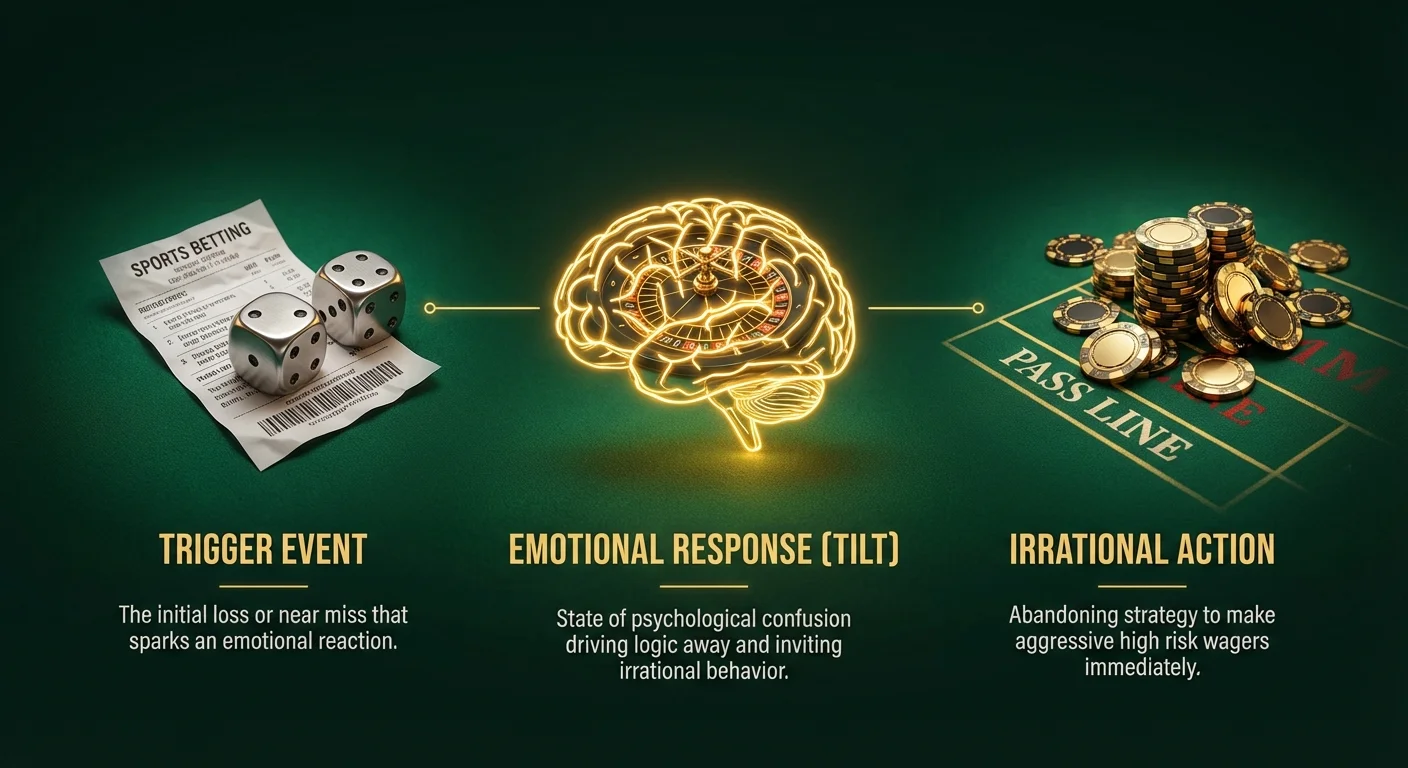
This is particularly relevant in sports betting. When you lose a bet by a massive margin, it is easy to accept your analysis was wrong. But when you lose on a "near miss" - a buzzer-beater, a VAR decision, or a back-door cover - your brain registers this almost like a win. It tells you, "You were right, you were just unlucky."
This triggers an urge to correct the "injustice" immediately. In the crypto betting sphere, where you can instantly reload your wallet with Bitcoin or Ethereum without waiting for bank clearance, this impulse can be acted upon in seconds. This is where the danger lies.
What is Betting Tilt?
Betting tilt is a state of mental or emotional confusion or frustration in which a player adopts a less than optimal strategy, usually resulting in becoming overly aggressive. It is the moment when logic leaves the room and emotion takes the steering wheel.
In sports betting, tilt manifests differently than in poker. You aren't shoving all-in on a bad hand; instead, you are deviating from your handicapping system.
The Two Main Types of Tilt
While most people associate tilt with anger after losing, "Winner's Tilt" is equally dangerous.
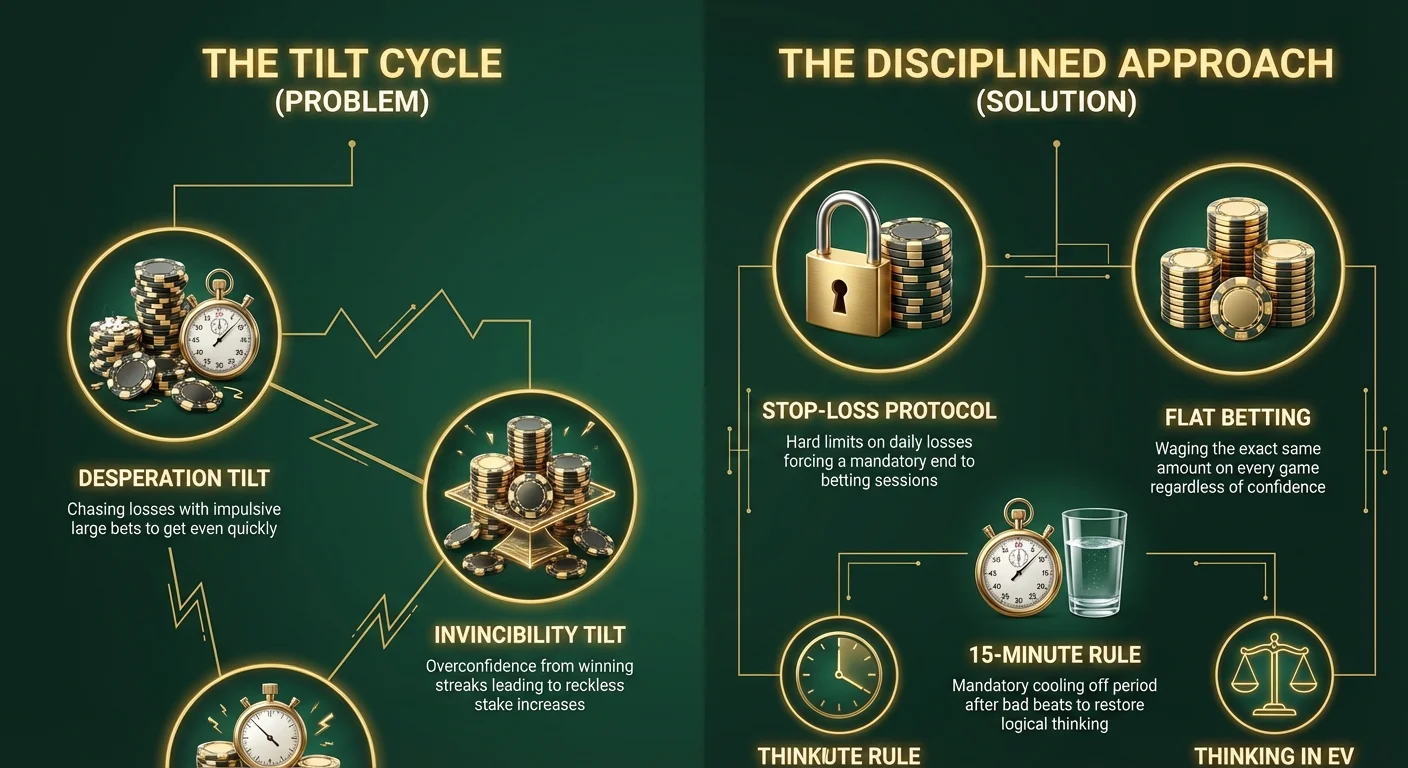
1. The Desperation Tilt (The Chase)
This occurs after a loss or a series of losses. The bettor feels an urgent need to get back to "even" for the day.
- The behavior: Betting on sports you don't follow, increasing stake sizes to cover previous losses (Martingale strategy), and betting on live lines without research.
- The mindset: "I just need one win to fix this."
2. The Invincibility Tilt (Winner's Tilt)
This occurs after a hot streak. The dopamine overload makes the bettor feel they cannot lose and that they have "solved" the sport.
- The behavior: Drastically increasing unit sizes, ignoring bankroll management rules, and betting on too many games because "everything I touch turns to gold."
- The mindset: "I'm playing with house money." (Note: It is never house money; it is your money once it hits your wallet).
Recognizing the Signs: Are You on Tilt?
Self-awareness is the first step toward emotional control. Tilt often creeps in physically before you realize it mentally. If you notice any of the following symptoms, you are likely compromised:
- Physical changes: Clenched jaw, increased heart rate, sweating, or slamming the mouse/desk.
- Speed of action: You are placing bets within seconds of a previous game finishing without checking line movement or team news.
- Abandoning the plan: You swore you would only bet on the NBA, but now you have a wager on 3rd division Japanese soccer.
- Wallet watching: You are obsessing over your total balance in BTC or USD rather than focusing on the quality of the next pick.
- Rationalizing bad bets: You tell yourself, "It's just a small hedge," or "I have a feeling about this one," rather than relying on data.
The Crypto Factor: Why Digital Currency Increases Tilt Risk
At CryptoGambling.com, we advocate for the advantages of blockchain betting - anonymity, speed, and low fees. However, these same features can exacerbate tilt if you aren't careful.
1. The Abstraction of Money
When you bet with chips in a casino, it feels less like "real" money than cash. Crypto takes this a step further. Betting "0.005 BTC" or "100 USDT" can feel like points in a video game rather than hard-earned currency. This dissociation makes it easier to throw good money after bad during a tilt session.
2. Instant Action
In traditional sportsbooks, depositing might take time, or you might hit a bank limit. In crypto sportsbooks, you can transfer funds from your private wallet to the sportsbook in minutes (or seconds with networks like Solana or Lightning Network). This removes the "friction" that usually acts as a cooling-off period.
3. Double Volatility
Imagine you bet 1 ETH on a game. You lose the bet (tilt factor 1). Simultaneously, the price of ETH drops by 5% (tilt factor 2). This "double loss" can trigger severe emotional distress, leading to reckless decisions to try and recoup the fiat value of the loss.
Strategies for Emotional Control
Knowing you are tilting is useless if you don't have a toolkit to stop it. Here are practical strategies to maintain your mental edge.
1. The Stop-Loss and Stop-Win Protocol
Before you log in to your crypto sportsbook, you must have hard numbers in mind.
- Stop-Loss: If you lose X units (e.g., 5% of your bankroll) in a day, you are done. No exceptions. Close the browser.
- Stop-Win: If you win Y units, you also stop or significantly reduce your stake size. Protect your profits from your own overconfidence.
2. The 15-Minute Rule
If you suffer a "bad beat" (a last-second loss), enforce a mandatory 15-minute break. Walk away from the screen. Get a glass of water. Do not look at the odds board. By the time you return, the immediate chemical surge of anger will have subsided, allowing you to view the next betting opportunity with logic rather than rage.
3. Use Stablecoins for Bankroll
To combat the "Double Volatility" tilt mentioned earlier, consider keeping your betting bankroll in stablecoins (USDT, USDC, DAI). This ensures that your wins and losses are based solely on your betting performance, not the fluctuation of the crypto market. You can convert your winnings to Bitcoin or Ethereum after you withdraw.
4. Graded Stakes vs. Flat Betting
Tilt usually manifests as erratic sizing. Adopting a strict staking system is your safety net.
| Staking Method | Description | Tilt Risk | Recommendation |
|---|---|---|---|
| Flat Betting | Betting the same amount (e.g., 1 unit) on every game. | Low | Best for Beginners. Removes the decision of "how much" to bet. |
| Percentage Betting | Betting a set % of your current bankroll (e.g., 2%). | Medium | Good for growth, naturally lowers stakes during losing streaks. |
| Confidence Betting | Varying stakes (1u to 5u) based on perceived edge. | High | Dangerous during tilt. Angry bettors rate every bet as "high confidence." |
| Martingale | Doubling stakes after every loss. | Critical | Never use this. It is the mathematical expression of tilt. |
Reframing Your Mindset: The Professional Perspective
The difference between a "square" (amateur) and a "sharp" (professional) is often how they view the concept of losing.
Thinking in EV (Expected Value), Not Results
If you bet on a coin flip where you get paid $2.00 for heads and lose $1.00 for tails, you should take that bet every time. Even if the coin comes up tails five times in a row, you played correctly.
In sports betting, you must separate the decision from the result.
- Good Bet, Bad Result: You bet the underdog, they led the whole game, and their star player got injured in the 4th quarter, leading to a loss.
- Reaction: No tilt. You made the right read; variance got you.
- Bad Bet, Good Result: You bet a heavy favorite just because they are popular, they played terribly, but the referee made a bad call that gifted them the win.
- Reaction: Caution. You got lucky. Don't mistake this for skill.
By focusing on making +EV (Positive Expected Value) decisions rather than just "winning," you detach your ego from the outcome of individual games.
The "Long Run" Fallacy
Bettors often hear "focus on the long run." But the long run is made up of short runs. To survive the short run, you must accept that losing streaks are statistically inevitable. Even a bettor with a 55% win rate (which is professional level) has a significantly high probability of losing 5, 6, or even 7 bets in a row at some point in the season. Preparing for this inevitability prevents the shock when it happens.
Practical Exercises to Strengthen Mental Game
Treat your mind like a muscle. Here are three exercises to improve your emotional control:
1. The Betting Journal
You cannot manage what you do not measure. Keep a record of your bets, but add a column for "Emotional State."
- Date / Event / Stake / Odds / Result / How I Felt
- Review this weekly. If you see losses correlating with "Angry," "Tired," or "Rushed," you have identified a tilt trigger.
2. The "Pre-Mortem"
Before placing a substantial wager, imagine you have already lost it. Imagine the team fumbled on the goal line. Ask yourself: "If I lose this money, will I be able to sleep tonight? Will I feel the urge to deposit more immediately?" If the answer is yes, the bet is too big for your current mental state. Lower the stake.
3. Variance Visualization
Use a variance calculator (available online) to simulate 1,000 bets at your win rate. You will see massive downswings in the graph. deeply understanding that these dips are normal mathematical occurrences helps you remain stoic when they happen in real life.
When to Walk Away
Sometimes, the only cure for betting tilt is distance. If you find yourself unable to stick to the rules above, or if gambling is affecting your mood outside of betting hours, it is time for a hard reset.
- Self-Exclusion: Most reputable crypto sportsbooks offer self-exclusion tools. Use them to lock your account for 24 hours or a week.
- Withdraw Funds: In the crypto world, you are your own bank. Withdraw your bankroll to a cold wallet (like a Ledger or Trezor). The extra steps required to move it back to an exchange and then to a sportsbook create a barrier that prevents impulsive betting.
Summary: The Mental Edge
In the unregulated, high-speed environment of crypto sports betting, you are the CEO, the CFO, and the risk manager of your operation. The market will always try to exploit your emotions. The bookmakers build their margins not just on the vigorous (juice), but on the assumption that you will lack emotional control after a loss.
To summarize your anti-tilt strategy:
- Acknowledge that tilt is biological, not a character flaw.
- Identify your personal triggers (bad beats, losing streaks, near misses).
- Implement hard rules: Stop-losses, flat betting, and cooling-off periods.
- Disconnect from the result and focus on the quality of the decision (EV).
- ** Utilize** the friction of cold storage to protect your bankroll from your own impulses.
The best bettors in the world aren't the ones who never lose; they are the ones who lose without losing their minds. Master your head, and your wallet will follow.