
The NBA regular season is a marathon - a grueling, six-month data accumulation exercise spanning 82 games. But for sports bettors, the NBA Playoffs are an entirely different sport. The rules may be the same, but the intensity, rotation management, coaching adjustments, and market efficiency shift drastically the moment the postseason tips off.
If you carry your regular-season betting model directly into the playoffs without adjustment, you are likely to see your bankroll evaporate. In the regular season, teams rest stars, experiment with lineups, and often punt games at the end of a road trip. In the playoffs, every possession matters, rotations tighten to seven or eight men, and defenses lock in.
This guide explores the intermediate and advanced strategies required to navigate NBA playoffs betting. We will dissect how postseason basketball differs from the 82-game grind, how to exploit series pricing, and why the betting markets react differently when the Larry O'Brien trophy is on the line.
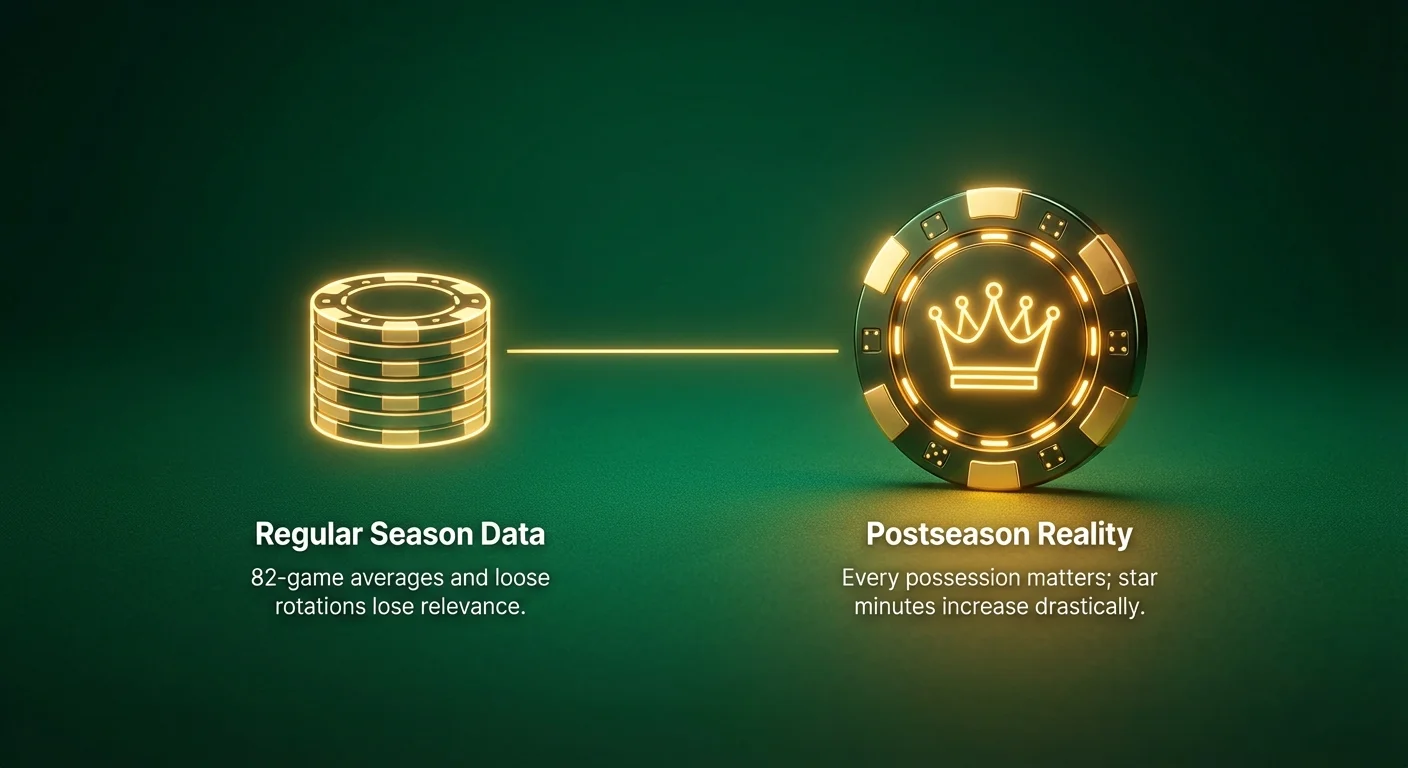
The Fundamental Shift: Regular Season vs. Postseason Data
The first mistake intermediate bettors make is relying too heavily on season-long averages. While a team's Offensive Rating (ORtg) over 82 games is a useful baseline, it loses relevance in a seven-game series against a specific opponent.
1. Rotations and Minutes
"Load management" does not exist in the playoffs. In the regular season, a superstar might average 32 to 34 minutes per game. In the playoffs, that number often jumps to 40 or 42 minutes.
- Impact on Betting: This drastically changes the value of Player Props. If a player's points over/under is set based on their 34-minute average, but they are projected to play 42 minutes, the "Over" holds significant value, even if the defensive matchup is tough.
- Bench Output: Bench production usually plummets in the postseason. Coaches shorten their rotations, relying only on players they trust defensively. Fade bench player props and look for overs on starters' volume stats (points, rebounds, assists).
2. Pace of Play
Postseason basketball generally slows down. Transition opportunities decrease as teams prioritize getting back on defense to prevent easy buckets. The game shifts to half-court sets, isolation scoring ("hero ball"), and matchup hunting.
- Impact on Totals: If two teams played a 125-120 shootout in February, do not assume the same will happen in May. The defensive intensity and slower pace often provide value on the Under, particularly in the first half of Game 1 when teams are feeling each other out.
| Factor | Regular Season | NBA Playoffs | Betting Adjustment |
|---|---|---|---|
| Star Minutes | 30-34 MPG | 38-44 MPG | Smash the Over on usage-based props. |
| Rotations | 9-11 Players | 7-8 Players | Avoid bench props; focus on starters. |
| Defensive Intensity | Variable/Low | Maximum | Lower projected totals; expect physical play. |
| Game Planning | Generic | Opponent Specific | Look for coaching adjustments Game-to-Game. |
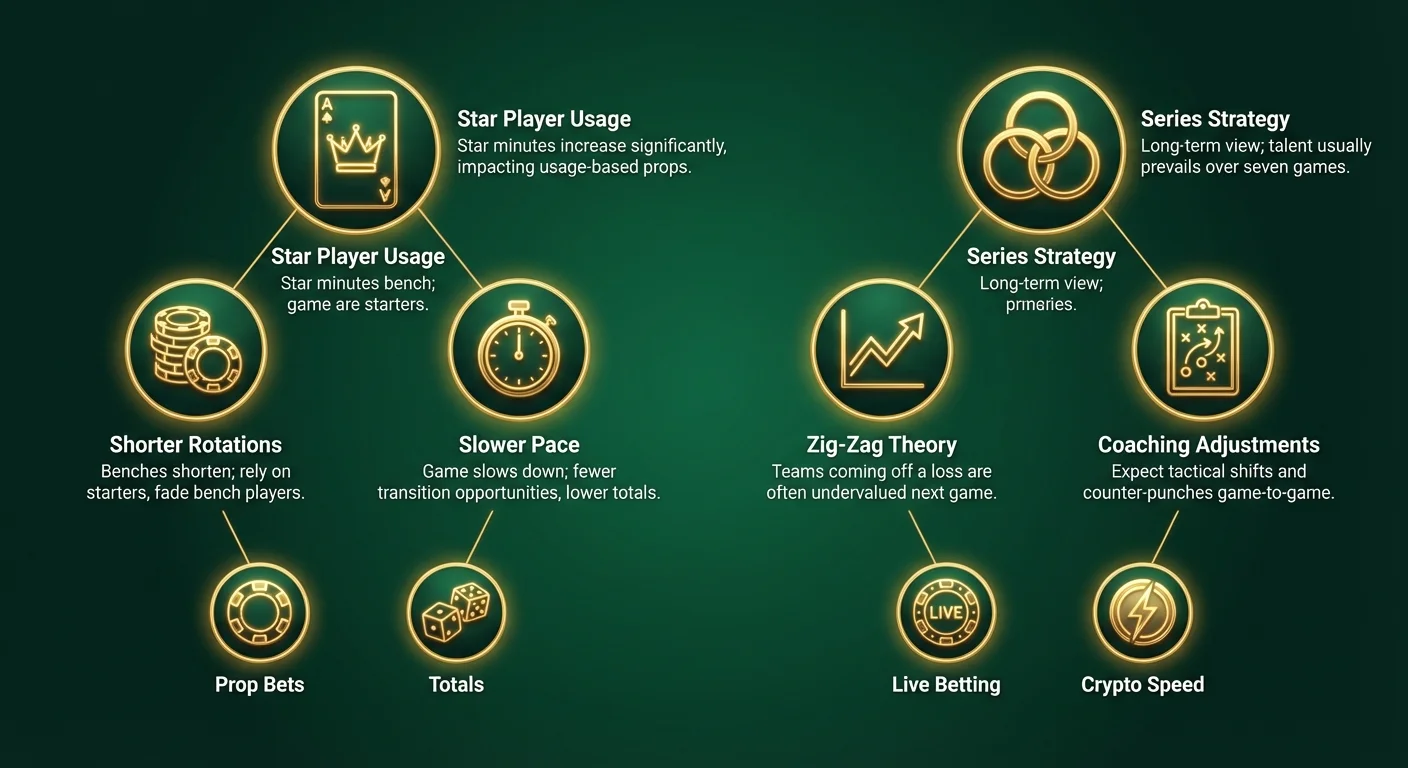
The 7-Game Series Format: Minimizing Variance
In March Madness (NCAA), the "one-and-done" format creates chaos and Cinderella stories. In the NBA, the best-of-seven format is designed to eliminate variance. This is why favorites dominate in the playoffs significantly more than in other sports. Over a long series, talent usually prevails.
However, betting on the favorite to win the series at -500 odds is rarely a good use of capital. Instead, you must look for leverage points within the series format.
The "Zig-Zag" Theory
This is one of the oldest concepts in playoff strategy, but it remains relevant. The theory suggests that a team coming off a loss - especially a favorite or a home team - is undervalued in the subsequent game.
In the NBA playoffs, human nature and desperation are quantifiable factors. A team down 0-1 or 1-2 faces a "must-win" scenario, leading to higher intensity. Conversely, the team leading the series may suffer from a slight complacency.
How to bet the Zig-Zag:
- Bounce Back ATS (Against the Spread): If a higher-seeded team loses Game 1 at home, they are statistically very likely to cover the spread in Game 2. The market knows this, so the line will be inflated, but the success rate remains high.
- The "Gentleman's Sweep": If a heavy favorite goes up 3-0, they often relax in Game 4, especially if Game 4 is on the road. The desperate home team (down 0-3) often wins or covers Game 4 to avoid the embarrassment of a sweep, only for the favorite to close it out in Game 5 at home.
Series Price Arbitrage and Hedging
The fluctuation of series prices offers incredible opportunities for bettors using crypto sportsbooks, which often allow for high-limit, instant wagers.
Scenario:
Team A is a massive favorite (-400) over Team B.
- Step 1: You believe Team A wins the series, but -400 is unbettable.
- Step 2: Wait for Game 1. If Team A starts slow and loses Game 1 (a common occurrence for teams resting before playoffs), their series price might drop to -150 or even -110.
- Step 3: This is your entry point. You are now betting on the superior team to win 4 of the next 6 games at near-even money.
Conversely, you can bet on an Underdog to win the series (+300) before it starts. If they win Game 1, their odds shorten drastically. You can then bet on the Favorite to win the series (now at better odds) to guarantee a profit regardless of the outcome.
Analyzing Coaching Adjustments
In the regular season, a loss is just a loss. In the playoffs, a loss triggers a tactical overhaul. NBA playoffs betting requires you to think like a coach.
If a team gets destroyed on the glass (rebounds) in Game 1, the coach will emphasize boxing out and may insert a bigger center into the rotation for Game 2.
- Betting Angle: Look for the rebounding "Over" for that team's center in Game 2.
If a star player is consistently trapped or double-teamed in Game 1, forcing the ball out of their hands, their assist numbers will likely rise in Game 2 as they adjust to passing out of the double team.
- Betting Angle: Take the "Over" on the star's assists and the "Under" on their points.
The "Series trends" trap: Be careful assuming a trend from Games 1 and 2 will last forever. By Game 3 or 4, the opposing coach will have adjusted to stop what worked previously. Playoff betting is a game of counter-punches.
The Role of Crypto in Playoff Betting
For the intermediate to advanced bettor, where you play is almost as important as what you play. Using crypto-focused sportsbooks offers distinct advantages during the high-turnover playoff season.
1. Speed of Capital
During the playoffs, games happen daily. On weekends, games run back-to-back. If you win a wager on the early game, you often want that liquidity available immediately for the late game or for live betting. Traditional sportsbooks can take days to process withdrawals or settle bets. Crypto betting sites utilizing Bitcoin, Ethereum, or USDT typically offer near-instant settlements and withdrawals, keeping your bankroll liquid and moving.
2. High Limits and Provability
Playoff markets are the most liquid markets in basketball. Crypto books often offer higher maximum bet limits than fiat books, allowing high-rollers to deploy significant capital on high-confidence series bets. Additionally, the transparency of blockchain transactions ensures that when you hit that massive parlay on the NBA Finals, the payout is verifiable and secure.
3. Anonymity and Sharp Lines
Many sharp bettors prefer the privacy of crypto sportsbooks. Furthermore, because crypto books often attract a global audience, their lines may move differently than Vegas-centric books. This allows you to "line shop effectively," finding a spread of -4.5 on a crypto site when Vegas has moved to -5.5.
Advanced Markets: Beyond the Moneyline
To truly maximize ROI in postseason basketball, you must look beyond who wins or loses.
1. Correct Series Score
This is a high-risk, high-reward market. Instead of betting the Celtics to win the series at -800, you can bet "Celtics to win 4-1" or "Celtics to win 4-2."
- Strategy: If a strong favorite is playing a scrappy underdog, a 4-0 sweep is rare due to the variance of three-point shooting. Betting the 4-1 or 4-2 outcome often yields positive odds (+250 or higher).
2. Series Leader Props
You can bet on who will score the most points or grab the most rebounds in a specific series.
- Strategy: Look for matchups. If a team has a weak interior defense, the opposing center is likely to lead the series in rebounding. If a team defends the perimeter well but struggles against isolation scorers, the star wing player will likely lead in scoring.
3. Quarter and Half Betting
Playoff games often follow a script. Home favorites tend to come out with immense energy in the 1st Quarter.
- Tip: Betting the Home Favorite -1.5 or -2.5 in the 1st Quarter is often safer than betting the full game spread, as it avoids the "garbage time" backdoor cover where the losing team scores meaningless points at the end of the game to beat the spread.
Live Betting the Playoffs
Live (In-Play) betting is perhaps the most profitable tool in the playoff arsenal. The emotional swings in the postseason are massive.
The "Run" Strategy:
NBA basketball is a game of runs. In the playoffs, when a home team goes on a 10-0 run, the crowd goes wild, and the road team often calls a timeout.
- The Play: Markets often overreact to these runs. If a favorite goes down by 8 points early in the second quarter, their live moneyline might flip to plus-odds (e.g., +120). If you still believe in their game plan, this is a value buy.
Foul Trouble:
Watch for star players picking up two fouls in the first quarter or three in the first half. Coaches will sit them.
- The Play: Bet against that team in the short term (2nd Quarter lines), but look to bet on them in the second half when the star returns fresh and aggressive.
Summary: Your Postseason Checklist
To transition from a regular-season gambler to a playoff sharp, adhere to these core principles:
- Discard 82-Game Averages: Focus on the specific matchup and recent form.
- Respect the Zig-Zag: Teams coming off a loss are dangerous; teams coming off a blowout win are often complacent.
- Shorten the Rotation: Bet "Over" on minutes and stats for stars; fade the bench.
- Monitor Adjustments: Watch the post-game press conferences. If a coach says "We need to stop allowing transition points," bet the Under in the next game.
- Utilize Crypto Advantages: Use the speed of crypto transactions to capitalize on live betting and arbitrage series prices.
The NBA Playoffs are the pinnacle of basketball betting. The lines are sharper, the bookmakers are smarter, but the predictability of player usage and team motivation is higher. By managing your bankroll and staying disciplined with the strategies above, you can turn the postseason intensity into profit.