
You've analyzed the matchup, crunched the stats, and checked the injury reports. You look at the NFL board and see the Kansas City Chiefs opened as -7 favorites against a struggling underdog. You check the public betting consensus and see that 85% of the betting public is hammering the Chiefs. It looks like a lock.
But then, something strange happens. Despite the overwhelming flood of public money on Kansas City, the sportsbook drops the line to -6.5. Then to -6.
This defies basic supply and demand logic. If everyone is buying the Chiefs, the price (the spread) should go up to make them less attractive, not down. When you see a line move in the opposite direction of the heavy betting percentages, you are witnessing Reverse Line Movement (RLM).
For the casual "square" bettor, this is confusing. For the professional "sharp" bettor, this is a siren song. It is one of the strongest indicators available that smart money - the kind of money bookmakers respect and fear - is on the other side.
In this advanced guide, we will dissect the mechanics of reverse line movement, teach you how to differentiate between noise and signal, and show you how to leverage this phenomenon to improve your win rate using modern crypto sportsbooks.
The Mechanics of Line Movement: Public vs. Sharp Money
To understand RLM, you first must understand the ecosystem of a sportsbook. The common misconception is that bookmakers aim to have an equal amount of money on both sides of a bet to guarantee a profit from the "vig" (vigorish/juice). While this is the ideal scenario, it is rarely the reality.
Bookmakers are essentially risk managers. They are willing to have an unbalanced book (more money on one side) if they believe the heavy side is going to lose. However, not all money is created equal.
The Two Classes of Bettors
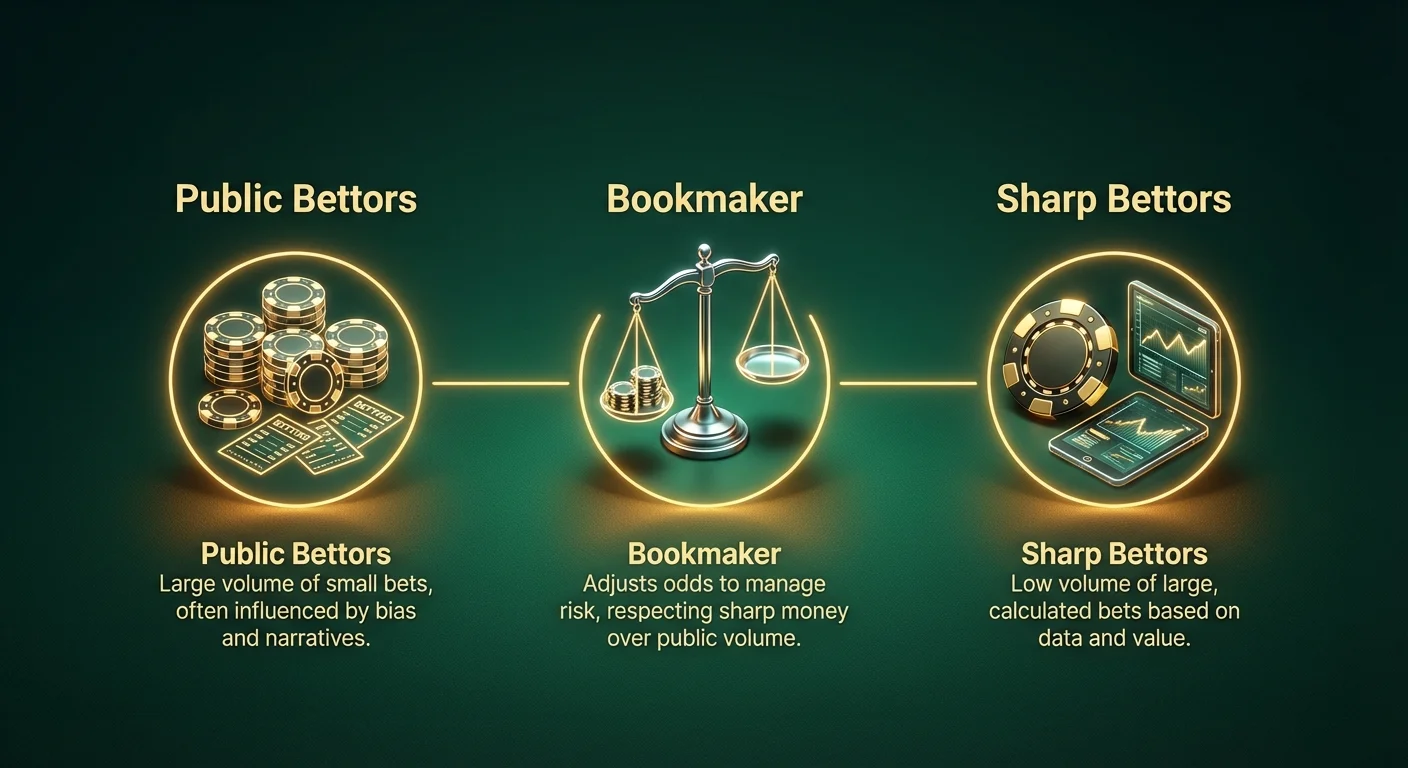
When analyzing line movement, you must distinguish between the two driving forces in the market:
| Feature | The Public ("Squares") | The Pros ("Sharps") |
|---|---|---|
| Betting Volume | High volume of small bets. | Low volume of massive bets. |
| Motivation | Entertainment, bias, TV narratives. | Math, value, modeled discrepancies. |
| Timing | Bets close to game time (weekends). | Bets early (openers) or on specific triggers. |
| Bookmaker Reaction | Books will shade lines slightly but often happily take their action. | Books move lines immediately to limit exposure. |
Why The Line Moves "In Reverse"
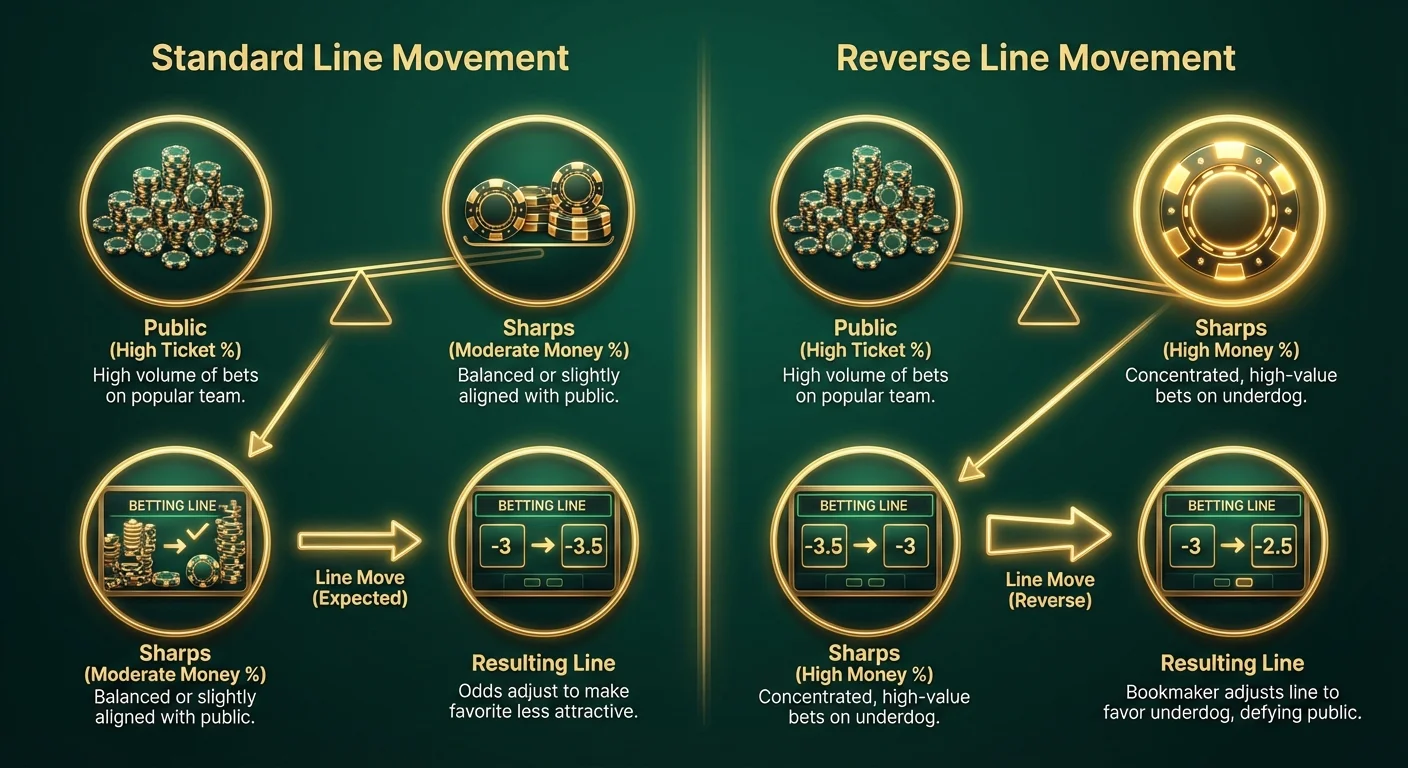
In a standard scenario, if 80% of the money is on Team A, the line moves to make Team A more expensive (e.g., -3 to -3.5). This encourages bets on Team B to balance the risk.
Reverse Line Movement occurs when the bookmaker receives a massive influx of bets on Team A (the public), but a few concentrated, high-limit bets from known professionals come in on Team B.
Even though the number of tickets is on Team A, the bookmaker respects the opinion of the Sharps betting on Team B. The bookmaker knows the Sharps are rarely wrong. To protect themselves from further sharp damage, they move the line in favor of Team B (or against Team A), defying the public percentages.
How to Identify Reverse Line Movement
Identifying RLM requires access to data. You cannot spot this by simply looking at the odds on your betting app; you need to see the Betting Splits.
Most major odds tracking sites and some transparent crypto sportsbooks provide two key data points for every game:
- Ticket Percentage: The percentage of individual bets placed on a side.
- Money (Handle) Percentage: The percentage of total cash wagered on a side.
The Golden Divergence
The signal for RLM is a significant divergence between the Ticket % and the Money %.
The Formula:
High Ticket % on Favorite + Line Movement toward Underdog = Reverse Line Movement
Example Scenario: NBA - Lakers vs. Pistons
Let's say the Lakers open as -8 favorites against the Pistons.
- Ticket Count: 75% of bets are on the Lakers.
- The Line Move: The line moves from Lakers -8 to Lakers -7.
Analysis:
The public loves the Lakers. They are betting them heavily. Logic dictates the line should move to -8.5 or -9. Instead, it dropped a full point. This tells you that despite 75% of the tickets being on Los Angeles, the money (likely sharp money) is hitting Detroit so hard that the books were forced to adjust. This is a clear "Sharp play" on the Pistons +8.
Visualizing the Discrepancy
Use this chart to interpret what you are seeing on an odds screen:
| Scenario | Ticket % | Money % | Line Move | Implication |
|---|---|---|---|---|
| Standard Movement | 70% on Team A | 75% on Team A | -3 to -3.5 | Public and Sharps agree. No edge. |
| Public Fade | 80% on Team A | 40% on Team A | -3 to -2.5 | RLM. Sharps are hammering Team B. |
| Split Decision | 55% on Team A | 55% on Team A | No Move | Balanced action. |
| Head Fake | 60% on Team A | 65% on Team A | -3 to -2.5 | Suspicious. Likely injury news, not RLM. |
Why Sharps Bet Against the Public (The Contrarian Value)
Why does RLM usually favor the unpopular side? Sharps are almost always contrarian because that is where the value lives.
The betting public suffers from Recency Bias. They bet on teams that looked good last week. They bet on overs (everyone wants to see points scored). They bet on superstars.
Bookmakers know this. They "shade" lines to exploit public bias. If the "true odds" of the Chiefs winning is -6, the book might open the line at -7, knowing the public will bet it anyway.
Sharps recognize that the line is inflated. They wait for the public to hammer the -7, pushing it perhaps to -7.5. Then, the sharps strike on the underdog at +7.5, capturing a massive amount of value. This sharp money forces the line back down (RLM), leaving the public holding bad tickets at an inflated number.
Strategies for Betting with RLM
Identifying the movement is step one. knowing how to profit from it is step two. Here is how to incorporate RLM into your betting process.
1. Wait for the "Limits" to Increase
Early in the week (for NFL) or the morning of (for NBA/MLB), betting limits are lower. Sharps often wait until game day when liquidity is high to place their max bets. This means the most genuine RLM signals often occur closer to game time.
- Tip: If you see RLM on a Tuesday for a Sunday NFL game, be cautious. It might be a "head fake" (see below). If you see it Sunday morning, it's likely genuine sharp action.
2. Follow the Move, Don't Chase the Number
If RLM moves a line from +7 to +5.5, the sharps got in at +7. If you bet now at +5.5, you have lost significant value. This is called "chasing the steam."
- Strategy: If you missed the best number, look for a different angle. Perhaps check the First Half lines or live betting opportunities. Sometimes, it is better to pass than to take a "bad number" just because the sharps are on that side.
3. Cross-Reference with Crypto Books
Crypto sportsbooks are essential tools for tracking RLM. Because crypto books often accept higher limits and offer faster settlements, they are playgrounds for whales and sharps.
- The Play: Compare the lines on a "public" fiat sportsbook (which attracts casuals) against a high-volume crypto exchange or sportsbook. If the crypto book is moving the line aggressively while the fiat book is stagnant, the crypto book is reacting to sharp action. Bet the sharp side on the slower fiat book before they adjust.
4. Focus on Key Numbers
RLM is most powerful when it crosses key numbers. In the NFL, lines moving off of 3, 7, or 10 are massive.
- Example: If the public is on the favorite at -3.5, and RLM pushes the line down to -2.5, the sharps didn't just bet the underdog; they felt strongly enough to push the line through the most critical number in football (3). This is a screaming buy signal for the underdog.
The Risks: When RLM is a "Trap"
Reverse line movement is a strong indicator, but it is not a magic crystal ball. There are scenarios where following the line move will burn you.
1. The Injury Head Fake
Sometimes lines move opposite to betting percentages not because of sharp money, but because of news.
- Scenario: 80% of tickets are on the Warriors. The line drops from -5 to -2.
- The Cause: It turns out Stephen Curry was just ruled out.
- The Verdict: This is not RLM; this is an adjustment for player availability. Always check Twitter/X or news feeds before assuming a line move is strategic.
2. The "Buyback"
Sharps are not a monolith. One group of sharps might love the Packers at -3, while another syndicate loves the Bears at +4.
You might see RLM push a line from -3 to -4 (due to Syndicate A). Then, Syndicate B sees value at +4 and hammers it back down. If you blindly follow the first move, you might be walking into a trap set by the opposing sharp group.
3. Low Liquidity Markets
In niche markets (e.g., Table Tennis, obscure Soccer leagues, Esports), it doesn't take much money to move a line. A single bet of $500 in Bitcoin might move a line in a small market. This is not necessarily "sharp" action; it's just a thin market reacting to volatility. RLM is most reliable in high-liquidity markets like NFL, NBA, and Premier League EPL.
Crypto-Specific Advantages in RLM Strategies
As a user of CryptoGambling.com, you have distinct advantages when utilizing RLM strategies compared to traditional fiat bettors.
Instant Bankroll Mobility
Speed is everything. When RLM occurs, the "stale" lines at slower books vanish in minutes.
- Fiat problem: Moving money from Bank A to Sportsbook B can take hours or days.
- Crypto solution: With Bitcoin, Litecoin, or USDT, you can move funds between books in minutes. If you spot RLM indicating a play on the Underdog, and Book A has already adjusted but Book B hasn't, you can deposit and strike immediately.
Higher Limits & Anonymity
Sharps prefer crypto sportsbooks because they don't limit winners as aggressively as soft fiat books. This means the line movements on major crypto betting sites are often more indicative of "true" price discovery. Watching the line movement on a high-volume crypto exchange can act as your "canary in the coal mine" for what will happen at other books.
Provably Fair & Transparency
While Provably Fair mostly applies to casino games, the transparency of blockchain betting allows for better verification of volumes in some decentralized betting protocols. You can sometimes see the wallet addresses and transaction sizes, giving you a literal view of "Smart Money" (large wallet transactions) vs. "Public Money" (dust transactions).
Practical Checklist: Executing the RLM Strategy
Ready to hunt for sharp action? Follow this checklist before placing your next wager.
- Check the Percentages: Open your odds screen. Look for games with a high ticket count (>70%) on one side.
- Check the Line History: Has the line moved against that 70%? (e.g., Public on Favorite, Line moved toward Underdog).
- Verify the Context:
- Are there injuries? (If yes, ignore RLM).
- Is it weather-related? (Wind affects totals heavily).
- Identify the "Why": Try to understand the value. Is the favorite playing their 3rd road game in 4 nights? Is the underdog getting a key player back?
- Shop for the Best Line: Use your crypto accounts. If the market has moved to +3.5, can you still find a +4 at a different book?
- Size Your Bet: RLM is a strong indicator, but bankroll management still applies. Do not go "all-in" just because the line moved.
Summary
Reverse Line Movement is the footprint of the professional bettor. It reveals where the smart money is flowing and exposes the bias of the general public.
By learning to ignore the noise of the "ticket count" and focusing on the reality of the line movement, you stop betting like a fan and start betting like a pro.
Key Takeaways:
- RLM defined: When the betting line moves in the opposite direction of the majority of bets.
- The Cause: Sportsbooks respecting large wagers from sharp bettors over the volume of public bets.
- The Signal: Look for >70% tickets on Team A, but the line gets better for Team A (indicating money on Team B).
- The Trap: Always filter for injuries and player news before betting RLM.
- The Edge: Use crypto sportsbooks for speed and line shopping to capture the value before the market settles.
Mastering RLM doesn't guarantee a win on every bet, but it ensures you are consistently standing on the side of the house and the pros - and that is the only way to win in the long run.