
The NCAA Tournament is arguably the most chaotic, exhilarating, and potentially profitable event in the sports betting calendar. For three weeks, casual fans and sharp bettors alike are glued to screens, watching 68 teams whittle down to one national champion. However, there is a distinct difference between throwing $20 into an office pool bracket and actually betting the NCAA tournament with a strategy designed for long-term profit.
While filling out a bracket is an exercise in predicting chaos, March Madness betting at a sportsbook requires discipline, data analysis, and an understanding of market psychology. The sheer volume of games - particularly in the opening rounds - provides ample opportunity to find value that oddsmakers might have missed.
This guide moves beyond basic bracketology. We will explore intermediate to advanced strategies for betting on the tournament, analyzing how game dynamics change from the First Four to the Final Four, and how using cryptocurrency sportsbooks can give you a distinct edge in speed and profitability.
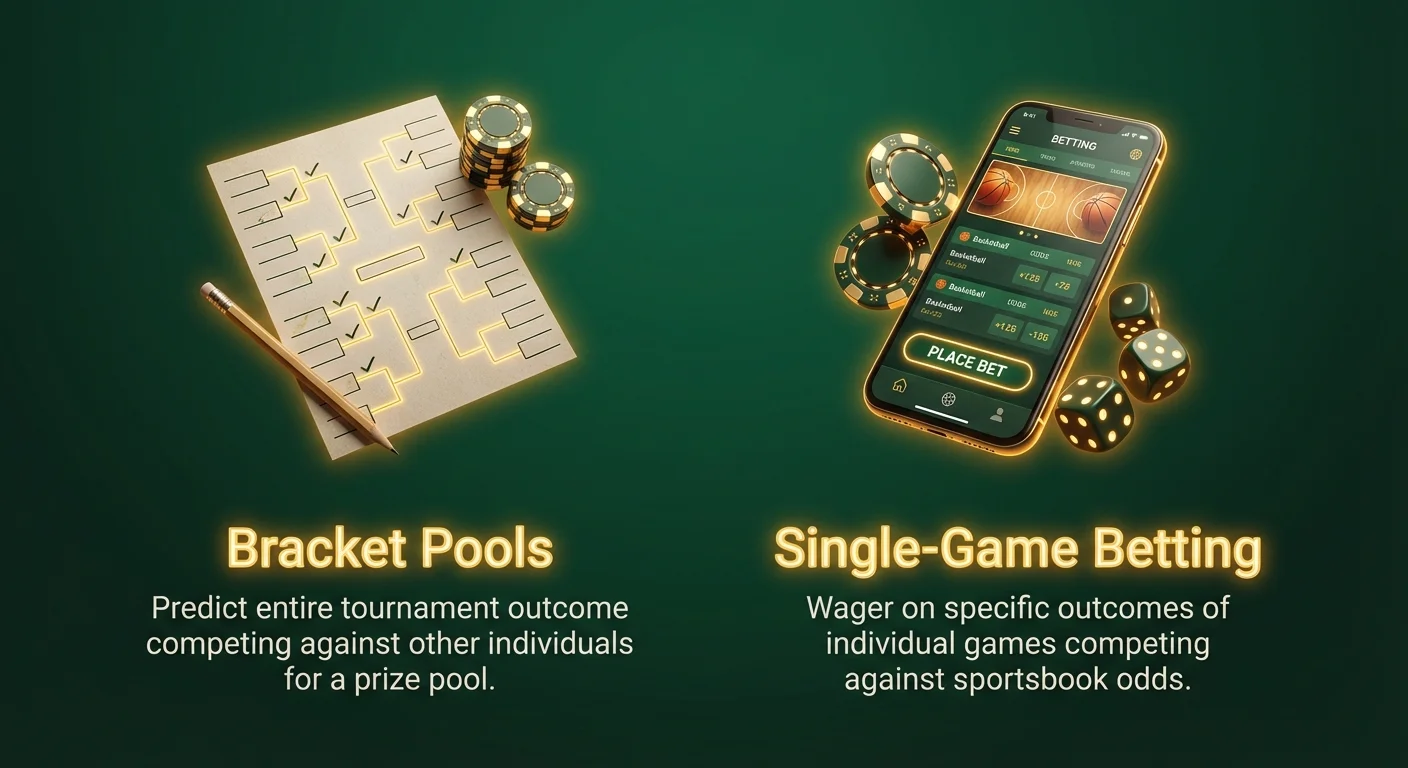
The Difference Between Brackets and Betting
Before diving into specific strategies, it is vital to distinguish between the two ways people gamble on March Madness.
- Bracket Pools: You are trying to predict the entire future. One wrong pick in the early rounds can ruin your "championship" pick. You are competing against other people, not the house. The goal is to differentiate your bracket from the public while picking the winner.
- Single-Game Betting: You are betting on specific outcomes (Spread, Moneyline, Total) of individual games. If you lose a bet on Thursday morning, it has no bearing on your ability to win a bet on Thursday night. You are competing against the sportsbook's lines.
For the serious bettor, single-game betting offers a much more consistent path to profit than the lottery-ticket nature of a bracket pool.
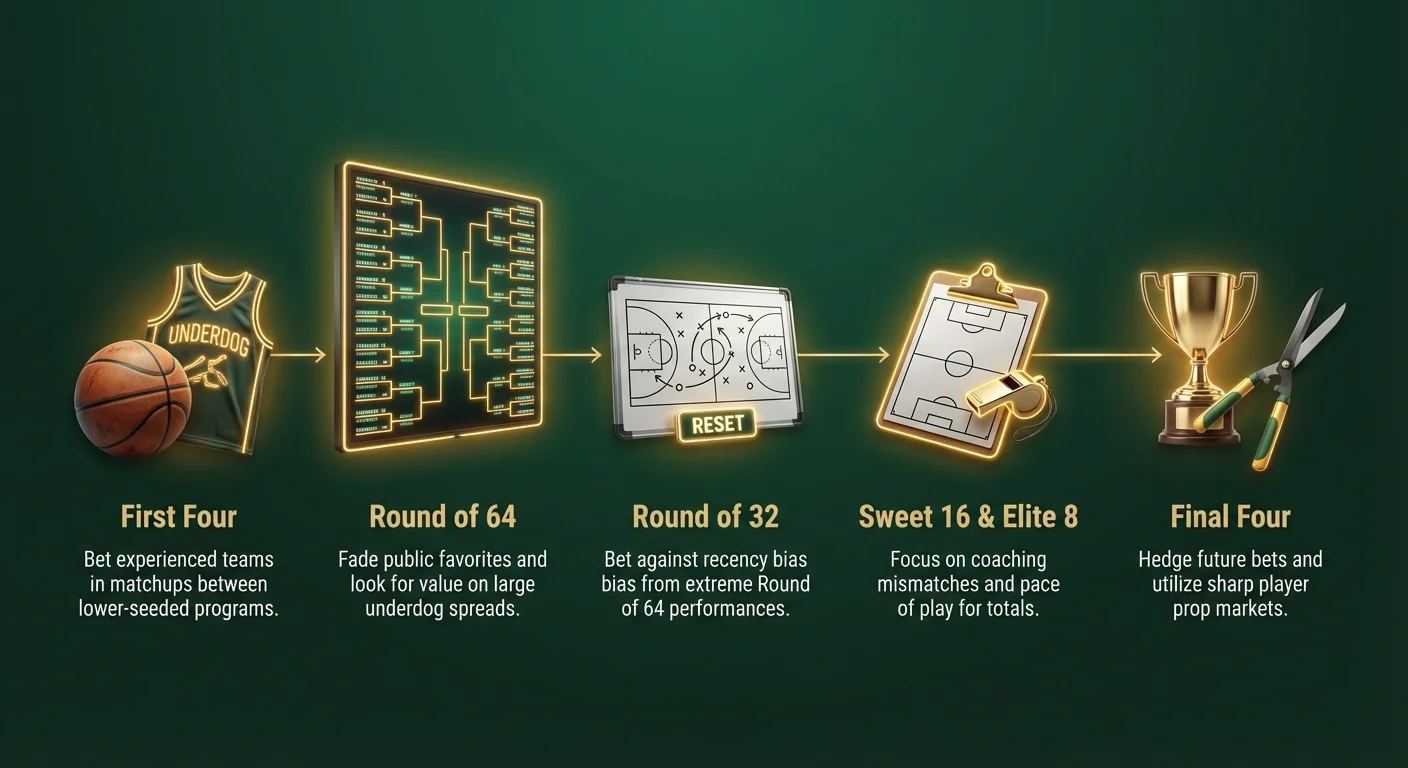
Round-by-Round Betting Strategy
The NCAA tournament is not a monolith; it is a series of mini-tournaments, each with its own psychological and statistical profile. A strategy that works in the Round of 64 may be disastrous in the Elite Eight.
The First Four: The Value of Desperation
The "First Four" games in Dayton are often overlooked, but they offer great betting value. These games feature the last four at-large teams (usually mediocre Power 6 teams) and the last four automatic qualifiers (usually lower-level conference champions).
- Strategy: Look for the experience edge. In matchups between two 16-seeds, the team with older players (Seniors/Juniors) usually handles the pressure of the national stage better than a younger, perhaps more talented, team.
- The Trend: Historically, First Four winners carry momentum into the Round of 64. Betting the First Four winner to cover the spread in their subsequent Round of 64 game has been a profitable angle in recent years.
The Round of 64: Managing the Chaos
This is the hardest round to bet because of the volume. With 32 games over 48 hours, "analysis paralysis" is real.
- Fade the Public Favorites: The general public loves betting favorites and "Overs." In the Round of 64, lines on top seeds (1, 2, and 3 seeds) are often inflated because oddsmakers know the public will bet them regardless of the number. Look for value on the underdogs covering large spreads (e.g., +14.5 or higher).
- The 12-5 and 11-6 Matchups: These are the most famous upset corridors. A 12-seed is often a strong mid-major champion (like a Murray State or Loyola Chicago type) playing a 5-seed that might be a slumping Power 6 team. If the 12-seed has a strong defense and efficient 3-point shooting, take the points - and sprinkle on the Moneyline.
The Round of 32: Regression to the Mean
After the chaos of Thursday and Friday, Saturday and Sunday often see a "regression to the mean."
- The Overreaction Play: If a team won by 30 points in the Round of 64, the public will pound them in the Round of 32. Conversely, if a top seed struggled but survived, the public will fade them.
- Strategy: Bet against the recency bias. Top seeds that survived a scare in the first round often tighten up their defense and cover in the second round.
The Sweet 16 and Elite 8: Coaching and Matchups
By the second weekend, the "flukes" are usually gone. These games feature the best teams and, more importantly, the best coaches.
- Coaching Mismatches: In a game where teams have days to prepare, superior coaching becomes the deciding factor. Look for coaches with a history of deep tournament runs (e.g., Tom Izzo, Bill Self) when matched against coaches making their first deep run.
- Pace of Play: Totals (Over/Under) become very sharp here. Analyze the "Adjusted Tempo" stats. If a fast-paced team plays a slow-paced defensive juggernaut (like Virginia or Houston), the slow team usually dictates the tempo. Lean toward the Under in these clashes.
The Final Four: Hedging and Prop Bets
With only three games left, the market is incredibly efficient.
- The Hedge: If you hold a futures ticket on a team to win the title, the Final Four is the time to hedge. Place a bet on their opponent to guarantee a profit regardless of the outcome.
- Prop Markets: Because the sides and totals are so sharp, look to player props. If a team relies heavily on one star player, but the opponent has an elite rim protector, bet the "Under" on that star's points prop.
Analyzing Matchups: Metrics That Matter
To bet like a pro, you must ignore the seed number and look at the underlying metrics. A 10-seed can statistically be better than a 7-seed. Here are the key metrics to analyze:
1. Adjusted Efficiency Margin (KenPom)
Ken Pomeroy's ratings (KenPom) are the gold standard. Look for the difference between a team's Adjusted Offensive Efficiency and Adjusted Defensive Efficiency.
- The Championship Metric: historically, almost every NCAA champion ranked in the top 20 in both offensive and defensive efficiency entering the tournament. Teams that are elite on one side but terrible on the other (e.g., #1 offense, #100 defense) rarely win it all, making them good "fade" candidates in the Elite 8.
2. Guard Play and Turnovers
In college basketball, guards control the game.
- Key Stat: Turnover Percentage. Teams that protect the ball usually cover the spread. If a favorite has a high turnover rate and is playing an underdog that relies on steals, you have a recipe for an upset.
3. 3-Point Variance
The "Great Equalizer." A lesser team can beat a superior team simply by getting hot from deep.
- Defensive 3-Point %: Be careful with this stat. Defensive 3-point percentage is often luck-based. However, 3-point attempt rate allowed is skill. If an underdog shoots a high volume of 3s and the favorite allows a high volume of 3s, the underdog has a high "variance ceiling," making them a dangerous Moneyline bet.
4. Free Throw Shooting
In close tournament games, the final minute can last 10 minutes due to fouling.
- The Backdoor Cover: If a favorite is leading by 8 and the spread is -10.5, late free throws matter. Always check a team's FT% before laying a big number. Poor free-throw shooting favorites are a nightmare for bettors.
Identifying Upset Patterns
Every year, brackets are busted by upsets. But these upsets aren't random; they follow patterns. Here is a comparison of common upset profiles to help you spot them before tip-off.
| Upset Profile | Characteristics | Betting Strategy |
|---|---|---|
| The "Live" Dog | High-scoring mid-major, experienced guards, top 50 offense. | Bet Moneyline and Spread. |
| The Pace Dragger | Extremely slow tempo, limits possessions, minimizes talent gap. | Bet the Under and the Spread (Underdog). |
| The 3-Point Bomber | Shoots >40% of shots from 3PT range. High variance. | Small stake on Moneyline (High Risk/Reward). |
| The Wounded Giant | High seed dealing with key injuries late in the season. | Fade the favorite aggressively. |
Betting Markets Explained
Moneyline
Simply picking the winner.
- Tip: Don't be afraid of the "Moneyline Parlay" in the Round of 64. Parlaying 2 or 3 heavy favorites (e.g., -500 odds) can create near even-money odds. However, limit these to 2-3 legs; one upset ruins the whole ticket.
The Spread
Handicapping the margin of victory.
- Tip: Look for "The Hook." A spread of -7.5 is significantly worse than -7. Buying a half-point (moving the line from -7.5 to -7) can save your bet if the favorite wins by exactly 7.
Totals (Over/Under)
Betting on the combined score.
- Tip: NCAA tournament games are played on neutral courts, sometimes in massive domes (like football stadiums). Depth perception in domes can negatively affect shooting percentages, historically leading to more "Unders" in dome games.
Futures
Betting on who will win the region or the championship.
- Tip: The best value is usually found before the bracket is revealed or after a team has a "bad" game in the regular season. Once the bracket is set, the path to the Final Four heavily dictates the odds.
The Crypto Advantage in March Madness
For the modern bettor, using cryptocurrency offers distinct advantages during the fast-paced month of March. When you are betting on the NCAA tournament, speed and flexibility are paramount.
1. Instant Liquidity for Live Betting
March Madness games often overlap. You might win a bet on a 12:00 PM game and want to use those winnings on a 2:30 PM game.
- Fiat Problem: Traditional sportsbooks can take hours or days to grade bets and process withdrawals.
- Crypto Solution: Crypto-native sportsbooks often offer instant settlement. Furthermore, moving money between books to shop for the best lines is done in minutes via Bitcoin, Litecoin, or USDT, rather than days via bank transfer.
2. High Limits and No Account Bans
During March Madness, if you go on a hot streak, traditional soft sportsbooks may limit your wager size.
- Provably Fair & Volume: Many crypto sportsbooks operate on higher volume models and welcome sharp action. They offer higher betting limits on major events like the NCAA tournament.
3. Anonymity and Security
Betting with crypto protects your personal data. You aren't handing over bank statements or credit card numbers to multiple sites. This security is essential when signing up for multiple books to get the best "Sign-Up Bonuses" available during the tournament.
4. Tournament Specific Bonuses
Crypto sportsbooks are known for aggressive marketing during March Madness. Look for:
- Bitcoin Bracket Contests: Free-to-enter pools with BTC prizes.
- Deposit Matches: High percentage re-load bonuses specifically for the tournament.
Practical Tips for Your Bankroll
To survive from the First Four to the cutting of the nets, you must manage your money.
- Unit Sizing: Determine your "unit" (usually 1-2% of your total bankroll). Never bet more than 3-5 units on a single game, no matter how confident you are.
- Avoid the "Bailout" Bet: If you lose your morning bets, do not double your wager on the late-night West Coast game to "make it back." This is the fastest way to hit $0.
- Shop for Lines: In a tournament with so much volume, line discrepancies exist. One book might have Duke -6.5 while another has Duke -7.5. Always bet the better number.
- Live Betting Momentum: College basketball is a game of runs. A 10-point lead can evaporate in two minutes. If a favorite goes down early, wait for the live line to adjust. You might get a pre-game -8 favorite at -2 live.
Summary
Betting on March Madness is a marathon, not a sprint. While the office bracket pool relies on luck, betting the NCAA tournament at a sportsbook rewards preparation and strategy.
Key Takeaways:
- Differentiate Rounds: Treat the Round of 64 differently than the Elite 8. The data suggests favorites stabilize as the tournament progresses.
- Analyze Metrics: Use efficiency ratings (KenPom) and turnover percentages rather than just win/loss records.
- Hunt for Value: Look for experience in the First Four, fade the public on huge spreads, and identify "live" underdogs with high 3-point variance.
- Leverage Crypto: Use cryptocurrency for speed, higher limits, and to take advantage of massive tournament deposit bonuses.
The madness is unpredictable, but your betting strategy shouldn't be. Stick to the data, manage your bankroll, and enjoy the best three weeks in sports.