
In the world of sports betting, there is an old adage: "Football is played by 22 men, but the quarterback decides the game." In hockey, the dynamic is even more extreme. While there are 12 forwards and 6 defensemen on a roster, one single player - the goaltender - plays 60 minutes and influences the outcome of the game more than any other individual athlete in team sports.
If you are betting on the NHL without a rigorous process for evaluating goaltenders, you are essentially gambling blind. The difference between a rested Vezina Trophy contender and a tired backup goalie can swing the implied probability of a win by 15% or more. Yet, many intermediate bettors still rely on outdated metrics like "Wins" or basic "Goals Against Average" (GAA) to make their decisions.
This guide explores the art and science of goalie betting. We will move beyond the box score to understand advanced metrics, situational factors, and the critical importance of confirmed starters. Whether you are using Bitcoin to bet on the playoffs or grinding the regular season with Ethereum, understanding the man in the mask is the key to unlocking consistent profit in hockey markets.

The Goalie's Impact on the Betting Line
To understand why goalie analysis is vital, you first need to understand how oddsmakers set their lines. When a sportsbook opens a line for an NHL game (usually the afternoon before or the morning of), they do so based on the presumed starting goaltender.
Because the NHL season is a grind (82 games), teams rarely play their best goalie every night. When a team switches from their "1A" starter (an elite goalie) to their backup, the betting markets react violently.
The "Goalie Delta"
The "Delta" is the difference in quality between the starter and the backup.
- Small Delta: Teams like the Boston Bruins or New York Islanders often have tandems where both goalies are excellent. Betting lines won't move much if the backup starts.
- Large Delta: Teams with an elite starter (e.g., Andrei Vasilevskiy or Connor Hellebuyck) and a sub-par backup see massive line shifts.
If you bet on a team at -150 odds expecting the starter, and the coach announces the backup, the "true line" might shift to -120 or even -110. You are now holding a ticket with terrible value. Conversely, if you can identify when a backup is playing before the books adjust, you gain a massive edge.
Advanced NHL Goaltender Stats: Moving Beyond GAA
The biggest mistake intermediate bettors make is looking at a goalie's Goals Against Average (GAA) and Wins. These are team stats, not goalie stats. A mediocre goalie behind an elite defense will have a low GAA. A world-class goalie behind a terrible defense will have a high GAA.
To find value in NHL goaltender stats, you need to look at metrics that isolate the goalie's performance from the team in front of him.
1. Goals Saved Above Expected (GSAx)
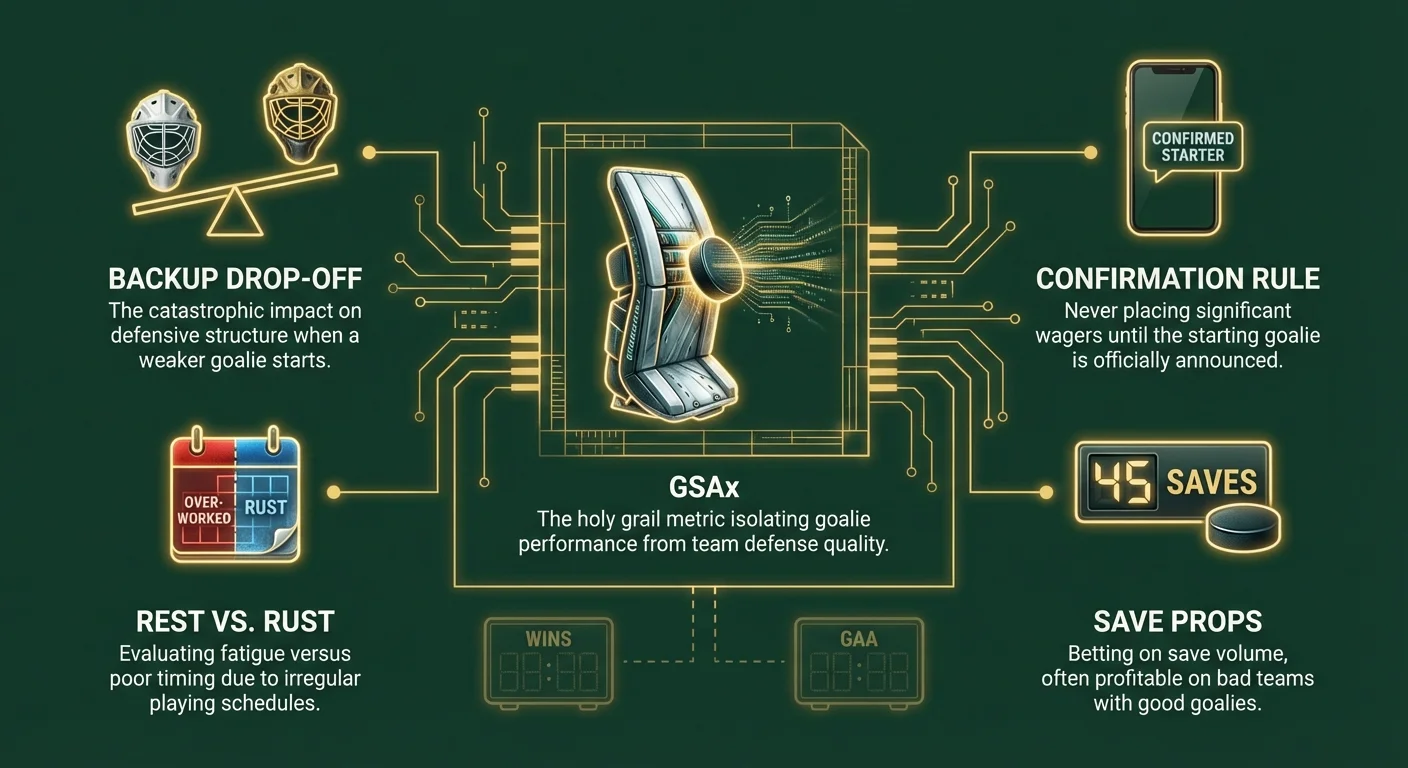
This is the holy grail of modern goalie analysis. Advanced analytics models calculate the "Expected Goals" (xG) a team should have conceded based on the quality and location of shots faced.
- If a goalie faces shots that equate to 3.5 Expected Goals but only allows 2, his GSAx is +1.5.
- If he allows 5 goals on those same shots, his GSAx is -1.5.
Betting Application: Look for mismatches where a goalie with a high positive GSAx is facing a goalie with a negative GSAx. If the moneyline is close to even, the GSAx advantage is a strong buy signal.
2. High-Danger Save Percentage (HDSV%)
Not all saves are created equal. A fluttering puck from the blue line is easy; a one-timer from the slot is difficult. HDSV% measures how well a goalie stops the most difficult shots.
- Why it matters: In tight games (especially playoffs), teams lock down defensively. The only shots that get through are often high-danger chances. A goalie with a poor HDSV% will crumble under pressure.
3. Delta/Consistency
Some goalies are volatile. They either post a shutout or get pulled in the first period. Others are steady, consistently giving up 2 or 3 goals.
- Betting Application: If betting a volatile goalie, the "Over" is often safer than the Moneyline. If betting a consistent goalie, you can trust them in low-scoring "Under" wagers.
Comparison: Traditional vs. Betting Stats
| Traditional Stat | Flaw | Better Stat | Why it Works |
|---|---|---|---|
| Wins (W) | Depends entirely on goal support. | GSAx | Isolates individual performance. |
| GAA | Heavily influenced by team defense. | HDSV% | Measures ability to make "clutch" saves. |
| Save % (Sv%) | Treats a 50ft shot the same as a breakaway. | xG Differential | Contextualizes shot quality. |
The Backup Goalie Strategy
Navigating the "backup goalie" landscape is where sharp bettors make their money. NHL teams play roughly 12 to 15 back-to-back sets (games on consecutive nights) per season. In 95% of these cases, the backup goalie will play one of those games.
The "Fade the Backup" Strategy
The public loves to bet on the favorite, regardless of who is in net. However, the drop-off to a backup goalie can be catastrophic for a team's defensive structure. The players know the backup is weaker, so they may play tentatively, collapsing the net rather than attacking.
When to fade the backup:
- The Tired Backup: The team played last night (tired legs) and is starting the backup tonight.
- The Road Backup: Backups typically perform significantly worse on the road where the home team has the "last change" advantage to dictate matchups.
- The "Scheduled Loss": A tired team with a backup goalie playing against a rested elite team.
The "Over" Trap
Intuitively, bettors smash the "Over" when two backup goalies are playing. While this often hits, sportsbooks are aware of this. They will inflate the total from 6.0 to 6.5 or increase the juice (vig) on the Over.
- Pro Tip: Instead of betting the full game Over, look at the 1st Period Over. Backups often struggle early as they adjust to the game speed (rust), but settle in by the second period.
Analyzing Situational Factors
Stats tell you what happened in the past; situational analysis tells you why it might happen tonight.
Rest vs. Rust
Goalies are creatures of habit.
- Overworked: If a starter has played 8 games in 14 days, fatigue sets in. Their lateral movement slows, and their HDSV% drops.
- Too Much Rest (Rust): If a goalie hasn't played in 10 days, their timing can be off. This often leads to "soft goals" early in the game.
Defensive Correlation
You cannot evaluate a goalie without evaluating the defense. Injuries to top defensemen directly impact goalie stats.
- If a team's #1 defenseman (who clears the crease and blocks shots) is injured, even an elite goalie will see a dip in numbers.
- Crypto Betting Advantage: Crypto sportsbooks often allow for high limits on player props. If a top defenseman is out, bet the Over on Goalie Saves. The goalie will face more shots because the defense is porous.
The Importance of Confirmation
In the NHL, lineups are not official until the "morning skate" (usually 10:30 AM to 12:00 PM local time) or warmups (30 minutes before puck drop).
The Rule of Confirmation:
Never place a significant wager on a moneyline until the starting goalie is Confirmed.
- Probable: A beat writer thinks he will start.
- Confirmed: The goalie was the first off the ice at morning skate (the universal sign of the starter) or the coach explicitly named him.
Crypto Agility
This is where using crypto sportsbooks offers a distinct tactical advantage.
- Speed of Funding: If news breaks at 11:00 AM that a backup is starting, the line will move within minutes. With instant Bitcoin or USDT deposits, you can top up your account and hit the "fade" bet before the sportsbook adjusts the odds.
- Live Betting: If a starter gets pulled or injured, crypto sites often have faster live-betting reaccreditation, allowing you to hedge or double down instantly.
Profiting from "Saves" Prop Bets
One of the most profitable, yet underutilized, markets in hockey betting is the Goalie Saves Prop. This is a bet on how many saves a specific goaltender will make in the game.
The Formula for the "Over" Saves Bet:
Bad Defense + Good Goalie + Opponent High Shot Volume = Profit
Look for a team that gives up a high volume of shots (e.g., San Jose Sharks, Anaheim Ducks) but has a capable goaltender. The goalie might lose the game 4-1, but because he faced 45 shots, he made 41 saves. If the prop line was 29.5, you win easily.
The Formula for the "Under" Saves Bet:
Elite Defense + Low Tempo Opponent = Profit
If the Carolina Hurricanes (known for suppressing shots) are playing a slow team, their goalie might only face 18 shots all night. Betting the Under on saves is a smart play here, even if they win the shutout.
Practical Steps to Evaluate a Goalie Matchup
Before placing your wager, run through this 5-step checklist:
- Confirm the Starter: Use resources like DailyFaceoff or Twitter beat writers. Do not guess.
- Check the Schedule: Is this a back-to-back? Is it the 3rd game in 4 nights?
- Compare GSAx (Last 10 Games): Don't look at the whole season. Goaltending is streaky. Who is hot right now?
- Review the H2H History: Some goalies have mental blocks against specific teams or in specific arenas.
- Identify the Value: If an elite goalie is -140 against a backup, is that price justified? Or is the backup actually decent (low Delta)?
Summary and Key Takeaways
Goaltending is the most volatile variable in sports betting. A "hot" goalie can steal a series, and a "cold" goalie can sink a favorite. To succeed in goalie betting, you must adopt a rigorous analytical approach.
- Ignore the Noise: Wins and GAA are virtually useless for predictive betting. Focus on GSAx and High-Danger Save Percentage.
- Watch the Backup: The biggest edges are found when understanding the drop-off between a starter and a backup.
- Bet the Props: Goalie save props often offer better value than moneylines because they are less dependent on the final score and more dependent on game flow.
- Leverage Crypto Speed: Use the speed of blockchain transactions to capitalize on line movements the moment a goalie is confirmed.
By treating the goaltender as an individual asset rather than just a part of the team, you shift the odds in your favor. In hockey betting, the man who stops the puck is the man who starts your profit.