
If you have opened a sportsbook app in the last five years, you have likely been bombarded with advertisements for Same Game Parlays (SGPs). They are the shiny, high-upside feature that dominates the homepages of major betting sites, promising massive payouts for predicting the specific narrative of a single match.
For the casual fan, SGPs are a way to turn a boring Monday Night Football game into a lottery ticket. But for the serious bettor, they represent a complex mathematical puzzle. While sportsbooks push these bets aggressively because they offer notoriously high profit margins for the house, that doesn't mean they are unwinnable.
To succeed with an SGP strategy, you must understand the mechanics underneath the hood. You need to understand how algorithms price correlation, how the "vig" compounds against you, and how to identify the rare scenarios where an SGP actually offers positive expected value (+EV).
This guide will move beyond the basics of how to place a bet and dive into the intermediate mechanics of correlation, risk assessment, and how to leverage crypto sportsbooks to maximize your returns on these high-variance wagers.
What is a Same Game Parlay?
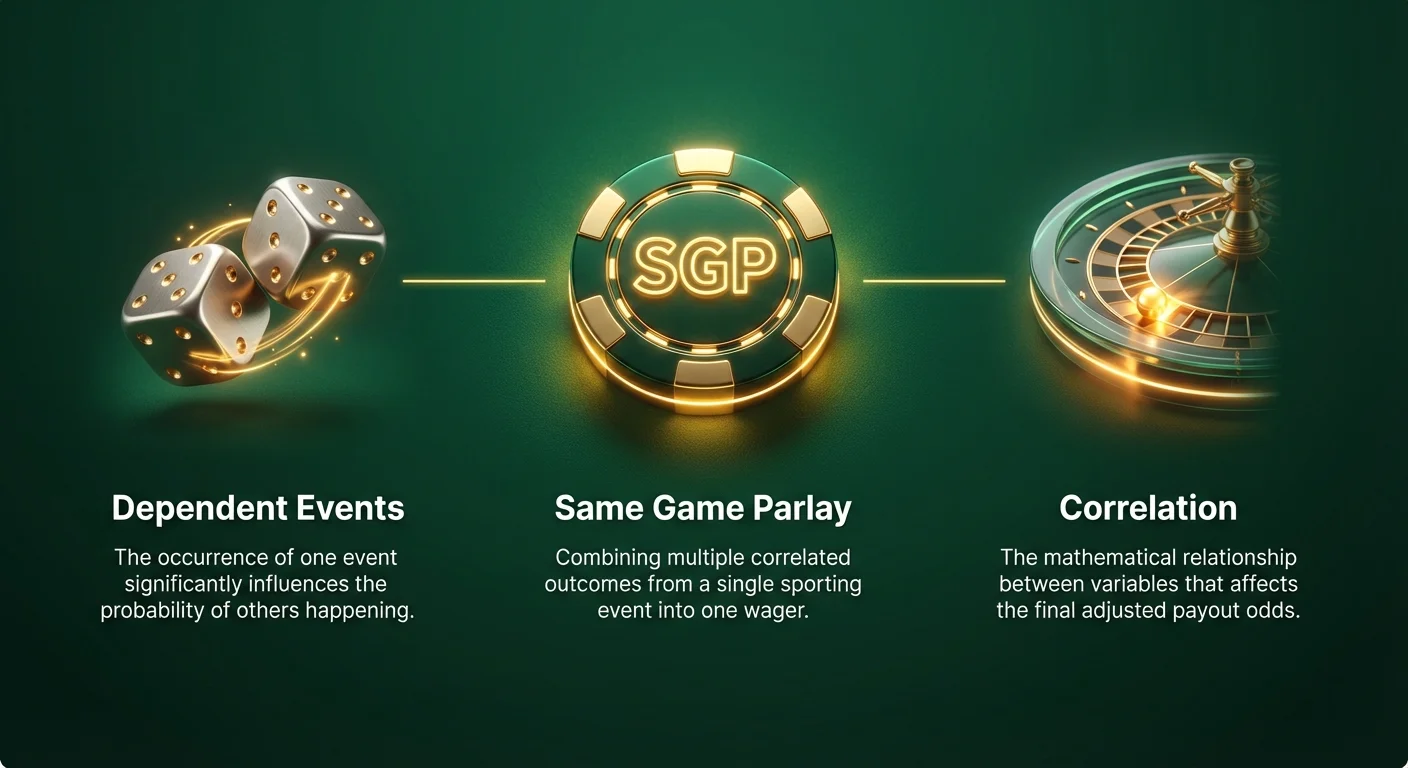
A Same Game Parlay allows bettors to combine multiple outcomes from a single sporting event into one wager. In the past, traditional sports betting rules prohibited parlaying correlated events (e.g., betting the Over on a team's total points and the Over on their Quarterback's passing yards) because the occurrence of one makes the other significantly more likely.
Modern sportsbooks, powered by advanced data modeling and algorithms, now allow this by dynamically adjusting the odds. They calculate the correlation between the legs you select and offer a payout that reflects the combined probability - usually with a significant premium charged for the convenience.
The Difference Between SGPs and Traditional Parlays
In a traditional parlay involving two completely separate games (e.g., Packers to win and Lakers to win), the math is straightforward. The probabilities of two independent events are multiplied.
In an SGP, the events are dependent. If you bet on the Kansas City Chiefs to win and Patrick Mahomes to throw for 300+ yards, those two events are tied together. If Mahomes throws for 300 yards, the Chiefs are highly likely to win. Consequently, the sportsbook will not give you the standard parlay multiplier; they will reduce the payout to account for the correlation.

The Economics: Why Sportsbooks Love SGPs
Before diving into strategy, it is vital to understand the enemy. Sportsbooks push same game parlay offers because the "hold" (the percentage of money the book keeps) is significantly higher than on straight bets.
On a standard spread bet (-110), the theoretical hold is roughly 4.5%. On a 3-leg SGP, the hold can skyrocket to 15%, 20%, or even 30%.
The Compounding Vig
The main reason SGPs are dangerous for your bankroll is that you are often paying "juice" or "vig" on every single leg, and the pricing algorithm often adds an extra "SGP tax" on top.
| Bet Type | Leg 1 Odds | Leg 2 Odds | True Probability Payout | Actual SGP Payout | House Edge Impact |
|---|---|---|---|---|---|
| Traditional Parlay | -110 | -110 | +264 | +264 | Standard |
| Uncorrelated SGP | -110 | -110 | +264 | +240 to +250 | High (SGP Tax) |
| Correlated SGP | -110 | -110 | +180 (Adjusted) | +140 to +160 | Very High |
Note: In the Uncorrelated SGP example (e.g., Over 45 points and an arbitrary player prop that doesn't affect the score much), books often pay less than a standard parlay simply because it is processed through the SGP engine.
Mastering Correlation: The Key to Strategy
If you are going to bet SGPs, you must stop thinking about "value" in terms of individual lines and start thinking about correlation. This is the single most important concept in correlated parlays.
Correlation refers to the relationship between two variables. In sports betting, it measures how the outcome of one wager affects the probability of another.
Positive Correlation (The "Stack")
This is when Leg A winning makes Leg B more likely to win.
- Example: NBA game. Tyrese Haliburton Over 10.5 Assists + Pacers Over 120.5 Points.
- Logic: If Haliburton is racking up assists, the team is likely scoring frequently.
- Book Reaction: The sportsbook's algorithm detects this immediately and drastically reduces your payout odds.
Negative Correlation (The "Conflict")
This is when Leg A winning makes Leg B less likely to win.
- Example: NFL game. Josh Allen Over 0.5 Interceptions + Bills Under 17.5 Points.
- Logic: While turnovers hurt scoring, it is not a 1:1 ratio. However, betting a Star QB to go Under his passing yards but the team to win by Over a large spread is a conflict.
- Book Reaction: Books will often give massive odds boosts for these, but they rarely hit. However, finding "soft" negative correlations is a strategy used by sharps (discussed later).
The "Null" Correlation
This occurs when legs have little to no impact on each other.
- Example: A specific player to get a yellow card in soccer + Over 2.5 goals.
- Strategy: You generally want to avoid these in SGPs. If the events aren't correlated, you are better off betting them as singles or in a traditional parlay if the book allows it, to avoid the SGP tax.
Strategy 1: The Narrative Approach (Scripting the Game)
The most effective way to build an SGP is to write a script for how the game will play out. Do not just pick props you like; pick props that tell a cohesive story.
Scenario: The Blowout
You believe the 49ers will demolish the Cardinals. Instead of just betting the spread (-10), you build a narrative SGP:
- 49ers Moneyline: The foundation.
- Christian McCaffrey Over Rushing Yards: In a blowout, teams run the ball to kill the clock.
- Brock Purdy Under Passing Attempts: If they are winning by 20, they stop throwing in the 4th quarter.
- Cardinals WR Over Receptions: The losing team will be in "garbage time" mode, throwing specifically to catch up against a soft defense.
By correlating the game state (Blowout) with the player usage (Run heavy for winner, Pass heavy for loser), you are betting on one thing happening (the blowout) rather than four separate random events.
Strategy 2: Hunting Pricing Inefficiencies
Sportsbook algorithms are good, but they are generic. They apply similar correlation math to every team, regardless of specific coaching tendencies. This is where you can find an edge.
The Quarterback/Receiver Stack
The most common correlation is QB Yards + WR Yards.
- The Algorithm: Assumes that if a QB throws for 300 yards, his WR1 gets about 30% of that production.
- The Edge: Find teams with a highly concentrated offense. If a team's QB targets one specific receiver 40% of the time, the sportsbook's generic correlation algorithm might not reduce the odds enough. You are getting a "discount" on the correlation because the book is treating them like an average duo, not a historic duo.
The "Anti-Correlation" Value
Sometimes, the math is wrong on negative correlations.
- Scenario: A heavy favorite (e.g., Man City) plays a defensive team.
- The Bet: Match Result: Draw + Under 2.5 Goals + Man City Most Corners.
- Why: The book might price the "Draw" and "Man City Most Corners" as slightly conflicting because favorites usually win when they dominate possession. However, in soccer, a dominant team drawing 0-0 often racks up 10+ corners trying to break the deadlock. The price on this SGP is often higher than the true probability.
Strategy 3: Using Crypto Sportsbooks for SGPs
When executing an SGP strategy, the platform you use matters. Crypto sportsbooks offer distinct advantages for intermediate and sharp bettors focusing on props and parlays.
1. Handling Limiting and Closures
If you start winning consistent SGPs on mainstream fiat sportsbooks (like FanDuel or DraftKings), you risk being limited quickly. Their risk management teams flag sharp prop bettors aggressively. Crypto sportsbooks, particularly those operating on decentralized models or with higher volume/lower KYC thresholds, tend to be more tolerant of winners or allow for easier account recreation (within their terms of service).
2. Niche Prop Markets
Many crypto books use different odds providers than the main Las Vegas/US corporate books. You might find that a crypto book has a player's rebound line at 6.5 while the rest of the market has moved to 7.5. Adding this "stale" line into an SGP instantly increases your Edge.
3. Instant Settlements and Withdrawals
SGPs are high-variance. You will lose often, and win big occasionally. When you hit a +2000 SGP, you want that liquidity immediately to reinvest or secure profits.
- Fiat: Withdrawal takes 1-3 business days.
- Crypto: Bitcoin or USDT withdrawals usually settle in minutes. This is crucial for bankroll velocity.
Practical Tips for Building Your Bet
Here is a checklist to run through before placing any Same Game Parlay.
1. Keep it Short (The 2-3 Leg Rule)
Every leg you add increases the "vig" the sportsbook collects. The sweet spot for long-term sustainability is 2 or 3 legs.
- Bad SGP: 6 legs, +4000 odds. (Pure lottery, negative EV).
- Good SGP: 2 legs, +150 odds. (Correlated, lower vig, plausible hit rate).
2. Avoid "Non-Booster" Legs
Never add a -500 leg (e.g., "Player to get 1+ catch") just to bump the odds slightly.
- The Risk: Even a "guaranteed" outcome fails occasionally (injury on the first play).
- The Reward: The minuscule odds boost is not worth the added risk of total bet failure.
3. Use SGPs for Bonus Abuse
The best time to bet an SGP is when the sportsbook offers a promotion.
- "No Sweat" SGP: If your bet loses, you get a free bet back.
- Profit Boosts: "Get a 50% boost on any NFL SGP."
- Math: These promotions often flip the math from Negative EV to Positive EV. If you only bet SGPs when you have a boost, you will likely be profitable in the long run.
4. Shop the Odds
SGP pricing varies wildly between books because their correlation algorithms differ.
- Book A: May price a correlation at +350.
- Book B: May price the exact same combo at +420.
- Tip: Build the betslip on 3 different crypto sportsbooks before clicking "Bet." Taking the +420 over the +350 is the difference between a winning and losing season.
Calculating Risk: The Variance Trap
It is essential to understand the toll SGPs take on your bankroll. Because the odds are longer (typically +400 or higher), your win rate will be low.
If you bet standard spreads (-110), you win roughly 50% of the time. If you bet SGPs at +400, you are expected to win only 20% of the time. You can easily go weeks without a win.
Bankroll Management for SGPs:
- Unit Sizing: Reduce your unit size. If your standard bet is 1% of your bankroll, your SGP bet should be 0.25% or 0.5%.
- The Mental Game: Prepare for "bad beats." Losing the last leg of a parlay is psychologically draining. If you cannot handle the swing, stick to straight bets.
When to AVOID Same Game Parlays
There are times when you should absolutely refuse to place an SGP.
- When the Lines are Sharp: If the Super Bowl lines have been hammered by sharps for two weeks, there is no value left. SGPs compound the efficiency of the market against you.
- Uncorrelated Garbage: If you are just picking "Over" on three random players because you "have a feeling," you are donating money. Without correlation, the parlay math is strictly worse than separate bets.
- To Chase Losses: Never fire a high-odds SGP on the Sunday Night Football game to try and make back money you lost during the afternoon games. This is the fastest way to zero out a crypto wallet.
Summary: Turning the Tables
Same Game Parlays are designed to be a profit engine for sportsbooks, capitalizing on the average fan's desire for a massive payday and their misunderstanding of probability. However, they are not unbeatable.
To win at SGPs, you must:
- Leverage Correlation: Only combine events that rely on each other (The Narrative).
- Price Shop: Use multiple crypto sportsbooks to find the algorithm that penalizes your correlation the least.
- Limit Legs: Stick to 2-3 legs to minimize the compounding house edge.
- Utilize Boosts: Aggressively use profit boosts and "risk-free" offers to create +EV situations.
Treat SGPs not as a lottery ticket, but as a sniper rifle. Wait for the specific game script where the market hasn't accounted for the correlation between a team's dominance and a player's performance, and then strike.