
In the high-variance world of sports betting, finding a consistent edge is the holy grail. While player props and advanced analytics get the glory, one of the most reliable, mathematically sound edges in NBA betting comes down to something much simpler: the calendar.
The NBA regular season is a grueling marathon - 82 games compressed into roughly 170 days. This logistical nightmare creates distinct inequalities between teams on any given night. While the NFL offers a week of rest between games and MLB is less physically taxing, the NBA sits in a unique sweet spot where fatigue, travel, and sleep deprivation measurably alter game outcomes.
Understanding NBA rest advantages and schedule spots allows you to identify value before the tip-off. This guide goes beyond basic "bet against the tired team" logic; we will dive into the nuances of the "schedule loss," the impact of load management, and how to use crypto betting platforms to capitalize on late-breaking schedule news.
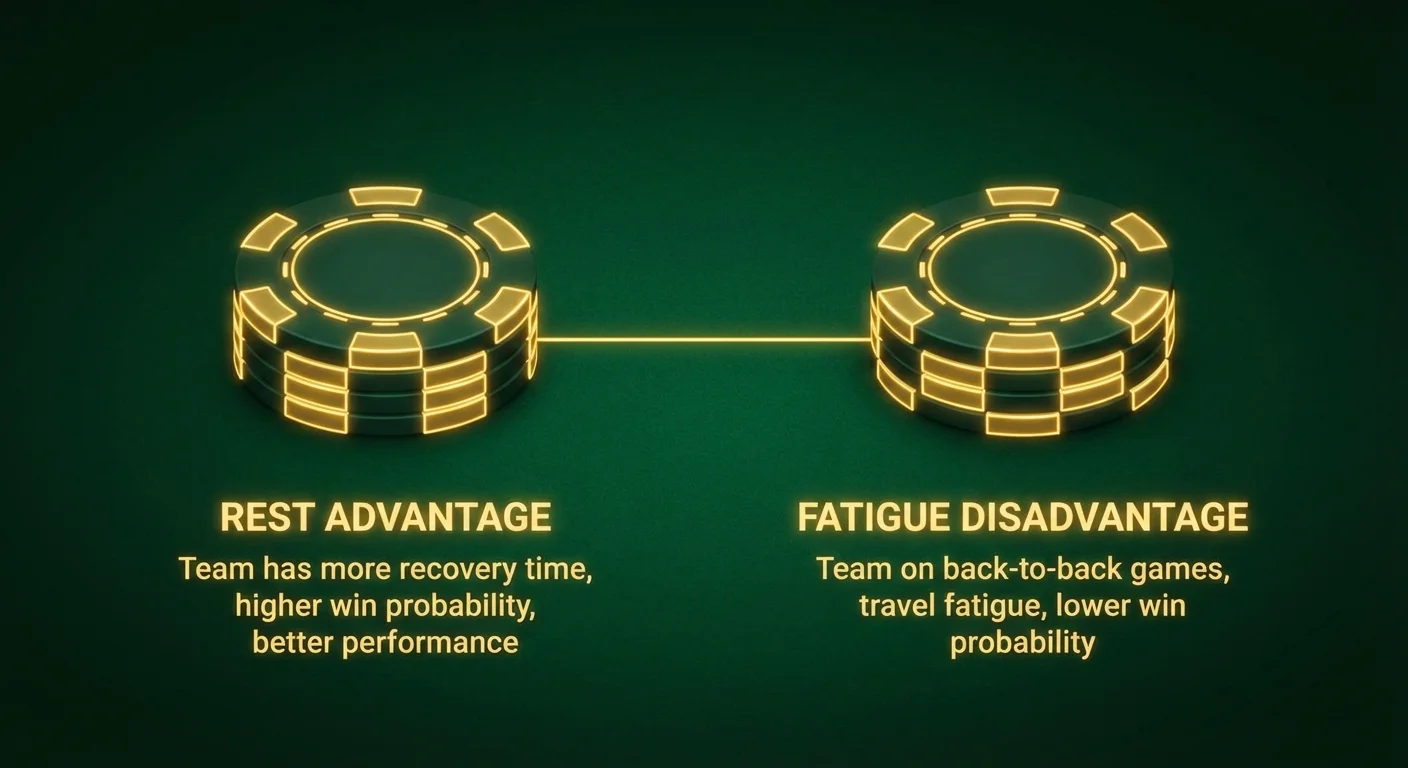
The Physiology of the Grind: Why Rest Matters
To bet successfully on the NBA, you must stop viewing teams as robots and start viewing them as collections of human employees subject to biological limits.
The average NBA game requires intense cardiovascular exertion, physical contact, and mental focus. Recovery is not immediate. When you factor in cross-country travel, changing time zones, and the notorious "red-eye" flights arriving at 3:00 AM, performance degradation is inevitable.
The "Schedule Loss"
In sharp betting circles, a "schedule loss" refers to a game where a team is set up to fail purely due to logistical disadvantages. Even if the Golden State Warriors are the better team on paper, if they are playing their fourth game in five nights, on the road, at high altitude, against a rested opponent, their win probability plummets.
Identifying these spots allows you to fade the public, who often bet based on team reputation rather than situational reality.
Deconstructing the "Back-to-Back" (B2B)
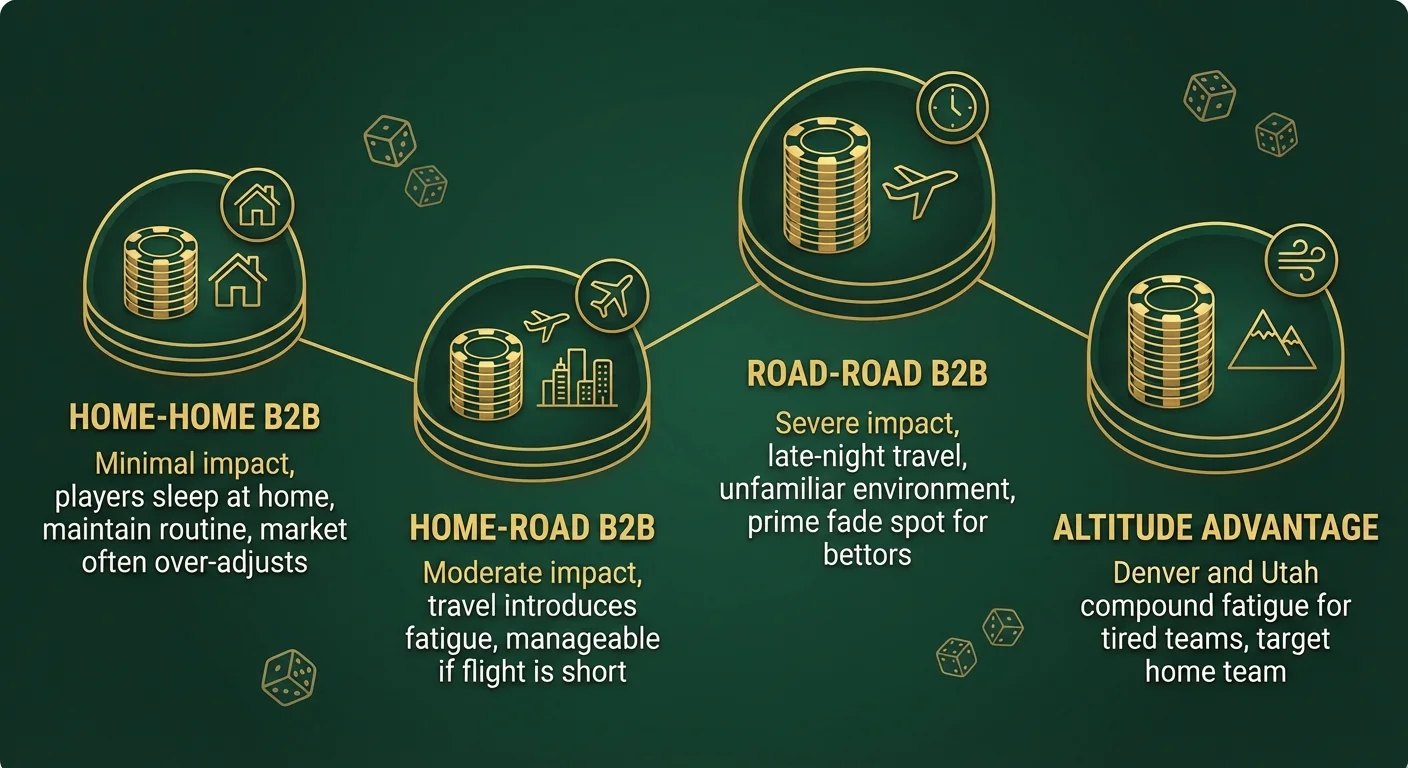
The most common schedule spot is the Back-to-Back (B2B) - playing games on two consecutive days. However, not all B2Bs are created equal. Blindly betting against every team on a B2B will burn your bankroll because oddsmakers bake a "fatigue tax" into the point spread (usually adjusting the line by 1.5 to 3 points).
To find the edge, you must distinguish between the different types of B2Bs:
1. Home-Home B2B
- Scenario: A team plays at home on Tuesday and at home again on Wednesday.
- Impact: Minimal. The players sleep in their own beds, have no travel fatigue, and maintain their routine.
- Betting Strategy: Be wary of fading a team in this spot. The market often over-adjusts, assuming fatigue where there is very little.
2. Home-Road B2B
- Scenario: A team plays at home, then flies immediately to a nearby city for a game the next night.
- Impact: Moderate. Travel introduces fatigue, but if the flight is short (e.g., New York to Philadelphia), the impact is manageable.
3. Road-Road B2B (The "Segababa")
- Scenario: The second game of a back-to-back, both played on the road.
- Impact: Severe. This involves late-night travel, hotel check-ins, and unfamiliar environments.
- Betting Strategy: This is a prime fade spot, especially if the opponent is rested and waiting at home.
4. The "3-in-4" and "4-in-5"
The most toxic schedule spots are when teams play three games in four nights (3-in-4) or four games in five nights (4-in-5). By the final game of these stretches, legs are heavy.
- Impact on Shooting: Jump shots tend to fall short (hit the front rim) when legs are tired.
- Impact on Defense: Defense requires more effort than offense. Tired teams often settle for lazy fouls or fail to close out on shooters.
The Rest Differential Matrix
The most profitable bets often arise when there is a significant Rest Differential. This isn't just about one team being tired; it's about the disparity between the two teams.
Here is a breakdown of how rest differentials typically impact betting outcomes:
| Team A Situation | Team B Situation | Advantage | Betting Angle |
|---|---|---|---|
| 0 Days Rest (B2B) | 0 Days Rest (B2B) | Neutral | Look at the Under. Sloppy play and heavy legs often lead to poor shooting percentages. |
| 0 Days Rest (B2B) | 1 Day Rest | Team B | Standard fade spot. Check if the line has over-adjusted. |
| 0 Days Rest (Road) | 2+ Days Rest (Home) | Team B (Strong) | The "Rest Advantage" play. High win probability for Team B. |
| 3+ Days Rest | 1 Day Rest | Variable | Beware of "Rust." Teams with too much rest (4+ days) often start slow in the 1st Quarter. |
The "Rust vs. Rest" Debate
While fatigue is a killer, rhythm is king in the NBA. Occasionally, a team will have 3 or 4 days off (due to scheduling quirks or the All-Star break).
- The Trap: Bettors assume the well-rested team will dominate.
- The Reality: Teams on long layovers often come out flat. Their timing is off, and they commit turnovers.
- Strategy: Consider betting the 1st Quarter or 1st Half spread on the team that is in rhythm (1 day rest), even if they are less rested than the opponent.
Load Management: The Modern Variable
In the modern NBA, the schedule doesn't just dictate fatigue - it dictates participation. "Load Management" is the practice of resting star players during B2B sets or dense schedule patches to prevent injury.
This creates massive volatility in betting markets. If LeBron James or Joel Embiid is ruled out 30 minutes before tip-off, the point spread can swing by 5 to 7 points instantly.
How to Exploit Load Management
- Predict the scratch: If a star player is coming off a long injury and faces a B2B, there is a high probability they will sit one of those games.
- Target the "Front End": Teams often play the star in the easier game (or the home game) and rest them for the harder road game.
- Use Crypto Speed: This is where betting with cryptocurrency becomes a tactical tool.
The Crypto Advantage in Schedule Betting
When news breaks that a star is resting (usually via a tweet from an insider like Shams Charania), sportsbooks adjust their lines within seconds.
- Traditional Fiat Books: If you need to deposit funds to hit a line, credit cards or bank transfers can lag or trigger verification pauses.
- Crypto Books: Deposits with assets like Bitcoin, Litecoin, or USDT are often automated and near-instant. Furthermore, crypto-native sportsbooks (like Stake or Cloudbet) often have higher automated limits and fewer restrictions on "sharp" action.
- Withdrawals: If you hit a big parlay based on a schedule spot, crypto allows you to withdraw your winnings immediately, rather than waiting 3-5 business days.
Specific Schedule Spots (Situational Handicapping)
Beyond simple fatigue, the schedule creates psychological spots that smart bettors exploit.
1. The "Lookahead" Spot
This occurs when a superior team plays a weak opponent immediately before a marquee matchup against a rival or elite team.
- Example: The Milwaukee Bucks play the Detroit Pistons on Tuesday, but have a massive game against the Boston Celtics on Thursday.
- Theory: The Bucks may overlook the Pistons, playing with low energy to save themselves for Boston.
- The Bet: Take the points with the underdog (Pistons).
2. The "Letdown" Spot
This happens immediately after a team plays a highly emotional, high-stakes game.
- Example: The Heat just beat the Celtics in double overtime on national TV. Two nights later, they play the Wizards.
- Theory: Emotional tanks are empty. The team comes out flat.
- The Bet: Fade the team coming off the massive win.
3. The "Getaway" Game
This is the final game of a long road trip (usually 4+ games). The players have been living out of suitcases for a week and just want to go home.
- Theory: Focus is low. Players are already thinking about their flight home.
- The Bet: Bet against the road team, especially if they are playing a respectable home team.
The Altitude Advantage: Denver and Utah
Geography plays a critical role in NBA handicapping, specifically regarding Denver and Utah.
- The Science: Denver (Mile High City) and Salt Lake City are at high elevations. The air is thinner. Oxygen saturation in the blood drops for unacclimatized athletes.
- The Angle: When an opponent arrives in Denver or Utah on the second night of a back-to-back, the altitude effects are compounded by general fatigue. It is physically harder to recover your breath.
- The Strategy:
- Target the Denver Nuggets and Utah Jazz specifically when they are at home facing a team on a B2B.
- Look at the Over in the 3rd and 4th quarters. The tired team's defense usually collapses before their offense does, leading to easy buckets for the home team.
Practical Strategy: A Step-by-Step Guide
Ready to implement this into your betting routine? Follow this workflow before placing your NBA bets.
Step 1: Check the Weekly Schedule
Don't just look at today's games. Look at the grid for the whole week. Identify teams playing 4 games in 6 nights or back-to-backs. Sites like RestOfTheNBA.com or standard schedule grids are essential.
Step 2: Identify the Mismatches
Circle the games where:
- Team A has 2 days rest (Home).
- Team B has 0 days rest (Road).
- Team B traveled across time zones (e.g., East Coast to West Coast).
Step 3: Anticipate Lineups
Check the injury reports. Is the star player on the tired team older than 30? If so, there is a high chance they sit.
- Pro Tip: If you suspect a star will sit, bet the opponent early (morning). If you wait until the official announcement, the value will be gone.
Step 4: Analyze the Line Movement
Has the market already reacted?
- If the line opened at -4 and is now -7, the "tired tax" has already been paid. There may be no value left.
- If the line has not moved, but the schedule spot is brutal, this is your entry point.
Step 5: Execute via Crypto Sportsbook
Utilize a trusted crypto betting site for the transaction.
- Anonymity: Ensure your strategy isn't limited by personal betting limits often found at soft fiat books.
- Bonuses: Use reload bonuses often available in Bitcoin to pad your bankroll against variance.
Summary: Rest is a Probability Enhancer
Betting on NBA rest advantages is not a magic wand that guarantees a win every time. Tired teams sometimes win on adrenaline. Rested teams sometimes shoot poorly.
However, sports betting is about Long-Term Expected Value (+EV). Over a sample size of hundreds of games, teams facing a "Schedule Loss" (Road B2B, 3-in-4, travel delays) cover the spread at a significantly lower rate than the league average.
By respecting the grind of the NBA schedule and identifying these predictable spots, you stop gambling on hunches and start investing in probabilities.
Key Takeaways
- Fade the "Segababa": Road-Road back-to-backs are the statistically worst spots for teams.
- Respect Altitude: Denver and Utah are death traps for tired teams.
- Watch for Letdowns: Teams often underperform immediately after their biggest wins of the season.
- Timing is Key: Use crypto sportsbooks to react instantly to injury news and load management announcements.
- Value over Trends: Don't just bet the spot blindly; ensure the line hasn't already moved too far to compensate for the rest disadvantage.
Disclaimer: This guide is for educational purposes only. Sports betting involves risk. Always gamble responsibly and never bet more than you can afford to lose.