
In the high-speed world of modern sports betting, the difference between a winning season and a losing one often comes down to milliseconds. While amateur bettors - often called "squares" - spend hours analyzing past trends and head-to-head records, professional bettors ("sharps") are playing a different game entirely. They are playing the game of information.
The most potent form of information in sports betting is injury reports and lineup news. When a star quarterback is ruled out, a starting pitcher gets scratched, or an NBA superstar decides to rest for load management, the betting lines move violently. If you can act on that information before the sportsbooks adjust their odds, you possess a mathematical advantage that almost no amount of handicapping can replicate.
This guide is designed for the intermediate bettor ready to move beyond basic stats and start betting the "information edge." We will explore how to source news instantly, how to interpret the value of a player relative to the betting line, and how the speed of cryptocurrency betting platforms can give you the execution velocity needed to beat the market.
Understanding the Information Edge
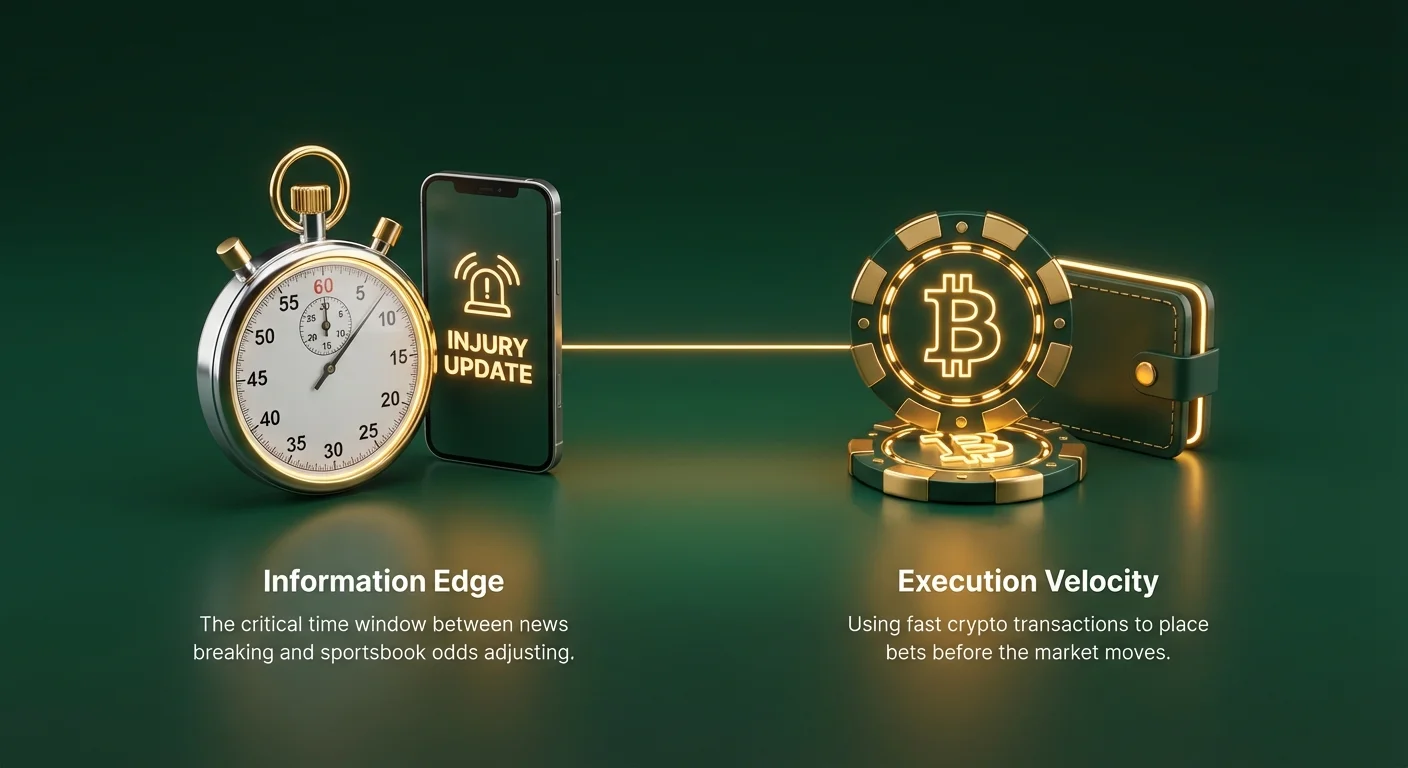
In financial markets, trading on non-public information is illegal; in sports betting, it is the holy grail. The "Information Edge" refers to the window of time between news breaking (a player injury or lineup change) and the sportsbooks adjusting their odds to reflect that news.
Markets are efficient, but they are not instantaneous. Even in the age of automation, there is a delay - sometimes seconds, sometimes minutes - where the odds available on the screen no longer reflect the true probability of the outcome.
The Lifecycle of Injury News
To exploit this edge, you must understand the lifecycle of a piece of news:
- The Event: A player tweaks an ankle in practice, or a coach decides to rest a starter.
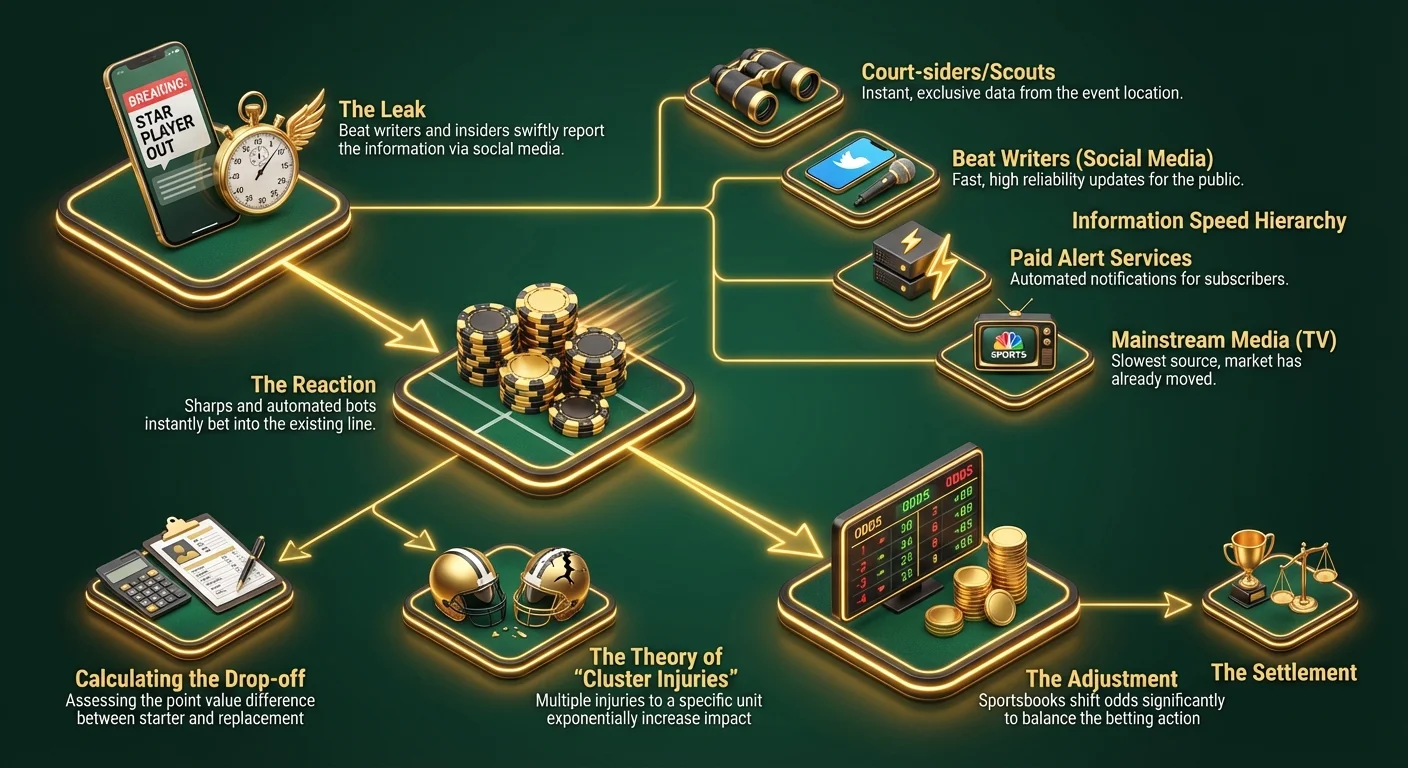
- The Leak: A beat writer, insider, or someone close to the team tweets or reports the information.
- The Reaction: Sharps and syndicate bots instantly hammer the existing line.
- The Adjustment: Sportsbooks pull the line off the board or adjust the odds significantly to balance the action.
- The Settlement: The market settles at a new price (the "Closing Line").
Your goal is to exist in step 3. If you bet after step 4, you are betting into an efficient market where the value has been sucked out.
Sourcing: Where to Find News First
If you are waiting for ESPN's SportsCenter or a push notification from a generic sports app to tell you a player is out, you are already too late. The market moved ten minutes ago. To compete, you need to curate your information feed.
The Hierarchy of Information Speed
| Source Type | Speed | Reliability | Actionability |
|---|---|---|---|
| Court-siders/Scouts | Instant | High | Elite (Exclusive to syndicates) |
| Beat Writers (Twitter/X) | Fast | High | Very High |
| Paid Alert Services | Fast | High | High |
| Fantasy Sports Apps | Moderate | High | Moderate |
| Mainstream Media (ESPN/TV) | Slow | Very High | Low (Market has already moved) |
Mastering Twitter/X for Betting
Twitter (now X) remains the primary ticker tape for sports bettors. However, following the team's official account is useless; they post lineups too late.
- Curate Lists: Create separate lists for each sport (e.g., "NBA Beat Writers," "NFL Insiders"). Do not clutter these lists with opinionated pundits; you only want reporters who break news.
- TweetDeck (X Pro): If you are serious about sitting at a desk and trading news, use TweetDeck to monitor multiple columns of beat writers simultaneously.
- Turn on Notifications: For key insiders (like Shams Charania or Adrian Wojnarowski in the NBA, Adam Schefter in the NFL), push notifications must be enabled.
Discord and Telegram Communities
Many crypto betting communities have migrated to Discord and Telegram. These groups often have bots that scrape Twitter APIs to post injury news milliseconds after it breaks. While you should verify sources, these bots are often faster than refreshing your own feed.
Analyzing Impact: The "So What?" Factor
Speed is nothing without analysis. Knowing a player is out is step one; knowing what that absence is worth to the point spread is step two. This is where the intermediate bettor separates themselves from the novice.
Not all starters are created equal, and the market often overreacts to "name brand" players while underreacting to crucial "system" players.
Calculating the Drop-off
You are not assessing the player's skill; you are assessing the difference between the starter and their replacement.
- NBA: In basketball, one player has the highest impact. A superstar like Luka Dončić might be worth 4 to 6 points on the spread. However, a rotational defender might be worth 0.5 points.
- NFL: The Quarterback is king. The drop-off from a Tier 1 QB (e.g., Patrick Mahomes) to a backup can swing a line by 7+ points. However, a starting Wide Receiver being out is rarely worth more than 0.5 to 1 point unless the team has zero depth.
- MLB: The starting pitcher drives 60-70% of the line. A late scratch of an ace for a bullpen arm can flip a team from a -150 favorite to a +130 underdog instantly.
The Theory of "Cluster Injuries"
An intermediate bettor looks for cluster injuries.
- Scenario: The starting Left Tackle is out.
- Market Reaction: Minimal movement.
- Scenario: The Left Tackle AND the Left Guard are out.
- Market Reaction: Significant.
Cluster injuries decimate a specific unit's functionality. In the NFL, missing two offensive linemen is exponentially worse than missing one, as it forces the offense to change its entire protection scheme.
Market Reaction and Betting the Closing Line
The ultimate metric for whether you are using injury news effectively is CLV (Closing Line Value).
If you see news that the Kansas City Chiefs' opponent has their starting QB ruled out, and you bet on the Chiefs at -3, and the line closes at Chiefs -6, you have gained 3 points of CLV. Over the long run, consistently beating the closing line is the surest indicator of a winning strategy.
Automated vs. Manual Adjustments
- Automated Books: Many "sharp" books use algorithms. When they sense a sudden influx of money on one side (steam), the computer automatically moves the line.
- Manual Books: Some smaller books or "soft" books rely on manual traders to move lines. These are your targets. When news breaks, hit the manual/soft books first. They will be the last to update.
The "Steam" Chase
When a major syndicate bets on injury news, the line moves at one book, then the next, then the next. This is called a "steam move."
- Strategy: Watch the sharpest book (e.g., Pinnacle). When they move their line due to injury news, immediately go to your crypto sportsbook or soft book and see if the old line is still available. This is known as "chasing steam" or "top-down betting."
Sport-Specific Strategy Guide
Different sports require different approaches to injury news.
NBA: The Volatility King
The NBA is the most sensitive sport to lineup news. "Load management" means stars sit out frequently, often with little warning.
- The 1:30 PM (ET) Injury Report: The NBA releases an official report early in the afternoon. This is the first wave of movement.
- The "Questionable" Tag: In the NBA, "Questionable" is a massive headache. It usually implies a 50/50 chance.
- Tip: If a player is Questionable on the second night of a back-to-back set, lean towards them sitting out.
- Shootaround News: Watch for reports from the morning shootaround. If a player is "getting shots up" or "moving well," positive line movement is imminent.
NFL: The Weekly Cycle
NFL injury betting is a week-long chess match.
- Wednesday/Thursday: First practice reports. "DNP" (Did Not Participate) is a red flag.
- Friday: The most critical day. Official game designations (Out, Doubtful, Questionable) are released.
- Rule of Thumb: "Doubtful" almost always means Out. "Questionable" is truly 50/50.
- Warmups: Inactives are released 90 minutes before kickoff. However, sharp bettors have usually figured it out before then based on "schefter bombs" or pre-game workout tweets.
Soccer: The Lineup Drop
In soccer, lineups are released exactly one hour before kickoff.
- Rotation Risk: In domestic cups or midweek games, managers often rotate squads. If you bet on Manchester City assuming Haaland starts, and he is benched, your equity is destroyed.
- Strategy: Wait for confirmed lineups in cup matches. In league matches, track press conferences held 1-2 days prior where managers discuss fitness.
The Crypto Advantage: Velocity and Agility
This is where playing on crypto-native platforms provides a distinct logistical edge over traditional fiat sportsbooks.
1. Instant Liquidity Movement
Injury news moves fast. You might see a great line at Bookmaker A, but your money is at Bookmaker B.
- Fiat: Withdrawing from Book A takes 2-5 days. Depositing to Book B takes minutes, but you might hit credit card limits. The opportunity is lost.
- Crypto: You can withdraw Bitcoin or USDT from a crypto sportsbook (often processed instantly or within minutes) and deposit it into another book immediately. This liquidity agility allows you to keep a smaller bankroll but still hit lines across multiple books.
2. High Limits on Derivatives
Crypto sportsbooks often offer high limits on niche markets. When injury news breaks, sometimes the best angle isn't the spread, but a Player Prop.
- Example: The starting Point Guard is out. The backup Point Guard's "Points Scored" prop is set at 8.5. Based on usage rates, he should score 14+.
- The Edge: Soft books often forget to adjust player props as quickly as they adjust the game spread. Crypto books allow you to hammer these props with significant volume before they correct.
3. Avoiding Bans
Betting on injury news is profitable, and books dislike profitable players. Traditional books are quick to limit or ban winners ("collaring"). Decentralized or crypto-focused books typically operate with a "high volume, low margin" model and are less likely to limit players for beating the line on news, provided the volume is there.
Common Pitfalls to Avoid
Even with fast info, you can lose money if you aren't careful.
1. The Overreaction
The public loves to overreact. "The star player is out? Bet against them!"
- The Ewing Theory: Sometimes teams play better immediately after a star is injured because the role players step up and play with higher energy.
- The Value: If the market moves the line 7 points for a player only worth 4 points, the value is actually on the team with the injury.
2. The "Head Fake"
Sometimes a coach will say a player is "likely to play" to force the opponent to prepare for them, only to rule them out at game time. Be wary of coaches known for lying about injuries (e.g., Belichick in the NFL was notorious for this; in the NBA, certain teams are notoriously vague).
3. Getting "Hooked"
You see the news, you rush to the book, and you bet. But you didn't notice the line had already moved 2 points while you were logging in. You are now betting a bad number.
- Discipline: If you missed the best number, pass. Do not bet the worse number just because you did the research.
Practical Tips: Your Daily Routine
To effectively bet the information edge, establish a routine.
- Morning Check: Review overnight injury reports and line movements. Check the "limit screens" to see where the money moved.
- Set Alerts: Ensure your Twitter lists and app notifications are active for the sports you are targeting that day.
- Identify Vulnerabilities: Look at the slate. Which teams are playing back-to-backs (NBA)? Which teams have banged-up QBs (NFL)?
- Prepare the Canvas: Have your crypto sportsbook tabs open and you wallet ready. Know your balance.
- The "Refresh" Window:
- NBA: 1:30 PM ET and 15 mins before tip-off.
- NFL: 4:00 PM ET (Practice reports) and 90 mins before kickoff.
- Execute: When news hits, verify it, check the line, and fire.
Summary
Betting on injury reports and lineup news is not about predicting the future; it is about reacting to the present faster than the rest of the market. It transforms sports betting from a game of opinion into a game of logistics and speed.
By curating high-speed information sources, understanding the mathematical value of player drop-offs, and utilizing the transactional speed of crypto sportsbooks, you can consistently capture Closing Line Value. Remember, the goal isn't just to win the bet - it's to make a bet that is mathematically superior to the line available at kickoff. That is the information edge.