
There is no feeling more agonizing in sports betting than watching a winning ticket evaporate in the eighth inning. You handicapped the game perfectly. You identified the starting pitching mismatch, your team took a 3-1 lead, and the starter left the mound with a quality start. Then, the bullpen gate opened. Two walks, a wild pitch, and a three-run homer later, your wager is dead. The "bullpen meltdown" is the bane of every baseball bettor's existence.
For intermediate and sharp bettors, the solution to this volatility lies in a specific market that strips away the chaos of the late innings: First 5 Innings (F5) betting.
This guide explores the mechanics, strategies, and advantages of F5 wagering. We will examine how this market allows you to isolate starting pitcher performance, avoid the randomness of middle relief, and utilize crypto sportsbooks to maximize the speed of your turnover. By shifting your focus to the first half of the game, you stop betting on a manager's bullpen management and start betting on the core matchup you actually researched.
What is First 5 Innings Betting?
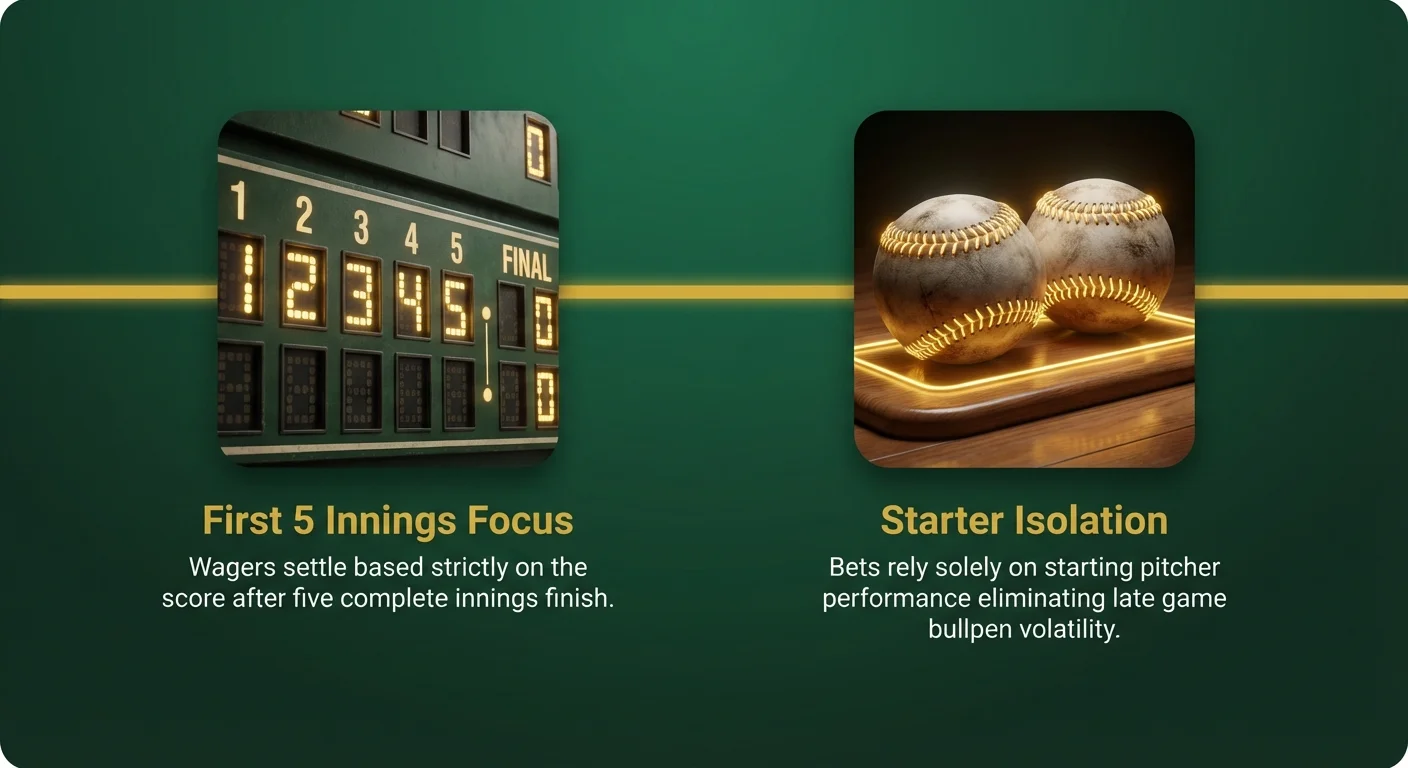
First 5 Innings betting, often abbreviated as F5, is exactly what it sounds like: a wager placed on the outcome of a baseball game based strictly on the score at the end of the fifth inning. Once the final out of the bottom of the fifth is recorded, your bet is graded. What happens in the sixth, seventh, eighth, ninth, or extra innings is entirely irrelevant to your bankroll.
While this concept is simple, the implications for strategy are profound. In a standard Major League Baseball game, the starting pitcher usually lasts between five and six innings. By betting the F5 line, you are essentially creating a derivative market that focuses almost exclusively on the starting rotation and the starting lineups.
The Rules of Engagement
Before diving into strategy, it is vital to understand how F5 rules differ from full-game wagers:
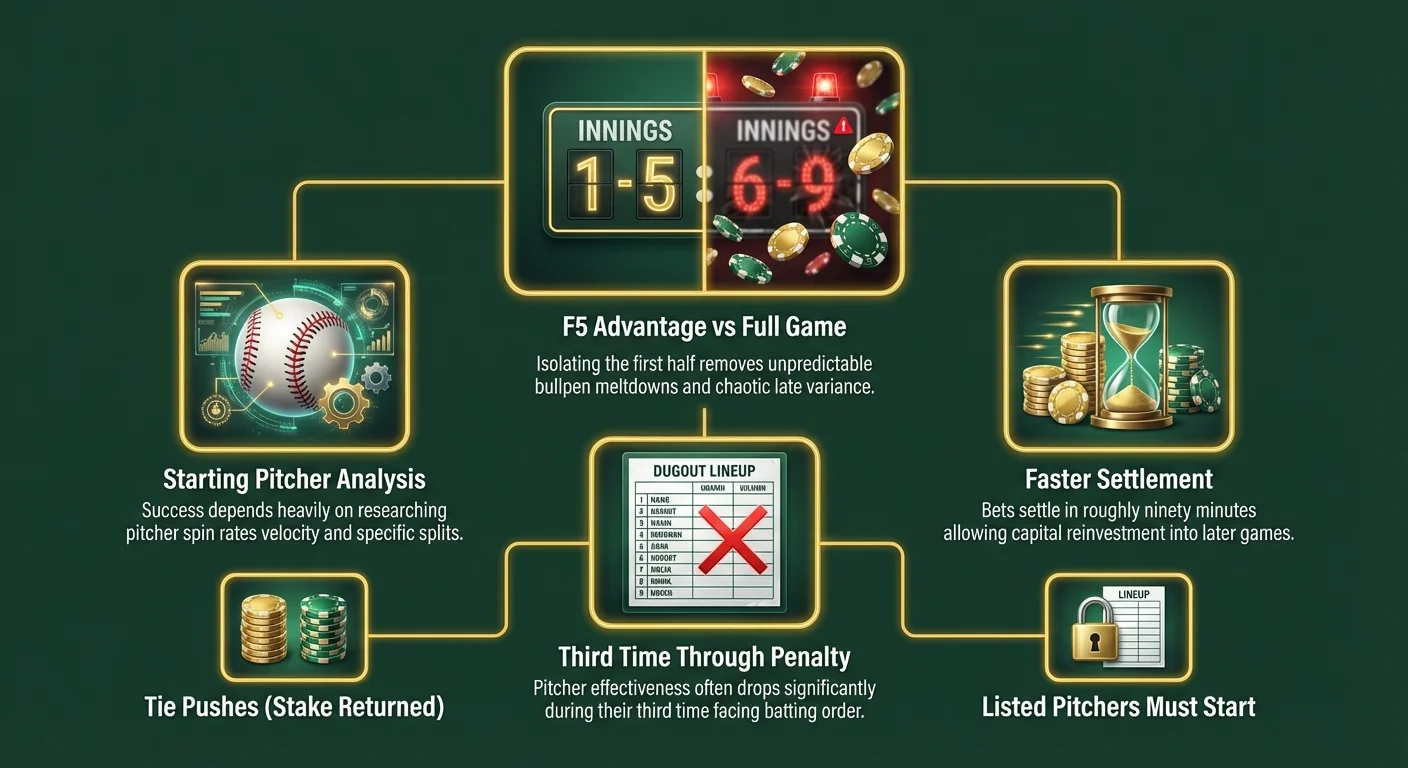
- Listed Pitchers Must Start: In F5 betting, the specific starting pitchers listed at the time of the bet generally must start the game. If there is a late scratch or a pitching change, the bet is usually voided (refunded).
- The Tie (Push): In a full-game moneyline bet, the game continues until there is a winner. In F5 betting, if the score is tied 2-2 after five innings, the bet is a "push." You get your original stake back. There is no overtime in F5.
- Official Game Rules: For an F5 bet to stand, the full five innings must be completed. If rain stops the game in the 4th inning, F5 bets are usually voided, even if the result eventually becomes official for full-game bettors.
The Philosophy: Why Sharps Prefer F5
Professional bettors ("sharps") despise variance. Their goal is to find an edge based on data, and the more variables introduced into an event, the harder it is to predict the outcome. The bullpen is the ultimate variable.
Isolating the Starter
The primary argument for F5 betting is the isolation of the starting pitcher. In modern baseball, starting pitchers are the most analyzed athletes in sports. We have data on their spin rates, velocity, release points, and splits against lefties and righties. When you bet the full game, your starter might give you 6 innings of shutout ball, only for a low-leverage middle reliever to blow the lead in the 7th.
By betting the F5, you are betting on the known quantity (the starter) rather than the unknown quantity (which relievers are available, rested, or effective that day).
Avoiding the "Manager Factor"
Late-game management is often frustrating for bettors. Managers might rest their closer because he pitched two days in a row, forcing a weaker arm into a high-leverage situation. They might make defensive substitutions that weaken the lineup. In the first five innings, managers generally leave their best players on the field and let the starter work. F5 betting removes the frustration of watching a manager "punt" a game in the late innings to save arms for the next day.
Analyzing The Markets: Moneyline, Spread, and Totals
Just like full-game betting, F5 offers three primary ways to wager. Understanding the nuance of each is critical for intermediate bettors looking to profit.
F5 Moneyline
This is the most common F5 wager. You are simply picking which team will be leading after five innings.
- The Strategy: Use this when backing an ace pitcher against a mediocre opponent. The odds will be better than the -0.5 line, but worse than the full game moneyline.
- The Safety Net: Remember the push. If you bet an underdog who manages to keep it tied through five, you don't lose money. This makes F5 underdogs highly valuable.
F5 Run Line (The -0.5 Spread)
In this market, the favorite is usually given a -0.5 handicap. This means to win the bet, your team must be leading. A tie is a loss.
- The Strategy: This is often the best way to back a heavy favorite. If you have a Cy Young contender facing a pitcher with a 5.00 ERA, you expect them to be winning, not tied. taking the -0.5 line reduces the "juice" (vigorish) significantly compared to the moneyline.
F5 Totals (Over/Under)
You can bet on the total number of runs scored in the first five innings.
- The Strategy: This is a pure "starting pitching vs. lineup" play. If two aces are dueling, the F5 Under is a classic sharp play. Conversely, if two starters prone to giving up home runs are playing in a hitter-friendly park (like Coors Field), the F5 Over is attractive before the possibly better bullpens slow the game down.
Strategic Handicapping for First 5 Innings
To succeed in first 5 innings markets, you cannot simply look at a team's win/loss record. You must dig deeper into metrics that specifically affect the early game.
1. The "Third Time Through" Penalty
One of the most statistically significant trends in baseball is the "Third Time Through the Order" penalty. Batters perform significantly better the third time they see a starting pitcher in a single game (usually the 5th, 6th, or 7th inning).
- F5 Application: Most starters will face the lineup twice comfortably within the first 5 innings. The volatility spikes when they face batters for the third time. F5 betting allows you to exit the market before the starter hits this statistical cliff. If a pitcher has terrible "third time through" stats, bet the F5 to back him, but avoid the full game where he might get shelled in the 6th.
2. Slow Starters vs. Fast Starters
Some teams are built to crush early. They have high on-base percentage (OBP) guys at the top of the lineup (1-2-3 hitters) who will see at least three at-bats in the first five innings.
- Analyze "First Inning Runs Scored" stats.
- Look for pitchers with high first-inning ERAs. Some pitchers struggle to find their rhythm early but settle in later. These are prime targets to fade in F5 markets.
3. Home/Road Splits
Pitchers are creatures of habit. Some perform significantly better at home than on the road, or vice versa.
- Example: A pitcher might have a 2.50 ERA at home and a 5.10 ERA on the road. If he is pitching on the road, the F5 market allows you to exploit this specific weakness immediately, without worrying if his team's offense will bail him out later.
4. Umpire Tendencies
In the first five innings, the strike zone is everything. Some umpires have tight zones (favoring hitters/Overs), while others have wide zones (favoring pitchers/Unders). This impact is magnified early in the game when starters are trying to establish the corners.
The Crypto Betting Advantage for F5
For bettors using platforms like those featured on CryptoGambling.com, F5 betting offers specific logistical advantages when combined with cryptocurrency.
Instant Settlement and Bankroll Velocity
Traditional sportsbooks sometimes wait until the game goes "final" to grade all bets, even F5 wagers. However, many modern crypto sportsbooks offer near-instant settlement.
- The Edge: An F5 bet settles approximately 1.5 to 2 hours after the first pitch. A full game takes 3+ hours. If you win an F5 bet on an East Coast game (starting at 7:00 PM ET), your funds could be released by 8:45 PM ET.
- Re-rolling: This allows you to re-invest that capital into West Coast games starting at 9:40 PM or 10:00 PM ET. You are effectively using the same portion of your bankroll twice in one evening, doubling your volume without depositing more funds.
High Limits and Anonymity
F5 markets are liquid. Because they are based on the most reliable data (starting pitching), books are willing to take sizeable action. Crypto sportsbooks, known for higher limits than fiat books, allow sharps to place significant wagers on starting pitcher only lines without the fear of immediate limiting that comes with betting obscure props.
Full Game vs. F5: A Comparison
To visualize why you might choose one over the other, consult the table below:
| Feature | Full Game Betting | First 5 Innings (F5) |
|---|---|---|
| Primary Variable | Complete Team Depth (Start + Bullpen) | Starting Pitcher + Top of Lineup |
| Duration | 9 Innings (approx. 3 hours) | 5 Innings (approx. 1.5 hours) |
| Tie Result | Goes to Extra Innings (Must verify winner) | Push (Stake Returned) |
| Volatility | High (Bullpen meltdowns common) | Lower (Based on starting matchup) |
| Pace of Play | Slower settlement | Faster settlement (Capital velocity) |
| Best For | Backing teams with elite Bullpens | Backing elite Starters with bad Bullpens |
Practical Tips for Your F5 Strategy
If you are ready to transition from full-game betting to F5, follow these practical steps to protect your bankroll.
1. Know the "Hook"
In F5 betting, the spread is almost always 0.5 runs. However, the total is where the "hook" (the half point) kills you.
- Tip: If the F5 total is 4.5, you avoid the push. If it is 4.0 or 5.0, a push is possible. Be aware that F5 totals are very sharp. A score of 2-2 (4 runs) is incredibly common after 5 innings. If you like the Over on a total of 4, try to shop lines to find a 3.5, even if you have to pay slightly higher juice (odds).
2. Fade the "Opener" Strategy
Modern baseball sometimes uses an "Opener" - a relief pitcher who starts the game for one inning before the "Bulk Guy" comes in.
- Warning: F5 betting is dangerous here. The "Listed Pitcher" rules can get tricky, and handicapping a bullpen game is exactly what F5 betting tries to avoid. If a team is using an Opener, it is usually best to skip the F5 wager entirely.
3. Weather Watch
Wind and humidity impact the ball immediately.
- Wind Blowing Out: In F5, there is no time for the wind to die down (which often happens late at night). If the wind is blowing out at Wrigley Field, the F5 Over is often a smarter play than the full game Over, as the conditions are guaranteed for those first 90 minutes.
4. Don't Pay the "Ace Tax"
Public bettors love backing aces like Gerrit Cole or Jacob deGrom. Consequently, sportsbooks inflate the prices on their F5 lines.
- Value Strategy: Instead of betting the Ace at -250 on the Moneyline, look for the opposing pitcher. If the Ace is facing a competent pitcher, the F5 Under is often the better value than laying heavy juice on the favorite.
Common Mistakes to Avoid
Even experienced bettors stumble when switching to F5. Avoid these pitfalls:
- Ignoring the Visiting Team Advantage: In the F5 market, the home team does not get to bat in the bottom of the 5th if they are leading. In the full game, the home team doesn't bat in the 9th if leading. This slightly skews the total number of outs. However, for F5 spreads (-0.5), the visiting team is guaranteed 15 outs (5 innings) to score, whereas the home team might only bat 4 times if they are winning comfortably and the game is moving fast (though they usually play the bottom of the 5th).
- Chasing Full Game Losses: Do not use F5 bets just to "get action" because you missed the start of the game. F5 requires specific research on starting pitchers.
- Overlooking Lineup Scratches: Since F5 relies heavily on the top of the order getting 2-3 at-bats, a star player resting on Sunday can kill your F5 offense. Always check the confirmed lineup before locking in your Bitcoin wager.
Summary
First 5 Innings betting is the sharp bettor's answer to the randomness of modern baseball. It removes the variables that are hardest to predict - bullpen performance, late-game management, and fatigue - and focuses the wager on the most predictable element of the sport: the starting pitcher.
By utilizing F5 lines, you can:
- Isolate starting pitching advantages.
- Protect yourself from late-inning collapses.
- Utilize crypto sportsbooks for faster settlement and bankroll turnover.
If you are tired of sweating out the ninth inning or watching a three-run lead disappear because a middle reliever couldn't find the strike zone, it is time to shorten the game. Do your homework on the starters, check the lineups, and look to the First 5 Innings market for a lower-variance approach to baseball betting.