
The landscape of sports betting has shifted dramatically in the last decade. Gone are the days when your involvement ended the moment the referee blew the opening whistle. Today, pre-match wagers are often just the appetizer. The main course is live betting strategy (also known as in-play betting), a dynamic, high-velocity environment where odds fluctuate every second and the sharpest minds can capitalize on market inefficiencies in real time.
For the intermediate bettor, transitioning from pre-match analysis to in-play advanced tactics requires a fundamental shift in mindset. You are no longer betting against a static line set by oddsmakers days in advance; you are battling algorithms, managing latency, and interpreting human psychology as it plays out on the field.
This guide explores the nuances of mastering live betting, specifically tailored for the modern crypto bettor. We will dissect how to identify momentum shifts, exploit the lag in bookmaker algorithms, and utilize the speed of cryptocurrency to maintain an edge.
The Mechanics of the In-Play Market
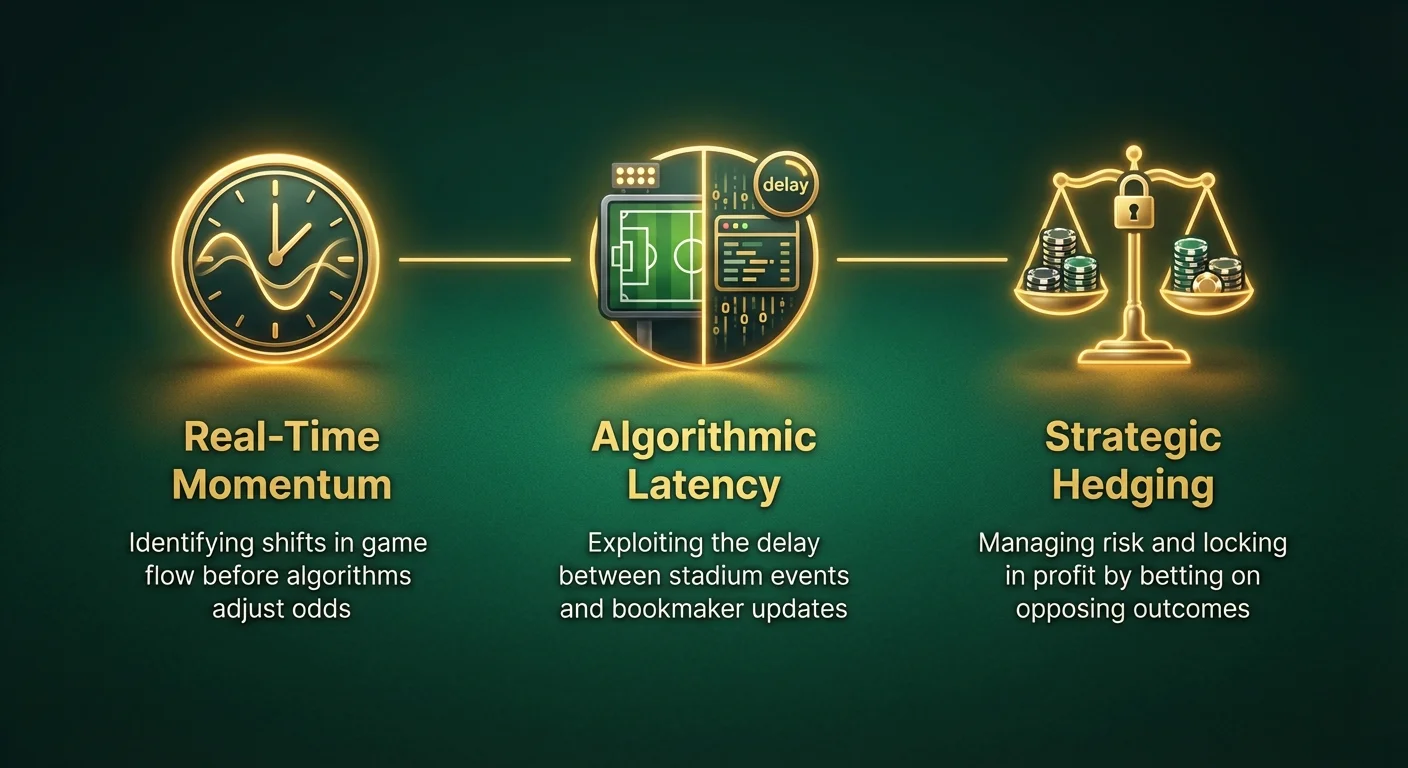
Before diving into strategy, it is crucial to understand the machinery behind the changing numbers on your screen. In-play odds are rarely managed manually by a human trader. Instead, they are driven by complex algorithms that ingest data feeds (possession, attacks, time remaining, score) to automatically adjust the price.
The Algorithm vs. The Eye Test
Algorithms are mathematical marvels, but they have a distinct weakness: they are reactive and data-dependent. They excel at calculating probability based on historical data and current stats, but they struggle with context.
- The Algorithm sees: Team A has 60% possession but is losing 0-1. The odds on Team A lengthen slightly.
- The Eye Test sees: Team A's possession is sterile, their star striker is limping, and the defenders are arguing with each other. The team has mentally collapsed.
This gap between raw data and contextual reality is where the value lies. Your goal in real time betting is to identify when the algorithm's math hasn't yet caught up to the game's reality.
Latency: The Invisible Enemy
Every live bettor must understand "latency." This is the delay between an event happening in the stadium and it appearing on your screen.
- Stadium Reality: 00:00 seconds.
- Data Scout/Feed: +1 to 3 seconds.
- Bookmaker Algorithm Update: +3 to 5 seconds.
- TV/Stream Broadcast: +10 to 45 seconds.
If you are betting based on a TV broadcast, you are betting on the past. Smart live betting involves anticipating what will happen, rather than reacting to what you just saw on a delayed stream.
Reading Momentum: The Art of Timing
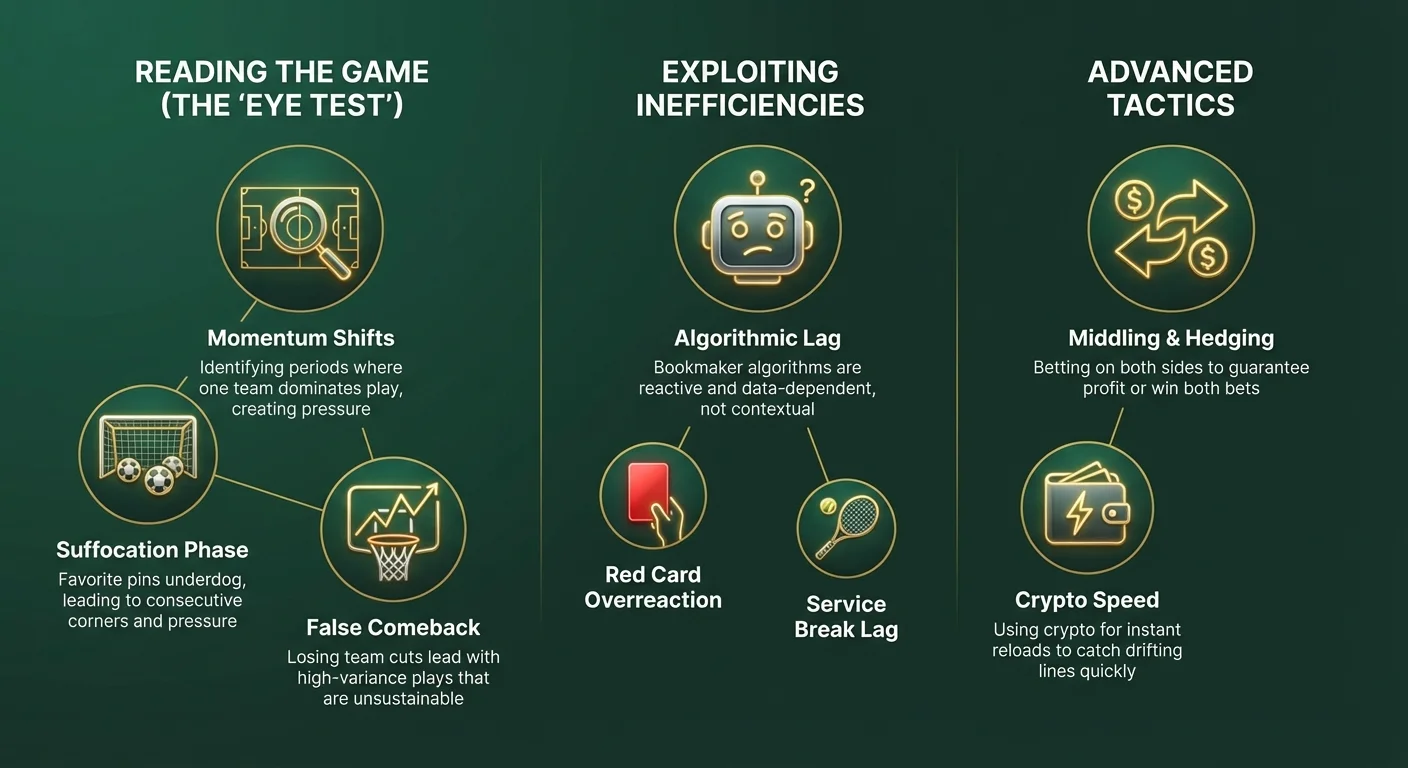
The most critical skill in live betting is identifying momentum shifts. Momentum is the invisible force that dictates the flow of a game. It is the period where one team dominates play, creating pressure that statistically suggests a goal or score is imminent.
The "Suffocation" Phase (Soccer/Football)
In soccer, goals often come in clusters or after sustained pressure. Look for the "Suffocation Phase." This occurs when a favorite is trailing or drawing, and they pin the underdog in their own penalty box.
Signs to watch for:
- Consecutive corners in a short span (3+ in 10 minutes).
- Clearances that only go as far as the midfield line, resulting in immediate regained possession.
- The underdog's defensive line dropping deeper toward their own goal.
The Strategy:
Don't just bet on the "Next Goal." Look at the Corner Markets or Next 10 Minutes markets. Often, the odds on "Over X Corners" offer better value during these phases than the match winner odds, as the algorithm may not fully weight the intensity of the pressure.
The "False Comeback" (Basketball)
In the NBA, huge leads are frequently erased. This is known as the "rubber band effect." However, not all comebacks are genuine.
Signs of a False Comeback:
- The losing team cuts a 15-point lead to 8 points using high-variance 3-point shooting, while the leading team is missing open looks (regression to the mean).
- The leading team has rested their starters.
The Strategy:
Wait for the momentum to stall. If the underdog cuts the lead to 6 but the favorite brings their starters back in, the live line might have shifted too far toward the underdog. This is the prime time to back the favorite again at a much better price than pre-game.
Exploiting Slow Line Moves and "Sleepy" Markets
While major markets (English Premier League, NFL, NBA) have hyper-efficient algorithms, smaller markets often suffer from "sleepy" lines. These are moments where the odds fail to react quickly enough to a game-changing event.
The Red Card Overreaction
When a heavy favorite receives a red card in soccer, the live odds on them winning drift immediately (e.g., from 1.50 to 2.80). However, algorithms often over-penalize superior teams. A top-tier team can often control a game against a bottom-tier team even with 10 men.
Strategy: Watch the first 10 minutes after the red card. If the favorite maintains possession and structure, the market has overreacted. Backing the 10-man favorite or taking the "Draw No Bet" option here provides immense value.
Tennis: The Service Break Lag
In tennis, the odds swing violently point-by-point. A common inefficiency occurs when a strong server goes down 0-30 or 15-40. The market assumes a break of serve is imminent and slashes the odds on the receiver.
Strategy: If you know the server has a high ace percentage and is mentally resilient, backing them to "Hold Serve" at 15-40 offers massive odds. You are betting on their ability to hit two good serves, which is statistically likely despite the current score.
Advanced Strategies: Hedging and Middling
Live betting isn't just about picking winners; it's about portfolio management. You can use live markets to guarantee profit or create "risk-free" shots at big payouts.
The Live Hedge (Locking in Profit)
- Scenario: You bet 1 mBTC on the Underdog (Team B) pre-match at 4.00 odds.
- In-Play: Team B scores early. The live odds on the Favorite (Team A) drift to 2.00.
- Action: You can now place a bet on Team A. No matter who wins, you secure a profit or at least cover your initial stake.
The "Middle" (The Holy Grail)
Middling involves betting on both sides of a total or spread at different numbers to try and win both bets.
Example: NBA Total Points
- Pre-Match: You bet Over 210.5 points.
- In-Play (3rd Quarter): The game is incredibly high-scoring. The live total line moves to 230.5.
- The Play: You bet Under 230.5.
The Outcome:
- If the total score is 200, you win the Under (lose the Over).
- If the total score is 240, you win the Over (lose the Under).
- The Middle: If the total score lands between 211 and 230, you win BOTH bets.
This strategy requires actively monitoring the lines and recognizing when a game has deviated significantly from the pre-game expectation.
The Crypto Advantage in Live Betting
For the advanced bettor, using cryptocurrency adds a layer of efficiency that fiat currency simply cannot match. In the fast-paced world of in-play advanced wagering, liquidity and speed are paramount.
Speed of Settlement and Reload
In live betting, you might spot an opportunity but realize your bankroll is tied up in pending bets.
- Fiat: Depositing via bank transfer can take hours or days. Credit cards may get declined due to repeated transactions.
- Crypto: A Lightning Network (Bitcoin) or Solana/TRC20 (USDT) deposit clears in seconds to minutes. This allows you to "reload" instantly to catch a drifting line before it corrects.
Higher Limits and Liquidity
Live markets often have lower betting limits than pre-match markets because the bookmaker is at higher risk. However, many crypto-native sportsbooks (specifically those operating with Bitcoin or Ethereum) often offer significantly higher ceilings for live wagers compared to traditional soft books.
Anonymity and Strategy Protection
Winning consistently on live markets often leads to limiting or banning by traditional bookies. Crypto sportsbooks, utilizing the "Provably Fair" ethos and blockchain transparency, are generally more tolerant of sharp action and high volume, provided you aren't exploiting technical glitches (latency arbitrage).
Comparison: Pre-Match vs. Live Betting
| Feature | Pre-Match Betting | Live (In-Play) Betting |
|---|---|---|
| Decision Time | Days/Hours | Seconds |
| Primary Tool | Statistics & Historical Data | "Eye Test" & Momentum Reading |
| Odds Volatility | Low/Stable | Extreme |
| Market Lock | Rare | Frequent (during VAR, goals, penalties) |
| Liquidity | Very High | Moderate to High |
| Best Strategy | Value Betting based on analysis | Situational Hedging & Momentum |
Risk Management: The Danger of the "Tilt"
The greatest danger in real time betting is emotional volatility. The speed of the game can induce a state of "tilt," where a bettor chases losses with rapid-fire wagers.
The "Chasing" Trap
When a live bet loses (e.g., a goal is scored against your wager), the temptation is to immediately bet on the next event to win the money back.
- Rule: Never place a "revenge bet" within 5 minutes of a loss.
- Rule: Pre-define your "Stop Loss" for a single game. If you lose 3 units on a match, stop betting on that match. The game is clearly not unfolding how you expected.
Managing The "Locked" Market
Live betting interfaces frequently "lock" or suspend betting when a significant event occurs (penalty, red card, VAR check).
- Tip: Do not spam the "Place Bet" button when markets are suspended. When the market reopens, the odds will have changed, but your bet request might still be processed at the new (worse) odds depending on the sportsbook's policy. Always wait for the market to settle.
Practical Tips for Specific Sports
Football (Soccer)
- The 75-Minute Rule: Late goals are statistically over-represented in certain leagues. If a game is 0-0 or 1-1 at the 75th minute and both teams are attacking, the "Over 0.5 Goals Remaining" market often holds value.
- Corner Arbitrage: If a favorite is losing, they will push for corners. Betting on corner handicaps live is often safer than betting on them to score.
American Football (NFL)
- The "Scripted" Start: Teams often script their first 15 plays. An underdog might score early due to a good script. Once the script runs out, talent usually takes over. Look to live bet the favorite if they go down 7-0 early in the first quarter.
Esports (CS:GO / Dota 2)
- Economy Management: In Counter-Strike, live odds often don't account for the in-game economy. If a team loses a round but has enough money to buy full weaponry for the next, the odds shouldn't drift as much as they do. This is a massive edge for bettors who understand the game mechanics.
Summary: The In-Play Checklist
To master live betting, you must treat it as a trading discipline rather than gambling. Before you click "submit" on that crypto wager, run through this mental checklist:
- Latency Check: Am I watching a stream that is more than 10 seconds behind? If so, am I betting on a stoppage (half-time) to negate the delay?
- The Why: Am I betting because the odds look juicy, or because I see a genuine momentum shift on the field?
- The Hedge: Does this live bet secure a profit from a pre-match position, or is it increasing my exposure?
- Bankroll: Is this bet within my unit size, or am I "rage betting" to cover a previous loss?
Mastering live betting strategy requires patience, discipline, and a fast internet connection. By combining the "eye test" with an understanding of algorithmic inefficiencies - and leveraging the speed of crypto banking - you can turn the chaos of a live match into a calculated, profitable venture.