
Managing a bankroll is the single most important skill a gambler can possess. When you combine the spinning wheel of Roulette with the dynamic, high-speed nature of cryptocurrency, the stakes - and the need for discipline - become even higher. While finding a lucky number or predicting a color streak is thrilling, the longevity of your gaming hobby depends entirely on how you manage your funds.
In the world of crypto gambling, you are essentially managing two types of volatility: the inherent house edge of the casino game and the market fluctuation of the asset you are betting with. Whether you are betting with Bitcoin, Ethereum, or a stablecoin like USDT, the principles of bankroll management remain the foundation of a healthy gambling experience.
This guide will walk you through the essentials of protecting your crypto at the roulette table. We will cover how to size your bets, how to choose the right roulette variation to preserve your funds, and how to set strict limits that keep you in the game longer.
What is a Bankroll?
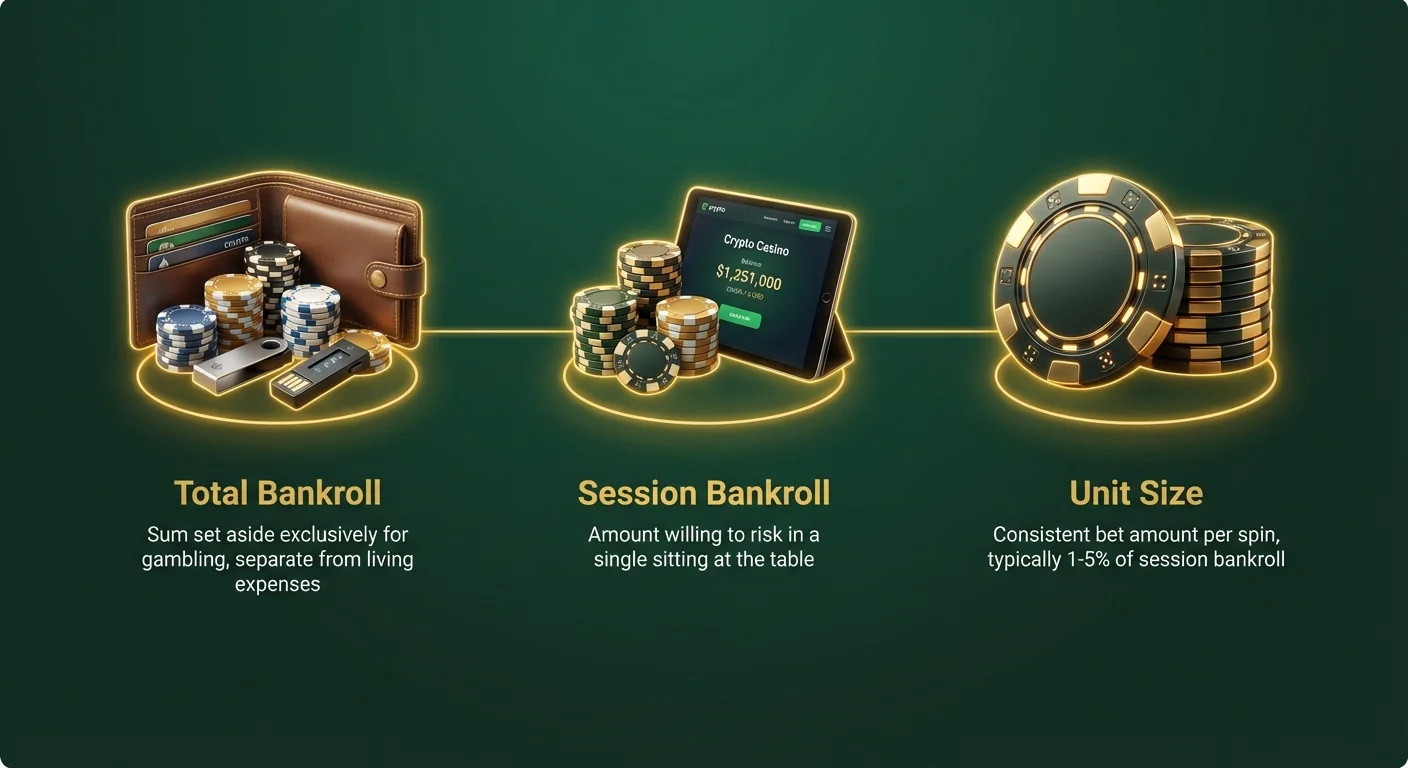
Before you place your first chip on the felt, you must define your bankroll. In strict terms, a bankroll is a sum of money set aside exclusively for gambling purposes. It is money that is entirely separate from your living expenses, rent, bills, or long-term crypto 'HODL' stacks.
In the crypto context, it is best to segregate your gambling funds into a specific "hot wallet" or a dedicated sub-account on your chosen casino platform. Never bet directly from your main investment wallet or cold storage wallet.
Total Bankroll vs. Session Bankroll
To manage your money effectively, you must distinguish between your Total Bankroll and your Session Bankroll.
- Total Bankroll: The total amount of crypto you are willing to lose over a long period (e.g., a month or a year). If this hits zero, you stop gambling until your budget refreshes.
- Session Bankroll: The amount you are willing to risk in a single sitting at the roulette table.
The Golden Rule: Never bring your entire Total Bankroll to a single session. A common recommendation is to risk no more than 10% of your Total Bankroll in one session. If you have 1.0 ETH set aside for gambling, your buy-in for a Tuesday night roulette session should not exceed 0.1 ETH.

The Mathematics of Survival: House Edge
Bankroll management isn't just about how much you bet; it's about what you bet on. You cannot manage your money effectively if you are playing a game that drains your funds mathematically faster than necessary. In Roulette, the version of the game you choose dictates the "tax" you pay to the casino on every spin.
There are three main variations of roulette, and choosing the wrong one is the most common mistake beginners make.
American vs. European vs. French
The primary difference lies in the zeros. The zero is the number that ensures the house has an edge (since it is neither Red nor Black, nor Odd nor Even).
| Game Version | Wheel Layout | House Edge | Impact on Bankroll |
|---|---|---|---|
| American Roulette | 0 and 00 | 5.26% | High Drain: The extra "00" almost doubles the house advantage compared to European. Avoid this version to protect your crypto. |
| European Roulette | Single 0 | 2.70% | Standard: The most common version in crypto casinos. Much friendlier to your bankroll. |
| French Roulette | Single 0 | 1.35%* | Best Value: Uses "La Partage" or "En Prison" rules. If you bet even-money and the ball lands on zero, you only lose half your bet. |
Note: The 1.35% edge applies specifically to even-money bets (Red/Black, High/Low, Odd/Even) in French Roulette.
Strategy Tip: Always look for French Roulette first. If unavailable, play European. Avoid American Roulette at all costs. Over 100 spins at $10 per spin, playing American roulette costs you theoretically $52.60, whereas European costs you $27.00. That difference adds up significantly over time.
Determining Your Unit Size
Once you have established your Session Bankroll and selected a European or French table, you must decide how much to bet per spin. This is called your "Unit Size."
A reckless player might take a $100 budget and place four $25 bets. If luck isn't immediately on their side, their session lasts two minutes. A disciplined player uses a percentage-based approach.
The 1% to 5% Rule
To withstand losing streaks (which are statistically inevitable), your bet size should be between 1% and 5% of your Session Bankroll.
- Conservative (1%): Best for maximizing playtime and enduring long cold streaks.
- Moderate (2-3%): A balance between thrill and safety.
- Aggressive (5%): High risk. A streak of 10 losses (which happens frequently) will halve your stack.
Example Calculation:
If you deposit 0.01 BTC (approx. $600 at $60k/BTC) for a session:
- Conservative Unit: 0.0001 BTC ($6)
- Aggressive Unit: 0.0005 BTC ($30)
Sticking to a consistent unit size prevents "tilt" - the emotional urge to bet big to recover losses.
Managing Crypto Volatility
Betting with cryptocurrency adds a layer of complexity known as exchange rate volatility. If you are betting with Bitcoin or Ethereum, the value of your chips is fluctuating against the dollar even while they are sitting on the table.
Strategy 1: The Stablecoin Shield
If your primary goal is to gamble without worrying about the crypto market crashing during your session, use stablecoins (USDT, USDC, DAI). This ensures that a $10 win is actually a $10 win, simplifying your bankroll math and risk.
Strategy 2: The Double Gamble
If you bet with BTC or ETH, be aware that you are gambling twice.
- Scenario A: You win 10% at roulette, and BTC goes up 10%. Result: Massive win.
- Scenario B: You win 10% at roulette, but BTC crashes 20%. Result: You have more sats, but less purchasing power.
Recommendation: For strict bankroll management, convert your gambling allowance to a stablecoin before the session. This isolates your gambling performance from market forces.
Understanding Bet Types and Variance
Bankroll management dictates which bets you should place. In Roulette, bets are divided into Inside Bets and Outside Bets. These have drastically different effects on the variance of your bankroll.
Outside Bets: The Bankroll Preservers
Outside bets cover large portions of the wheel. They offer lower payouts but higher win frequencies.
- Types: Red/Black, Odd/Even, High/Low, Dozens, Columns.
- Bankroll Impact: These bets result in a "smooth" graph. You will win and lose back and forth, extending your playtime. This is ideal for beginners or those with smaller bankrolls.
- Payout: 1:1 or 2:1.
Inside Bets: The Bankroll Eaters
Inside bets cover specific numbers or small groups.
- Types: Straight Up (1 number), Split (2 numbers), Street (3 numbers), Corner (4 numbers).
- Bankroll Impact: These are high variance. You will likely endure long periods of losing chips, hoping for a significant payout to replenish the stack.
- Payout: Up to 35:1.
The Middle Ground: The Street Bet
As referenced in roulette guides, the Street Bet covers three consecutive numbers in a line (e.g., 10, 11, 12).
- Odds: 8.1% chance to hit (European).
- Payout: 11 to 1.
- Strategy: Betting one unit on a Street offers a compromise. It pays enough to boost a bankroll significantly but hits often enough that you don't need an infinite budget to survive.
Setting Limits: The Stop-Loss and Take-Profit
Discipline is not just about how you bet, but when you quit. Most players know they should stop when they lose, but few know when to stop when they are winning.
The Stop-Loss Limit
This is an absolute floor. If your Session Bankroll is 0.005 BTC, your Stop-Loss might be exactly that amount. Once those chips are gone, you close the browser. Never deposit "just a little more" to chase losses.
The Take-Profit Limit
The house edge guarantees that the longer you play, the more likely you are to lose. Therefore, if you are winning, you must have an exit strategy to lock in those profits.
- Rule of Thumb: Set a Take-Profit goal of 20% to 30% of your session bankroll.
- Implementation: If you start with $100 and reach $130, you conclude the session. It may not seem like a life-changing win, but consistent small wins are better than devastating losses.
The Time Limit
Fatigue leads to bad math and emotional decisions. Set a strict time limit (e.g., 45 minutes). When the timer goes off, the session ends regardless of whether you are up or down.
Common Betting Systems: Risks and Rewards
Many players use betting systems to manage their bankroll. While they can structure your play, they cannot overcome the house edge and come with specific risks to your wallet.
1. The Martingale System (Negative Progression)
This is the most famous strategy. You double your bet after every loss.
- The Logic: One win recovers all previous losses plus a profit of one unit.
- The Bankroll Danger: The stakes rise exponentially.
- Bet 1: $10
- Bet 2: $20
- Bet 3: $40
- Bet 4: $80
- Bet 5: $160
- Bet 6: $320
- Bet 7: $640
- The Risk: If you hit a losing streak of 7 or 8 spins (which is statistically common), you might hit the table limit or run out of funds.
- Verdict: Dangerous for beginners. Requires a massive bankroll for a very small return.
2. The D'Alembert System (Low-Risk Progression)
This is a safer alternative for bankroll management.
- How it works: Increase your bet by 1 unit after a loss; decrease it by 1 unit after a win.
- The Bankroll Benefit: The bets do not grow exponentially like the Martingale. It allows you to recover losses gradually without risking your entire stack in a few spins.
- Verdict: Excellent for beginners playing even-money bets (Red/Black).
3. Flat Betting (The Gold Standard)
Flat betting means wagering the exact same amount on every spin, regardless of the previous outcome.
- How it works: You bet $5 on Black. If you win, you bet $5 again. If you lose, you bet $5 again.
- The Bankroll Benefit: This is the only method that does not manipulate your risk. It ensures your bankroll lasts the longest amount of time possible given the house edge.
- Verdict: Highly recommended for strict bankroll management.
Provably Fair: The Crypto Advantage
One distinct advantage of managing a bankroll in crypto casinos is the Provably Fair technology. In traditional online casinos, you have to trust the software. In crypto gambling, you can verify the fairness. Always playing on Provably Fair tables ensures that your money management strategies are applied against true odds, not a rigged system.
Provably Fair algorithms allow you to check the fairness of every spin using cryptographic hashes. While this doesn't change the odds or the house edge, it ensures that your bankroll isn't being drained by a manipulated game. Always playing on Provably Fair tables ensures that your money management strategies are applied against true odds, not a rigged system.
Psychological Traps to Avoid
Even with the best mathematical plan, human psychology can destroy a bankroll.
The Gambler's Fallacy
This is the belief that past results influence future outcomes.
- The Trap: "Red has hit 8 times in a row, so Black must be next."
- The Reality: The roulette wheel has no memory. The odds of Black are roughly 48.6% on every single spin, regardless of history.
- Bankroll Consequence: Players increase their bets drastically on the "due" number, often losing their entire stack when the streak continues.
Chasing Losses
After a bad loss, the urge to bet big to get "back to even" is powerful. This is the fastest way to hit zero. If you hit your Stop-Loss, accept the defeat. Tomorrow is another day, and your bankroll needs to survive to see it.
Summary: Your Bankroll Management Checklist
To wrap up, here is your quick checklist for protecting your crypto at the roulette table:
- Segregate Funds: Move gambling crypto to a separate wallet; never play with daily expense money.
- Choose the Right Wheel: Play French or European Roulette. Avoid American Roulette.
- Size Your Bets: Bet no more than 1% to 5% of your session bankroll per spin.
- Set Limits: Establish strict Stop-Loss and Take-Profit figures before you start.
- Watch the Variance: Stick to Outside bets or D'Alembert strategies if you want your bankroll to last.
- Verify: Use Provably Fair tools to ensure the game integrity.
- Exit Strategy: Quit while you are ahead or when your timer runs out.
Roulette is a game of chance, but how you handle your money is a game of skill. By treating your bankroll with respect and adhering to strict math-based principles, you transform from a gambler hoping for luck into a player managing risk. Keep your crypto safe, play responsibly, and enjoy the spin.