
Keno is one of the oldest gambling games in existence, tracing its roots back to ancient China. Yet, in the modern landscape of cryptocurrency casinos, this lottery-style classic has evolved into two distinct experiences: Video Keno and Live Draw Keno.
For a beginner logging into a crypto casino for the first time, the choice can be confusing. Do you want the lightning-fast, solitary action of an RNG (Random Number Generator) game, or do you crave the suspense and human connection of a live studio broadcast?
While the core rules remain the same - pick numbers, wait for the draw, check for matches - the speed, odds, bankroll management, and overall "vibe" differ drastically between the two formats. This guide will dissect the differences, helping you decide which version aligns with your personality, your wallet, and your winning goals.

The Tale of Two Games: Definitions and Basics
Before diving into the complex metrics of RTP (Return to Player) and volatility, it is essential to understand what actually distinguishes these two formats.
What is Video Keno?
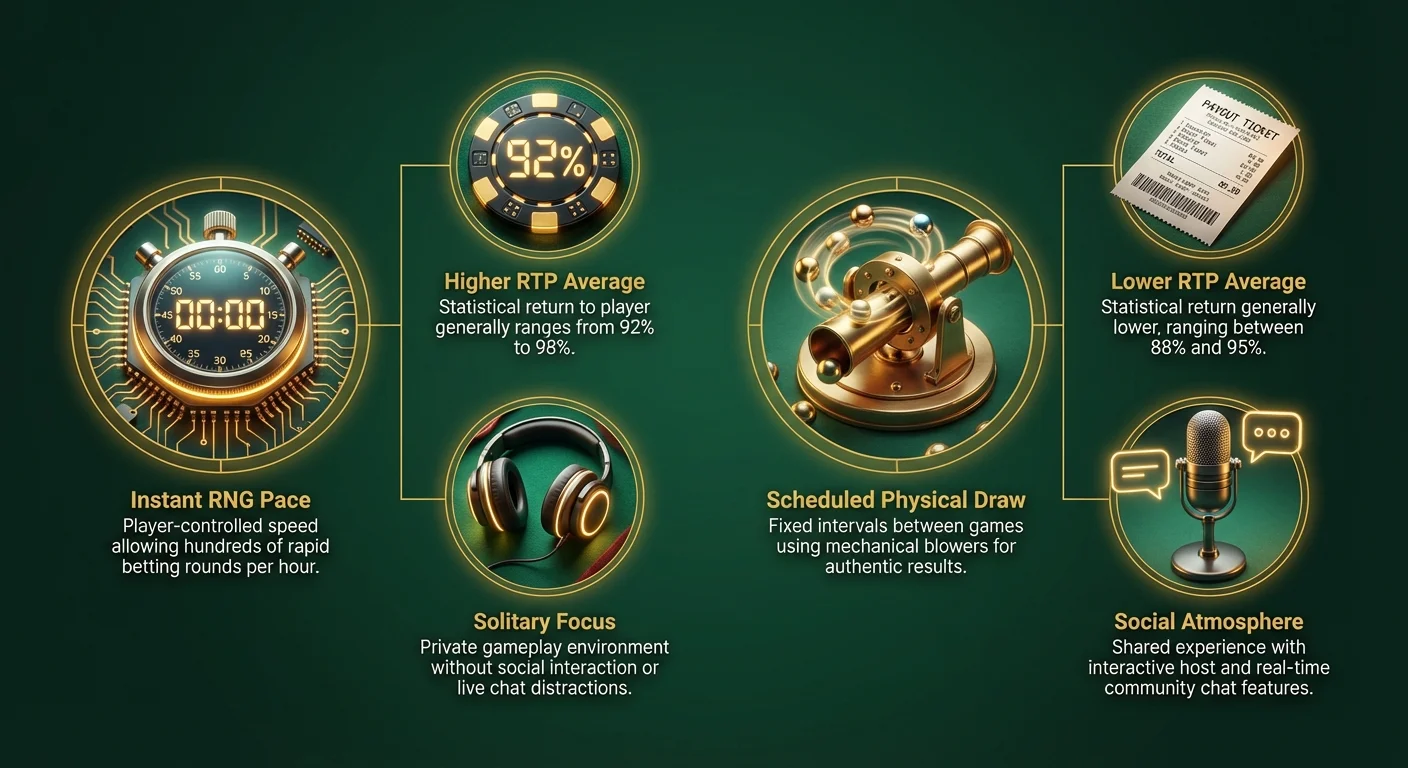
Video Keno (often called Instant Keno) is the digital, automated version of the game. It functions similarly to a slot machine. You interact with a software interface, select your numbers, and press "Play." The results are generated instantly by a Random Number Generator (RNG).
- Speed: You determine the pace. You can play 10 rounds in a minute or one round in an hour.
- Technology: Relies on algorithmic code. In crypto casinos, this is often "Provably Fair," meaning you can mathematically verify the randomness of every draw.
- Availability: 24/7, with zero waiting time.
What is Live Draw Keno?
Live Draw Keno brings the casino floor to your screen. A human presenter (or a real mechanical ball machine) draws the numbers in real-time via a video stream.
- Speed: Fixed. You must wait for the betting window to close and the ball drawing process to finish. Rounds usually take 3 to 5 minutes.
- Technology: Relies on physical mechanics (air blowers and numbered balls) and optical recognition software.
- Availability: Usually 24/7, but scheduled on a fixed timeline.
Speed and Volatility: The "Burn Rate" Factor
The most significant difference between Video Keno and Live Draw is the speed of play, which directly impacts your bankroll management.
The Velocity of Video Keno
In Video Keno, you are the master of time. If you use the "Auto-Play" feature common in crypto Keno games, you might burn through 500 rounds in a single hour.
- The Danger: Even with a high RTP, the "house edge" works against you over time. The faster you play, the faster the theoretical loss catches up to you.
- The Upside: If you are chasing a specific pattern or cluster, you can test your theory hundreds of times in a short session. It is ideal for players who want quick dopamine hits and immediate results.
The Pacing of Live Draw
Live Keno acts as a natural brake on your spending. Because you have a limited amount of time to place bets, and then a mandatory waiting period while the balls are drawn, you play significantly fewer rounds per hour.
- Bankroll Preservation: Betting $1 per round in Live Keno costs you roughly $12-$15 per hour. Betting $1 per round in Video Keno could cost you $600+ per hour in turnover (not losses, but amount wagered).
- The Experience: The pause creates suspense. It mimics the feeling of watching a lottery draw on TV, allowing you to celebrate wins or lament losses with other players in the live chat.
Odds and RTP: Which Game Pays Better?
This is the controversial topic where seasoned gamblers pay the most attention. While specific paytables vary by game provider and casino, general trends exist.
Return to Player (RTP) Comparisons
Video Keno typically offers a higher RTP than traditional land-based Keno.
- Standard Video Keno: 90% to 96% RTP.
- Crypto-Exclusive Keno: Some simplified blockchain Keno games offer RTPs as high as 98% or 99% (with lower max payouts).
Live Draw Keno varies wildly.
- Studio Games: Usually range between 88% and 95%. The overhead costs of running a live studio (hiring presenters, camera crews, maintaining equipment) often result in a slightly lower RTP compared to the purely software-based Video Keno.
The Paytable Impact
Always check the paytable before playing. A "5 out of 5" catch might pay 50x in one video game but only 30x in a live version.
| Feature | Video Keno | Live Draw Keno |
|---|---|---|
| RTP (Average) | 92% - 98% | 88% - 95% |
| Max Win Potential | High (often progressive jackpots) | High (fixed large payouts) |
| Min Bet | Very Low (often $0.10 or less) | Low to Medium ($0.50 - $1.00) |
| Game Speed | Instant | Slow (Scheduled) |
| Social Aspect | None | High (Live Chat) |
Strategies for Different Formats
Because the mechanics differ, the strategy you employ should also change. A strategy that works for a high-volume video session may be boring or ineffective in a slow-paced live environment.
Video Keno Strategy: The "Cluster" and "4-Card" Approach
Since you can play rapidly, Video Keno is excellent for testing pattern theories.
- 4-Card Keno: Many video variants allow you to play four cards simultaneously. This spreads your risk. You might pick a "Top Half" cluster on Card 1, a "Bottom Half" on Card 2, and specific "Hot Numbers" on Cards 3 and 4.
- Pattern Betting: Players often use the 4x5 Corner strategy (selecting a cluster of 5 numbers in each corner of the grid). In Video Keno, you can set this pattern and run it on auto-pilot to see if the RNG eventually hits your "zone."
Live Keno Strategy: The "Cold Number" Hunt
In Live Keno, you have time to analyze. Most live interfaces display the "Hot" (frequently drawn) and "Cold" (rarely drawn) numbers from the last 50 or 100 rounds.
- The Gambler's Fallacy: While every draw is independent, many live players love betting on "Cold" numbers, believing they are "due" to hit.
- Betting on the Bonus: Many Live Keno games (like Mega Ball or specific provider variants) include multipliers or bonus balls. The strategy here is often to maximize exposure to the bonus number, ensuring you have a ticket in play when the multiplier strikes.
The Crypto Advantage: Provably Fair vs. Physical Physics
One of the unique aspects of playing Keno at a crypto casino is the technology powering the draw.
Provably Fair (Video Keno)
In standard online casinos, you simply trust the software is fair. In crypto casinos, Video Keno is often Provably Fair.
- How it works: Before the round starts, the server creates a "seed" (the result) and hashes it. You (the player) also provide a "client seed."
- The Result: The combination of these seeds generates the numbers. After the round, you can verify that the casino didn't change the numbers after you placed your bet. This offers a level of transparency that Live Keno cannot technically match.
Physical Draws (Live Keno)
Live Keno relies on physics. The balls are blown around in a machine.
- Trust Factor: You trust your eyes. You see the ball pop up. However, you cannot mathematically verify the result on the blockchain in the same way you can with a smart contract or Provably Fair algorithm.
- Anomalies: Occasionally, physical machines have "biases" (e.g., a ball is slightly heavier or a machine has a tilt). While casinos test rigorously to prevent this, some "advantage players" watch live streams for thousands of hours hoping to spot these physical imperfections.
Experience and Atmosphere: Solitary vs. Social
This is often the deciding factor for players.
Video Keno is for the Introvert/Strategist:
- It is just you and the machine.
- No distractions.
- You can turn off the sound, listen to your own music, and focus entirely on your betting patterns.
- Great for playing on mobile while commuting or multitasking.
Live Keno is for the Extrovert/Casual Player:
- Live chat features allow you to talk to the host and other players.
- There is a shared sense of community. When a specific number hits that everyone was waiting for, the chat lights up.
- The hosts are often entertaining, telling jokes or engaging with the audience during the downtime between draws.
Which Format Suits Your Style?
If you are still on the fence, check the profiles below to see where you fit in.
Profile A: The "Grinder"
- Goal: To clear a casino bonus or generate small, consistent wins.
- Preference: You like control. You want to stop when you're up and double down instantly when you're down.
- Verdict: Video Keno. The high RTP options available at crypto casinos make this the better mathematical play for grinding.
Profile B: The "Jackpot Hunter"
- Goal: To turn $1 into $50,000.
- Preference: You don't care about small wins; you want the life-changing payout.
- Verdict: Tie (Game Dependent). Both formats offer high-volatility payouts. However, Video Keno allows you to play more rounds per hour, theoretically giving you more "tickets" to the lottery in a shorter timeframe.
Profile C: The "Entertainment Seeker"
- Goal: To have fun for two hours on a Friday night with a $50 budget.
- Preference: You want to be entertained, look at high-quality visuals, and feel like you're in a real casino.
- Verdict: Live Draw Keno. The slow pace ensures your $50 lasts much longer, and the host adds value beyond just the numbers.
5 Practical Tips for Keno Beginners
Regardless of which version you choose, these universal tips will help you play smarter.
Check the "Spots" Sweet Spot:
In Keno, hitting 10 out of 10 is statistically nearly impossible. Mathematical analysis suggests that choosing between 4 and 8 numbers usually offers the best balance of decent odds and respectable payouts.Mind the Crypto Volatility:If you are betting in Bitcoin or Ethereum, remember that the value of your coin changes. A 0.001 BTC bet might be worth $30 today and $35 tomorrow. Many players prefer using stablecoins (like USDT) for Keno to keep their bankroll easier to track.
Don't Chase "Patterns" blindly:
Just because the number 7 hasn't hit in 20 rounds doesn't mean it is coming next. In Video Keno, the RNG has no memory. In Live Keno, the ball hopper doesn't care about the past. Use patterns for fun, not as a financial guarantee.Look for "Bonus" Features:
Standard Keno is great, but modern crypto Keno games often have "Powerballs" or "Multipliers." If the last ball drawn matches one of your picks, your win could be multiplied by 4x or 5x. These variations increase volatility but add excitement.Set a Loss Limit:Because Keno is a game of high house edge (compared to Blackjack or Poker), it is vital to set a strict stop-loss. Decide how much you are willing to spend for the entertainment, and never deposit more to chase losses.
Conclusion
The battle between Video Keno and Live Draw isn't about which game is "better" - it's about which game is better for you.
If you value the transparency of Provably Fair algorithms, high RTP, and the ability to control your own speed, Video Keno is the clear winner. It adapts to your schedule and allows for rapid-fire strategy testing.
However, if you view gambling as a social activity and want to extend your bankroll while enjoying a game-show atmosphere, Live Draw Keno offers an experience that software simply cannot replicate.
At CryptoGambling.com, we recommend trying both. Use your welcome bonus to play a few rounds of Live Keno to get a feel for the classics, then switch to Video Keno when you want a quick, high-intensity session. Just remember: Keno is a game of chance. Pick your lucky numbers, enjoy the ride, and play responsibly.