
Every sports bettor, from the casual weekend warrior to the sharpest professional, eventually confronts the same ancient adage: "The house always wins." But have you ever stopped to ask why? It isn't because the sportsbook knows who is going to win the match. It isn't because the games are rigged. The house wins because of a simple mathematical concept woven into every single number you see on the betting board.
This concept goes by many names: the vig, juice, margin, or the overround.
Understanding vigorish is the single most important step in transitioning from a gambler who guesses to a sports bettor who invests. If you do not understand the juice, you are paying a tax you cannot see. However, once you learn how to calculate it and, more importantly, how to minimize it using modern crypto sportsbooks, you immediately increase your long-term profitability.
In this guide, we will dismantle the mathematics of the sportsbook, explain exactly how the house makes its money, and show you how to use low-juice crypto betting sites to keep more of your winnings in your own digital wallet.
What is the Vig?
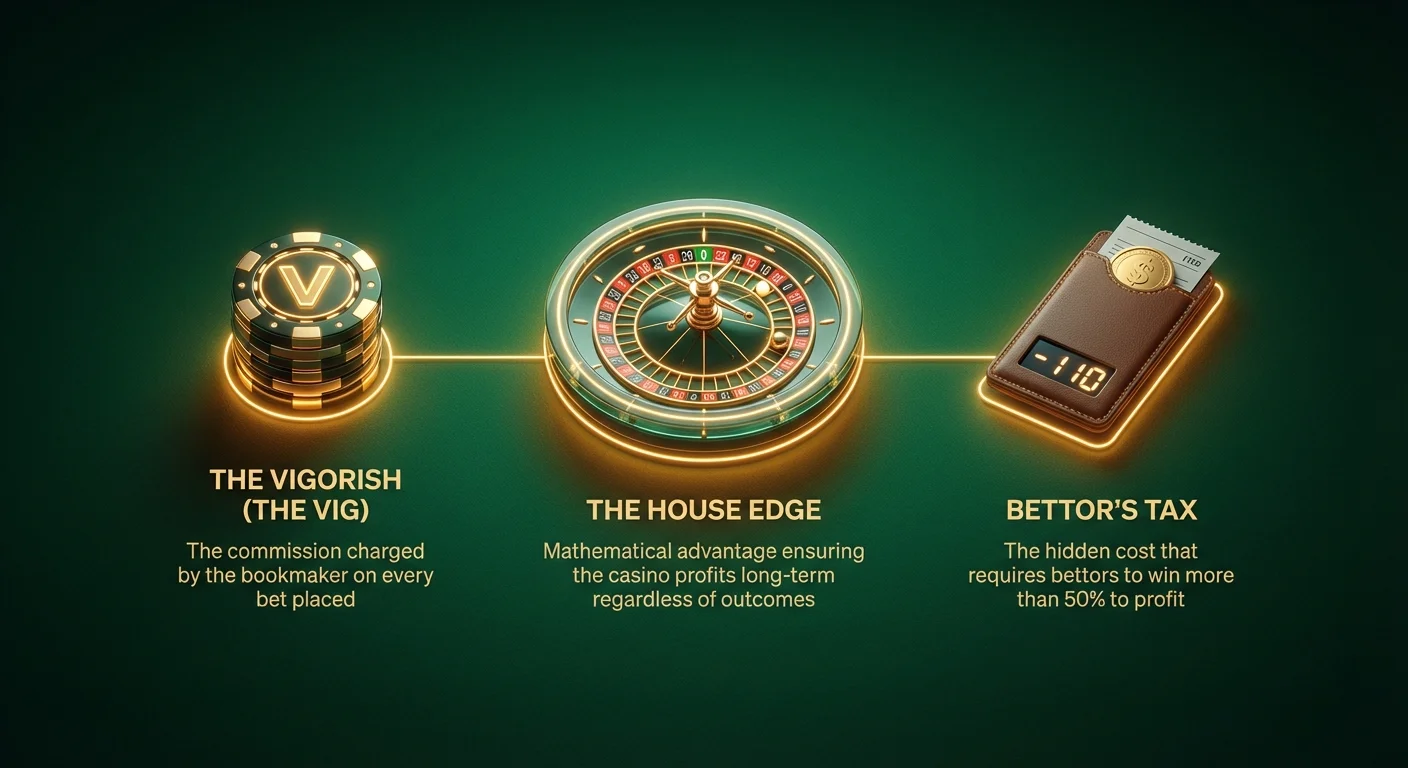
"Vig" is short for vigorish, a Yiddish loanword derived from the Russian vyigrysh (winnings). In the sports betting world, it represents the fee charged by the bookmaker for accepting your bet.
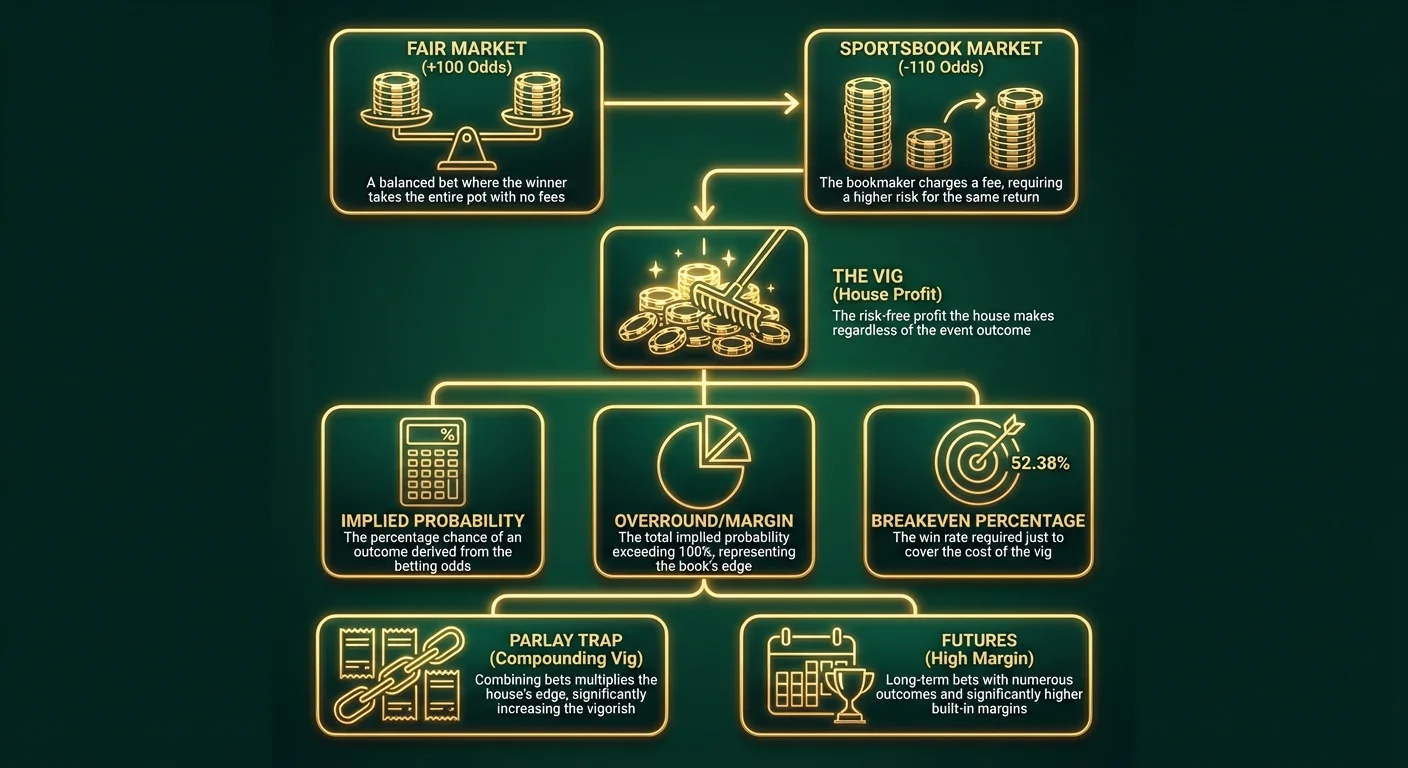
Think of a sportsbook not as a gambler betting against you, but as a broker connecting two sides of an argument. If you want to bet on Team A, and your friend wants to bet on Team B, you might bet $100 against his $100. The winner takes the $200 pot. This is a fair bet with zero juice.
A sportsbook, however, acts as the middleman. To facilitate that action, they take a cut. Instead of putting up $100 to win $100, they ask you to risk $110 to win $100. That extra $10 is the juice. It is the price of admission.
The Coin Flip Analogy
The easiest way to visualize the vig is through a standard coin flip.
The Fair Market (No Vig):
- Heads: 50% chance of winning. Fair Odds: +100 (2.00 Decimal).
- Tails: 50% chance of winning. Fair Odds: +100 (2.00 Decimal).
- If you bet $100 on Heads and win, you get $100 profit. If you lose, you lose $100. Over 1,000 flips, you will likely break even.
The Sportsbook Market (Standard Vig):
- Heads: Odds -110 (1.909 Decimal).
- Tails: Odds -110 (1.909 Decimal).
In this scenario, you must bet $110 to win $100.
- Scenario A: You bet $110 on Heads. It lands Heads. You win $100. The bookmaker gives you your $110 back plus $100 profit.
- Scenario B: Another bettor bets $110 on Tails. It lands Heads. He loses his $110.
The Bookmaker's Profit:
The bookmaker collected $220 in total wagers ($110 from you, $110 from the loser). They paid out $210 to you ($110 stake + $100 profit).
The bookmaker keeps $10.
That $10 is the risk-free profit the house made regardless of the coin flip outcome. That is the vig.
How to Calculate Implied Probability and Margin
To beat the book, you must look past the odds shown on the screen and see the percentages underneath. This is called Implied Probability.
Every set of odds translates to a percentage chance of an outcome occurring. When you add up the percentages of all possible outcomes in a match, a fair market should equal 100%. In a sportsbook, that number will always exceed 100%. The amount over 100% is the Overround or Margin.
Step 1: Converting American Odds to Percentage
The formula differs depending on whether the odds are negative (favorites) or positive (underdogs).
For Negative Odds (e.g., -110):
Example: -110 Odds
\frac{110}{(110 + 100)} \times 100 = \frac{110}{210} \times 100 = \mathbf{52.38%}
For Positive Odds (e.g., +130):
Example: +130 Odds
\frac{100}{(130 + 100)} \times 100 = \frac{100}{230} \times 100 = \mathbf{43.48%}
Step 2: Calculating the Juice
Let's look at a standard NFL spread bet.
- Team A: -110
- Team B: -110
We already calculated that -110 implies a 52.38% probability.
- Team A Implied Prob: 52.38%
- Team B Implied Prob: 52.38%
- Total Market Percentage: 52.38% + 52.38% = 104.76%
The true probability of the event is 100% (one team must win). The additional 4.76% is the theoretical hold or margin the sportsbook has added to the market.
Crypto Context: Decimal Odds
Many crypto sportsbooks default to Decimal odds (European style). The math here is actually much simpler.
Formula:
Example:
- Team A: 1.91 (-110 equivalent) -> $(1 / 1.91) * 100 = 52.36%$
- Team B: 1.91 (-110 equivalent) -> $(1 / 1.91) * 100 = 52.36%$
- Total: 104.72%
The Cost of High Juice: Why Line Shopping Matters
Beginners often ignore the difference between -110 and -105. It seems like pennies. However, over the course of an NFL season or a year of betting, the difference is massive. It is the difference between being a losing bettor and a professional.
Let's look at the "Breakeven Percentage." This is the percentage of bets you must win just to get your money back (zero profit/loss).
| Odds (American) | Odds (Decimal) | Wager to Win $100 | Breakeven Win Rate |
|---|---|---|---|
| +100 | 2.00 | $100.00 | 50.00% |
| -105 | 1.95 | $105.00 | 51.22% |
| -110 | 1.91 | $110.00 | 52.38% |
| -115 | 1.87 | $115.00 | 53.49% |
| -120 | 1.83 | $120.00 | 54.55% |
The Reality Check:
The best sports bettors in the world typically hit around 55% to 57% long-term.
- If you bet at -110 (Standard Juice), you need to be right 52.38% of the time just to not lose money.
- If you find a crypto book offering -105 (Reduced Juice), you only need to be right 51.22% of the time.
That 1.16% gap is where the profit lives. If you are hitting 53% winners:
- At -110 odds, you are barely profiting.
- At -105 odds, you are making a solid ROI (Return on Investment).
The Crypto Advantage: Low Juice Explained
This is where the revolution of cryptocurrency betting comes into play. Traditional fiat sportsbooks (the ones you see advertised on TV) have massive overheads. They pay for expensive licenses, payment processing fees (credit cards take 3-5%), chargeback insurance, and massive marketing campaigns.
To cover these costs, they charge standard (-110) or high (-115 or -120) vig.
Crypto sportsbooks operate differently:
- Low Transaction Costs: Sending Bitcoin, Litecoin, or USDT costs pennies compared to Visa/Mastercard processing fees.
- No Chargebacks: Crypto transactions are irreversible. The book doesn't need to budget for fraud.
- Global Reach: They operate with lower regulatory overhead in many jurisdictions.
Because their operating costs are lower, top-tier crypto books pass the savings to the player in the form of Reduced Juice.
What to Look For
- -105 Lines: Many crypto books offer -105 on NFL and NBA spreads as a standard, rather than a promotion.
- Low Margin Futures: Compare the "To Win Super Bowl" lists. You will often find the implied probability sum is much lower on crypto sites than fiat sites.
- 1-Cent Lines: Some baseball markets on crypto sites offer "dime lines" or even tighter spreads, where the gap between the favorite and underdog is minimal.
Where the Juice Hides: Traps to Avoid
While we have focused on spread betting (standard -110 lines), sportsbooks make the majority of their money on markets where the juice is harder to calculate and much higher.
1. The Parlay Trap
Parlays are the "sucker bet" of the gambling world. When you combine multiple bets into one ticket, you aren't just multiplying the odds; you are compounding the vigorish.
If you bet three individual games at -110, the house has a 4.76% edge on each. If you parlay them, that edge compounds mathematically. The bookmaker's hold on a 3-team parlay often exceeds 10-12%, and on big "lotto ticket" parlays (10+ teams), the house edge can be upwards of 30% or 40%.
Crypto Tip: If you must play parlays, look for crypto books that offer "Parlay Boosts." These percentage bumps on your payout help neutralize the compounding vig.
2. Futures Markets
Betting on who will win the World Cup or the NBA Championship before the season starts is fun, but the math is brutal.
Because there are so many outcomes (30+ teams), the bookmakers bake in a massive safety net.
- Standard Spread Overround: ~4.5% to 5%
- Futures Market Overround: ~20% to 40%
Always calculate the overround on a futures market before betting. If the implied probabilities of all teams add up to 140%, you are paying a 40% tax on your wager.
3. Prop Bets
Player props (e.g., "LeBron James Over 25.5 Points") are softer markets, meaning they are easier to beat than the spread. However, books compensate for this by charging higher juice. You will rarely see -110 on both sides of a prop. It is usually -115/-115 or -120/-120.
Practical Strategy: How to Beat the Vig
You cannot eliminate the vig completely (unless you bet peer-to-peer), but you can minimize it to the point where your skill can overcome it.
1. Open Multiple Crypto Accounts
Never be loyal to one sportsbook. Different books have different liabilities.
- Book A might have the Chiefs at -3 (-110).
- Book B might have the Chiefs at -3 (-105).
- Book C might have the Chiefs at -2.5 (-115).
If you like the Chiefs, betting at Book B saves you money. Betting at Book C gives you a better number (the hook).
Because crypto deposits and withdrawals can be near-instant (especially with Litecoin, Ripple, or USDT), you can move your bankroll between books in minutes to catch the best line. This is a massive advantage over fiat bettors who wait 3-5 days for bank transfers.
2. Calculate the "True Odds"
Before placing a bet, remove the vig to see what the book thinks the actual probability is.If the line is -110/-110, the book thinks it's a 50/50 game.If you handicap the game and believe your team has a 60% chance to win, you have found Positive Expected Value (+EV).
You are betting because your calculated probability is higher than the book's implied probability (plus the vig).
3. Avoid "Derivatives" Unless You Have an Edge
Full-game spreads usually have the lowest vig. Quarters, halves, and alternative spreads often have higher margins built in. Stick to the main markets until you are confident in your ability to beat the higher tax.
Summary: The Path to Profitability
The house always wins because the math is built in their favor. The vigorish is the rent you pay to live in their world. But just like rent in the real world, you can shop around for a better deal.
Here is your checklist for managing vig:
- Understand that -110 is not fair odds; it includes a fee.
- Calculate the breakeven percentage (52.38% for standard lines).
- Switch to crypto sportsbooks to access reduced juice (-105) lines.
- Avoid high-vig traps like massive parlays and futures with high overrounds.
- Shop for lines aggressively using the speed of crypto transactions.
By lowering the juice you pay, you lower the bar for how often you need to be right. In the tight margins of sports betting, saving those few percentage points is often the defining line between a recreational hobbyist and a profitable sharp.