
Most sports bettors know the pain of "the hook." You bet on a favorite at -3.5, they win by a field goal (3 points), and your ticket is ripped up. Conversely, there is the thrill of betting an underdog at +6.5, watching them lose by exactly 7, and wishing you had just a tiny bit more breathing room.
This is where the world of alternate lines comes into play.
Within crypto sportsbooks, you are no longer limited to the single number the oddsmaker sets. You have the power to customize your wager. You can "buy" points to secure a safer line in exchange for a higher price, or "sell" points to accept a harder line in exchange for a significantly higher payout.
While this flexibility is powerful, it is also a double-edged sword. If you buy points blindly, you are paying a "tax" that destroys your long-term profitability. If you sell points recklessly, you increase your variance to unsustainable levels.
This guide explores the math, strategy, and psychology behind alternate spreads. We will cover when it makes mathematical sense to pay for better numbers, when to look for "plus-money" value by selling points, and how key numbers dictate the true cost of these moves.
Understanding Alternate Lines
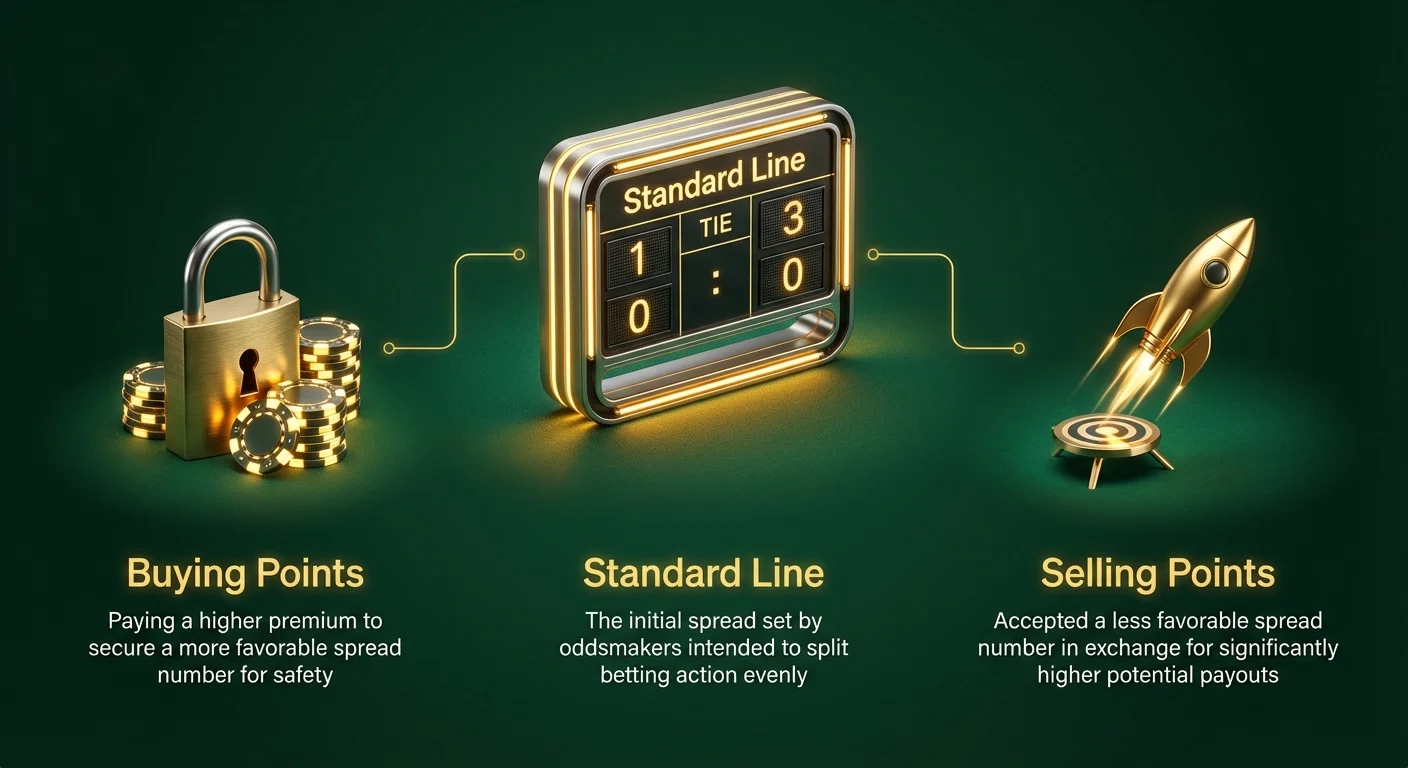
Before diving into complex strategies, we must define the mechanics. In a standard market, a sportsbook sets a spread intended to split the betting public 50/50 (roughly).
- Standard Line: Kansas City Chiefs (-3.5) vs. Baltimore Ravens (+3.5). Both sides priced at -110.
However, crypto betting sites offering high liquidity allow you to slide this bar in either direction.
Buying Points (Moving the Line in Your Favor)
When you buy points, you are paying a premium to get a number that is easier to cover. You are trading payout potential for win probability.
- Example: You move the Chiefs from -3.5 to -2.5.
- The Cost: Instead of risking $110 to win $100 (-110), you might now risk $150 to win $100 (-150).
Selling Points (Moving the Line Against You)
When you sell points, you are taking a worse number than the public line in exchange for better odds. You are trading win probability for payout potential.
- Example: You move the Chiefs from -3.5 to -7.5.
- The Reward: Instead of risking $110 to win $100, you might wager $100 to win $180 (+180).
The Economics of the "Vig": calculating the True Cost
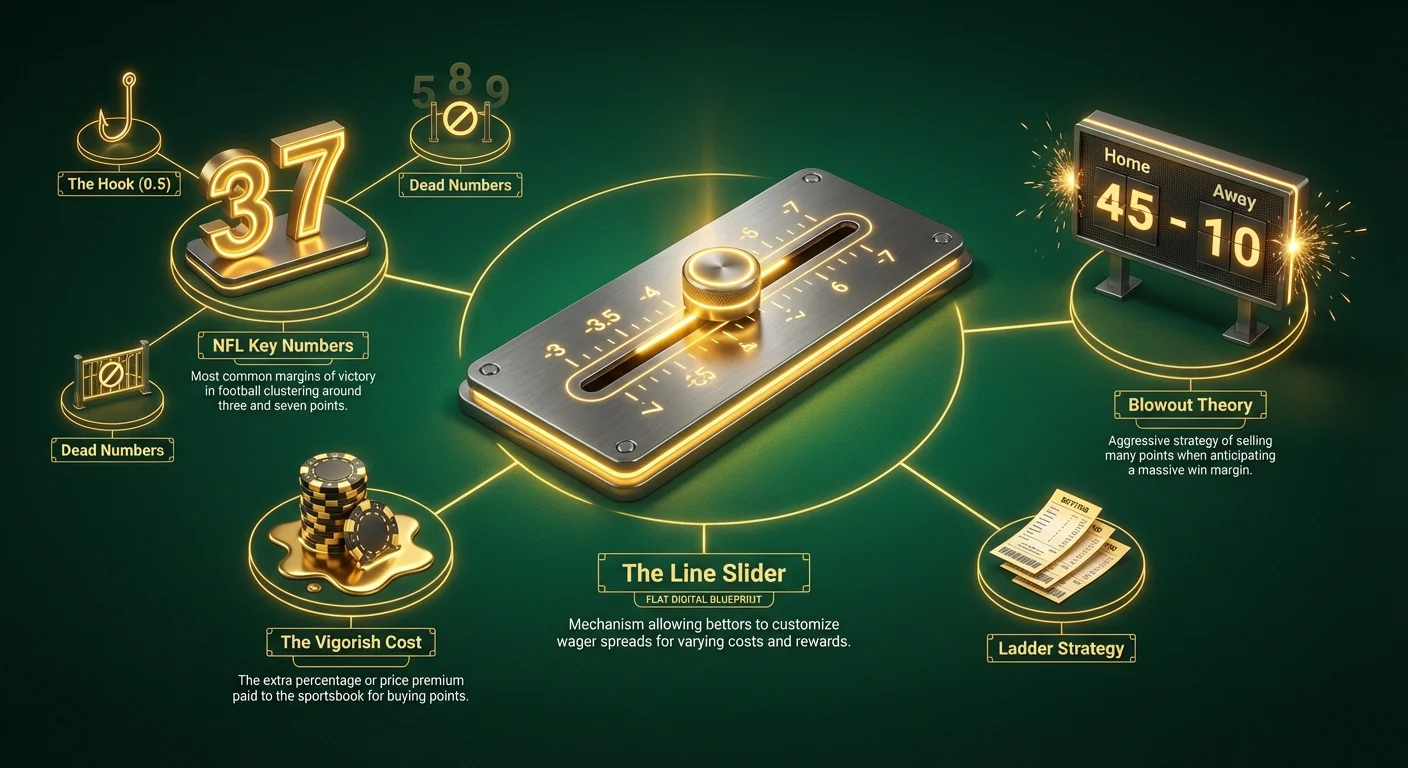
The most common mistake intermediate bettors make is ignoring the math behind the move. They buy points because it "feels safer." However, sportsbooks charge a premium (vigorish) for this service. To know if buying points is worth it, you must understand Break-Even Percentage.
The Break-Even Percentage is the percentage of time you need to win a bet at specific odds to make a profit of zero.
| Odds format (American) | Implied Probability (Break-Even Win Rate) |
|---|---|
| -110 (Standard) | 52.38% |
| -120 | 54.55% |
| -130 | 56.52% |
| -140 | 58.33% |
| -150 | 60.00% |
Strategy Implication:
If you move a line from -3.5 (-110) to -2.5 (-150), the sportsbook is demanding you win 7.62% more often (60% - 52.38%) to justify that purchase.
Ask yourself: Does moving across the number 3 actually alter the game outcome more than 7.62% of the time? If the answer is yes, it's a good buy. If the answer is no, you are burning money.
Buying Points: The Strategy of Key Numbers
Not all points are created equal. This is the golden rule of alternate lines. The value of a half-point varies wildly depending on the sport and the specific number you are crossing.
The NFL Key Numbers
In the NFL, scoring happens in increments of 3 (field goals) and 7 (touchdowns with extra points). Because of this, final margins of victory cluster around these numbers.
- 3: The most common margin of victory (approx. 15% of games).
- 7: The second most common margin (approx. 9% of games).
- Secondary Keys: 6, 10, and 14.
When to Buy Points (The "Sharp" Approach)
You should generally only consider buying points if you are crossing a primary key number (3 or 7) and the price (vig) is right.
1. The "Hook" on the 3:
If a favorite is listed at -3.5, they must win by 4. If they win by exactly 3, you lose. Moving this line to -3 (push on a field goal win) or -2.5 (win on a field goal win) is the most valuable move in sports betting. Sportsbooks know this, and they charge a premium for it.
- Tip: If you can buy off -3.5 to -3 for 20 cents or less (e.g., -110 to -130), it is often mathematically sound.
2. The "Hook" on the 7:
Similar to the 3, if an underdog is +6.5, buying them to +7 or +7.5 is valuable because 7 is a frequent margin.
When NOT to Buy Points (The "Square" Approach)
1. Buying through "Dead Numbers":
Moving a line from -5.5 to -4.5 is almost always a bad investment. Very few NFL games end with a margin of 5. You are paying extra vigorish for numbers that rarely decide the outcome of the bet.
2. Buying points in the NBA (Usually):
NBA scoring is continuous (1, 2, and 3 points). While games can end close, there are no structural "key numbers" as powerful as the NFL's 3 and 7. Late-game intentional fouling creates high variance in the final score. Buying an NBA line from -4 to -2 is rarely worth the heavy price increase because the frequency of a game landing exactly on 3 or 4 is not high enough to justify the juice.
Selling Points: Hunting for Plus-Money
Selling points is the strategy of the aggressor. It is used when you believe the market is wrong about the nature of the game, not just the winner.
Scenario 1: The Blowout Theory
If you believe a team favored by -3 is actually vastly superior and will dominate the game, betting them at -3 (-110) is safe, but betting them at -9.5 (+240) offers immense value.
If your handicapping suggests a mismatch that the public hasn't realized (perhaps due to an injury overreaction or a fatigue spot for the opponent), selling points allows you to capitalize on your read.
Scenario 2: Fading the Public Narrative
Often, lines are inflated because the public loves a specific team.
- Example: The public loves the Dallas Cowboys. They are -6 favorites against a struggling team.
- Your Read: You think the struggling team is undervalued and will actually win the game outright.
- The Play: Instead of taking the underdog at +6 (-110), you sell points and take the underdog at -2.5 (+210). You are betting on them to win (essentially) for a 2x payout.
The Crypto Advantage in Selling Points
Using a crypto sportsbook offers distinct advantages here. Traditional fiat books often limit the upside on alternate lines or have poor liquidity on deep alternates. Crypto books, using global liquidity and lower overhead, often provide:
- Wider Ranges: You can find lines ranging from -20 to +20 on a standard NFL game.
- Higher Limits: VIP crypto bettors can place significant volume on alternate spreads without triggering manual review delays.
- Instant Settlement: High-volatility bets (like selling points for +300 odds) are best settled instantly using Bitcoin or Tether (USDT) so you can reinvest the profits immediately.
Alternate Lines vs. Teasers
You must distinguish between buying points on a single bet and playing a Teaser.
- Alternate Line (Single Bet): You change the spread for ONE game. You pay higher juice or get better odds.
- Teaser (Multi-Leg Bet): You buy points (usually 6 in NFL) on TWO or more games, and you must win ALL legs to cash the ticket.
The Warning:
Many bettors use teasers to move lines through key numbers (e.g., taking the Chiefs -7.5 down to -1.5 and the 49ers -8 down to -2). While this looks attractive, remember you are compounding risk. If one leg fails, the whole bet loses.
The Strategy:
If you only like one specific matchup, use an alternate line. Do not force a second game into a teaser just to get the point manipulation. Buying points on a single game is expensive, but it doesn't require a second event to go your way to get paid.
Practical Strategy: A Decision Matrix
When looking at the board, run your potential bet through this matrix to decide if you should stick to the standard line, buy, or sell.
1. Identify the Margins
- Low Variance Game (Defensive Battle): Points are premium currency.
- Action: Buy Points if crossing a Key Number. In a game with a total of 38, moving from +2.5 to +3.5 is massive.
- High Variance Game (Shootout): Points are cheap and plentiful.
- Action: Sell Points or stick to the standard line. In a game with a total of 56, paying to move from -6 to -4 is rarely worth it, as the variance will likely swing the score by double digits anyway.
2. Check the Price (The 20-Cent Rule)
In the NFL, a general rule of thumb for "The Hook" (0.5 points):
- Buying onto or off of the 3: It is usually worth paying up to 20-25 cents (e.g., -110 to -135).
- Buying onto or off of the 7: It is usually worth paying up to 15-20 cents.
- Buying non-key numbers (5, 8, 9): Almost never worth more than 5-10 cents.
3. The "Ladder" Strategy (For Selling Points)
If you are confident in a blowout, don't put your entire stake on one aggressive alternate line. Ladder it.
- Total Stake: 1 Unit (e.g., 100 USDT)
- Bet A: 0.5 Units on Standard Spread -6 (-110)
- Bet B: 0.3 Units on Alt Spread -9.5 (+160)
- Bet C: 0.2 Units on Alt Spread -13.5 (+250)
This way, if they cover the standard but not the blowout, you minimize losses. If the blowout hits, you maximize ROI.
Crypto-Specific Considerations for Alt Lines
The math of betting remains the same regardless of currency, but the execution differs on crypto platforms.
1. Provably Fair and Transparency
Some modern crypto-native betting apps (specifically those built on decentralized protocols) offer "Provably Fair" mechanisms. While usually applied to casino games, this transparency is moving into sports through on-chain settlement. When betting obscure alternate lines (like 4th quarter alt spreads), ensuring the book isn't grading arbitrarily is key.
2. Arbitrage Opportunities
Because crypto books often operate independently of the major Vegas/European data feeds (or shade their lines based on heavy "whale" action in Bitcoin), you can sometimes find massive discrepancies in alternate line pricing between a fiat book and a crypto book.
- Example: Fiat Book has Team A -3.5 at -110. Crypto Book (seeing heavy action on Team A) has moved to -4.5. You might be able to buy back the +4.5 on the underdog at a better price on the Crypto site.
3. Stablecoin Bankroll Management
When selling points for high odds (e.g., +300), you will face long losing streaks (variance). Managing your bankroll in stablecoins (USDC/USDT) prevents the "double gamble" of the underlying crypto asset's volatility affecting your betting bankroll.
Summary: The Golden Rules of Line Movement
Alternate lines are a tool, not a magic wand. They should be used to express a specific opinion on a game that the standard line does not capture.
- Respect the 3 and 7: In the NFL, these numbers are sacred. Buying onto them can save you; buying off them blindly costs you.
- Avoid Dead Numbers: Never pay a premium to cross numbers like 5, 8, or 9 in football.
- Sell High, Buy Low: Sell points when you predict high volatility/blowouts. Buy points when you predict a low-scoring, defensive grind.
- Calculate the Breakeven: Always ask, "Does this line move increase my win probability enough to cover the extra juice?"
- Use Crypto Liquidity: Take advantage of the deeper markets and higher limits found on top-tier crypto sportsbooks to place these specialized wagers.
By mastering the alternate line, you stop betting the number the bookie gives you, and start betting the number that fits your handicapping. That is the difference between a gambler and a sports investor.