Every Keno player, from the casual weekend gambler to the dedicated enthusiast, has likely stared at the board and wondered: Is there a code to crack? Humans are hardwired to recognize patterns; it is an evolutionary trait that has kept us alive. When we look at a Keno grid, our brains naturally try to connect the dots, find clusters, and predict where the next lightning strike will land.
In the world of crypto gambling, where transparency and technology meet chance, the debate over "Hot" and "Cold" numbers is more relevant than ever. Can tracking past results actually help you profit in a game governed by Random Number Generators (RNG)? Or is it merely a comforting superstition?
This guide delves deep into the mathematics, psychology, and strategic reality of Keno patterns. We will debunk common myths, explain how the technology behind crypto Keno works, and provide you with actionable strategies to manage your bankroll rather than chasing ghosts.
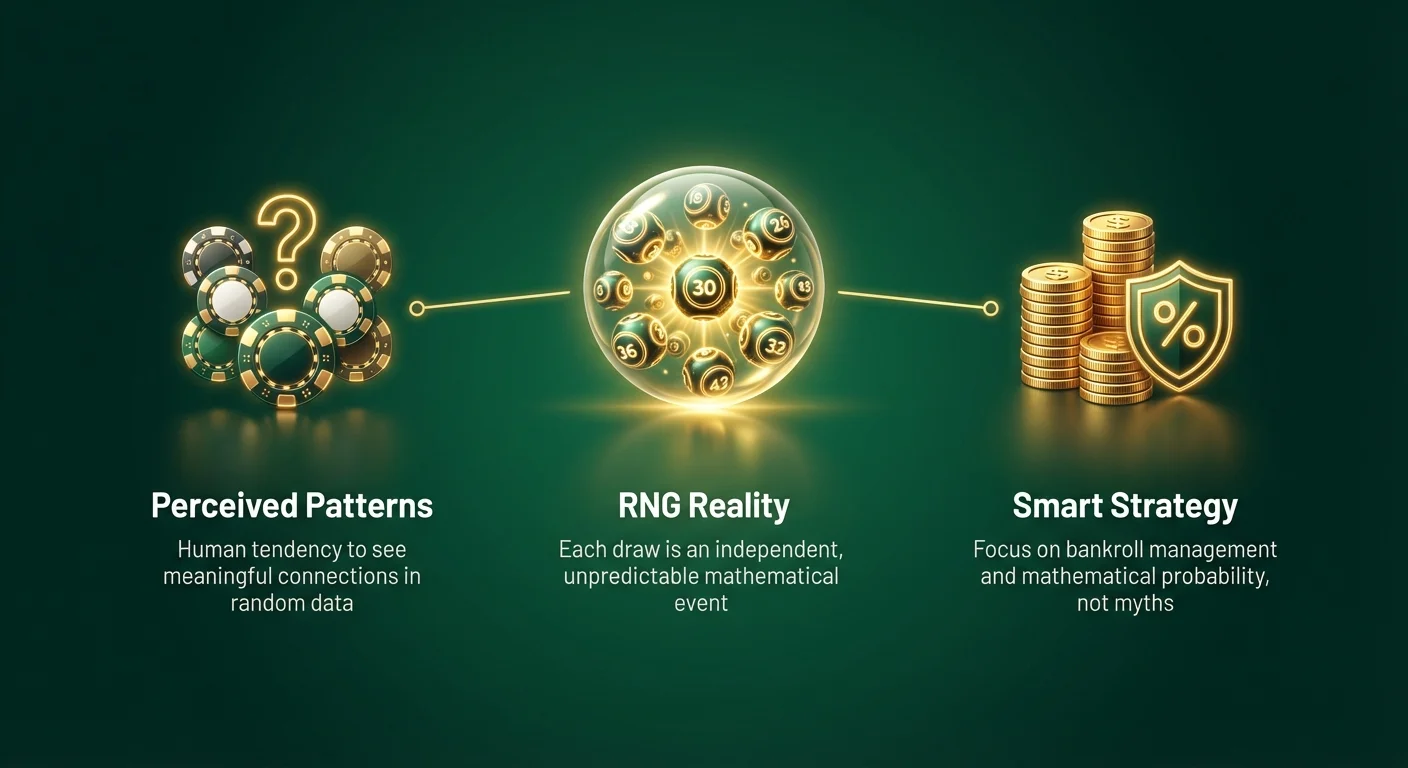
The Psychology of the Grid: Why We See Patterns
Before we crunch the numbers, it is vital to understand why Keno patterns are so seductive. This phenomenon is known as Apophenia - the tendency to perceive meaningful connections between unrelated things. When you see numbers 23, 24, and 25 hit in a row, it feels like a sequence. To the Keno machine, however, it is just a random selection of three distinct values.
This leads to the Gambler's Fallacy, the erroneous belief that if a particular event occurs more frequently than normal during the past, it is less likely to happen in the future (or vice versa). In Keno, this manifests in two distinct schools of thought:
- The "Hot" Bettors: These players believe that numbers currently hitting are "lucky" and will continue to appear.
- The "Cold" Bettors: These players believe that numbers that haven't appeared in a while are "due" to hit soon to balance the statistics.
Understanding that these are psychological traps is the first step to becoming a smarter player.
Hot and Cold Numbers: The Statistical Reality
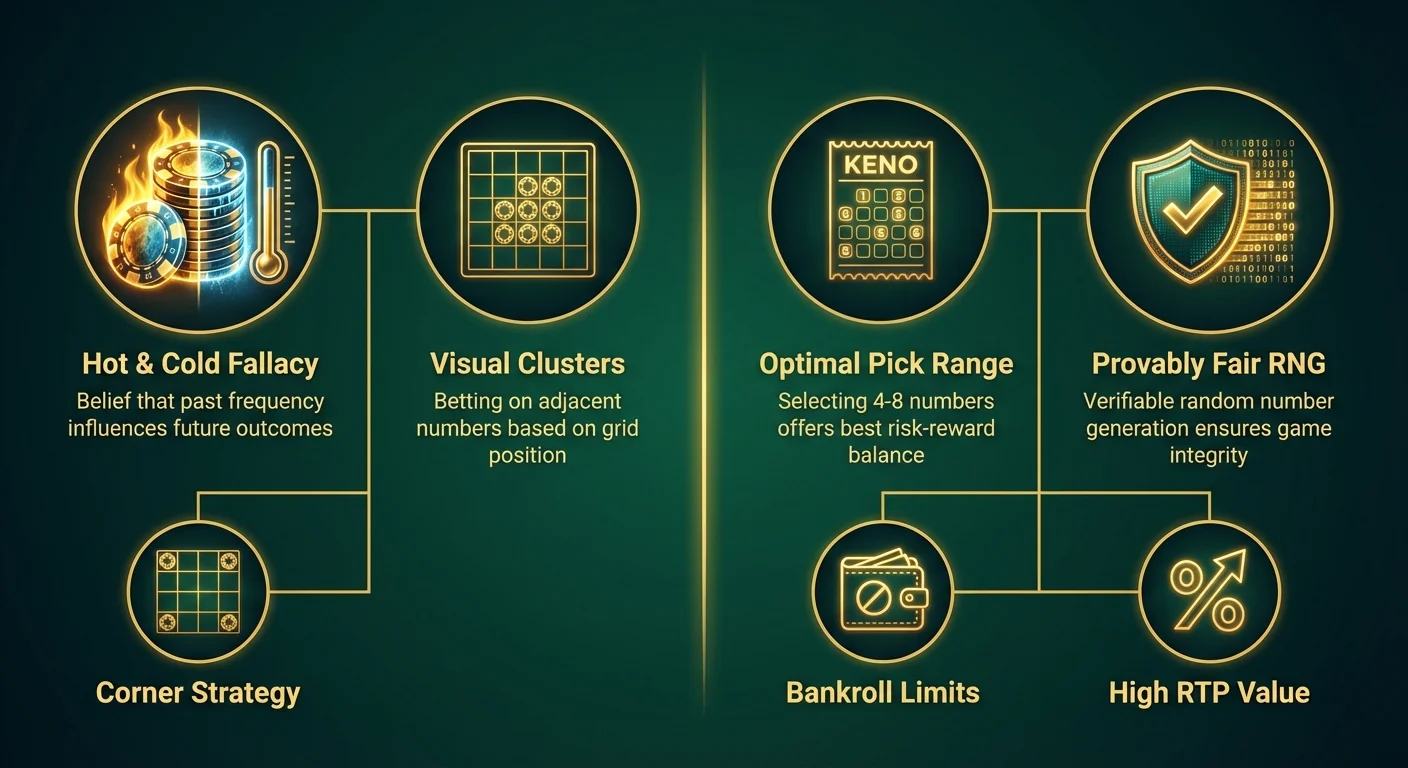
Most modern crypto Keno interfaces create a helpful (or perhaps distracting) visual aid: they highlight Hot and Cold numbers.
What Are Hot Numbers?
Hot numbers are spots that have been drawn most frequently over a specific set of recent games (usually the last 50 to 100 rounds).
- The Theory: The RNG is "favoring" these numbers.
- The Reality: In a short sample size, variance is normal. Just because a coin flips heads ten times in a row doesn't mean the coin is weighted; it is a statistical anomaly that will even out over millions of flips.
What Are Cold Numbers?
Cold numbers are spots that have not been drawn for the longest period.
- The Theory: The number is "overdue." If number 17 hasn't hit in 50 games, it must hit soon to satisfy probability.
- The Reality: The Keno ball (or algorithm) has no memory. It does not know that number 17 has been absent. The odds of number 17 appearing in the next game are exactly the same as they were 50 games ago (1 in 4).
The Verdict
Tracking Hot and Cold numbers provides no mathematical advantage. However, many players use them as a method to simplify the decision-making process. If picking numbers randomly stresses you out, choosing Hot or Cold numbers is a harmless way to play, provided you understand that it does not increase your RTP (Return to Player).
Keno Patterns and Visual Strategies
Beyond individual numbers, many players swear by spatial patterns on the Keno card. These are often derived from land-based Keno lore but are frequently applied to online crypto Keno.
1. The Cluster Strategy
This involves picking numbers that are grouped tightly together on the grid (e.g., a 2x3 block).
- Logic: Players believe the algorithm often picks numbers in "clumps."
- Debunking: The visual representation of the grid is for the player's benefit. To the computer, the numbers are just a data set. A cluster of
1, 2, 11, 12looks related on a grid, but mathematically, they are just four independent integers.
2. The 4x5 Corner Strategy
A popular method often cited in strategy forums involves betting on the corners of the grid.
- How to play it: You select a cluster of numbers in each of the four corners (Top Left, Top Right, Bottom Left, Bottom Right). For example, selecting
1, 2, 11, 12(Top Left) and9, 10, 19, 20(Top Right), and so on. - The Goal: The idea is to catch a "wave" where the numbers drift toward the edges.
- Utility: While this doesn't improve odds, it does offer high variance coverage. By spreading bets across the four furthest points, you are betting against the numbers congregating in the center. It's a fun way to play, but statistically neutral.
3. Lines and Rows
Some players bet entire horizontal rows or vertical columns.
- Logic: "The machine is stuck on the top row."
- Debunking: While it is visually satisfying to see a whole row light up, it is incredibly rare. The probability of an entire row of 10 numbers being drawn in a standard 20-number draw is astronomically low.
The Role of RNG and Provably Fair Technology
In traditional casinos, Keno uses a blower with 80 ping-pong balls. In the crypto gambling world, the game is powered by a Random Number Generator (RNG).
How Crypto RNG Works
A Pseudo-Random Number Generator (PRNG) uses complex algorithms to produce a sequence of numbers that approximates true randomness. The "seed" number determines the outcome.
Why Patterns Fail Against RNG:
The RNG cycles through thousands of number combinations per second, even when the game isn't being played. The moment you press "Bet," the software grabs the current nanosecond's combination. For a pattern to work, you would need to predict the exact millisecond you press the button and know the algorithm's seed - an impossible feat.
The "Provably Fair" Advantage
One major benefit of playing Keno at crypto casinos is the Provably Fair system. Unlike traditional "black box" casino software, Provably Fair allows you to verify the fairness of every round.
- Server Seed: Generated by the casino (hashed/hidden).
- Client Seed: Generated by your browser or chosen by you.
- Nonce: A counter that increases with every bet.
Because the outcome depends on the Client Seed (which you can control), the casino cannot "rig" the game to avoid your Hot numbers. This transparency proves that the draws are truly independent events, further debunking the idea that the machine "knows" which numbers are overdue.
The Mathematical Sweet Spot: Probabilities vs. Payouts
If patterns don't work, what does? The answer lies in probability mathematics. Keno is a game of balancing Frequency of Wins against Size of Wins.
The house edge in Keno is notoriously high (often 20-30% in land-based casinos), but crypto Keno sites often offer significantly better odds (sometimes reducing the house edge to 1-3%).
Analyzing the "Pick" Count
The most critical decision you make isn't which numbers to pick, but how many.
| Number of Picks | Probability of Hitting All | Typical Payout (Crypto) | Verdict |
|---|---|---|---|
| Pick 1 | 25.00% (1 in 4) | 3x | Low Risk, Low Reward |
| Pick 5 | 0.064% (1 in 1,550) | ~500x | The Sweet Spot |
| Pick 10 | 0.00001% (1 in 8.9 million) | ~Variable | High Risk, Lottery Style |
| Pick 20 | 1 in 3.5 Quintillion | Jackpot | Virtually Impossible |
Note: Payouts vary wildly between casinos. Always check the paytable.
Strategy Tip: Statistical analysis suggests that picking between 4 and 8 numbers offers the best balance. In this range, the payouts are substantial enough to cover losses, but the odds of hitting a winning combination are realistic enough to keep your bankroll alive.
Practical Strategies for Crypto Keno
Since we cannot predict the numbers using patterns, we must control the elements we can influence: our budget, our risk level, and our platform choice.
1. Bankroll Management (The Only Real Guarantee)
If you assume a house edge of 3%, you will statistically lose $3 for every $100 wagered over the long run. To play effectively:
- Set a Stop-Loss: Decide exactly how much crypto you are willing to lose in a session. If you hit that limit, log off.
- Session Limits: Do not play endlessly. Keno is fast; you can play 10 rounds a minute. This speed drains bankrolls quickly.
2. Shop for the Best RTP
Not all Keno games are created equal.
- Land-based Keno: RTP is often ~70-80%.
- Online/Crypto Keno: RTP can range from 90% to 99%.
- Action: Before playing, look for the "Information" or "Rules" tab. Always choose the game with the highest Return to Player percentage. A 98% RTP game will stretch your Bitcoin balance much further than a 92% game.
3. Consistency vs. Randomness
While patterns don't change the odds, sticking to a set of numbers can prevent the psychological pain of "switching."
- Scenario: You play numbers 1, 2, 3. You switch to 4, 5, 6. Then 1, 2, 3 hits. This induces "tilt" (emotional gambling).
- Solution: Either stick to your lucky numbers every time or use the "Auto-Pick" / "Quick Pick" feature every time. Be consistent in your method, not necessarily the numbers.
4. Utilize Way Tickets (Reduced Systems)
If you want to play patterns like the "4x5 Corners," consider splitting your bet. Instead of one large bet on 20 numbers, play multiple smaller bets on smaller clusters.
- Example: Instead of betting 10 numbers on one ticket, play two tickets of 5 numbers each. It is often easier to hit 5 out of 5 than 10 out of 10, and it keeps the volatility lower.
Comparison: Traditional Keno vs. Crypto Keno
Understanding the platform nuances can help you apply your strategy more effectively.
| Feature | Traditional Keno | Crypto Keno |
|---|---|---|
| Speed | Slow (games every 5-10 mins) | Instant (on demand) |
| Fairness | Regulated auditors | Provably Fair (User verifiable) |
| Picks | Usually fixed | Highly customizable |
| Payouts | Slow (Cashier cage) | Instant (Direct to wallet) |
| Patterns | Physical balls (physics involved) | Pure math (RNG algorithms) |
Expert Advice: How to Create Your Own "Pattern"
If you enjoy the ritual of creating patterns, do so with the understanding that it is for entertainment. Here is a balanced approach to "Pattern Play" that respects the math:
- The Hybrid Approach: Select 2 "Hot" numbers (to ride the wave), 2 "Cold" numbers (hedging your bets), and 2 personal lucky numbers. This gives you a 6-spot ticket that covers all psychological bases.
- The Yin-Yang: Bet on the top half of the board one game, and the bottom half the next. This doesn't improve odds, but it varies the gameplay and prevents boredom.
- The Fibonacci: Use the Fibonacci sequence (1, 1, 2, 3, 5, 8, 13, 21...) as your selected numbers. It is a famous mathematical sequence found in nature. It won't help you win more, but it's a "geeky" and fun way to select spots.
Conclusion: Do Patterns Matter?
To answer the titular question: No, Keno patterns do not matter statistically. Hot numbers are not guaranteed to stay hot, and cold numbers are under no obligation to warm up. The ball has no memory, and the blockchain RNG is relentlessly random.
However, patterns matter psychologically. If playing a specific shape or tracking hot numbers makes the game more enjoyable for you, then it has value as entertainment. The key is to never bet more money under the false assumption that a pattern guarantees a win.
Key Takeaways for the Smart Crypto Gambler:
- Trust the Math, Not the Myth: Every number has an equal 25% chance of being drawn in a standard game.
- Manage Your Crypto: Volatility in coin prices combined with game volatility can be dangerous. Bet small percentages of your bankroll.
- Verify the Game: Play at casinos offering Provably Fair Keno to ensure the lack of patterns is genuine randomness, not manipulation.
- Find the Sweet Spot: Stick to picking 4-8 numbers to maximize your potential for a decent return.
Keno is a game of chance, meant to be enjoyed for the thrill of the draw. By letting go of the need to control the outcome through nonexistent patterns, you can focus on the fun, play responsibly, and perhaps - with a little genuine luck - hit that big win.