
Video poker is the "thinking player's" alternative to slots. It combines the flashing lights and instant gratification of a slot machine with the mathematics and decision-making of poker. But when you move this game to the world of cryptocurrency, you face a unique challenge. You are battling two distinct forces: the variance of the cards and the volatility of the coin.
For a beginner, the allure of a Royal Flush payout in Bitcoin or Ethereum is massive, but the road to getting there is paved with dry spells and bad beats. This is where "Grinding" comes in. A grinder isn't looking to get rich in one spin; they are looking to survive, maximize their playtime, and mathematically position themselves to catch the big wins when they finally arrive.
To survive the swing, you need more than just a strategy chart; you need ironclad bankroll management. This guide will walk you through how to size your bets, why the "Max Coins" button is your best friend (and worst enemy), and how to protect your crypto assets while hunting for that elusive Royal Flush.
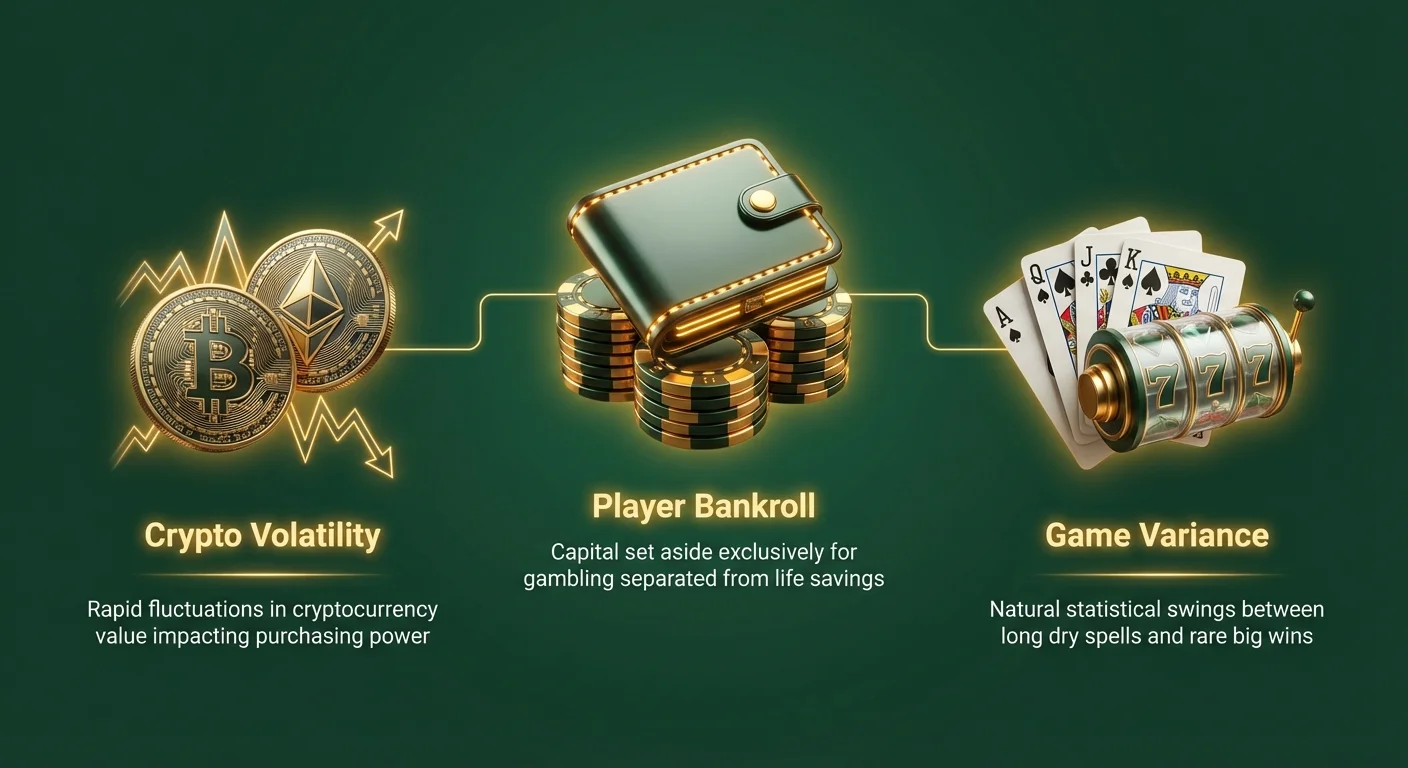
Understanding the Double Threat: Variance and Volatility
Before opening your wallet or connecting your crypto wallet, you must understand the environment you are playing in. In traditional gambling, you worry about the house edge. In crypto video poker, you have to worry about the game swing and the market swing.
What is Game Variance?
Variance describes the "swinginess" of a game. A game with low variance pays out small amounts frequently (keeping your bankroll steady). A game with high variance pays out rarely, but the amounts are huge.
Video poker is naturally a game of variance. While you will frequently hit pairs or three-of-a-kind to keep you afloat, the bulk of the Return to Player (RTP) is concentrated in the rare hands: the Royal Flush and the Straight Flush. This means you will likely lose money slowly over a long period, waiting for a sudden, massive spike upward.
What is Crypto Volatility?
Volatility refers to the price action of the currency you are using. If you deposit 0.01 BTC when Bitcoin is at $60,000, your bankroll is worth $600. If Bitcoin drops to $55,000 while you are playing, your bankroll effectively shrinks in purchasing power, even if you haven't lost a single hand.
The Grinder's Solution:
- Stablecoins: If you want to focus purely on poker strategy without stressing about the market, play using stablecoins (USDT, USDC). This neutralizes market volatility.
- Token Management: If you play with volatile assets (BTC, ETH, LTC), treat the gambling session separate from your investment portfolio. Never play with crypto you are hoping to "sell high" tomorrow.
The First Pillar: Defining Your Bankroll
A "bankroll" is not the total amount of money you own. It is a specific amount of money set aside exclusively for gambling purposes. If you lose it, it should not impact your ability to pay rent, buy groceries, or hold your crypto investments.
For a video poker grinder, we break the bankroll down into three categories:
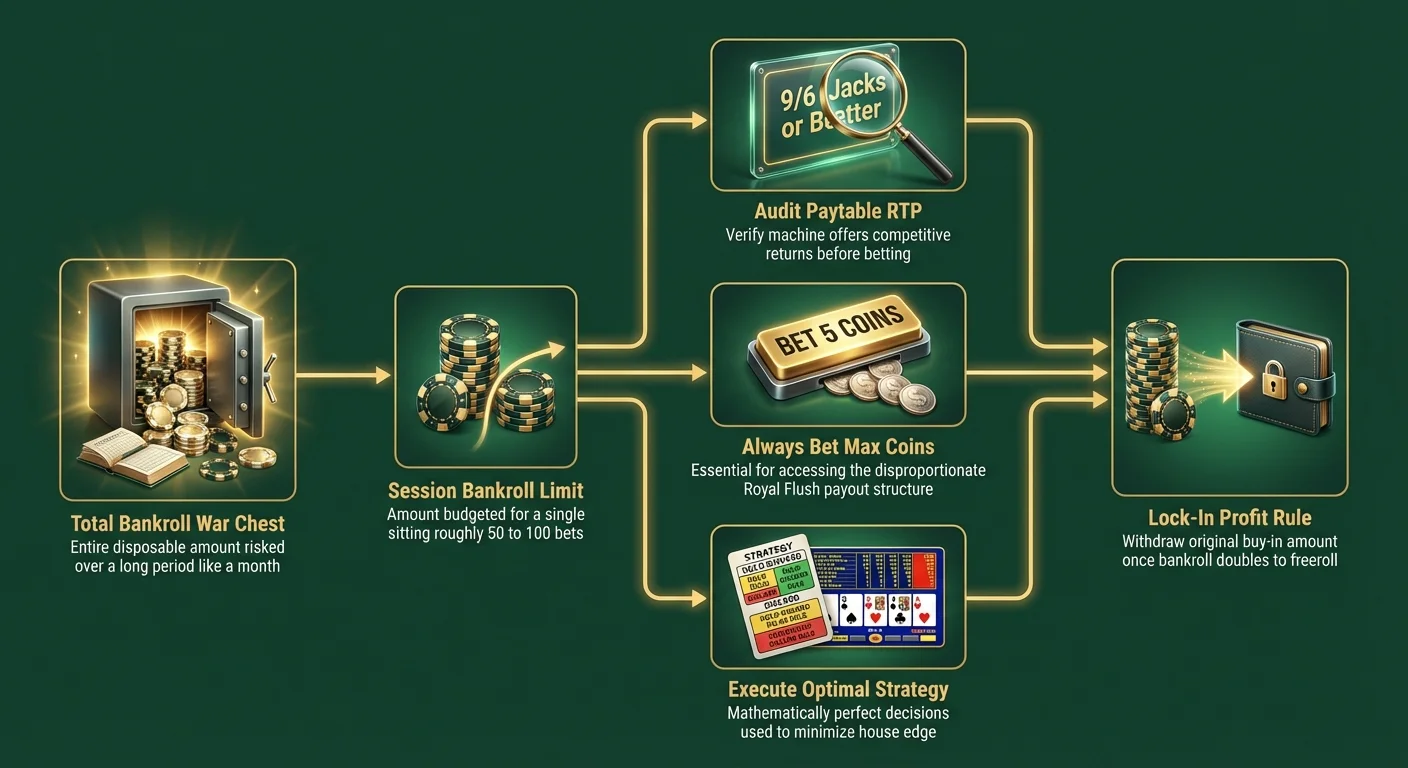
1. The Total Bankroll (The War Chest)
This is the total amount you are willing to risk over a month or a year. Professional video poker players often suggest you need enough buy-ins to survive a "Royal Flush Cycle" (roughly 40,000 hands). For a beginner, this is overkill. A good rule of thumb for a total beginner bankroll is 500x your base betting unit.
2. The Session Bankroll (The Daily Limit)
This is what you bring to the table for a single sitting. You should never bring your entire war chest to a single session. A healthy session bankroll should be roughly 50 to 100 bets. If you are betting $5 per hand, you need $250 to $500 for that session. This gives you enough "ammo" to weather a streak of bad cards without busting out before the probability corrects itself.
3. The Stop-Loss Limit
This is the psychological barrier. If you lose your session bankroll, you stop. Chasing losses in crypto gambling is dangerous because the speed of transactions allows you to reload your wallet instantly. You must have the discipline to say, "The variance got me today," and log off.
The "Max Coins" Commandment
If you read any guide on video poker, including standard manuals or advanced strategy books, you will see one piece of advice repeated ad nauseam: Always Play Max Coins.
For beginners, this can be scary. Why bet 5 coins when 1 coin gets you into the game? The answer lies in the Royal Flush payout structure.
The Mathematical Penalty
Video poker machines are programmed to incentivize risk. Let's look at a standard "Jacks or Better" paytable payout for a Royal Flush:
| Coins Bet | Royal Flush Payout | Payout Per Coin |
|---|---|---|
| 1 Coin | 250 | 250 |
| 2 Coins | 500 | 250 |
| 3 Coins | 750 | 250 |
| 4 Coins | 1000 | 250 |
| 5 Coins (Max) | 4000 | 800 |
As you can see, betting 1 through 4 coins yields a linear return (250x). However, the moment you bet the 5th coin, the payout jumps disproportionately to 800x per coin.
If you play less than max coins, you are voluntarily increasing the house edge by several percentage points. You are effectively playing a rigged game.
The Grinder's Adjustment: Denomination Downsizing
The problem for many beginners is that "Max Coins" sounds expensive. If the machine is a $1 machine, a max bet is $5. If your bankroll is only $50, that's only 10 hands - far too few to survive variance.
Do NOT lower your coins to 1.
INSTEAD, lower your denomination.
If you cannot afford a $5 bet (Max coins on a $1 machine), switch to a $0.25 machine. Max coins there will only cost you $1.25. You get the full mathematical advantage of the 4000-coin payout without blowing your budget.
Key Rule: It is always better to play 5 coins at a lower denomination than 1 coin at a higher denomination.
Game Selection: Choosing Your Volatility
Not all video poker games are created equal. Just as different cryptocurrencies have different risk profiles, different video poker variants have different volatility levels. Your bankroll strategy must match the game you choose.
Low Variance: Jacks or Better (The Safe Haven)
Jacks or Better (specifically the 9/6 version, referring to payouts for Full House and Flush) is the gold standard for strategy for grinders.
- Why: It pays out on a pair of Jacks or higher. This happens frequently (roughly 21% of hands).
- Bankroll Impact: Your money lasts longer. You will experience a "slow bleed" or a "slow climb."
- Target Audience: Beginners with smaller bankrolls who want to maximize play time.
Medium Variance: Bonus Poker
Bonus Poker operates like Jacks or Better but offers higher payouts for four-of-a-kind hands (especially Aces).
- Why: To pay for those big four-of-a-kind bonuses, the game usually pays less for Two Pair or Full Houses.
- Bankroll Impact: Slightly choppier than Jacks or Better. You need a slightly larger buffer.
High Variance: Deuces Wild & Double Double Bonus
These are the thrill-seeker games. In Deuces Wild, the 2s are wild, creating massive hands frequently, but the lowest paying hand is usually Three of a Kind.
- Why: You will go many hands winning absolutely nothing, followed by a sudden explosion of winnings.
- Bankroll Impact: These games are "bankroll killers." You can lose 20 hands in a row easily. However, the upside is massive.
- Requirement: You need a session bankroll roughly 2x to 3x larger than what you would use for Jacks or Better to survive the dry spells.
Practical Strategy: The 4-Step Grind
Now that you have your money sorted and your game picked, here is the practical workflow for a session.
Step 1: Check the Paytable (The RTP Check)
Before you bet a single Satoshi, look at the paytable. In crypto casinos, RTP (Return to Player) can vary.
- Look for 9/6 on Jacks or Better (9 coins for Full House, 6 for Flush).
- If you see 8/5 or 6/5, the house edge is significantly higher. Your bankroll will deplete much faster on these machines.
- Tip: In crypto gambling, "Provably Fair" games often display the RTP or House Edge in the settings. Check this first.
Step 2: Set the Unit Size
Calculate 1% of your total session bankroll. That is your max bet per hand.
- Session Bankroll: $200
- Max Bet: $2
- Coin Selection: Play a $0.40 or $0.50 denomination machine (5 coins x $0.40 = $2.00).
Step 3: Play with Optimal Strategy
Bankroll management is useless if you throw away money on bad decisions. Video poker is not a guessing game.
- Hold the Pairs: In Jacks or Better, a low pair (like 4s) is statistically more valuable than keeping a single Ace or King.
- Break the Flush/Straight: Never hold a "kicker." If you have 4 cards to a flush and a high pair, break the pair to go for the flush (depending on the specific variant rules), but never keep a high card just because "it's high" if it doesn't fit the pattern.
- Use Cheat Sheets: There is no shame in having a strategy chart open in another tab while you play online. It reduces the house edge to mere decimals.
Step 4: The "Lock-In" Strategy
One advantage of crypto gambling is the speed of withdrawals. Unlike land-based casinos where you have to walk to the cage, or fiat online casinos that take days to process, crypto is near-instant.
Use the "Half-Win" Rule:If you double your session bankroll (e.g., you started with $100 and are now at $200), immediately withdraw your original $100 back to your secure wallet. Now, you are "freerolling." You are playing entirely with house money. This eliminates the psychological pain of losing and guarantees you break even at worst.
Managing the "Tilt"
"Tilt" is a poker term for when frustration causes you to make bad decisions. In video poker, tilt manifests as:
- Playing too fast: Clicking "Draw" without checking your hold cards.
- Raising stakes: Increasing your bet size to "win back" losses quickly.
- Deviating from strategy: Going for a gutshot straight because you "feel lucky."
Video poker is a game of grinding. It is repetitive. The moment you feel bored, frustrated, or desperate, your bankroll is in danger.
- The 500-Hand Break: Set a rule that after every 500 hands (or roughly 45 minutes), you stand up, stretch, and check your crypto balance.
- The Loss Limit: If you lose your session bankroll, do not deposit more from your cold wallet. The transfer time (waiting for blockchain confirmations) is a natural "cooling off" period - use it to reflect, not to reload frantically.
Crypto Bonuses: The Bankroll Booster
One distinct advantage of grinding at crypto casinos is the aggressive bonus structures. Because crypto transactions have lower fees for the operator, they often pass savings on to players via Rakeback or Deposit Bonuses.
Rakeback is Key
For a grinder, Rakeback is superior to a Deposit Bonus.
- Deposit Bonuses usually come with high wagering requirements (e.g., 40x rollover) that lock your funds.
- Rakeback gives you a percentage of your wagered money back, win or lose.
- Strategy: If the house edge is 0.5% and you get 0.2% rakeback, you have effectively cut the house's advantage nearly in half. This extends your bankroll life significantly. Always activate rakeback before starting a grind.
Summary: The Grinder's Checklist
Surviving the swing in crypto video poker isn't about luck; it's about preparation. Before your next session, ensure you can check off these boxes:
- Bankroll Separation: My gambling funds are separate from my life savings/investment portfolio.
- Session Sizing: I have at least 50-100 max bets available for this specific session.
- Denomination Check: I am playing a denomination where I can comfortably bet 5 Coins (Max) every single hand.
- Game Choice: I am playing a variant (like Jacks or Better) that matches my risk tolerance.
- Paytable Audit: I have confirmed the machine offers a competitive paytable (9/6 or similar).
- Exit Strategy: I know my "Stop-Loss" number and my "Lock-In" number.
The cards will fall where they may, and the crypto markets will move up and down. You cannot control the deal, but by managing your bankroll with discipline, you ensure that you are still sitting at the table when that Royal Flush finally hits the screen.