
Keno is one of the most exhilarating games in the crypto casino world. It is fast-paced, offers massive potential payouts, and is incredibly simple to play. However, that speed and simplicity come with a cost: Keno is a high-variance game. When you combine the natural volatility of Keno with the market volatility of cryptocurrencies like Bitcoin, Ethereum, or Solana, you create a financial environment that can thrill you one minute and deplete your balance the next.
For beginners entering the world of crypto gambling, understanding how to manage a bankroll is far more important than picking "lucky" numbers. Without a solid financial strategy, even a winning streak can turn into a loss due to poor funds management.
This guide will walk you through the essentials of crypto bankroll management specifically tailored for Keno. We will cover how to set limits, calculate bet sizes, understand the relationship between "spots" and volatility, and how to protect your funds against crypto market swings.
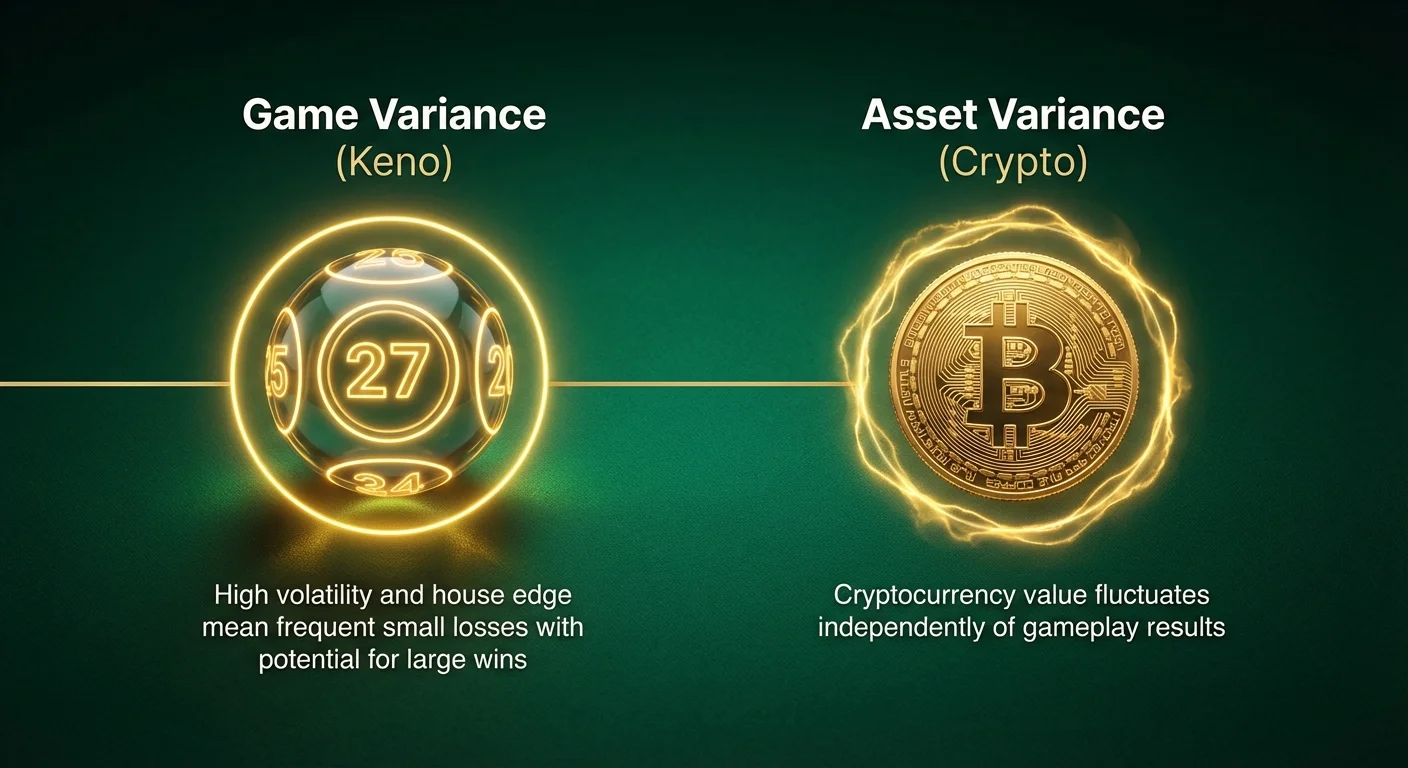
The Double Variance Dilemma: Game vs. Asset
Before diving into the math of betting, it is crucial to understand the unique position of a crypto Keno player. You are battling two types of variance simultaneously:
- Game Variance (Keno): Keno has a high house edge (often between 10% and 30%, though some crypto versions offer better RTPs) and high volatility. You will lose more rounds than you win, but the wins can be substantial.
- Asset Variance (Crypto): The value of the currency you are betting with fluctuates. If you deposit $100 worth of Bitcoin, it might be worth $90 or $110 an hour later, regardless of your game results.
Successful management requires you to respect both. If you are playing with a volatile asset, your betting strategy needs to be more conservative than if you were playing with a stablecoin (like USDT or USDC) or fiat currency.
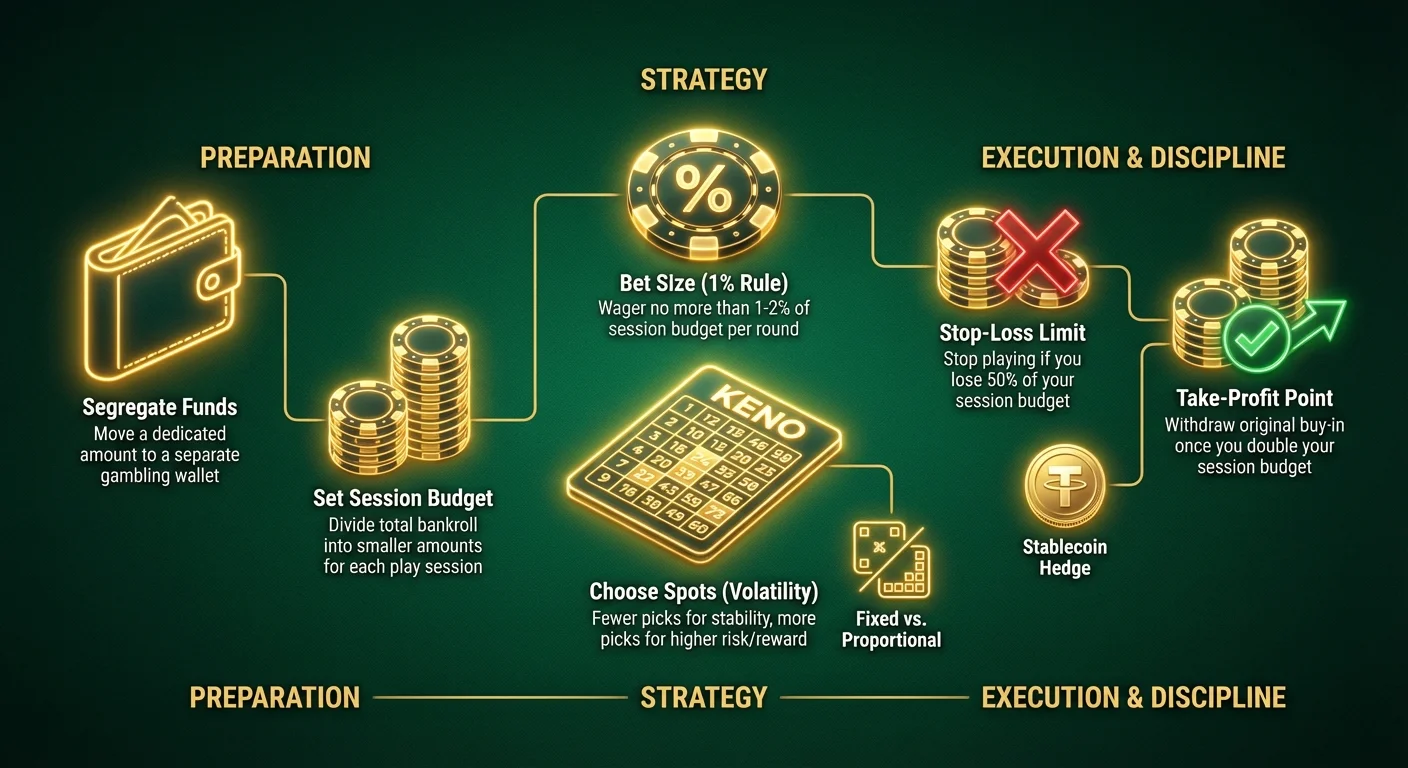
Setting Up Your Keno Bankroll
The first step in bankroll management happens before you even log in to the casino. You must establish a "gambling bankroll" that is entirely separate from your investment portfolio or daily living expenses.
The Segregation Rule
Never gamble directly from your main crypto wallet (like a Ledger or a primary exchange account).
- Create a dedicated gambling wallet: Transfer only the amount you are willing to lose to the casino.
- Mental Accounting: Once the crypto hits the casino balance, consider it "spent." If you win, it's a bonus. If you lose, it was the price of entertainment.
Determining Your Session Budget
A common mistake beginners make is looking at their total balance and betting based on that number. Instead, you should break your bankroll down into Session Budgets.
If you have 0.01 BTC in your casino account, do not consider that your budget for tonight. Divide it by 5 or 10. That 0.001 BTC is your "Session Budget." This prevents you from tilting and blowing your entire stack in one bad run.
Calculating Bet Sizing: The 1% Rule
In a game as fast as Keno - where a new draw can happen every few seconds - your bet size must be small relative to your balance to survive the inevitable losing streaks.
The Golden Ratio
For high-volatility games like Keno, the standard advice is to bet no more than 1% to 2% of your session budget per round. Conservative players often stick to 0.5%.
Example:
- Total Bankroll: $1,000 (in BTC)
- Session Budget: $200
- Maximum Bet per Round: $2 (1% of session budget)
Fixed vs. Proportional Betting
There are two main ways to handle your bet sizing as the game progresses:
| Strategy | How It Works | Pros | Cons |
|---|---|---|---|
| Fixed Betting | You bet the same amount (e.g., $1) every round regardless of wins or losses. | Easy to track; protects you from losing streaks. | Doesn't capitalize on winning streaks; bankroll grows slowly. |
| Percentage Betting | You bet 1% of your current balance. If you win, you bet more. If you lose, you bet less. | Automatically preserves capital during losses (bets get smaller). | Can be tedious to calculate manually; requires discipline. |
Recommendation for Beginners: Stick to Fixed Betting. It provides a consistent baseline and makes it easier to track how many rounds you have left before you hit your limit.
Keno Strategy: Managing Volatility Through "Spots"
In Keno, you decide the volatility of the game by choosing how many numbers (spots) to pick. This is a critical component of bankroll management that is often overlooked.
Most crypto Keno games allow you to pick between 1 and 10 (sometimes up to 15 or 20) numbers.
- Low Spots (1-3 picks): You will win small amounts frequently. This extends your playtime and preserves your bankroll.
- Medium Spots (4-8 picks): A balance between reasonable win frequency and decent payouts.
- High Spots (9+ picks): You will lose almost every round, chasing a massive jackpot. This burns through a bankroll very quickly.
The "Spots" Risk Spectrum
If you are playing with a limited budget, you should stick to lower spot counts.
- Bankroll Preservation Mode: Pick 2 or 3 numbers. The odds of hitting 2 out of 2 are roughly 1 in 16. This keeps your balance hovering and allows for longer sessions.
- Growth Mode: Pick 4, 5, or 6 numbers. As referenced in general Keno statistics, numbers in the mid-range (4-8) offer the best theoretical return on investment (RTP) relative to the risk.
- Jackpot Mode: Picking 10+ numbers is effectively buying a lottery ticket. Only do this with profit you have already made, never with your base bankroll.
Pro Tip: If you are playing with Bitcoin and the price of BTC drops suddenly, switch to a lower spot strategy (1-3 picks) to secure small wins and stabilize your balance value.
Crypto-Specific Management Tips
Gambling with crypto offers distinct advantages, such as instant withdrawals and provable fairness, but it requires specific handling.
1. The Stablecoin Hedge
If the crypto market is in a downtrend (bear market), consider converting your gambling bankroll into a stablecoin like USDT or USDC.
- Why? If you hold Bitcoin and it drops 10% while you are playing, you have effectively lost 10% of your buying power even if you broke even in the game.
- Strategy: Play in USDT to lock in the dollar value of your wins. Only convert back to volatile crypto when you are ready to HODL.
2. Mind the Decimals (Satoshi Blindness)
It is easy to overbet when playing with crypto because the numbers look small. Betting 0.0005 BTC might look like "nothing," but depending on the market price, that could be $15 to $30.
- Always toggle the display to Fiat currency (USD/EUR) if the casino allows it. This keeps you grounded in the real-world value of your bets.
3. Leverage Provably Fair Tools
One of the biggest risks in gambling is playing on a rigged system. Crypto Keno often features "Provably Fair" technology, allowing you to verify that the outcome was random.
- While this doesn't save your bankroll from bad luck, it ensures you aren't losing money to a cheat. Always play on reputable crypto casinos that offer this verification.
Stop-Loss and Take-Profit Limits
Discipline is the engine that keeps your bankroll management running. You must set rigid exit points.
The Stop-Loss
This is the point where you walk away, no matter what.
- Rule: If you lose 50% of your session budget, stop.
- Why? Chasing losses is the fastest way to hit zero. If you lose half your budget, it's not your day. Save the remaining 50% for tomorrow.
The Take-Profit
This is the point where you secure your winnings.
- Rule: If you double your session budget (up 100%), withdraw the original amount immediately.
- Why? This creates a "Freeroll." You are now playing only with house money. If you lose it all, you are mathematically back to where you started, not in the negative.
Example Scenario
- Start: $100 Session Budget.
- Play: Hitting 5-spot patterns.
- Result: You hit a lucky streak and balance goes to $220.
- Action: Withdraw $100 back to your cold wallet. Continue playing with the $120 profit.
Avoiding Common Keno Traps
Even with good math, psychological traps can destroy a bankroll. Here is what to avoid:
The "Hot Number" Fallacy
Many players obsess over "hot" (frequently drawn) and "cold" (rarely drawn) numbers. You might see data suggesting numbers like 1, 4, 23, or 34 hit often.
- The Reality: In crypto Keno, the Random Number Generator (RNG) resets every millisecond. Previous results have zero influence on future results.
- The Risk: Do not increase your bet size just because you think a "cold" number is "due" to hit. It isn't. Bet sizing should be based on your wallet balance, not superstition.
The Martingale Strategy
This is a popular strategy where you double your bet after every loss to recover losses.
- Verdict: Avoid this in Keno.
- Reason: Keno has long losing streaks. If you are playing a 5-spot game, you could easily lose 20 rounds in a row. Doubling your bet 20 times is mathematically impossible for most bankrolls and will hit the casino's table limit, resulting in a total loss.
Summary Checklist for Keno Bankroll Management
To summarize, here is your cheat sheet for a safe and sustainable Keno experience:
- Segregate Funds: Move a specific amount to a dedicated gambling wallet.
- Set a Session Limit: Divide your total bankroll into smaller session budgets.
- Bet Small: Wager no more than 1-2% of your session budget per round.
- Understand Volatility: Use fewer spots (1-3) for safer play, and more spots (4-8) for riskier growth.
- Respect the Asset: Use stablecoins if you want to avoid market fluctuation risk.
- Lock Profits: Withdraw your original buy-in once you have doubled your money.
- Ignore Patterns: Don't chase losses based on "hot" or "cold" number myths.
Crypto Keno is a marathon, not a sprint. By respecting the volatility of both the game and the currency, you ensure that you stay in the game long enough to potentially hit those lucky numbers. Play smart, play safe, and may the odds be in your favor.