
If you ask a casual sports bettor what their goal is, they will almost universally say, "To pick winners." If you ask a professional, "sharp" bettor the same question, they will say, "To find value." These two concepts might sound similar, but the gap between them is where the sportsbooks make their profit.
In the world of advanced sports betting, your win-loss record is a vanity metric. It tells a story of the past, often heavily influenced by variance (luck). The only true predictor of long-term sustainability and future profit is Closing Line Value (CLV).
If you are serious about treating sports betting as an investment rather than entertainment, you must stop obsessing over which team lifts the trophy and start obsessing over the price you paid for the ticket. This guide dives deep into the mathematics of market efficiency, explaining why beating the closer is the holy grail of betting and how you can leverage crypto sportsbooks to consistently find an edge.
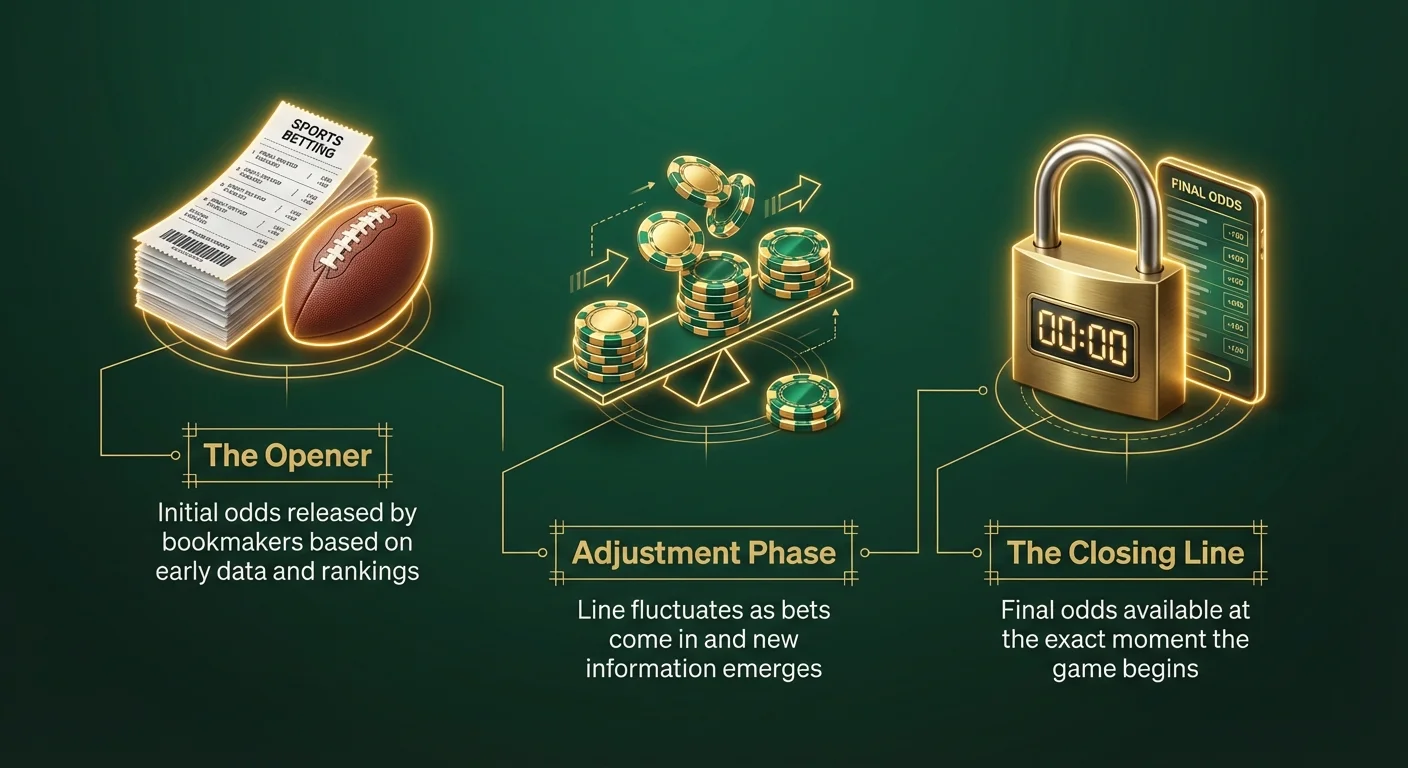
What is the Closing Line?
To understand Closing Line Value, you must first understand the lifecycle of a betting market. A betting line is not a static number; it is a living, breathing price that fluctuates based on information and monetary volume.
- ** The Opener:** The oddsmakers release an initial line. This is often based on power rankings and algorithms. Limits are usually low here because the bookmakers are vulnerable to sharp bettors who might know more than they do.
- The Adjustment Phase: As bets come in, the line moves. If sharp money pounds the favorite, the odds shorten or the point spread increases. Injuries, weather reports, and lineup changes all impact the line during this phase.
- The Closing Line: This is the final set of odds available the second the game begins (kick-off, tip-off, or first pitch).
The Efficient Market Hypothesis
Why is the closing line special? It represents the "truth." By the time a game starts, all available information - every injury rumor, every weather pattern, and the opinions of the smartest syndicates in the world - has been priced into the market.
Because limits are highest right before the game starts, this is when the market is most efficient. The "Wisdom of the Crowds" dictates that while individual bettors may be wrong, the aggregate market is exceptionally accurate at predicting the true probability of an outcome. Therefore, the closing line is widely accepted as the true probability of the event occurring (minus the sportsbook's vigorish/juice).
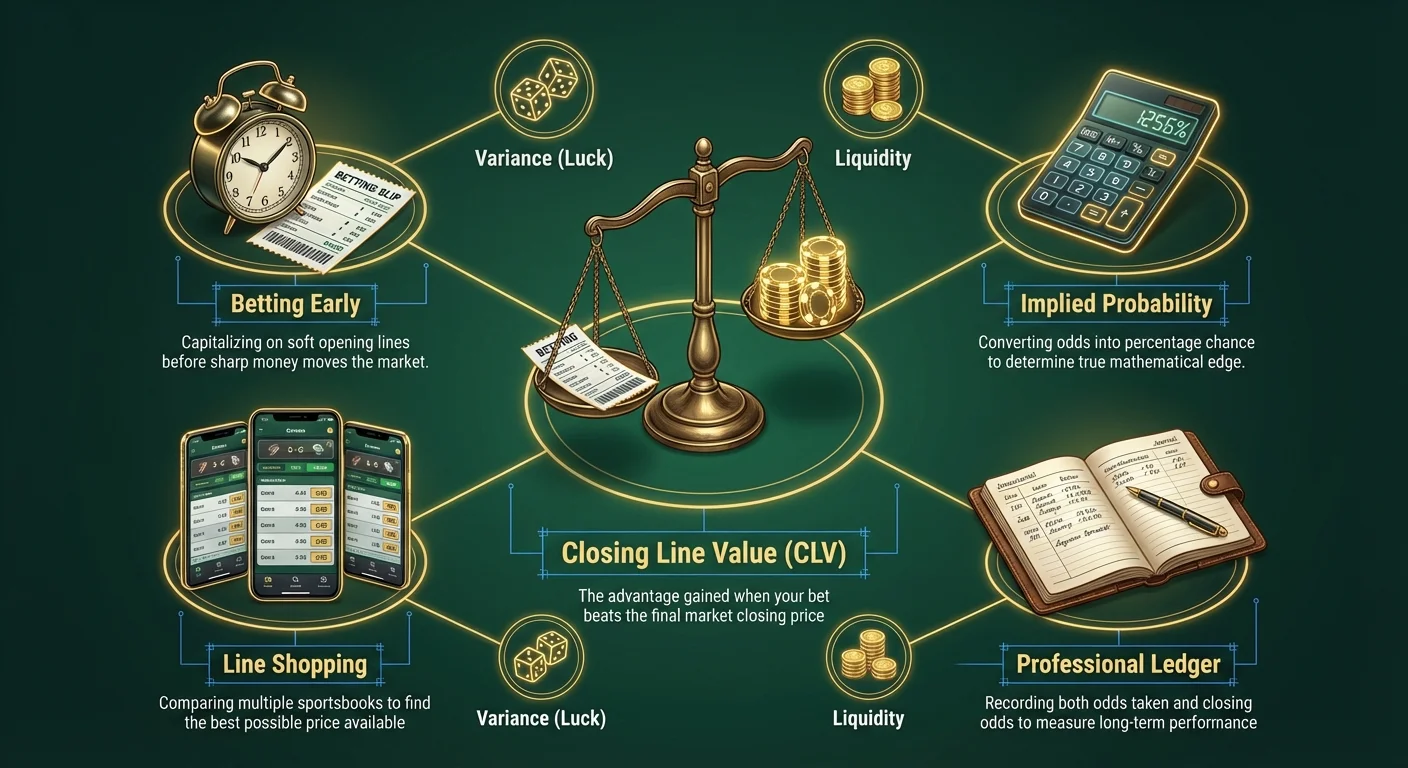
Defining Closing Line Value (CLV)
Closing Line Value is the advantage you possess when the odds you bet are better than the odds at market close.
If you bet on the Buffalo Bills at -3.0 (-110) on Tuesday, and by Sunday kickoff the line has moved to Bills -5.0 (-110), you have achieved massive CLV. You hold a ticket that requires the Bills to win by a field goal to push, while everyone betting on Sunday needs them to win by a touchdown to cover.
The Two Types of Value
- Price Value: Getting better odds on the same outcome (e.g., betting the Lakers at +150 when they close at +130).
- Spread/Total Value: Getting a better number on the spread or total (e.g., betting Over 48.5 when the line closes at 51.5).
If you consistently beat the closing line, you are essentially buying $1.00 bills for $0.90. Even if that specific bet loses due to a bad bounce or a referee's error, the math dictates that if you repeat that process 1,000 times, you will be profitable.
The Math: Why CLV Trumps Win Rate
Many bettors believe that hitting 55% of their bets is the key to riches. However, a 55% winner can go broke, and a 48% winner can be profitable, depending entirely on the price they pay.
Let's look at the math behind Implied Probability.
| Odds Format (American) | Decimal Odds | Implied Probability (Break-even Win %) |
|---|---|---|
| -200 | 1.50 | 66.67% |
| -150 | 1.67 | 60.00% |
| -110 | 1.91 | 52.38% |
| +100 | 2.00 | 50.00% |
| +150 | 2.50 | 40.00% |
The "Coin Flip" Scenario
Imagine a fair coin flip (50/50 chance). The true probability is 50%.
- Bettor A bets Heads at -110 (Implied Prob: 52.38%). He is betting into a negative edge. He needs to win 52.38% of the time to break even, but the coin only lands Heads 50% of the time. He will lose money long-term.
- Bettor B finds a line where Heads is +110 (Implied Prob: 47.62%). He has an edge. He only needs to win 47.62% of the time to break even, but he will win 50% of the time.
Now, apply this to CLV. If you bet a team at +110, and the line closes at -110, the market is telling you the team actually has a 52.38% chance to win (roughly). You hold a ticket paying out as if they had a 47.62% chance. The difference between those two percentages is your Expected Value (EV).
Key Takeaway: If you consistently have negative CLV (the line moves against you), it means the market has determined your bet is worse than the price you paid. You are betting on outcomes that are less likely to happen than the odds suggest.
How to Calculate Your CLV
To track this simply, you can compare the No-Vig (Fair) price of the closing line against the price you secured.
Step-by-Step Calculation
- Record your bet: You bet Miami Heat +4.5 (-110).
- Record the Closing Line: At tip-off, the line is Miami Heat +2.5 (-110).
- Determine the Value:
- In spread betting, you beat the line by 2.0 points.
- In moneyline betting, if you bet +130 and it closes +110, you beat the price by 20 cents.
For a more advanced percentage-based metric, you need to calculate the difference in implied probability.
Formula:
Note: For accuracy, you must remove the "vig" (bookmaker fee) from the closing line before calculating the implied probability to get the "fair" probability.
Strategies to Generate Consistent CLV
Finding CLV isn't about guessing; it's about strategy, timing, and using the right platforms.
1. Betting Early vs. Betting Late
The easiest way to get CLV is to bet openers. When lines are first released (often Sunday night for the following week's NFL games), the market is "soft." The bookmakers haven't taken enough money to sharpen the line.
- Pros: High likelihood of finding mistakes in the lines.
- Cons: Lower betting limits; injury news during the week can wreck your position.
2. Chasing Steam (with Caution)
"Steam" refers to sudden, heavy movement on a line across the entire market, usually triggered by a betting syndicate taking a position.
- If you see a line move from -3 to -3.5 at sharp books (like Pinnacle or Bookmaker), you can quickly go to a "slower" book that is still showing -3 and place your bet.
- Crypto Advantage: Many crypto sportsbooks act as "reccreational" books. They may be slower to update their lines than the major market makers. This lag time is your window of opportunity.
3. Line Shopping (The Golden Rule)
You cannot be a CLV bettor if you only use one sportsbook. You need access to multiple odds providers to find the "rogue" line.
- Scenario: Book A has the Total at 220.5. Book B has it at 221.5. Book C has it at 219.5.
- If the market consensus closes at 221.0, a bet on Over 219.5 (Book C) offers significant CLV.
4. Leveraging Crypto Sportsbooks
Crypto betting sites are essential for CLV hunters for three specific reasons:
- Liquidity: High-volume crypto books allow for larger bets without moving the line as drastically as smaller fiat books.
- Anonymity: Consistently beating the closing line is the fastest way to get limited or banned by traditional fiat sportsbooks. Crypto books (especially decentralized ones or those with lax KYC) are generally more tolerant of sharp action or harder to ban effectively.
- Instant Bankroll Mobility: To line shop effectively, you need money in multiple places. With Bitcoin or USDT, you can move funds between books in minutes, allowing you to sniper a line before it disappears.
Tracking: The Professional Bettor's Ledger
You cannot improve what you do not measure. Most bettors track Date, Team, Odds, Result, and Profit. To track CLV, you must add two columns to your spreadsheet.
Recommended Spreadsheet Columns:
| Date | Event | Selection | Odds Taken | Closing Odds | CLV (Diff) | Result | Profit |
|---|---|---|---|---|---|---|---|
| 10/12 | NYG vs DAL | DAL -3 | -110 | -5.5 (-110) | +2.5 pts | WIN | +0.91u |
| 10/12 | GSW vs LAL | Over 220 | -110 | 218 (-110) | -2.0 pts | LOSS | -1.00u |
How to Analyze:
Review your spreadsheet monthly.
- If you are Winning but have Negative CLV: You are running lucky. Prepare for a downswing.
- If you are Losing but have Positive CLV: You are running unlucky (variance). Trust the process; the results will turn.
When CLV Doesn't Matter (The Exceptions)
While CLV is the primary metric for success, there are nuances where it might not tell the whole story.
1. Late Breaking News
If you bet the Chiefs -3 on Monday, and on Friday Patrick Mahomes breaks his leg in practice, the line will move to Chiefs +3. You now have massive negative CLV. However, this wasn't a "bad bet" in terms of skill; it was an unpredictable external event. Pure bad luck.
2. Low Liquidity Markets
In obscure markets (e.g., Table Tennis, division 3 soccer, or niche esports), the closing line is not as efficient because there isn't enough volume to shape it perfectly. In these markets, the closer might be just as wrong as the opener.
3. The "Fake" Move
Sometimes a line moves not because of sharp money, but because of massive public liability (Square money). If the public piles on a popular team, the book might move the line just to balance their risk, even if the "true probability" hasn't changed. Beating the closing line against public money is less valuable than beating it against sharp money.
Practical Tips for Crypto Bettors
If you are using Bitcoin, Ethereum, or Stablecoins to bet, keep these specific tips in mind regarding CLV:
- Watch the FIAT markets: Crypto books often copy lines from major fiat market makers. Watch the screen on a site like DonBest or OddsJam. When the fiat line moves, check your crypto book immediately. You often have a 30-60 second window to bet the old number.
- Use Stablecoins for tracking: Calculating CLV is hard enough without worrying about the fluctuation of BTC or ETH price. Betting in USDT or USDC makes tracking your mathematically expected value much easier.
- Don't ignore Provably Fair games: While sports betting relies on CLV, many crypto casinos offer "Provably Fair" games. These have a fixed house edge (negative CLV by default). Keep your "investing" to sports (where you can get positive CLV) and your "entertainment" to the casino.
Summary
Gambling is a game of probability, not certainty. The score on the scoreboard tells you who won the game, but the Closing Line Value tells you who won the bet.
If you consistently bet teams at -3 when the market closes at -4, you are effectively beating the casino. You are playing a game with a weighted coin in your favor. It requires patience, discipline, and rigorous tracking, but it is the only proven path to long-term profitability in sports betting.
Key Takeaways:
- Ignore the result temporarily: Analyze the quality of the bet based on where the line closed.
- Shop for lines: Use the flexibility of crypto deposits to keep accounts at multiple books.
- Track religiously: Add a "Closing Odds" column to your tracker today.
- Trust the math: Positive CLV + Volume = Profit.
Start tracking your CLV today, and you will stop hoping for luck and start engineering your own success.