
The landscape of sports wagering has shifted dramatically in the last decade. Gone are the days of cash-only exchanges in smoky backrooms or waiting days for a bank transfer to clear at a traditional online bookmaker. The intersection of blockchain technology and sports handicapping has created an ecosystem that is faster, more private, and generally more player-friendly than anything that came before it, exploring the advantages of Bitcoin sportsbooks.
If you are reading this, you are likely standing at the threshold of this new world, wallet ready, looking for a clear explanation of how to bet on sports using digital assets. Whether you are holding Bitcoin, Ethereum, Litecoin, or Tether, the fundamental logic of beating the bookie remains the same, but the mechanics of the transaction have evolved.
This guide serves as your comprehensive crypto sportsbook guide. We will strip away the confusion of confusing interfaces, demystify the odds, and walk you through the exact process of placing your first wager. From connecting your digital wallet to understanding why the "spread" matters more than the winner, this is your entry point into the high-stakes arena of bitcoin betting.
Getting Started: The Crypto Prerequisites
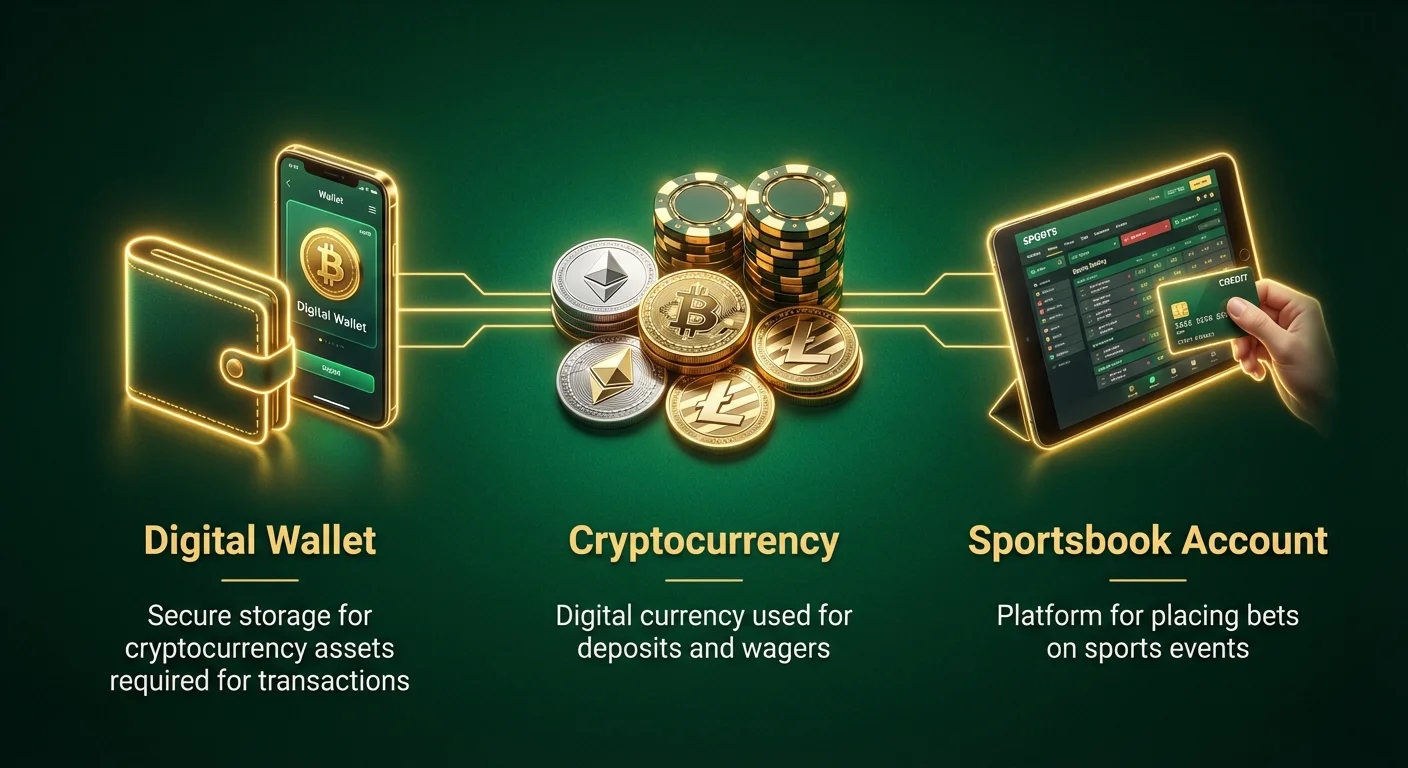
Before you can analyze a matchup or pick a winner, you need the infrastructure to place the bet. Unlike traditional sites that require credit cards and invasive identity checks, crypto betting relies on blockchain transactions.
1. The Digital Wallet
To bet with crypto, you must hold crypto. If you already have assets on an exchange (like Binance, Coinbase, or Kraken), you are halfway there. However, for the best security and seamless connectivity with Web3 sportsbooks, it is recommended to use a personal wallet rather than leaving funds on an exchange, exploring the full spectrum of custody.
- Software Wallets (Hot Wallets): Apps like MetaMask (for Ethereum/Polygon) or Exodus (for Bitcoin/Litecoin) are ideal for daily betting activities. They are user-friendly and offer quick access to funds.
- Hardware Wallets (Cold Wallets): Devices like Trezor or Ledger offer maximum security. While great for storage, they add a step to the betting process as you must physically approve transactions.
2. Choosing Your Currency
Not all coins are created equal in the eyes of a bettor.
- Bitcoin (BTC): The gold standard. High limits, accepted everywhere, but transaction fees can be high during network congestion.
- Ethereum (ETH): Widely accepted, but "gas fees" (transaction costs) can eat into small bankrolls.
- Litecoin (LTC) & Dogecoin (DOGE): The unsung heroes of crypto betting. They offer lightning-fast transaction speeds and negligible fees, making them perfect for smaller wagers.
- Stablecoins (USDT/USDC): These are pegged to the US Dollar. Betting with stablecoins is a massive strategic advantage because it protects your bankroll from market volatility. You don't want to win your sports bet but lose money because the price of Bitcoin crashed by 10% during the game.
Navigating the Interface: Anatomy of a Crypto Sportsbook
When you first log in to a crypto betting site, the screen can look like a stock market terminal. It is dense with numbers, fluctuating percentages, and jargon. Let's break down the three distinct zones you will interact with.
The Sidebar (The Menu)
On the left side of most desktop interfaces (or the hamburger menu on mobile), you will find the sport selection.
- Top Leagues: Usually pinned to the top (NFL, NBA, Premier League, UFC).
- Live/In-Play: These are games currently happening. As a beginner, avoid these for your first bet. The odds move too fast, and it is easy to make a mistake.
- A-Z Sports: The full catalog, ranging from Tennis to obscure markets like Table Tennis or eSports.
The Dashboard (The Odds)
The center of the screen displays the matches. You will typically see the two teams playing, the start time, and three columns of numbers. These columns represent the three main bet types: Moneyline, Spread, and Total.
The Bet Slip (The Checkout)
Usually located on the right side or popping up from the bottom on mobile. This is your shopping cart. Nothing happens until you confirm the bet here. The slip will calculate your potential payout based on your stake.
Decoding the Odds: American vs. Decimal
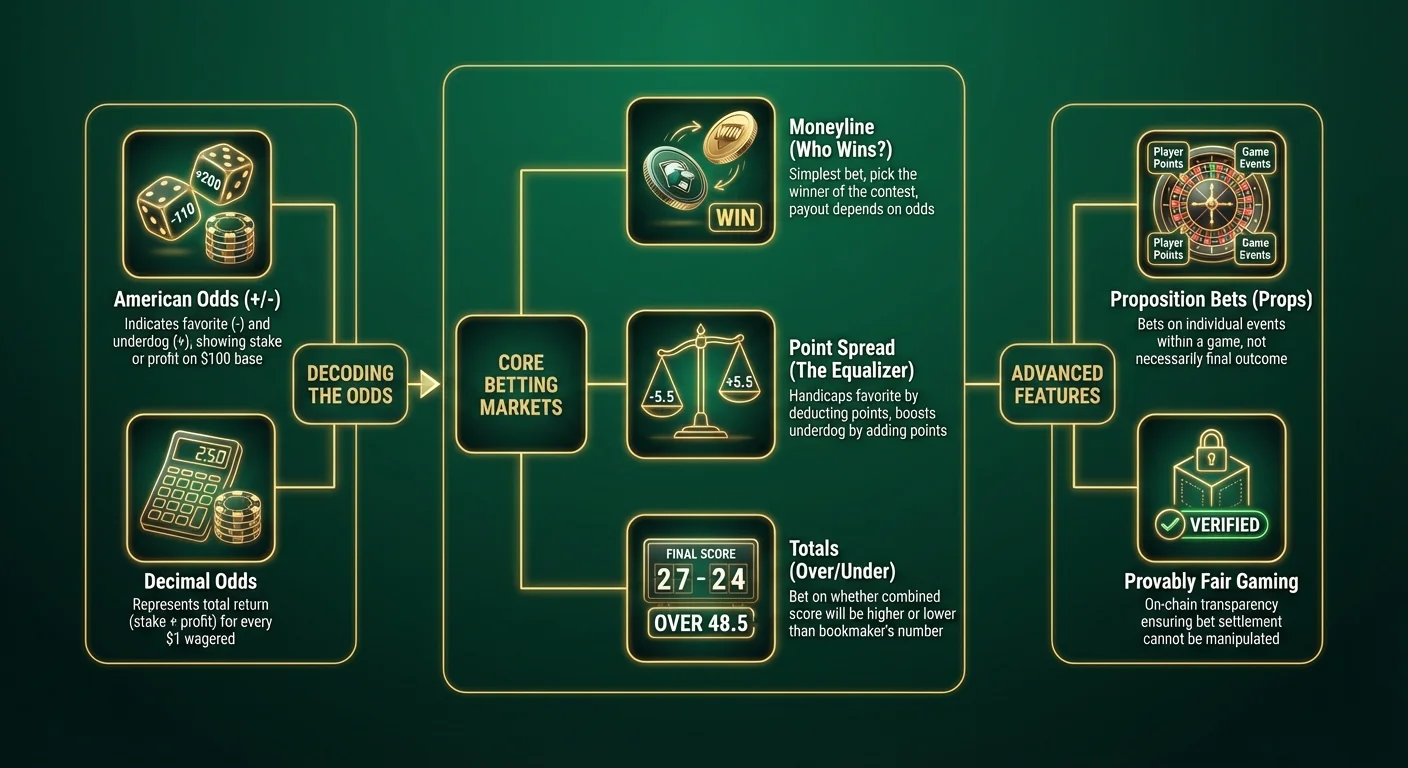
One major difference in bitcoin betting is that many platforms cater to a global audience and default to Decimal Odds (e.g., 1.90), whereas US-based bettors are used to American Odds (e.g., -110). Understanding both is crucial, including how to read different betting odds formats.
American Odds (+/-)
- The Minus (-): Indicates the favorite. The number shows how much you must bet to win $100.
- Example: -150 means you bet $150 to win $100 profit.
- The Plus (+): Indicates the underdog. The number shows how much you win on a $100 bet.
- Example: +200 means you bet $100 to win $200 profit.
Decimal Odds
These are much easier to calculate mathematically. The number represents the total return (stake + profit) for every $1 wagered.
- Calculation: Stake x Decimal Odd = Total Payout.
- Example: A $100 bet at 2.50 odds returns $250 ($150 profit + $100 stake).
Quick Conversion Table
| Concept | American Odds | Decimal Odds | Implied Probability |
|---|---|---|---|
| Heavy Favorite | -400 | 1.25 | 80% |
| Standard Favorite | -110 | 1.91 | 52.4% |
| Even Money | +100 | 2.00 | 50% |
| Small Underdog | +150 | 2.50 | 40% |
| Longshot | +400 | 5.00 | 20% |
The Big Three: Core Betting Markets
Now that you can read the board, it is time to choose your weapon. 90% of professional sports betting volume occurs on these three specific wager types.
1. The Moneyline (Who Wins?)
This is the simplest bet in sports. You are simply picking the winner of the contest. If your team wins, you get paid.
- Strategy: While picking a massive favorite (e.g., Manchester City vs. a relegation team) seems safe, the payout is often tiny. Conversely, betting heavy underdogs is high risk. The "sweet spot" for value is often finding slight underdogs you believe have a tactical advantage.
- Draw Note: In sports like Soccer (Football), there is a "3-Way Moneyline" which includes the Draw. If you bet on Team A to win and they draw, you lose. Be careful to check if "Draw No Bet" is available if you want to eliminate the tie scenario.
2. The Point Spread (The Equalizer)
Bookmakers created the spread to make uneven games interesting. They handicap the favorite by deducting points and boost the underdog by adding points.
- The Favorite (-): If the LA Lakers are -5.5, they must win by 6 or more points.
- The Underdog (+): If the Miami Heat are +5.5, they need to win the game outright OR lose by 5 or fewer points.
- The Hook: You will often see half-points (.5). This ensures there is no "push" (tie). One side will always win, and one will always lose.
Why bet the spread? It allows you to bet on a great team but get better odds (usually around -110 / 1.91) compared to the terrible payout of a Moneyline favorite.
3. The Totals (Over/Under)
Sometimes, you don't know who will win, but you know how the game will be played. Will it be a defensive slugfest or a high-scoring shootout?
- Over: You bet that the combined score of both teams will be higher than the bookmaker's number.
- Under: You bet the combined score will be lower.
- Example: In an NFL game with a Total of 48.5, a score of 27-24 (51 total points) is a win for the Over.
Advanced Crypto Features: Provably Fair & Props
Since you are betting on a crypto sportsbook guide compliant platform, you may encounter features not found in Vegas.
Proposition Bets (Props)
These are bets on individual events within a game that don't necessarily affect the final outcome.
- Player Props: "LeBron James Over/Under 25.5 Points."
- Game Props: "Will there be a safety?" or "Total Corner Kicks."
Props are excellent for beginners because they are easier to research. It is easier to predict that a star quarterback will throw for yards against a bad defense than it is to predict the final score of the game.
Provably Fair Gaming
While mostly applied to casino games (dice, crash), some modern crypto sportsbooks are integrating on-chain transparency for bet settlement. This ensures that the bookmaker cannot manipulate the outcome or retroactively change the odds after the bet is placed, as the "contract" of the wager is recorded on the blockchain (or a hashed version of it).
Step-by-Step: Placing Your First Wager
Let's walk through the physical process of making a bet using Bitcoin or USDT.
Step 1: Deposit Funds
Navigate to the "Cashier" or "Wallet" section. Select your currency (e.g., Bitcoin). The site will generate a unique deposit address and a QR code.
- Crucial: Copy this address exactly. Send funds from your personal wallet to this address. Wait for 1 confirmation (usually 10-60 minutes for BTC, seconds for LTC/SOL).
Step 2: Select Your Market
Find the sport you want (e.g., NBA). Click on the specific game (e.g., Warriors vs. Celtics).
Step 3: Click the Odds
Let's say you like the Celtics on the Moneyline at +130. Click that number. It will instantly highlight and populate your Bet Slip.
Step 4: Enter Stake
On the Bet Slip, enter the amount you want to risk.
- Crypto Note: Many sites allow you to view your balance in Fiat (USD) even if you bet in BTC. This is highly recommended to avoid "decimal blindness" (betting 0.01 BTC thinking it's small, when it's actually hundreds of dollars).
Step 5: Review and Confirm
Check the team, the odds, and the stake one last time. Click "Place Bet."
Once confirmed, the bet is live. You cannot cancel it.
Strategic Fundamentals for Beginners
Knowing how to bet on sports is different from knowing how to win. The house always has an edge (the "vig" or "juice"), but disciplined bettors can find profit.
Bankroll Management: The Golden Rule
Never bet money you cannot afford to lose. In sports betting, we use the term "Unit."
- One Unit = 1% to 2% of your total bankroll.
- If you deposit $1,000 equivalent in crypto, your standard bet size should be $10 to $20.
- The Trap: Do not increase your bet size to chase losses. If you lose three bets in a row, do not bet double on the fourth to "make it back." This is the fastest way to hit zero.
Shopping for Lines
One of the beauties of crypto betting is the ease of moving funds. You should ideally have accounts at 2 or 3 different sportsbooks.
- Site A might have the Chiefs at -3.
- Site B might have the Chiefs at -2.5.
- Betting the -2.5 is significantly better value. Over the course of a year, getting that extra half-point can be the difference between profit and loss.
Understanding "The Vig"
Bookmakers charge a fee on bets. In standard -110 odds, you bet $110 to win $100. If you and a friend bet opposite sides, the book takes $220 total and pays the winner $210. The remaining $10 is the juice or vig. To break even long-term, you must win 52.38% of your bets.
The Crypto Edge: Withdrawals and Privacy
You have placed your bet, watched the game, and won. Now comes the best part of bitcoin betting: the payout.
Speed
Traditional sportsbooks often make you wait 3-5 business days for a bank wire or check. Crypto sportsbooks process withdrawals significantly faster. Automated withdrawals can hit your wallet in minutes. Even manual reviews rarely take more than 24 hours.
Privacy
Many crypto-first sportsbooks operate as "No-KYC" (Know Your Customer) or "Low-KYC" platforms. This means you can often withdraw your winnings without sending photos of your passport or utility bills, provided your behavior hasn't flagged any fraud detection systems. This privacy is a massive draw for bettors who value data security.
Volatility Management
If you win a bet in Bitcoin and the price of Bitcoin drops 5% the next day, your purchasing power drops.
- Tip: If you are betting for income rather than holding crypto long-term, consider withdrawing your winnings into a Stablecoin (USDT/USDC) or converting them immediately upon receipt.
Summary: Your Checklist for Success
Placing your first crypto sports bet is an exciting mix of analysis, risk, and technology. To ensure your experience is smooth, remember these key takeaways:
- Secure Your Setup: Use a private wallet and double-check deposit addresses.
- Start Small: Stick to Moneyline or Spread bets on sports you understand.
- Mind the Maths: Understand that -110 means you risk more than you win.
- Manage the Bankroll: Never bet more than 1-2% of your stack on a single game.
- Enjoy the Speed: Utilize the instant deposit and withdrawal features that only crypto can offer.
Sports betting is a marathon, not a sprint. By utilizing cryptocurrency, you are equipping yourself with the most efficient running shoes on the market. Now, check the odds, find your edge, and place that first wager with confidence.