
Gambling with cryptocurrency offers a unique thrill. Transactions are lightning-fast, anonymity is a major perk, and the potential for massive wins on high-variance slots is enticing. However, playing with Bitcoin, Ethereum, or other digital assets adds a layer of complexity that traditional fiat gamblers don't have to face: asset volatility.
When you spin the reels using USD, a dollar is always a dollar. When you bet with Bitcoin, the value of your bankroll can fluctuate wildly in the middle of your gaming session, regardless of whether you are winning or losing on the slot machine.
This guide is designed for beginners entering the world of crypto slots. We will move beyond basic advice and explore smart betting strategies specifically tailored for volatile currencies. You will learn how to calculate safe bet sizes, how to understand the "double variance" of crypto slots, and how to preserve your stack for the long haul.
The Challenge of Double Volatility
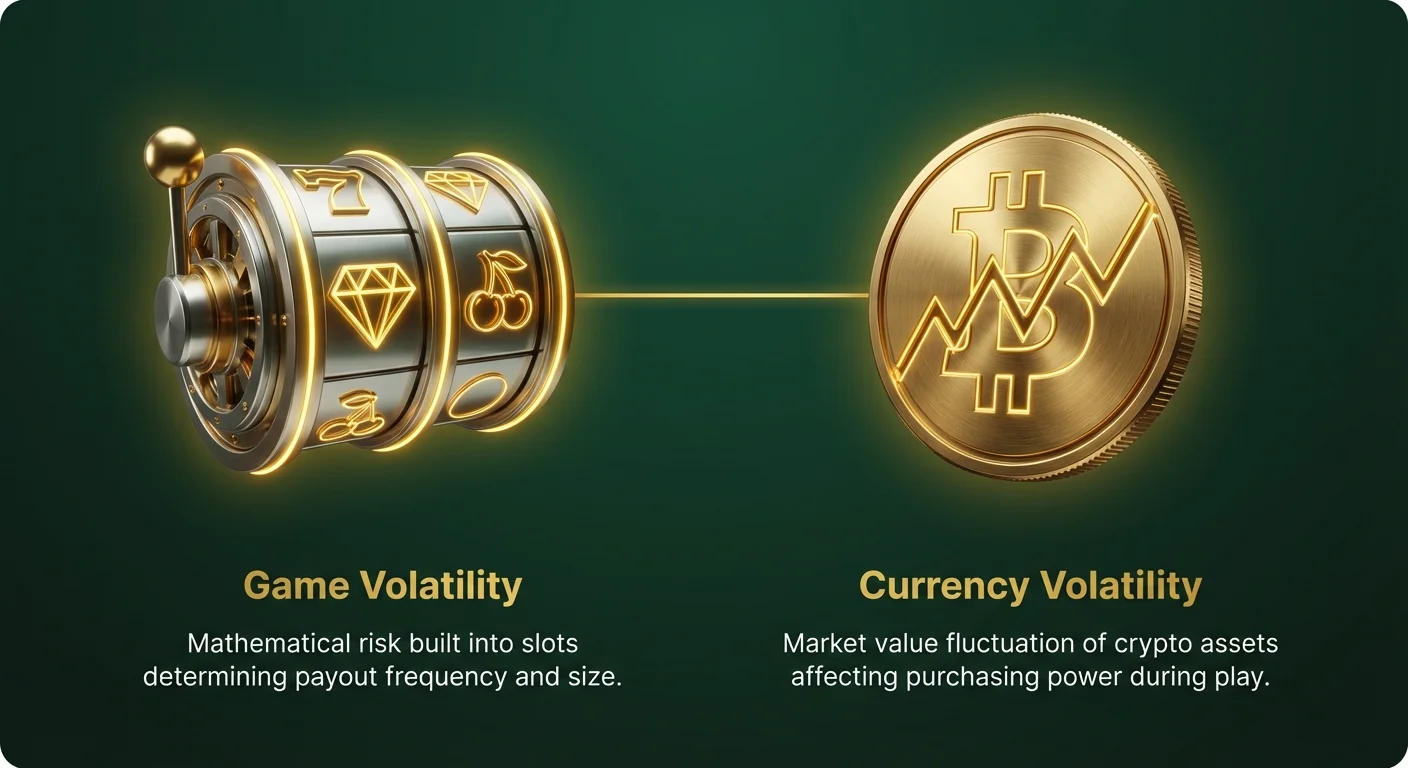
Before diving into the math of bankroll management, understand the environment you are playing in. In crypto gambling, you are battling two forces simultaneously:
- Game Volatility (Variance): This is the mathematical risk built into the slot machine. High-variance slots pay out infrequently but in large amounts; low-variance slots pay out often but in smaller amounts.
- Currency Volatility: This is the market fluctuation of your crypto asset. If Bitcoin drops by 10% while you are playing, your purchasing power has decreased, even if your coin balance stayed the same.
Smart betting means insulating yourself against these swings so that a bad run of luck doesn't wipe out your entire portfolio.
Step 1: Defining Your Crypto Gambling Budget
The golden rule of gambling is universally known: Never bet money you cannot afford to lose. However, in the crypto world, this rule requires a specific calculation method. Because many crypto holders view their coins as investments (HODLing), it can be difficult to mentally separate "investment funds" from "entertainment funds."
The Segregation Method
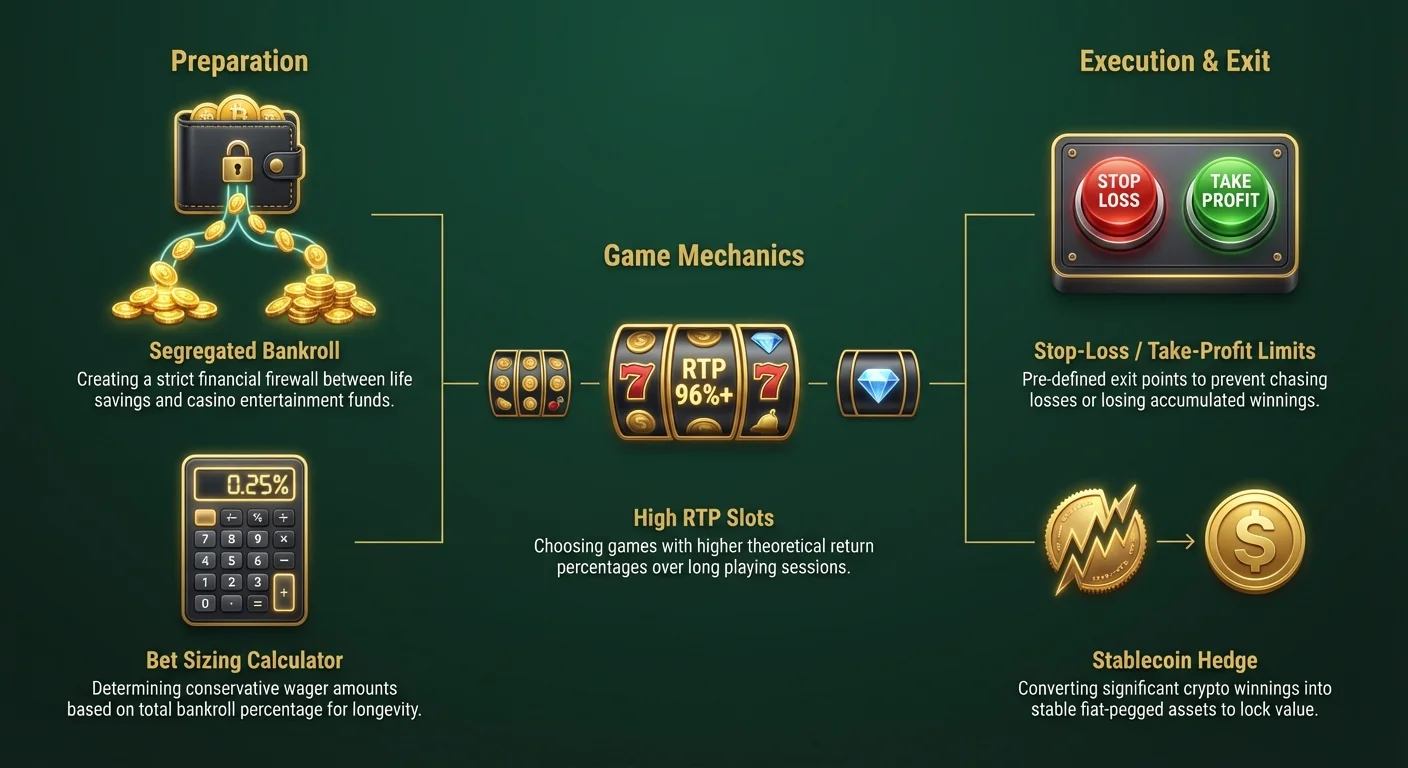
Do not gamble directly from your main hardware wallet or investment exchange account. You must create a "firewall" between your life savings and your casino bankroll.
- Determine Disposable Income: Look at your finances in fiat terms first. How much value are you willing to lose this month? Let's say it is $200.
- Transfer Only that Amount: Move only $200 worth of crypto to the casino wallet.
- The "Write-Off" Mindset: The moment that crypto hits the casino deposit address, mentally write it off as spent. If you win, it's a bonus. If you lose, it was the price of entertainment, prepaid in advance.
Fiat vs. Crypto View
Modern crypto casinos often allow you to toggle your balance display between the crypto unit (e.g., 0.005 BTC) and a fiat equivalent (e.g., $300).
Recommendation for Beginners: Toggle the view to Fiat (USD/EUR).
Human brains are not naturally good at calculating fractions like 0.00045 ETH on the fly. Seeing a balance of $50 drop to $40 triggers a stronger caution response than seeing 0.0025 drop to 0.0020. This visual trick helps you stick to your gambling budget.
Step 2: Calculating Bet Sizes
Once your bankroll is funded, the most key decision you make is your "Unit Size" (the cost per spin). A common mistake beginners make is overestimating how long their crypto will last because the decimal numbers look so small.
The 1% Rule (And Why it's Risky for Slots)
Standard gambling advice suggests betting 1% of your bankroll per hand. In slow games like Blackjack, this works. In slots, where you can spin the reels 15 to 20 times per minute, betting 1% can deplete your funds in under 10 minutes of a cold streak.
The Smart Betting approach for slots:
- Conservative: 0.10% to 0.25% of total bankroll per spin.
- Aggressive: 0.50% of total bankroll per spin.
Bet Sizing Table
Here is a breakdown of recommended bet sizes based on a hypothetical bankroll, ensuring you get enough playtime to weather the volatility.
| Total Bankroll (USD Value) | Conservative Bet (Safe Play) | Aggressive Bet (High Risk) | Estimated Spins (Conservative) |
|---|---|---|---|
| $100 | $0.20 | $0.50 | 500+ |
| $500 | $1.00 | $2.50 | 500+ |
| $1,000 | $2.00 | $5.00 | 500+ |
| $5,000 | $10.00 | $25.00 | 500+ |
Note: In crypto terms, you must constantly recalculate. If 1 BTC = $60,000, a $100 bankroll is roughly 0.0016 BTC. A $0.20 spin is roughly 0.000003 BTC (300 Satoshi).
Understanding Coin Denominations
To manage your bankroll, you must understand the units used by the slot machine.
- mBTC (Milli-Bitcoin): 1/1,000th of a Bitcoin.
- uBTC (Micro-Bitcoin): 1/1,000,000th of a Bitcoin.
- Satoshi: The smallest unit (0.00000001 BTC).
Always double-check the "Coin Value" and "Bet Level" settings before spinning. Hitting "Max Bet" on a crypto slot can instantly wager hundreds of dollars if you aren't paying attention to the denomination.
Step 3: Understanding Slot Variance and RTP
Your bankroll management strategy must change based on the specific game you choose. Not all slots consume money at the same rate.
RTP (Return to Player)
RTP is the theoretical percentage a game pays back over millions of spins. A 96% RTP slot theoretically returns $96 for every $100 wagered.
- Bankroll Tip: Stick to slots with an RTP of 96% or higher. This reduces the "house edge" and extends your playtime.
Volatility (Variance) Profiles
Volatility determines the risk of the specific game.
- Low Volatility: Frequent wins, but small amounts (often less than the bet size). These games sustain your bankroll for a long time. They are excellent for beginners who want entertainment without rapid losses.
- High Volatility: Long periods of "dead spins" (losing) followed by massive wins. These require a much larger bankroll (at least 500x your bet size) to survive the dry spells.
- Jackpot Slots: These have the highest volatility. A portion of every bet goes to the progressive pot, meaning the base game pays out less often. Only play these if you are comfortable losing your session budget quickly for a chance at a life-changing sum.
Pro Tip: If your bankroll drops by 30% in a session, switch from a High Volatility slot to a Low Volatility slot to try and stabilize your balance.
Step 4: Setting Loss Limits and "Take-Profit" Goals
In the world of volatile assets, knowing when to stop is more important than knowing how to play. You need strict exit strategies for both winning and losing scenarios.
The Stop-Loss Limit
This is the absolute floor. If you start with 0.01 BTC, your stop-loss might be 0.005 BTC. If you hit that number, you log out immediately.
- Why it works: It prevents "chasing losses." Chasing losses is the fastest way to drain a wallet, especially when you convince yourself that the machine is "due" for a win (a fallacy known as the Gambler's Fallacy).
The Take-Profit Goal (Key for Crypto)
This is where crypto bankroll management differs from fiat. If you hit a big win in Bitcoin, and then the price of Bitcoin crashes the next day, you have lost value. Conversely, if you win and Bitcoin skyrockets, you have won twice.
The Strategy:
- Set a win goal (e.g., doubling your buy-in).
- Once hit, withdraw the original buy-in amount immediately to your secure wallet.
- Play only with the "house money" (the winnings).
Advanced Move: The Stablecoin Hedge
If you win a significant amount (e.g., $1,000 worth of ETH) and you are worried about market volatility:
- Use the casino's exchange feature (if available) or withdraw to an exchange.
- Convert the winnings into a Stablecoin (USDT or USDC).
- This "locks in" the fiat value of your win, protecting it from a sudden market dip.
Step 5: Managing Bonuses and Wagering Requirements
Crypto casinos are famous for massive deposit bonuses (e.g., "100% Match up to 1 BTC"). While this doubles your bankroll, it can be a trap for your gambling budget.
The Wagering Trap
Bonuses come with "wagering requirements" (rollover). If you deposit $100 and get a $100 bonus with a 35x rollover, you must bet $7,000 ($200 x 35) before you can withdraw any money.
- Bankroll Impact: Your funds are frozen until the requirement is met.
- Smart Betting Advice: If you prefer the freedom to withdraw your remaining bankroll at any time (for example, if the crypto market spikes and you want to sell), decline the bonus. Play with raw cash only. This gives you total control over your assets.
Practical Strategy Checklist for Beginners
To summarize, here is your step-by-step checklist for a smart betting session:
- Check Market Prices: Is your crypto high or low? If it's at an all-time high, consider selling some for stablecoins to gamble with, rather than risking the appreciating asset.
- Set the Session Budget: Transfer only what you can lose to the casino.
- Choose the Right Slot:
- Check RTP (aim for 96%+).
- Check Volatility (Low for longevity, High for jackpot hunting).
- Calculate Bet Size: Ensure your balance can cover at least 300 to 500 spins.
- Set Auto-Play Limits: Most modern slots allow you to set "Stop on Loss" or "Stop on Win" within the auto-spin feature. Use this! It removes emotion from the decision.
- Verify Fairness: Look for "Provably Fair" slots. These allow you to verify the randomness of every spin using cryptographic hashes, ensuring the game isn't rigged against your bankroll.
Summary: Longevity is the Goal
Managing a gambling budget for volatile assets requires discipline. You aren't just playing against the casino edge; you are managing the fluctuations of the crypto market.
By segregating your funds, calculating your bets based on conservative percentages, and using stablecoins to lock in wins, you move from being a "gambler" to a "smart bettor." Remember, the goal of bankroll management isn't to guarantee a win - that's impossible - but to guarantee that you stay in the game long enough to enjoy the experience and potentially catch that lucky streak.
Play smart, keep your keys safe, and never bet more than you can afford to lose.