Walk into any land-based casino, or log into your favorite crypto gambling site, and you will almost always see it: the electronic marquee displaying the "History" of the last 10 to 20 spins. It stands like a beacon, showing a long streak of reds, or perhaps identifying Number 17 and Number 32 as "Hot Numbers," while Number 5 is listed as "Cold."
For the average player, this information is irresistible. The logic seems sound: "Red has hit six times in a row; Black is overdue!" or "Number 17 is on fire, I need to back it."
This line of thinking is the single most expensive mistake in gambling. It is known as the Gambler's Fallacy, and it is the primary reason why roulette tables remain profitable for casinos centuries after their invention.
In this guide, we are going to dismantle the myths surrounding hot and cold numbers. We will explore the mathematics of independent events, explain why pattern recognition is a trap in RNG (Random Number Generator) games, and show you how to shift your strategy from chasing ghosts to managing mathematical risk.
The Psychology of Patterns: Why We Believe the Lie
Humans are biologically wired to recognize patterns. It is a survival mechanism that served us well in nature - recognizing that dark clouds mean rain or that a rustle in the grass means a predator. However, when applied to a game of pure chance like roulette, this instinct backfires.
In a casino environment, this manifests as apophenia - the tendency to perceive meaningful connections between unrelated things. When you see a "Hot Number" board, your brain attempts to construct a narrative where the wheel has a memory and a bias.
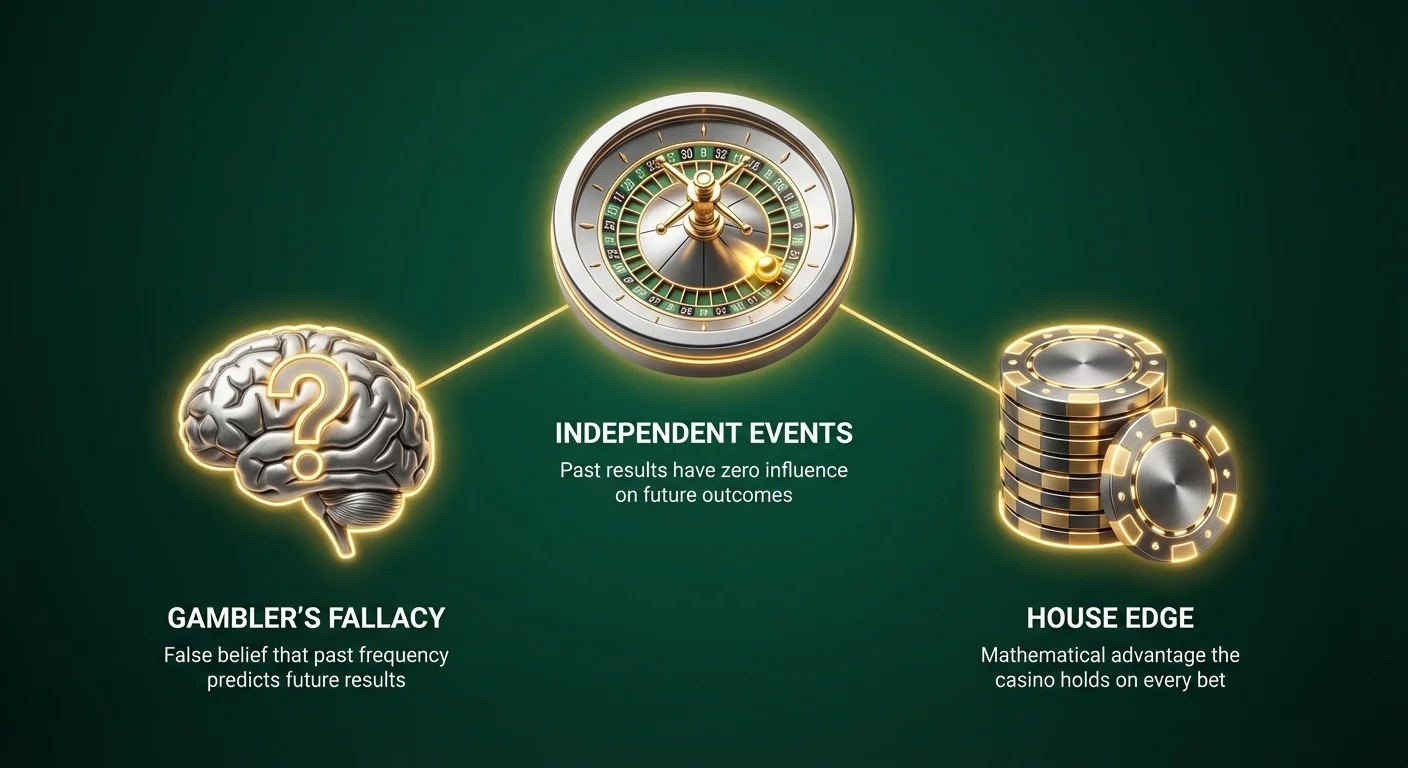
What is the Gambler's Fallacy?
The Gambler's Fallacy (also known as the Monte Carlo Fallacy) is the erroneous belief that if a particular event occurs more frequently than normal during the past, it is less likely to happen in the future (or vice versa).
In roulette, this usually presents itself in two ways:
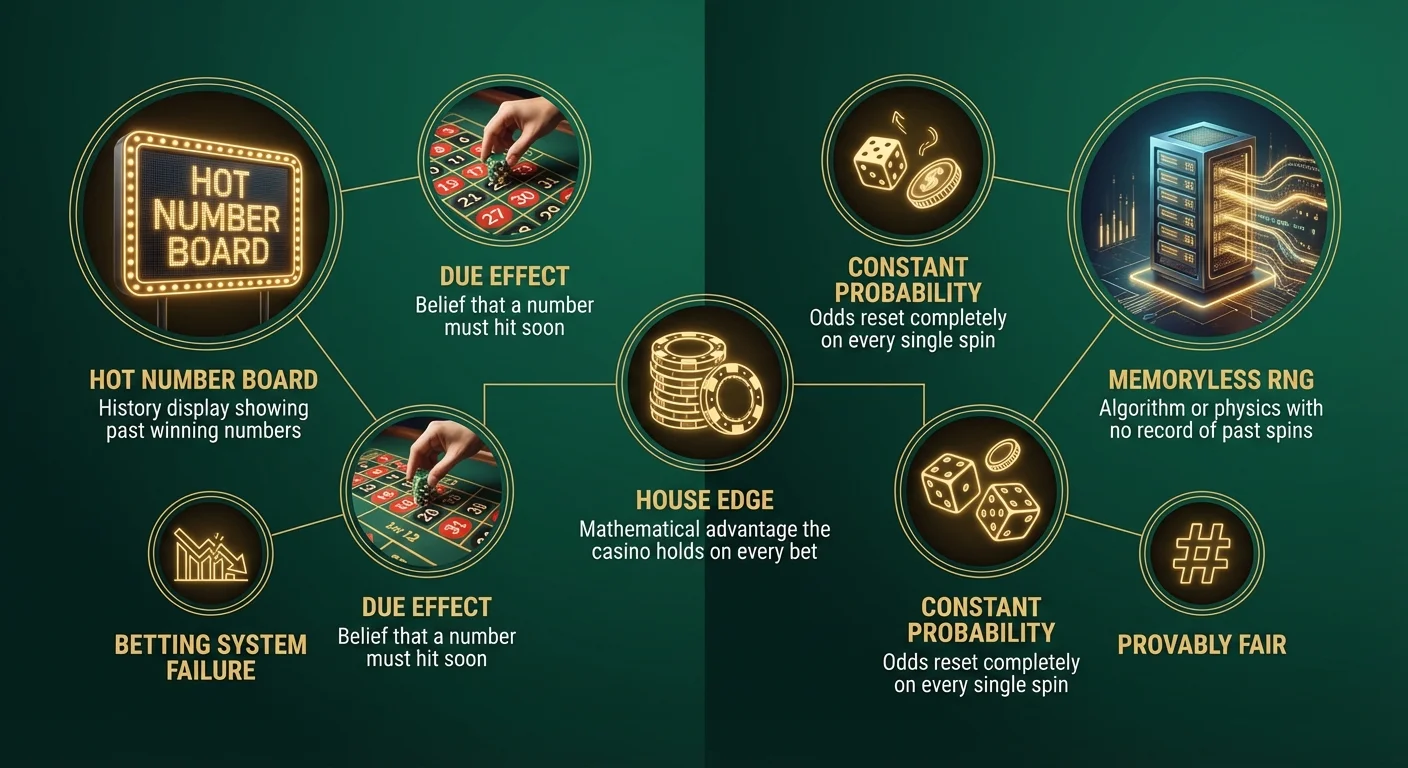
- The "Due" Effect: "Red has hit 10 times in a row, so Black must be next to balance the universe."
- The "Hot" Hand: "Number 23 has hit three times in the last hour; the wheel loves 23 today."
The reality is simple: The roulette wheel has no memory. The ball does not know where it landed on the previous spin, nor does the RNG algorithm care about the seed generated five seconds ago.
The Math: Independent Events vs. Dependent Events
To understand why looking for patterns is a losing strategy, one must distinguish between independent and dependent events.
- Dependent Events: These are events where the outcome of the first action affects the second. Example: Blackjack. If an Ace is dealt to the player, that Ace is removed from the deck. The probability of drawing an Ace on the next card decreases.
- Independent Events: These are events where the previous outcome has zero influence on the next. Example: Roulette.
Every time the dealer spins the wheel, or you click "Spin" on a crypto casino interface, the probability resets completely.
The Probability breakdown
Let's look at the odds of Red vs. Black on a European (single zero) wheel. The probability of hitting Red is approximately 48.6%.
- Spin 1: Probability of Red is 48.6%. Result: Red.
- Spin 2: Probability of Red is still 48.6%. Result: Red.
- Spin 10: After nine consecutive Reds, the probability of the 10th spin being Red is still 48.6%.
While the odds of a streak of 10 Reds occurring before the first spin is incredibly low (roughly 1 in 1,376), once the first 9 spins have happened, they are history. They no longer exist in the equation. The 10th spin is a singular, isolated event with the same 48.6% probability as the first.
Hot and Cold Numbers: Fact or Feature?
If the math proves that past spins don't influence future spins, why do almost all online roulette games feature "Hot" and "Cold" number displays?
The answer is marketing, not mathematics.
These displays are designed to encourage betting action. They provide indecisive players with a "reason" to place a chip. A player who might walk away because they don't know what to bet on will see that "Cold Number 4" and decide to bet on it, believing it is "due."
Analyzing the "Hot" Number Myth
A number is usually designated as "Hot" if it has appeared more frequent than the statistical average over the last X amount of spins (usually 500 or 1000).
In a truly random game, variance is natural. Over a sample of 100 spins, it is statistically normal for some numbers to appear 4 or 5 times while others appear 0 times. This is not evidence of a bias; it is the definition of randomness. Randomness is clumpy, not perfectly evenly distributed in the short term.
The "Cold" Number Trap
Betting on Cold numbers is arguably more dangerous than betting on Hot ones. This strategy relies on the Law of Large Numbers, which states that over an infinite number of trials, the results will average out (e.g., each number hitting 2.7% of the time).
However, "the long run" in mathematics refers to millions or billions of spins. You do not have the bankroll or the time to wait for the law of large numbers to correct a variance. A number can stay "Cold" for thousands of spins simply by chance.
Physical Wheels vs. RNG: The Crypto Context
When playing at CryptoGambling.com recommended sites, you are likely encountering two types of roulette: Live Dealer (Physical) and Software (RNG). It is vital to understand the difference regarding myths.
1. The Physical Wheel (Live Dealer)
In the 19th and 20th centuries, "Hot Numbers" were occasionally real. This was due to Wheel Bias. Imperfections in manufacturing, a slight tilt in the floor, or wear and tear on the frets could cause the ball to favor a specific sector of the wheel.
- Historical Context: In 1873, Joseph Jagger hired clerks to record spins at Monte Carlo. He found a bias in one wheel and won a fortune.
- Modern Reality: Today's casinos (and the studios used by providers like Evolution Gaming or Pragmatic Play) use laser sensors and computer leveling. They rotate wheels daily. The chances of finding a biased wheel in a modern live casino are virtually zero.
2. The RNG Wheel (Provably Fair)
In software-based roulette, the outcome is determined by a Random Number Generator. This is a complex algorithm that produces a sequence of numbers that lacks any predictable pattern.
In the world of Crypto Gambling, this is elevated by Provably Fair technology.
- How it works: Before the spin, the server creates a "seed" (the result) and hashes it (encrypts it) so you can't see it. You also provide a client seed.
- The Result: The spin outcome is a combination of these seeds.
- The Proof: After the spin, you can verify the hash to prove that the casino didn't change the result based on your bet size or the "Hot/Cold" history.
Because the RNG creates a result instantly based on mathematical complexity, "streaks" and "patterns" are purely visual coincidences.
System Failure: Martingale and D'Alembert
Many betting systems are explicitly built on the Gambler's Fallacy. Understanding why they fail is key to protecting your crypto stack.
The Martingale Strategy
The Martingale suggests that if you lose a bet on an even-money proposition (like Red/Black), you should double your bet on the next spin. The theory is that eventually, you must win, and when you do, you will recoup all losses plus a small profit.
Why it fails:
- Table Limits: Every roulette table has a maximum bet. If you hit a losing streak of 7 or 8 spins (which is common), the required bet to cover your losses will often exceed the table limit.
- Bankroll Depletion: The exponential growth of bets is terrifying. Starting with just $10, a streak of 10 losses requires a wager of $10,240 on the 11th spin - just to win your original $10 back.
The D'Alembert System
As noted in historical records, Jean-Baptiste le Rond d'Alembert was a brilliant mathematician who unfortunately fell for the fallacy that bears his name. He believed nature seeks equilibrium. His system involves increasing your bet by one unit after a loss and decreasing it by one unit after a win.
Why it fails:
While less aggressive than the Martingale, the D'Alembert relies on the idea that a session of Red/Black will end with roughly equal amounts of each. In reality, you could easily see 70 Reds and 30 Blacks in a 100-spin session, slowly draining your bankroll as you chase the "equalizer" that never comes.
The Real Numbers: House Edge and Odds
If you want to play intelligently, stop looking at the history board and start looking at the Table Layout. The only numbers that actually affect your long-term winning potential are the House Edge percentages.
The presence of the Zero (and Double Zero) is what gives the casino the advantage. It is not about which number is hot; it is about how many pockets are on the wheel.
Comparison of Roulette Variants
| Variant | Total Pockets | Zeroes | House Edge | Notes |
|---|---|---|---|---|
| French Roulette | 37 | 0 | 1.35% | Assuming "La Partage" rule applies to even-money bets. |
| European Roulette | 37 | 0 | 2.70% | Standard single-zero game. |
| American Roulette | 38 | 0, 00 | 5.26% | The worst odds due to the added "00". |
Strategy Tip: If you are playing online with Bitcoin or other cryptos, you have the luxury of choice. There is never a valid reason to play American Roulette (5.26% edge) when European or French tables are just a click away.
Practical Strategy: Playing Without the Fallacy
So, if patterns are a myth and the house always has an edge, how should you play? The goal is to maximize entertainment and minimize the rate of loss, giving variance a chance to swing in your favor.
1. Ignore the History Board
Mentally put a piece of tape over the history marquee. Treat every spin as the first spin of the day. If you want to bet on Red, do it because you like Red, not because Black has hit five times in a row.
2. The "La Partage" Rule is Your Best Friend
In French Roulette, the La Partage rule states that if you bet on an even-money option (Red/Black, High/Low, Odd/Even) and the ball lands on Zero, you get half your bet back.
- This cuts the house edge from 2.7% down to 1.35%.
- This is statistically superior to any pattern-based strategy you could ever devise.
3. Use Street Bets for Coverage
If you dislike the 50/50 grind of Red/Black, consider Street Bets (betting on a row of 3 numbers).
- The Math: A Street Bet pays 11 to 1. The probability of hitting is 8.1% (European).
- The Strategy: Instead of betting on a "Hot" number straight up (1 in 37 chance), place a Street bet that includes that number. You get better table coverage. As noted in strategy guides, you can cover significant portions of the table (e.g., 4 different streets) to cover 12 numbers while managing volatility better than betting single numbers.
4. Manage Your Bankroll, Not the Pattern
The only thing you can control is how much you bet.
- Set a Loss Limit: If you lose X amount of crypto, stop.
- Set a Win Goal: If you double your buy-in, withdraw the profit.
- Unit Sizing: Your standard bet should be no more than 1% to 2% of your total session bankroll. This allows you to weather the natural variance of the game without going bust on a "cold streak."
Conclusion: The Liberated Player
Debunking the myths of hot numbers and the Gambler's Fallacy doesn't take the fun out of roulette; it actually makes it more enjoyable. When you stop agonizing over patterns that don't exist, you stop feeling like the game is "rigged" when a streak continues against you.
You accept the game for what it is: a thrilling sequence of independent events where anything can happen on any given spin.
Key Takeaways:
- Memoryless: The wheel and the RNG have no memory. Past spins do not influence future results.
- Myth Busting: "Hot" and "Cold" numbers are retrospective descriptions, not predictive tools.
- Game Selection: Always choose European or French roulette over American roulette to mathematically improve your chances.
- Provably Fair: Utilize crypto casinos with Provably Fair technology to ensure that the randomness is genuine, rather than trusting a history board.
Next time you log on to CryptoGambling.com to play, look at the wheel, check the layout, and place your bets based on odds and bankroll - not on the ghosts of spins past.