
Entering the world of sports betting, particularly when using cryptocurrency, is an adrenaline-fueled experience. The transaction speeds are instant, the anonymity is comforting, and the potential to turn a small Bitcoin deposit into a substantial holding is enticing. However, the sports betting landscape is littered with the bankrolls of bettors who thought they could outsmart the system without first mastering the basics.
Whether you are betting with Bitcoin, Ethereum, or USDT, the fundamental rules of sports wagering remain the same. The house has an edge, and that edge is significantly widened when players make preventable mistakes. For rookies, the difference between a fun hobby and a financial nightmare often comes down to discipline and avoiding common pitfalls.
This guide is not about how to pick the winner of the Super Bowl; it is about how to stop beating yourself. We will dismantle the most frequent errors new and experienced bettors make, explaining the psychology behind them and providing actionable strategies to protect your crypto bankroll.
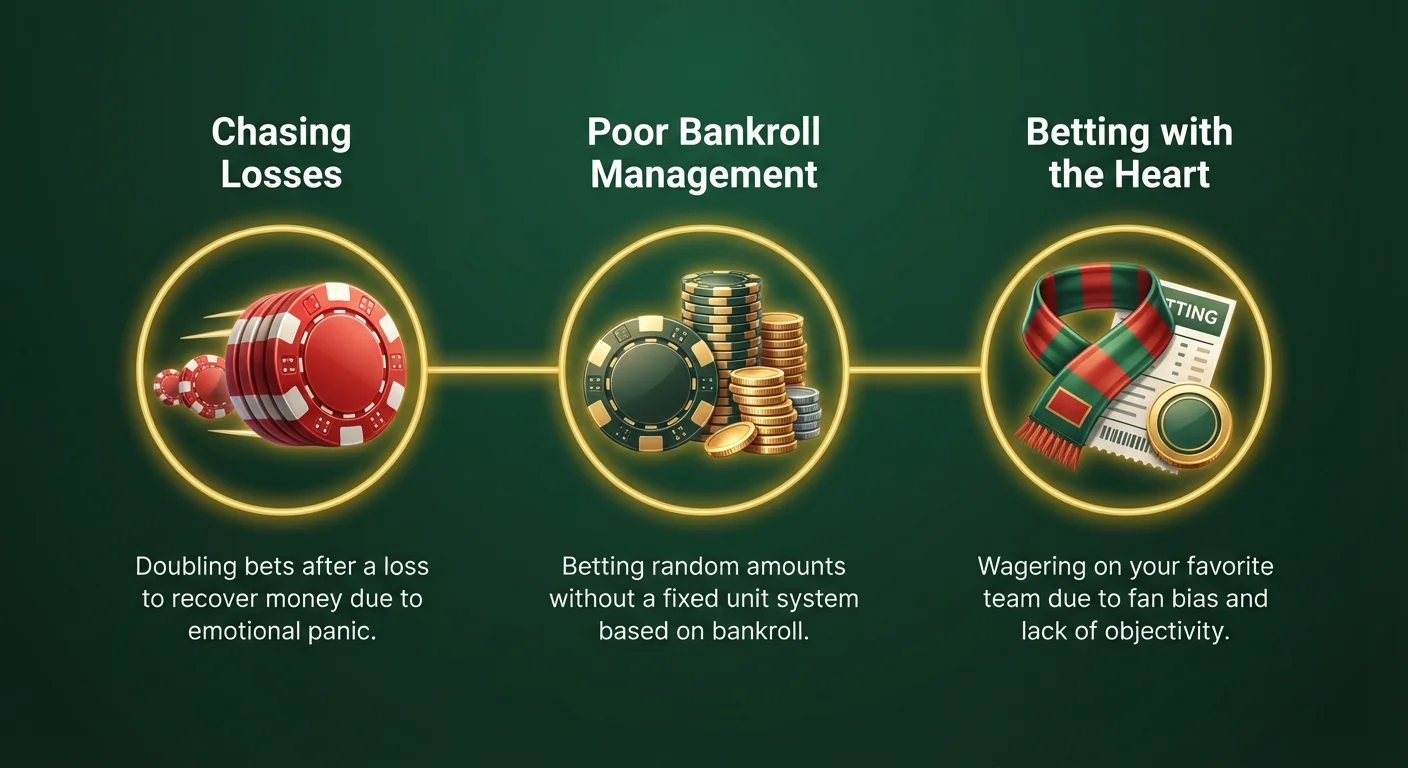
1. The Cardinal Sin: Chasing Losses
If there is one mistake that has bankrupted more bettors than any other, it is chasing losses. This occurs when a bettor suffers a loss (or a streak of losses) and immediately places a larger bet to "win back" the lost money.
The Psychology of the Chase
Chasing is driven by emotion, specifically panic and ego. When you lose a bet, your brain registers it as a financial pain. To alleviate that pain, you convince yourself that the next bet is "due" to hit. This is often referred to as "Tilt" - a term borrowed from poker - where frustration clouds rational judgment, which are classic behavioral finance traps.
The Mathematical Reality
In crypto betting, where transaction limits are high and deposits are fast, chasing is dangerous. Let's look at the "Martingale" strategy, a common chasing method where you double your bet after every loss.
| Bet Number | Stake (mBTC) | Result | Total Loss if Lost |
|---|---|---|---|
| 1 | 1 | Loss | 1 |
| 2 | 2 | Loss | 3 |
| 3 | 4 | Loss | 7 |
| 4 | 8 | Loss | 15 |
| 5 | 16 | Loss | 31 |
Why this fails:
- Bankroll Limits: You eventually run out of funds.
- Table Limits: Sportsbooks have maximum bet limits to prevent this exact strategy.
- The Odds: Losing 5 bets in a row is statistically more common than you think.
How to Fix It: Set a "Stop-Loss" limit. If you lose a certain percentage of your bankroll in a day (e.g., 5%), stop betting. Log off. The games will be there tomorrow.
2. Misunderstanding "Value" vs. "Winners"
Novice bettors ask, "Who is going to win this game?"
Professional bettors ask, "Is there value in this number?"
These are two very different questions. Betting solely on who you think will win, without regarding the odds, is a guaranteed way to lose money long-term. This is because sportsbooks price favorites (the team expected to win) with poor payout odds.
The Coin Flip Analogy
Imagine a fair coin toss (50/50 chance).
- If a bookie offers you odds of 2.00 (+100) on Heads, that is a fair bet.
- If a bookie offers you odds of 1.50 (-200) on Heads, that is a bad bet, even if it lands on Heads.
Over time, if you consistently bet on outcomes where the probability of winning is lower than the implied probability of the odds, you will lose.
How to Calculate Implied Probability
To find value, you must understand what the odds represent in percentage terms.
- Decimal Odds:
- American Odds (-):
- American Odds (+):
The Strategy: Only bet when you believe the team's actual chance of winning is higher than the implied probability offered by the sportsbook.
3. Poor Bankroll Management
In the crypto world, volatility is king. You don't want your betting strategy to add more volatility to your portfolio. The most common technical error is "Variable Staking" - betting random amounts based on how confident you feel.
One day you bet 0.001 BTC, the next day you bet 0.01 BTC because you "have a feeling." If the large bet loses and the small bet wins, you are down money even with a 50% win rate.
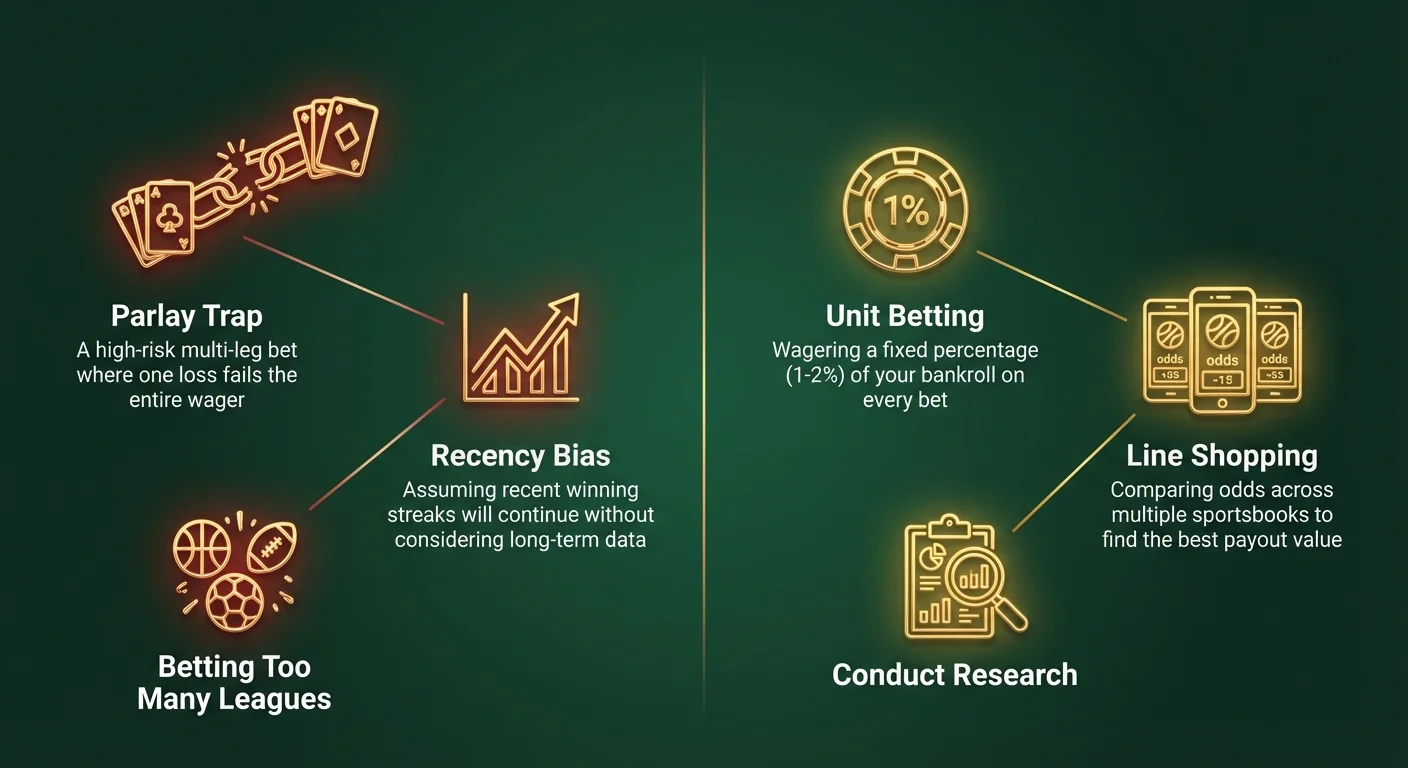
The Solution: Unit Betting
Adopt a "Unit" system. A unit is a fixed percentage of your total bankroll.
- Conservative: 1% per bet.
- Standard: 2% per bet.
- Aggressive: 3-5% per bet (Not recommended for beginners).
Example:
If you deposit $1,000 worth of USDT:
- Your Unit size (1%) = $10.
- Every single bet should be $10.
- Do not deviate.
This protects you from variance. Even if you go on a 10-game losing streak (which happens), you still have 90% of your bankroll left.
4. The Parlay Trap
Sportsbooks love to promote parlays (accumulators). You'll see social media posts of people turning $5 into $5,000. These are lottery tickets, not investments.
Why Parlays are dangerous
A parlay requires every single "leg" of the bet to win. If you bet a 4-team parlay and go 3-1, you lose everything.
Furthermore, the "House Edge" compounds in a parlay.
- On a single bet, the bookie might have a 4.5% edge (the vigorous/juice).
- On a 3-team parlay, that edge can jump to over 12%.
- On a 5-team parlay, the bookie effectively keeps 20%+ of all money wagered over time.
The Fix: Stick to Single Bets. It may seem boring to grind out wins one game at a time, but it is the only way to build a sustainable profit. If you must bet parlays for fun, allocate no more than 0.25 units to them.
5. Betting with the Heart (The "Fan" Bias)
Betting on your favorite team is a recipe for disaster. As a fan, you are incapable of being objective. You will overlook injuries, ignore poor coaching decisions, and overestimate your team's ability because you occupy an emotional space, not a logical one.
Similarly, betting against a rival team because you hate them is equally destructive.
The Rule: never bet on games involving your favorite team. Enjoy the game as a fan. Keep your crypto for games where you are financially invested, not emotionally invested.
6. Crypto-Specific Mistakes
Betting with cryptocurrency introduces a layer of complexity that traditional fiat bettors don't face. Here are errors specific to the blockchain bettor:
A. Ignoring Volatility
Imagine you deposit 0.1 BTC when Bitcoin is trading at $60,000. You bet well and increase your balance to 0.12 BTC. However, during that week, the price of Bitcoin drops to $45,000.
- In BTC terms: You are up 20%.
- In Fiat terms: You have lost purchasing power.
Solution: If you are betting for profit, consider using Stablecoins (USDT, USDC) to maintain a consistent bankroll value. If you are betting to accumulate more Bitcoin regardless of price, stick to BTC.
B. The "Fat Finger" Deposit
Crypto transactions are irreversible. If you send your deposit to the wrong address, or send BCH to a BTC address, that money is gone forever.
Solution: Always copy-paste addresses and check the first 4 and last 4 characters. Use QR codes whenever possible.
C. Bonus Rollover Misunderstandings
Crypto casinos often offer massive welcome bonuses (e.g., "100% match up to 1 BTC"). However, rookies often fail to read the Rollover (Wagering) Requirements.
If the rollover is 40x, you must wager the bonus amount 40 times before you can withdraw a single satoshi. This can lock up your original deposit. Always read the Terms & Conditions.
7. Lazy Research and "Touting"
In the age of social media, everyone is a "capper." Rookies often follow Instagram or Twitter accounts claiming to have "100% Locks" or "Fixed Games."
The Truth About Touts
If someone truly had a system that guaranteed wins, they wouldn't be selling it to you for $50 a month; they would be betting it themselves and living on a private island. Most touts delete their losing picks and only repost their winners to create an illusion of success.
Conducting Your Own Research
Don't bet blindly. Before placing a wager, check:
- Injuries: Is the star player out?
- Motivation: Does this game matter to the team? (End of season tanking is real).
- Schedule: Is the team playing their 3rd game in 4 nights? (Fatigue factor).
- Public Consensus: If 90% of the public is betting on one side, be very careful. The public usually loses.
8. Betting Too Many Leagues (Spray and Pray)
A common Saturday afternoon mistake: Betting on the Premier League in the morning, the NBA in the afternoon, college football in the evening, and UFC at night.
No one can be an expert in everything. Sportsbooks have teams of analysts and algorithms for every sport. You cannot beat them on a broad front.
Specialization is Key. Pick one sport, or even better, one specific conference or league (e.g., NCAA Big Ten Basketball). Learn the teams, the coaches, and the trends inside out. You are more likely to find value in a niche market than in the Super Bowl where the lines are razor-sharp.
9. Failing to "Shop" for Lines
Because crypto allows for near-instant deposits and withdrawals, you have a massive advantage: mobility. Yet, many bettors stick to one single sportsbook.
Imagine you want to bet on the Los Angeles Lakers.
- Site A has the Lakers at -5.
- Site B has the Lakers at -4.5.
If the Lakers win by exactly 5 points, the bettor at Site A pushes (gets money back), while the bettor at Site B wins. Getting that extra half-point is often the difference between a winning and losing season.
Strategy: Open accounts at 2 or 3 reputable crypto sportsbooks. Before placing a bet, check the odds at all of them and take the best price. This is the easiest way to improve your ROI (Return on Investment) without taking any extra risk.
10. Recency Bias
Recency bias is the tendency to think that what just happened will happen again.
- Example: Team A just won three games in a row by 20 points. You assume they are unstoppable and bet heavily on them.
- Reality: The market has likely over-adjusted, making Team A overpriced.
Sports are cyclical. Hot teams cool down; cold teams regress to the mean. Don't bet on a team just because they looked good on TV last night. Look at the season-long data.
Practical Checklist: How to Bet Like a Pro
To summarize, here is your pre-game checklist to avoid rookie errors:
- Bankroll Check: Is this bet within my 1-2% unit size?
- Value Check: Am I betting this because I think they will win, or because the odds are wrong?
- Head Check: Am I chasing a loss from earlier today? Am I betting on my favorite team?
- Research Check: Have I checked the injury report and starting lineups?
- Market Check: Have I compared odds at different sportsbooks to get the best line?
Conclusion
Sports betting is a marathon, not a sprint. The house relies on you making mistakes - betting with emotion, chasing losses, and ignoring math - to make their profit. By eliminating these common errors, you drastically reduce the sportsbook's edge.
Protect your crypto. Treat your betting bankroll like an investment portfolio, not a slot machine. Discipline, patience, and value-hunting are the only "systems" that work in the long run. Start small, track your bets, and learn from every loss.