
Tennis is unique among major sports. Unlike football or basketball, where the accumulation of points determines the winner in a linear fashion, tennis is segmented. A player can win more points or even more games than their opponent and still lose the match. This unique scoring structure opens the door to some of the most profitable and strategic betting markets in the world of sports gambling: Set Betting and Game Handicaps.
For the intermediate bettor, moving beyond the simple "Match Winner" (Moneyline) market is the first step toward professional-level profitability. Moneyline odds on top-tier favorites like Novak Djokovic or Iga Swiatek are often negligible, offering little value for the risk involved. Conversely, backing an underdog to win outright is often a bridge too far.
This is where alternative markets shine. By utilizing game spreads and correct score markets, you can manipulate the risk profile of your wager to find true value. Whether you are betting with Bitcoin, Ethereum, or stablecoins, understanding these mechanics will allow you to leverage the speed and liquidity of crypto sportsbooks to your advantage.
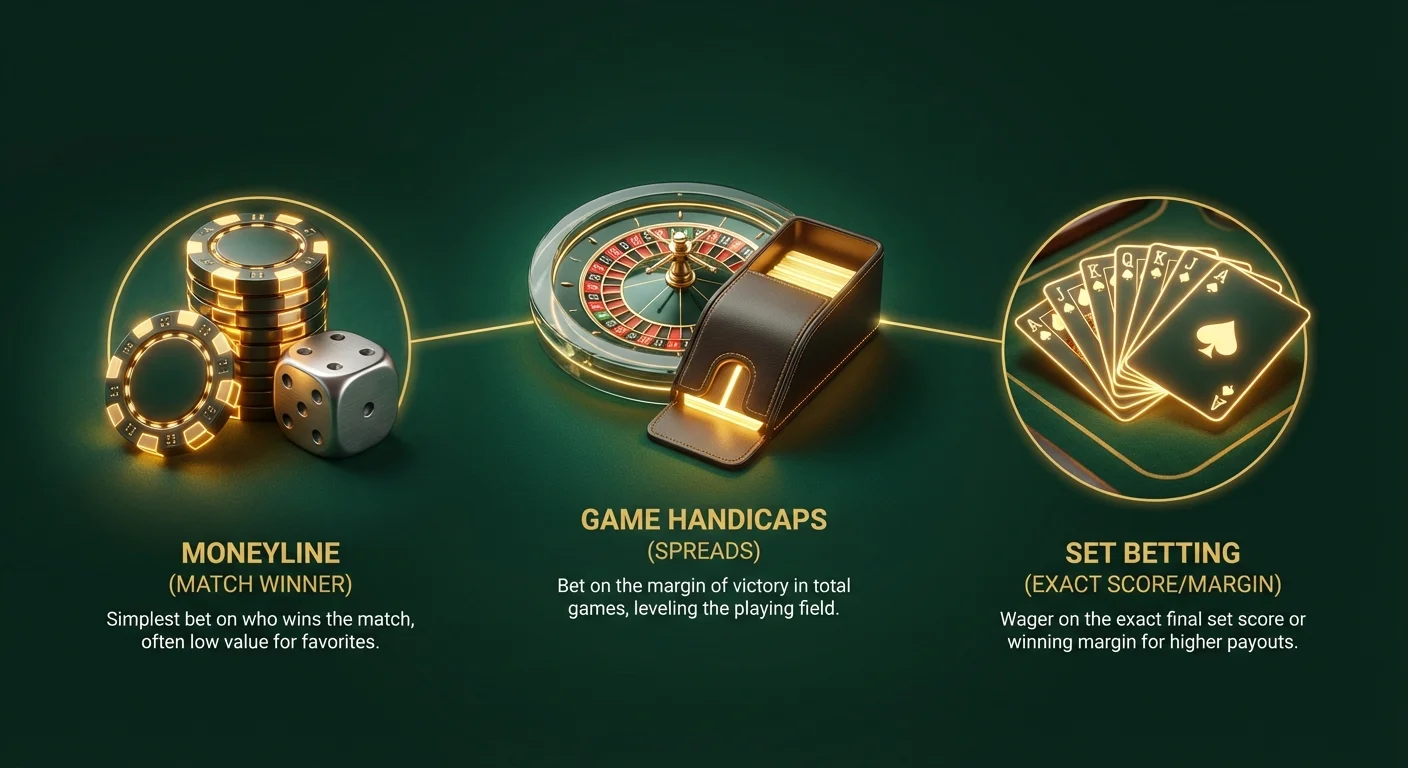
The Problem with the Moneyline
Before diving into handicaps, it is essential to understand why you are moving away from the Moneyline. In early rounds of Grand Slams or Masters 1000 events, you will frequently see odds like 1.10 (-1000) for a favorite. To make a $100 profit, you have to risk $1,000. In a sport where a twisted ankle or an "off day" can happen instantly, the risk-to-reward ratio is poor.
To find better odds (e.g., 1.90 or -110), you need to look at how the player wins, not just if they win. This is the realm of handicaps and set betting.
Understanding Tennis Game Handicaps
The Game Handicap is the most popular alternative market in tennis. It functions similarly to the point spread in the NFL or NBA but is based on the total number of games won by each player by the end of the match.
The bookmaker sets a "line" (the handicap) to level the playing field between the favorite and the underdog.
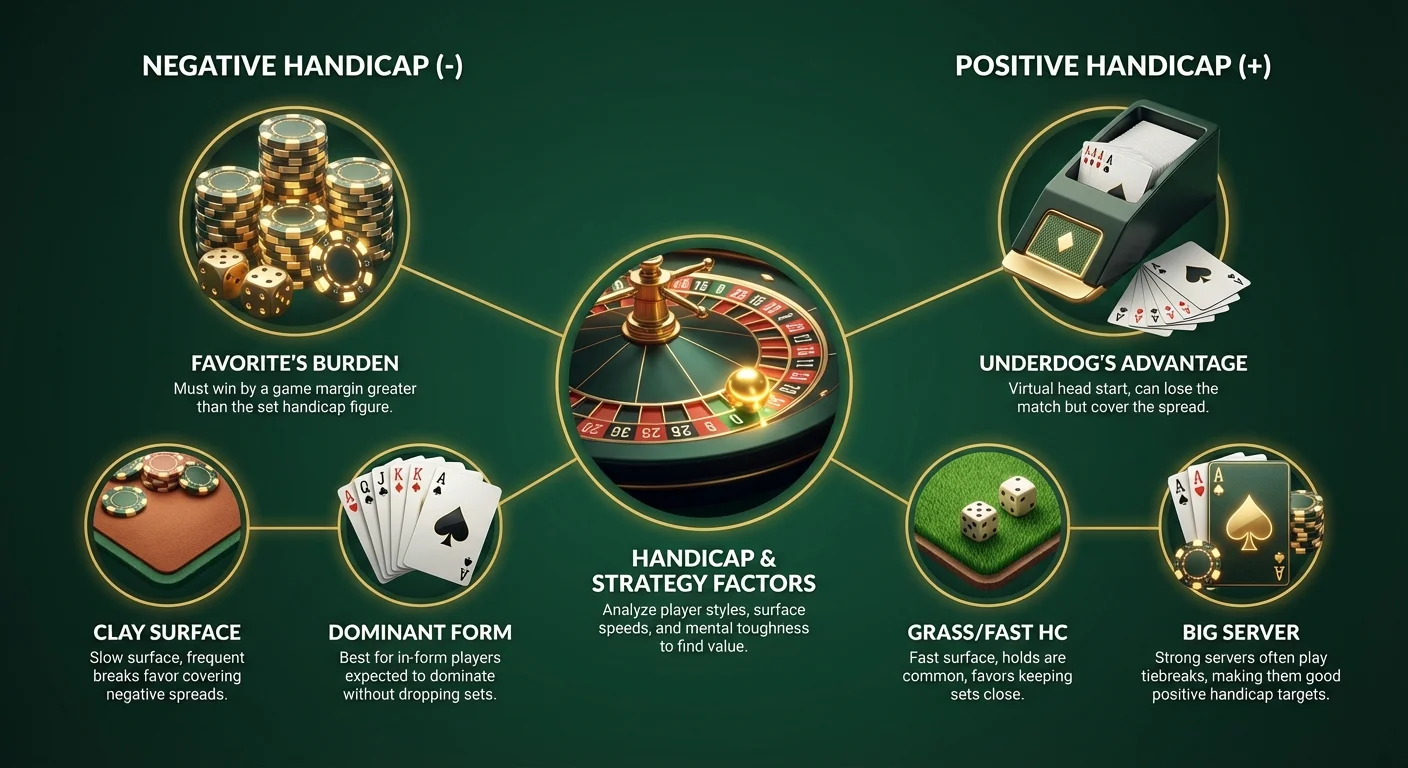
The Negative Handicap (-)
This is assigned to the favorite. They must win by a margin of games greater than the handicap figure.
- Example: Alcaraz (-4.5 games) vs. Tiafoe
- Result: Alcaraz wins the match 6-4, 6-4.
- The Math: Alcaraz won 12 games; Tiafoe won 8 games.
- Differential: 12 - 8 = 4.
- Outcome: 4 is not greater than 4.5. The bet loses.
If Alcaraz had won 6-3, 6-3, the differential would be 6 games, covering the -4.5 spread comfortably.
The Positive Handicap (+)
This is assigned to the underdog. They are given a virtual head start.
- Example: Ruud (+3.5 games) vs. Nadal
- Result: Nadal wins the match 7-6, 6-4.
- The Math: Nadal won 13 games; Ruud won 10 games.
- Differential: 13 - 10 = 3.
- The Adjustment: Ruud's 10 games + 3.5 handicap = 13.5.
- Outcome: 13.5 > 13. The bet wins.
The "Winning Loser" Scenario
One of the most fascinating aspects of Game Handicaps is that your player does not need to win the match to cover the spread.
Imagine you bet on a heavy server like John Isner or Reilly Opelka with a +2.5 game handicap.
- Score: The opponent wins 7-6, 7-6.
- Games: Opponent (14) - Your Player (12).
- Differential: 2 games.
- Outcome: Your +2.5 bet wins, even though your player lost in straight sets.
This makes the game handicap market an excellent tool for backing underdogs who have strong serves and are difficult to break, even if they aren't quite good enough to win the match outright.
Deep Dive: Tennis Set Betting
While game handicaps focus on the micro-battles, Tennis Set Betting focuses on the macro-result. This market allows you to predict the exact final score in sets or the margin of victory.
Set Handicap
This is simpler than game handicaps. It usually revolves around the line of 1.5 sets.
-1.5 Sets (The Favorite): You are betting that the favorite will win in straight sets (2-0 in ATP/WTA best-of-3 matches, or 3-0/3-1 in Grand Slam best-of-5 matches, though usually -1.5 in Slams implies winning 3-0 or 3-1).
- Risk: If they drop a single set, the bet loses.
- Reward: Significantly higher odds than the Moneyline.
+1.5 Sets (The Underdog): You are betting that the underdog will win at least one set. They can lose the match 2-1, and your bet still cashes.
- Strategy: This is ideal for "grinders" or players who are known to fight hard but might lack the stamina to close out a top-tier opponent.
Tennis Correct Score
This is the high-variance, high-reward sector of tennis betting. You are predicting the exact set scoreline.
Common Markets for Best-of-3 Matches (ATP/WTA):
- 2-0
- 2-1
- 0-2
- 1-2
Common Markets for Best-of-5 Matches (Grand Slams):
- 3-0
- 3-1
- 3-2
- 0-3
- 1-3
- 2-3
Predicting a 3-2 victory in a Grand Slam final often yields massive odds (e.g., 6.00 to 9.00). However, this requires a deep understanding of player psychology and fitness levels.
Market Comparison: Risk vs. Reward
To visualize which market suits your strategy, refer to the table below.
| Market | Difficulty | Risk Level | Potential Payout | Best Used For |
|---|---|---|---|---|
| Moneyline | Low | Low | Low | Parslays or Toss-up matches |
| Set Handicap (-1.5) | Medium | Medium | Medium | Dominant favorites on preferred surfaces |
| Game Handicap (+) | Medium | Medium | Medium | Big servers playing against superior returners |
| Game Handicap (-) | High | High | High | Favorites expected to blowout opponents (e.g., 6-2, 6-2) |
| Correct Score | Very High | Very High | Very High | Precision sniper bets; finding value on specific outcomes |
Strategies for Handicap and Set Betting
Success in these markets requires more than just knowing who the better player is. You must understand playing styles and surface speeds.
1. The "Big Server" Paradox
Players who serve massive aces but have poor return games (e.g., Hurkacz, Isner, Kyrgios in his prime) are nightmares for Negative Game Handicaps. Even if they are vastly superior, they tend to play tiebreaks (7-6).
- Scenario: Favorite wins 7-6, 7-6.
- Game Differential: +2 games.
- Result: Fails to cover a -2.5, -3.5, or -4.5 spread.
Strategy: When a dominant server plays a decent opponent, look to bet the Underdog on the Game Handicap (+) or take the Over on Total Games. Avoid backing the server on a negative game handicap.
2. Surface Specialists (Clay vs. Grass)
Surface dictates the margin of victory.
Clay: The surface is slow. Breaks of serve are frequent. It is easier for a superior player to break a weaker player multiple times.
- Betting Angle: Look for Negative Game Handicaps (-) on heavy favorites (e.g., Nadal or Alcaraz on clay). Scores like 6-1, 6-2 are common.
Grass/Fast Hard Court: The surface is fast. Holding serve is easier. Breaks are rare.
- Betting Angle: Look for Positive Game Handicaps (+) on underdogs. Even if they lose, they are likely to keep the sets close (6-4 or 7-5).
3. The "Slow Starter" Strategy (Live Betting)
Some top players are notorious for starting slow, dropping the first set, and then storming back to win.
- Strategy: If a favorite like Djokovic or Medvedev loses the first set, the live odds for them to win 2-1 (Correct Score) skyrocket. If you believe in their fitness and mental toughness, this is a prime value spot.
4. Backing the "Mental Collapse"
In the WTA (Women's Tour) specifically, momentum swings can be drastic. It is not uncommon to see a scoreline of 6-0, 0-6, 6-2.
- Strategy: If you are betting on a volatile player, avoid high negative game handicaps (-5.5), as one bad set ruins the math. Stick to Moneyline or -1.5 Set Betting if you are confident they will win, as the total games might not reflect the winner.
The Crypto Advantage in Tennis Betting
Why trade these markets using cryptocurrency? The nature of tennis betting pairs perfectly with the benefits of blockchain technology.
1. Instant Settlement and Turnover
Tennis matches happen around the clock, globally. If you win a bet on the Australian Open (morning), you want those funds available immediately for the European swing (afternoon). Traditional fiat sportsbooks can take days to process withdrawals. Crypto sportsbooks often offer instant automated payouts, allowing you to compound your bankroll daily.
2. Micro-Betting and Limits
Because crypto allows for divisibility (Satoshis), you can make precise wagers on high-odds markets like Correct Score without breaking the bank. Furthermore, top crypto sportsbooks generally offer higher betting limits than soft fiat books, which is crucial if you find a high-value handicap line and want to maximize it.
3. Privacy and Global Access
Tennis is a global sport. You might be watching a tournament in Tokyo while sitting in a region with strict banking regulations. Using Bitcoin or USDT bypasses banking restrictions, ensuring you never miss a value line due to a declined credit card transaction.
Calculating Value: A Practical Example
Let's look at how to identify value using a hypothetical match: Sinner vs. De Minaur.
Moneyline: Sinner is 1.25 (-400). Implied probability: 80%.
- Verdict: Too expensive.
Analysis: Sinner is in great form, but De Minaur is a "backboard" who returns everything. Sinner will likely win, but De Minaur will make him work for it. You expect a scoreline like 6-4, 7-5.
Option A: Set Betting (-1.5 Sets) @ 1.80
- Requires Sinner to win 2-0.
- Risk: If De Minaur nicks a set, you lose.
Option B: Game Handicap (Sinner -3.5) @ 1.90
- Requires Sinner to win by 4 games.
- Scoreline 6-4, 7-5 = 13 games vs 9 games. (Difference of 4).
- Verdict: This bet wins.
Option C: Game Handicap (De Minaur +4.5) @ 1.85
- Requires De Minaur to stay within 4 games.
- Verdict: If the score is 6-4, 6-4, De Minaur loses by 4. The +4.5 handicap covers.
The Decision: If you respect De Minaur's ability to hold serve, Option C is the safest play. Even if Sinner dominates 6-3, 6-4, De Minaur loses by 5, and you barely lose. But if it's 7-6, 6-4, you win easily.
Common Pitfalls to Avoid
As you venture into these markets, beware of these common intermediate mistakes:
- The Retirement Trap: Different sportsbooks have different rules for retirements.
- Rule A: Bet stands if one set is completed.
- Rule B: Match must be fully completed for action.
- Handicap Implication: Generally, if a player retires, handicap bets are voided because the total games cannot be calculated. However, always check the T&Cs of your specific crypto sportsbook.
- Ignoring Dead Rubbers: In round-robin tournaments (like the ATP Finals) or Davis Cup, a player might have already qualified or been eliminated. Their motivation to cover a -4.5 handicap drops significantly.
- Chasing High Odds on Correct Score: Betting on a 3-2 result is fun, but it is a lottery ticket. Do not make this your primary strategy. Use it for small "sprinkle" bets only.
- Ignoring Weather: High wind neutralizes skill gaps. It makes holding serve harder and leads to messier, closer matches. This favors the Plus (+) Handicap.
Summary and Key Takeaways
To elevate your tennis betting from casual to calculated, you must embrace the nuance of the game.
- Use Game Handicaps to find value on favorites without paying the Moneyline premium, or to back underdogs who will fight hard but ultimately lose.
- Use Set Betting (-1.5) when backing a dominant favorite on their preferred surface against an inconsistent opponent.
- Analyze the Surface: Back negative spreads on Clay; back positive spreads on Grass.
- Know the Server: Don't bet negative game handicaps on tiebreak-prone servers.
- Leverage Crypto: Use the speed of crypto transactions to react to markets and rotate your bankroll efficiently across global time zones.
Tennis is a game of points, but betting on tennis is a game of prices. By mastering handicaps and set betting, you stop hoping for a player to win and start capitalizing on how the match unfolds.