
Imagine a scenario where the world's best NFL team is playing against the league's worst performing squad. If the sportsbook only offered a simple "who will win" wager - known as a Moneyline, betting would be nonexistent. Everyone knows the favorite will likely win, but the payout would be so small (perhaps risking $100 to win $1) that it isn't worth the risk. Conversely, betting on the underdog feels like throwing money away.
This is the fundamental problem that Point Spread betting solves. It is the great equalizer of sports gambling, designed to level the playing field between two mismatched opponents. By assigning a handicap to the favorite and an advantage to the underdog, oddsmakers create a scenario where the betting interest is theoretically split 50/50.
For beginners entering the world of crypto sports betting, understanding the spread is the first true step toward becoming a profitable handicapper. While Moneyline betting asks "who will win," spread betting asks "how much will they win by?"
In this guide, we will dismantle the mechanics of the point spread, explain how to read the odds, and provide actionable strategies to help you beat the bookies using your preferred cryptocurrency.
What is Point Spread Betting?
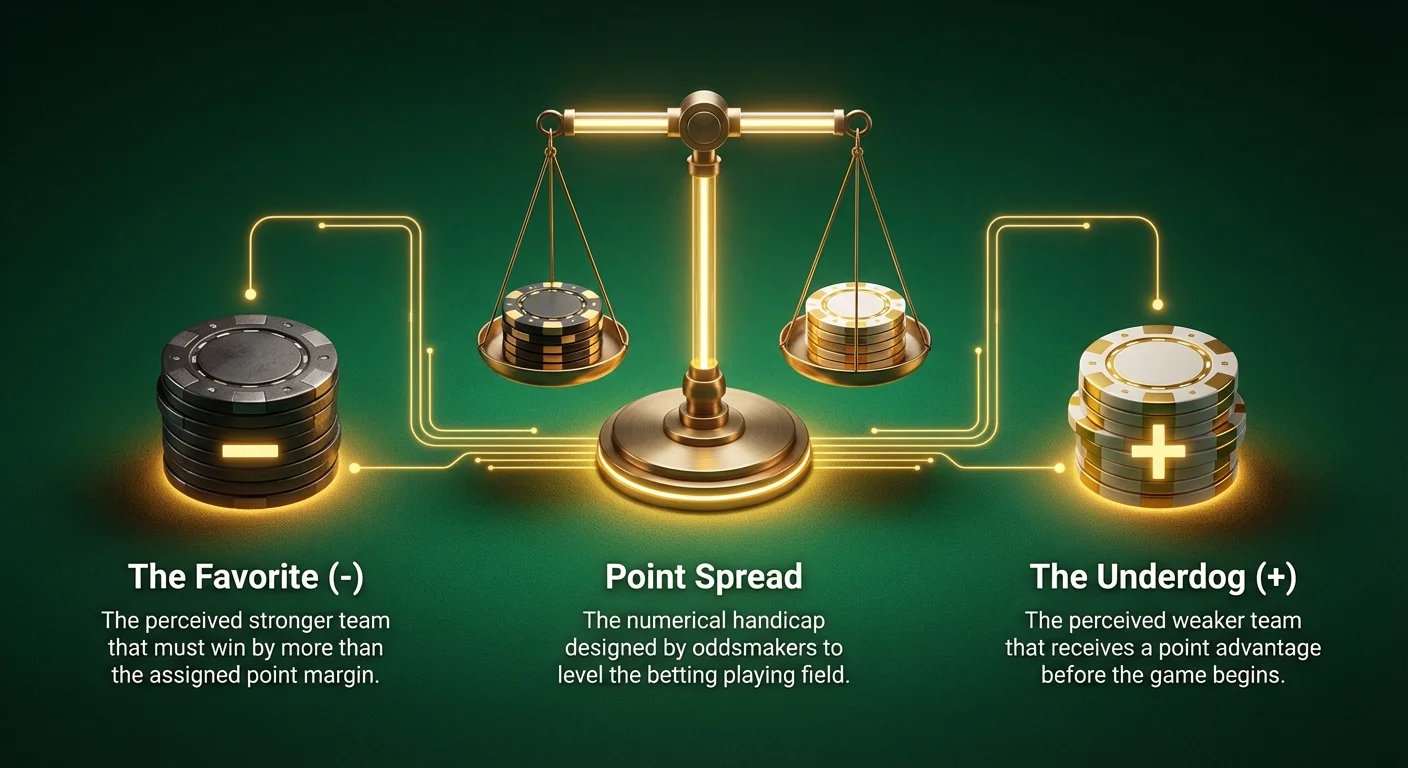
At its core, a point spread is a margin of victory projected by the sportsbook. It acts as a handicap. To win a spread bet, you aren't just picking a winner; you are betting on a team to outperform the expectations set by the oddsmakers.
When you look at a crypto sportsbook interface, the point spread is usually displayed with two symbols:
- The Minus (-): Indicates the Favorite. This team must win by more than the indicated number of points.
- The Plus (+): Indicates the Underdog. This team must either win the game outright OR lose by less than the indicated number of points.
A Practical Example
Let's look at a hypothetical NFL matchup between the Kansas City Chiefs and the Las Vegas Raiders.
The Line:
- Kansas City Chiefs -6.5
- Las Vegas Raiders +6.5
Scenario A: Betting the Favorite (Chiefs -6.5)
To win this bet, the Chiefs must subtract 6.5 points from their final score and still have more points than the Raiders. Practically, this means they must win by 7 points or more.
- Score: Chiefs 27, Raiders 20. (27 - 6.5 = 20.5). 20.5 > 20. You win.
- Score: Chiefs 24, Raiders 20. (24 - 6.5 = 17.5). 17.5 < 20. You lose.
Scenario B: Betting the Underdog (Raiders +6.5)
To win this bet, you add 6.5 points to the Raiders' final score. You win if the Raiders win the game outright, or if they lose by 6 points or fewer.
- Score: Chiefs 27, Raiders 24. (24 + 6.5 = 30.5). 30.5 > 27. You win.
- Score: Chiefs 35, Raiders 10. (10 + 6.5 = 16.5). 16.5 < 35. You lose.
The Vigorish: The Cost of Doing Business
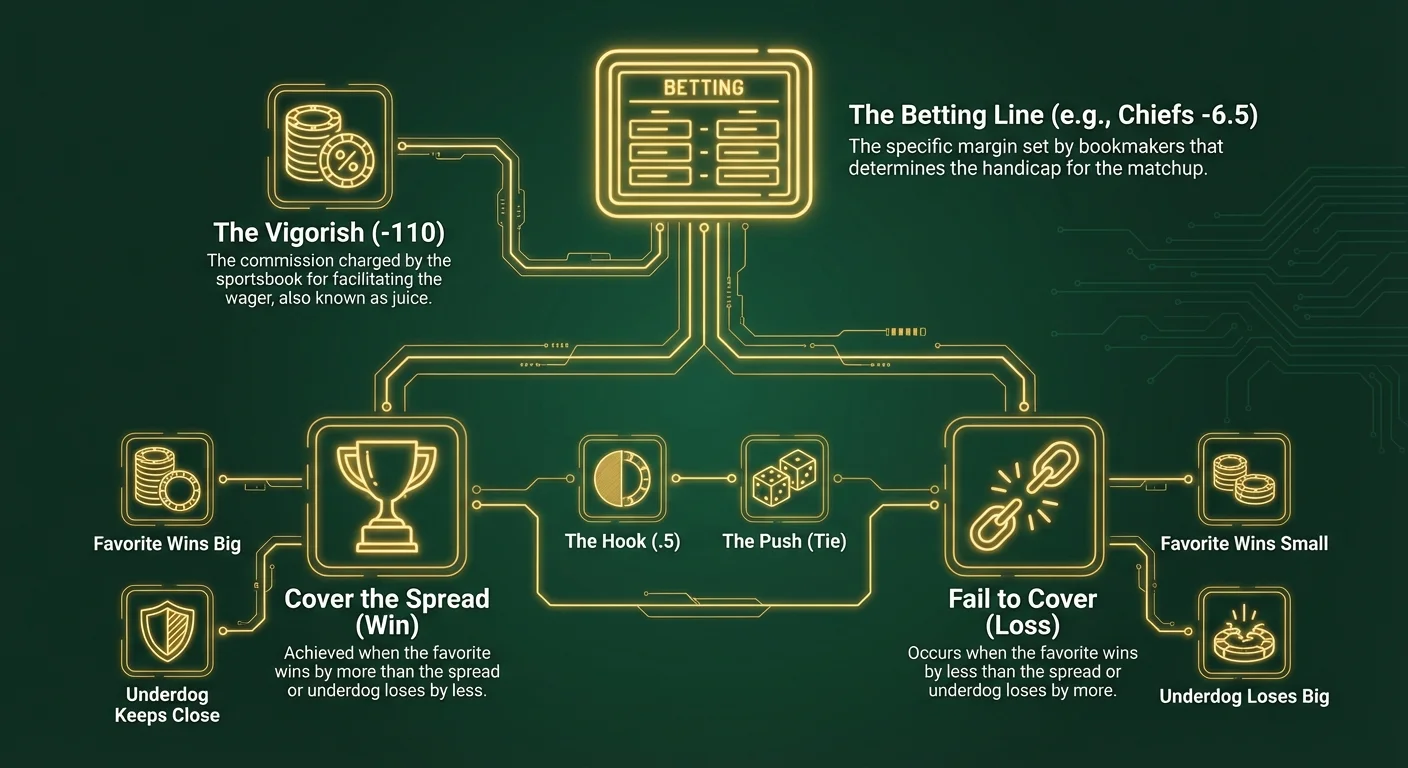
You might notice that point spread bets almost always come with a secondary number, usually -110. This is the price of the bet, also known as the "vig," "juice," or "odds."
Because the point spread makes the game a theoretical 50/50 toss-up, the sportsbook charges a commission to facilitate the bet.
- -110 Odds: You must bet $110 to win $100.
- -105 Odds: You must bet $105 to win $100.
If you bet $110 on the Chiefs -6.5 and they cover, you get your $110 back plus $100 in profit. The extra $10 is the fee you pay the sportsbook for the opportunity. This means that to be profitable long-term, you must win approximately 52.38% of your spread bets to break even against standard -110 juice.
Crypto Advantage: Reduced Juice
One of the major benefits of using crypto betting sites over traditional fiat sportsbooks is the potential for "reduced juice." Because Bitcoin, Ethereum, and USDT transactions have lower processing fees for the operator, many crypto books offer standard lines at -105 or even -101. This significantly lowers the break-even percentage required to be a profitable bettor.
The Hook, The Push, and The Half-Point
You will often see spreads that end in a half-point, such as -3.5 or -7.5. In betting slang, the .5 is called "The Hook."
Why The Hook Exists
Bookmakers love the hook because it guarantees a result. In sports like football and basketball, you cannot score half a point. Therefore, a line of -3.5 guarantees there will be a winner and a loser - there are no ties.
The Push
If a spread is a whole number, such as -3, a tie is possible.
- The Bet: Dallas Cowboys -3
- The Result: Cowboys win 24-21 (exactly 3 points).
- The Outcome: This is a Push.
In the event of a push, the bet is voided, and your original stake is refunded to your crypto wallet instantly. You don't win, but you don't lose.
Spread Betting Across Different Sports
While the concept remains the same, point spread explained nuances differ depending on the sport.
NFL and College Football
Football is the king of spread betting. Because of the scoring system (touchdowns = 7, field goals = 3), certain numbers are mathematically more significant.
- Key Numbers: The most common margins of victory in the NFL are 3 and 7.
- Strategy: Buying a spread from -3.5 down to -3 is often worth the extra "juice" because landing on that key number saves you from a loss (turning it into a push).
NBA and Basketball
Basketball spreads can be volatile. Because scoring is frequent and games often end with "meaningless" free throws, the backdoor cover is a common phenomenon (where a team scores late points to cover the spread despite the game's outcome being decided).
- Volatility: NBA spreads move rapidly. A line might open at -5 and close at -8 depending on player rest or injury news.
MLB (Run Line) and NHL (Puck Line)
Baseball and Hockey are low-scoring sports, so a variable point spread doesn't work well. Instead, they use a fixed spread with variable odds.
- MLB Run Line: Almost always set at -1.5 (Favorite) and +1.5 (Underdog).
- NHL Puck Line: Similar to baseball, set at -1.5 / +1.5.
| Sport | Terminology | Standard Line | Key Factor |
|---|---|---|---|
| Football | Point Spread | Variable (e.g., -3, -7.5, -14) | Key Numbers (3, 7) |
| Basketball | Point Spread | Variable (e.g., -2, -12.5) | Late-game fouling |
| Baseball | Run Line | Fixed (-1.5 / +1.5) | Bullpen strength |
| Hockey | Puck Line | Fixed (-1.5 / +1.5) | Empty net goals |
ATS Betting: Against The Spread
When researching teams, you will frequently encounter the acronym ATS. This stands for Against The Spread.
A team's Win/Loss record tells you how good they are at football or basketball. Their ATS record tells you how valuable they are to you, the bettor.
- Example: A team might be 10-2 straight up (winning games), but only 4-8 ATS. This means the team wins, but rarely by enough points to cover the inflated spreads the bookmakers assign them. They are "overvalued" by the market.
- The "Good" Bad Team: Conversely, a terrible team might be 2-10 straight up but 9-3 ATS. They lose games, but they keep it closer than the experts predict. These are often the most profitable teams to bet on.
How Spreads Move: Market Dynamics
The point spread is not static. It is a living number that reacts to information and money. Understanding line movement is crucial for timing your bets.
1. Opening Line
The oddsmakers release an initial number (e.g., Packers -4).
2. Public Money vs. Sharp Money
- Public Money: The casual bettors usually bet on favorites and "overs." If the public floods the Packers -4, the bookie might move the line to -4.5 or -5 to make the other side more attractive.
- Sharp Money: Professional bettors (Sharps) bet based on math and value. If Sharps think the Packers at -4 is too high, they will bet the opponent, forcing the bookie to drop the line to -3.5.
3. External Factors
Injuries, weather reports, and lineup changes will cause immediate, drastic shifts in the spread.
Crypto Tip: Crypto sportsbooks are automated and react instantly to global market shifts. However, because deposits are instant, you can often "catch" a stale line. If a star player is ruled out and the line moves at a major Vegas book, you might have a 30-second window to bet the old line at your crypto book before their algorithm updates.
Strategy: How to Beat the Spread
Winning at spread betting requires more than gut feeling. Here are five strategies to improve your ATS win rate.
1. Shop for Lines (The Crypto Advantage)
This is the single most effective strategy for any bettor. Because you can hold accounts at multiple crypto sportsbooks without monthly fees, you should always check the odds at different sites.
- Site A: Bills -7 (-110)
- Site B: Bills -6.5 (-110)
- Analysis: If the Bills win by exactly 7, Site A pushes (refund), but Site B wins. That half-point is massive. Always take the -6.5.
2. Fade the Public
The general betting public loses money long-term. A classic strategy is to look at where the majority of the bets are going and bet the opposite.
- If 85% of the bets are on the favorite, but the line isn't moving (or is moving toward the underdog), this is called "Reverse Line Movement." It indicates that while the public likes the favorite, the "Sharps" (big money) like the underdog. Follow the Sharps.
3. Beware the "Teaser" Trap
Many beginners try to manipulate the spread using "Teasers" (adjusting the line 6 points in their favor). While tempting, teasers reduce your payout odds significantly. While teasing through key numbers (like moving a +2 underdog to +8) can be smart, teasing through "dead numbers" (like moving -7 to -1) is mathematically unsound long-term.
4. Situational Handicapping
Don't just look at team stats; look at the situation.
- Sandwich Spots: Is a team playing a weak opponent right before a massive rivalry game? They might overlook the weak team and fail to cover the spread.
- Travel Schedules: In the NBA, teams playing the second night of a "back-to-back" on the road historically cover the spread at a lower rate due to fatigue.
5. Middle Betting (The Middle)
This is an advanced move often made easier with the speed of crypto betting.
- Bet 1 (Monday): You bet Underdog +7.
- Line Move: By Sunday, the favorite has been bet up, and the line is now +10.
- Bet 2 (Sunday): You bet Favorite -10.
- The Middle: If the Favorite wins by 8 or 9 points, you win BOTH bets. If the result falls outside that range, you win one and lose one, only losing the "juice." It is a low-risk, high-reward play.
Crypto-Specific Considerations for Spread Betting
Betting spreads with cryptocurrency offers distinct advantages over fiat currency:
- Micro-Betting Capabilities: Many crypto books allow satoshi-level bets (fractions of a cent). This allows beginners to practice spread betting strategies and test ATS models without risking significant capital.
- Stablecoin Usage: To avoid the volatility of Bitcoin or Ethereum affecting your bankroll during a pending bet, consider using USDT or USDC. There is nothing worse than winning a spread bet, only to find the value of your winning crypto dropped 5% during the game.
- Provably Fair Archives: While spreads are determined by real-world events, some crypto-native platforms offer "virtual sports" spread betting. Ensure these utilize Provably Fair algorithms, allowing you to verify the randomness of the simulation on the blockchain.
Summary: Key Takeaways
Point spread betting is the engine that drives the sports betting industry. It turns boring blowouts into nail-biters and transforms every possession into a potential swing in profitability.
To recap your path to mastering the spread:
- Understand the Math: The Favorite (-) gives points; the Underdog (+) gets points.
- Respect the Juice: Standard odds are -110; look for reduced juice (-105) crypto books to increase ROI.
- Mind the Hook: That extra half-point (.5) determines winners and losers. Avoid it or buy it off if the price is right.
- Track ATS Records: Win/Loss records are for fans; ATS records are for bettors.
- Shop Around: Use the flexibility of crypto wallets to move funds quickly to the sportsbook offering the best number.
Spread betting levels the playing field, but disciplined strategy is what tilts the odds in your favor. Start small, track your bets, and never bet more than you can afford to lose. Happy handicapping!