
The allure of sports betting is undeniable. It combines the thrill of competition with the tantalizing possibility of easy money. We have all seen the screenshots on social media: the ten-leg parlays turning five dollars into fifty thousand, or the self-proclaimed "whales" flashing stacks of cash next to a luxury car. It paints a picture of a world where getting rich is fast, easy, and guaranteed - provided you buy their picks.
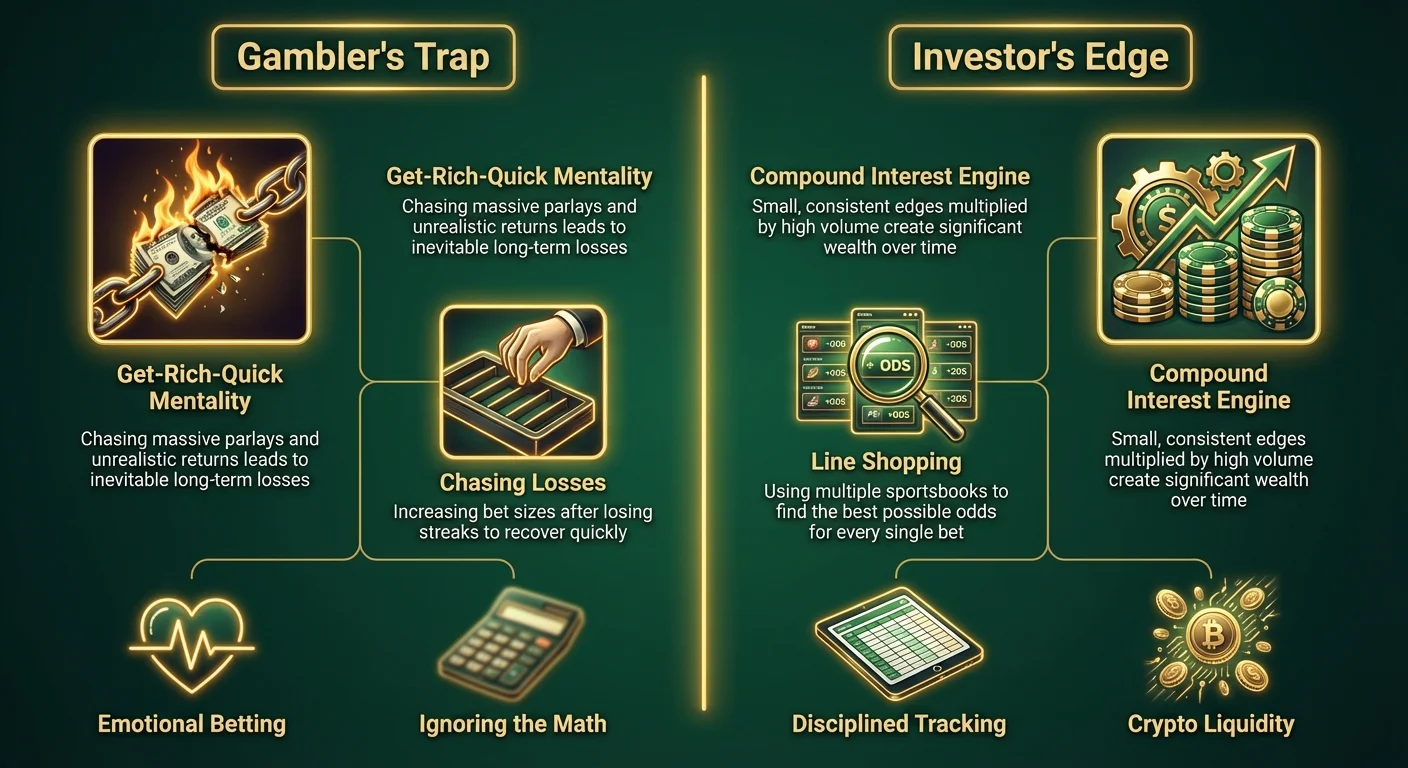
The reality, however, is drastically different. If you treat sports betting as a get-rich-quick scheme, you are almost certainly destined to go broke. But if you treat it as an investment - a disciplined, mathematical grind known as "getting rich slow" - you have a fighting chance at long-term profitability.
This guide is a reality check. It is designed to strip away the marketing hype and look at the cold, hard math of sports betting. We will cover what realistic win rates actually look like, why Return on Investment (ROI) matters more than winning tickets, and how using cryptocurrency sportsbooks can aid your long-term strategy through better odds and faster liquidity. If you are ready to stop gambling and start investing, this is where you begin.
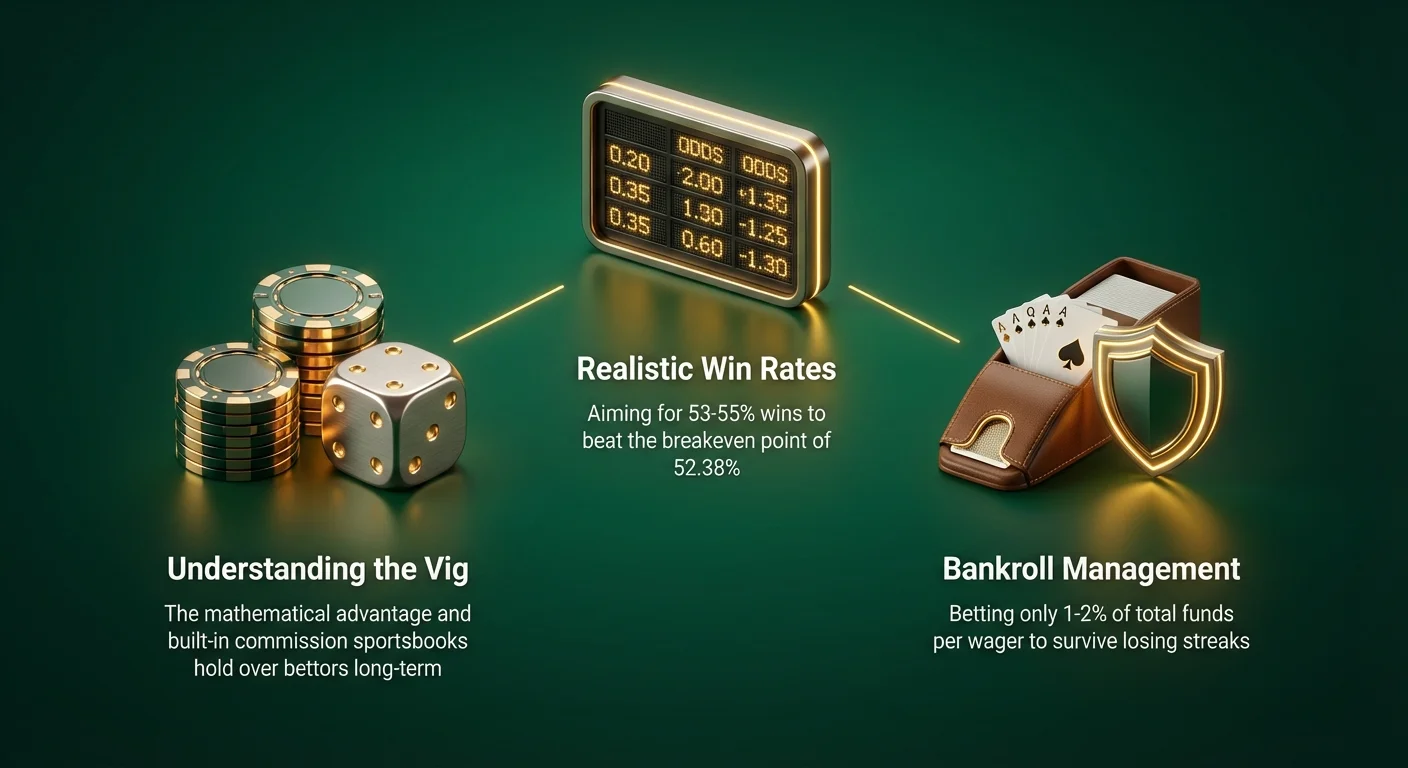
The Math Behind the Madness: Understanding the "Vig"
Before setting expectations for winning, you must understand why you are expected to lose. Sportsbooks are not charities; they are businesses built on a mathematical edge known as the vigorish, vig, or juice.
In a standard spread or total bet, the odds are typically set at -110 (American odds) or 1.91 (Decimal odds). This means you must wager $110 to win $100.
If two bettors take opposite sides of a game, the bookmaker collects $220 total ($110 from each). The winner gets their $110 back plus $100 profit. The loser loses $110. The bookmaker keeps the remaining $10, regardless of the outcome. That guaranteed commission creates a hurdle you must clear just to break even.
The Break-Even Point
To "get rich slow," you first have to stop losing money. Because of the vig, winning 50% of your bets is not enough. You will slowly bleed out your bankroll at a 50% win rate.
The Magic Number is 52.38%.
If you bet spreads and totals at standard -110 odds, you must win 52.38% of your wagers just to have $0 profit and $0 loss. Any win rate above this number generates profit; anything below it generates a loss.
Realistic Win Rates: What Pros Actually Achieve
This is where beginners often have their expectations shattered. Many novices believe that a "good" bettor wins 70% or 80% of the time. This is mathematically impossible over the long term.
Here is a breakdown of win rates over a significant sample size (1,000+ bets):
| Win Rate | Status | Outcome |
|---|---|---|
| 50.0% | The Coin Flipper | You are losing money due to the vig (-4.55% ROI). |
| 52.4% | The Breakeven | You are treading water. You aren't losing, but you aren't winning. |
| 53-54% | The Sharp Hobbyist | You are profitable. You are beating the bookmaker. |
| 55-57% | The Professional | This is world-class. You are likely limited by books or moving lines. |
| 60%+ | The Unicorn (or Liar) | unsustainable long-term. Usually a sign of a small sample size or a scam. |
Key Takeaway: If you can hit 54% winners over the course of an NFL season, you are crushing it. The margin between a loser and a professional is often just two or three extra wins out of every 100 bets.
Return on Investment (ROI) vs. Yield
While win rate is good for ego, ROI (Return on Investment) pays the bills. In sports betting, ROI is calculated as:
Profit / Total Amount Wagered = ROI
If you bet $10,000 over the course of a year and end up with $500 in profit, your ROI is 5%.
Benchmarking Your Betting ROI
In the stock market, the S&P 500 historically returns about 10% annually. In sports betting, because you are turning over your bankroll constantly (betting the same money multiple times), a lower per-bet ROI can still result in massive bankroll growth.
- 1% to 3% ROI: This is a very solid, sustainable return for high-volume bettors.
- 4% to 6% ROI: Exceptional. If you sustain this over thousands of bets, you are an elite bettor.
- 10%+ ROI: Extremely rare over the long term on liquid markets (like NFL spreads). It may be possible in niche markets (like player props or obscure soccer leagues) where limits are lower.
If someone promises you they can double your money in a week, they are asking you to gamble with reckless variance, not invest with an edge.
The "Get Rich Slow" Engine: Compound Interest
Why do we accept a 3% ROI? Because of volume and compounding. Unlike the stock market, where you might buy a share and hold it for a year, a sports bettor might bet their bankroll hundreds of times in a year.
The Power of Volume
Imagine you have a $1,000 bankroll.
- You bet $20 per game.
- You place 500 bets in a year.
- Total amount wagered = $10,000.
- You have a 3% ROI.
- Profit = $300.
That is a 30% increase on your starting $1,000 bankroll, despite only making 3% per bet. This is how professionals make a living: a small edge multiplied by massive volume.
Flat Betting vs. Compounding
To truly build wealth, you must manage your "units." A unit is the standard size of your bet (usually 1-2% of your total bankroll).
- Flat Betting: You bet $50 per game forever. Your profit grows linearly.
- Proportional Betting: You bet 1% of your current bankroll. As you win, your bankroll grows, and your bet size grows with it.
If you start with $5,000 and bet 1% ($50), and you go on a winning streak, your bankroll hits $6,000. Your next bet is now $60. This is how you "get rich slow." You let the math of compound interest do the heavy lifting.
Bankroll Management: The Shield Against Ruin
You cannot win if you lose all your chips. The biggest difference between a gambler and a sports investor is bankroll management.
The 1% Rule
Standard advice for beginners is to never bet more than 1% to 2% of your total bankroll on a single wager.
- Conservative: 1% ($10 on a $1,000 bankroll)
- Standard: 2% ($20 on a $1,000 bankroll)
- Aggressive: 3% ($30 on a $1,000 bankroll) -> Risk of ruin increases significantly here.
Why so small?
Even a 55% winner will experience brutal losing streaks. It is statistically probable that you will lose 5, 8, or even 10 bets in a row at some point.
- If you bet 10% of your bankroll per game, a 10-game losing streak wipes you out.
- If you bet 1% of your bankroll, a 10-game losing streak is just an annoying Tuesday.
The Crypto Advantage in Long-Term Betting
In the modern era, using cryptocurrency betting sites is one of the best tools for the "Get Rich Slow" strategy. Here is why crypto platforms align with professional betting goals:
1. Line Shopping and Liquidity
To maintain a 54% win rate, you need the best odds. You cannot bet -110 if another book has the same team at +100. You need to have accounts at multiple books.
- Fiat Friction: Moving USD from a bank to a sportsbook can take days. Withdrawals are even slower.
- Crypto Speed: You can withdraw Bitcoin, Litecoin, or USDT from one book and deposit it into another in minutes. This allows you to hunt for the best price (lines) instantly.
2. Lower Fees = Higher ROI
Traditional sportsbooks often pass credit card processing fees onto the customer or build them into worse odds. Crypto transactions have minimal network fees. When your margin for error is small (remember the 52.38% breakeven), saving 2-3% on deposit/withdrawal fees makes a massive difference to your bottom line.
3. Avoiding Currency Inflation
Many sharp bettors use Stablecoins (USDT, USDC). This allows you to keep your bankroll in a digital format that is pegged to the US Dollar, avoiding the volatility of Bitcoin while enjoying the speed of blockchain technology. This isolates your sports betting edge from market volatility.
Red Flags: Spotting the "Get Rich Quick" Scams
Part of setting realistic expectations is learning to ignore the noise. The internet is full of "touts" selling picks. To protect your bankroll, avoid anyone who uses the following terminology:
- "Locks of the Century": There is no such thing as a lock. A -500 favorite loses often enough to wreck a bankroll.
- "Fixed Matches": If someone actually knew a match was fixed, they wouldn't sell the information to you for $50 on Instagram; they would be betting it silently to avoid alerting the authorities.
- "Guaranteed Wins": In a game of probabilities, nothing is guaranteed. This is false advertising.
- "Whale Plays" / "100 Unit Bombs": This encourages poor bankroll management. No professional bets 50 times their normal size on one game.
If a handicapper was hitting 70% winners, they would be banned from every sportsbook in the world and would be billionaire wealthy. They wouldn't need your subscription fee.
The Reality of Variance (The Long Run)
The hardest part of getting rich slow is the psychology of variance. You can make perfect bets - getting the best odds on a team that statistically should win - and still lose because the quarterback trips over his own shoelaces.
This is called variance.
In the short term (1 week or 1 month), luck dominates skill. You can be a terrible bettor and win 10 in a row. You can be a pro and lose 10 in a row.
In the long term (1 year or 1,000+ bets), skill dominates luck. The math eventually balances out.
Dealing with Downswings
When you hit a losing streak (and you will):
- Do not chase: Never increase your bet size to "make back" losses.
- Trust the process: If your handicap was sound, the results will turn.
- Take a break: Sometimes stepping away for 48 hours resets your mental state.
Practical Steps to Start Your Journey
If you are ready to accept the grind and aim for a realistic 3-5% ROI, here is your starter checklist:
- Define Your Bankroll: Set aside money that is strictly for betting. If you lose it, it should not impact your life.
- Choose Your Unit Size: Stick to 1% of that bankroll.
- Open Multiple Crypto Sportsbooks: Register at 3+ reputable crypto betting sites.
- Shop for Lines: Before every bet, check all your accounts. If Book A has the Chiefs at -3 (-110) and Book B has them at -2.5 (-110), taking the -2.5 is the difference between winning and losing.
- Track Everything: You cannot improve what you do not measure. Use a spreadsheet or an app to track every bet, the odds, the closing line, and the result.
- Specialize: Don't bet on NFL, NBA, Korean Baseball, and Table Tennis simultaneously. Pick one sport or league, become an expert, and find your edge there.
Conclusion
Can you get rich betting on sports? Yes.
Will it happen overnight? Absolutely not.
Sports betting is not a lottery; it is a market. Like any market, it rewards discipline, information, and patience while punishing greed and impulsivity. By setting realistic expectations - aiming for a 54-55% win rate and steady bankroll growth - you separate yourself from the 99% of bettors who are just paying for entertainment.
Embrace the grind. Respect the math. Use the speed of crypto to your advantage. Get rich slow, and you might just stay rich forever.