
For decades, the sports betting industry has operated inside a "black box." You place a wager, the money disappears from your account, and if you win, the sportsbook manually credits you - eventually. During this process, bettors have zero visibility into the backend mechanics. If a bookmaker decides to void a winning bet due to a "palpable error" or limits a successful account, the player has little recourse.
The integration of blockchain technology into sports betting is dismantling this black box. By utilizing distributed ledgers, smart contracts, and oracle systems, the industry is moving toward a model of "trustlessness" - where you don't need to trust the bookie to do the right thing because the code enforces it automatically, upholding the architecture of trust. This guide explores the mechanics of blockchain betting, how it differs from traditional "Provably Fair" casino algorithms, and how intermediate bettors can leverage this technology for unparalleled betting transparency.
The Evolution: From Server-Side to On-Chain
To understand where we are going, we must distinguish between standard crypto betting and true blockchain verification.
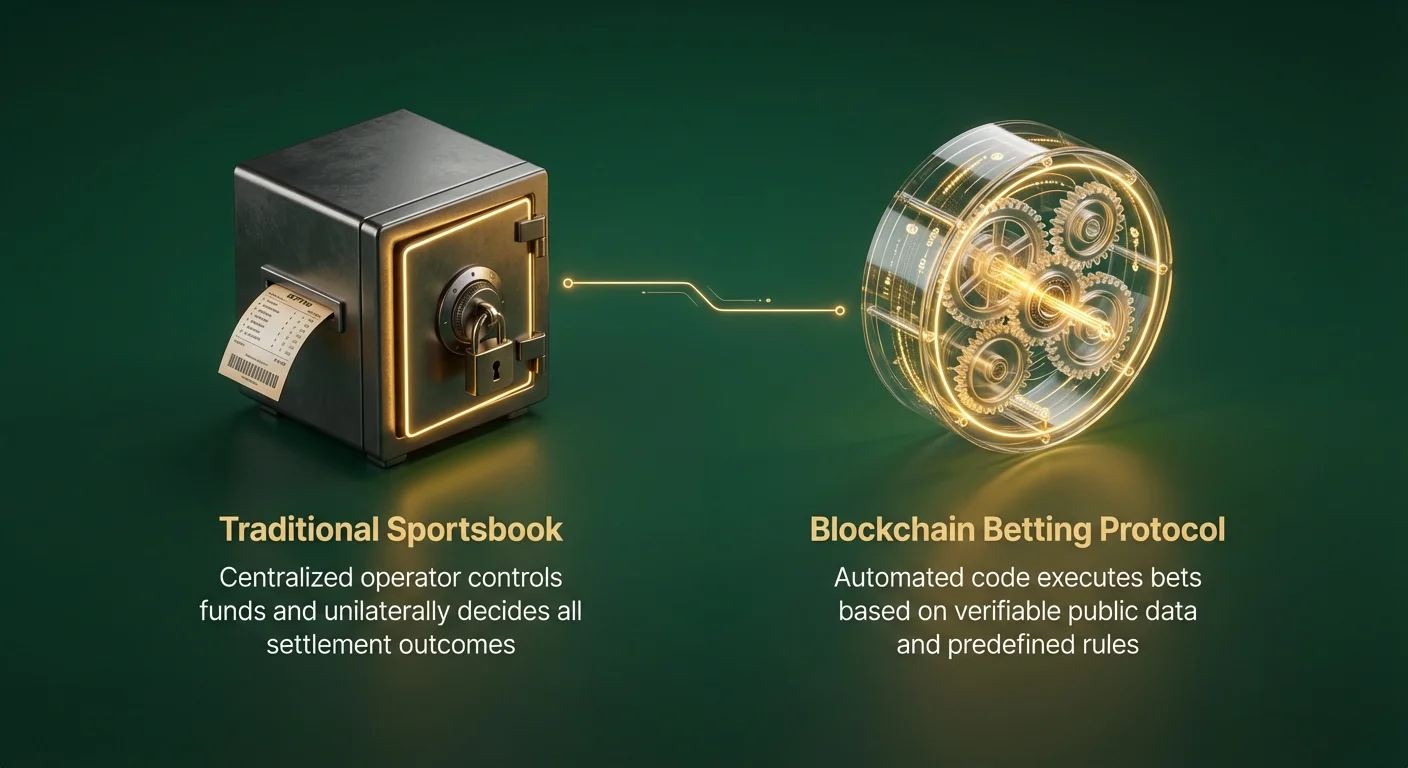
Most "crypto sportsbooks" today are simply traditional Web 2.0 betting sites that accept Bitcoin or Ethereum as a payment method. They still hold your funds in a centralized wallet, they still determine the odds on a private server, and they still have the final say on settlements.
True blockchain betting (often found in Decentralized Sportsbooks or "prediction markets") moves the logic of the bet onto the blockchain itself. Here, the sportsbook is not a company holding your money; it is a piece of code (a smart contract) that acts as an automated escrow agent.
The Core Pillars of On-Chain Betting
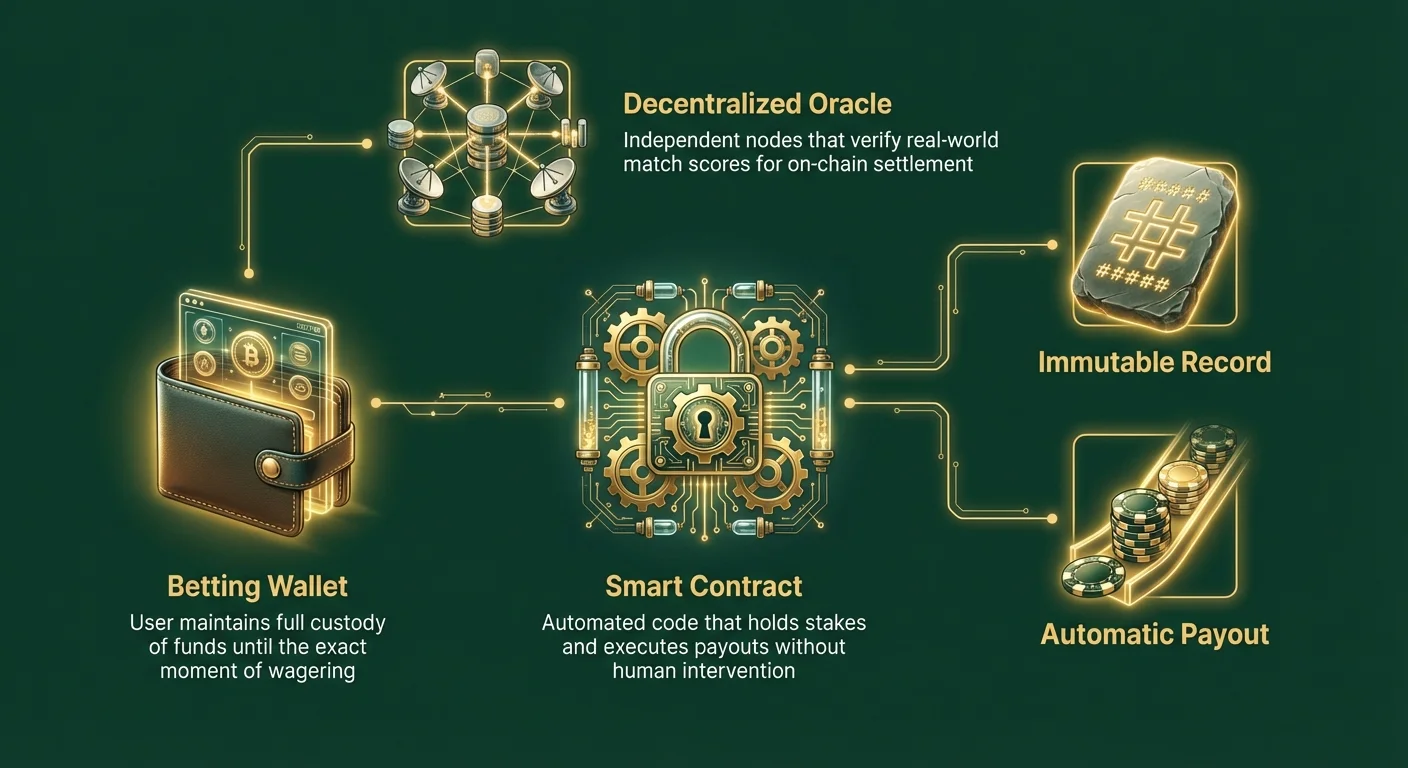
- Non-Custodial Betting: You do not deposit funds into a betting account. You connect your Web3 wallet (like MetaMask or Phantom), and funds only leave your wallet when you confirm a specific bet transaction.
- Smart Contract Settlement: The terms of the bet (Team A to win @ 2.00 odds) are written into code. Once the game ends, the contract automatically executes the payout. No human approval is required.
- Immutable Record: Every wager is recorded on the public ledger. It cannot be altered, deleted, or denied after the fact.
"Provably Fair" in Sports vs. Casino Games
If you have played crypto slots or dice, you have likely encountered the term provably fair. In casino games, this refers to cryptographic algorithms (using server seeds and client seeds) that prove the Random Number Generator (RNG) wasn't rigged.
However, a provably fair sportsbook operates differently. You cannot use an RNG to determine the outcome of a Premier League football match (unless the match is virtual/simulated). Real-world sports rely on external data.
Therefore, "Provably Fair" in sports betting refers to the transparency of the settlement process, not the generation of the outcome. It answers three questions:
- Was the bet accepted at the odds displayed?
- Did the smart contract lock the necessary liquidity to pay me if I win?
- Is the source of the match result (the data feed) accurate and tamper-proof?
The Oracle Problem: Bridging Real World and Blockchain
This is the most critical concept for intermediate bettors to grasp. Blockchains are isolated networks; Bitcoin knows how much BTC you have, but it does not know who won the Super Bowl.
To settle a sports bet on-chain, the smart contract needs an external data feed. This is provided by Oracles.
How Oracles Work
An Oracle acts as a bridge. When a match ends, the Oracle fetches the score from trusted API providers (like ESPN, Sportradar, or official league data) and pushes that data onto the blockchain. The smart contract reads this data and releases the funds to the winner. This mechanism demonstrates how trustless data feeds secure settlement.
Decentralized Oracles (The Gold Standard)
If a sportsbook uses a single, private Oracle, they could theoretically feed false data to the contract to make you lose. This is why top-tier blockchain betting platforms use Decentralized Oracle Networks (like Chainlink).
In this system, multiple independent nodes verify the score. If 9 out of 10 nodes agree that the Lakers won, the data is confirmed. This consensus mechanism makes it nearly impossible for a bad actor to rig the settlement.
Comparing Betting Models
Understanding the trade-offs between centralized crypto books and on-chain decentralized protocols is vital for your strategy.
| Feature | Centralized Crypto Sportsbook | Decentralized Sportsbook (DeFi) |
|---|---|---|
| Custody | Site holds funds (Risk of insolvency) | Self-custody (Funds in your wallet) |
| KYC | Often required for large withdrawals | No KYC (Anonymous) |
| Odds Source | Set by internal traders/algorithms | Set by liquidity pools or P2P markets |
| Settlement Speed | Minutes to Days (Manual approval) | Instant (Smart contract execution) |
| Limits | Winners get limited/banned | generally limited only by pool liquidity |
| Fees | The "Vig" or "Juice" | Gas fees + Protocol fees |
How to Verify Your Bets on the Blockchain
In a truly transparent ecosystem, you don't just take the operator's word for it. You can verify the action yourself. Here is a practical workflow for verifying a blockchain bet:
Step 1: Locate the Transaction Hash (TXID)
When you place a bet on a decentralized platform, your wallet will generate a Transaction Hash. This is your digital receipt. It looks like a long string of alphanumeric characters, representing the lifecycle of a transaction.
Step 2: Use a Block Explorer
Go to the block explorer relevant to the chain you are using (e.g., Etherscan for Ethereum, Solscan for Solana, PolygonScan for Polygon). Paste your TXID into the search bar.
Step 3: Read the Input Data
Look for the "Interacted With (To)" field. This should be the betting platform's smart contract address. In the "Input Data" or "Logs" section, you will see the parameters of your bet encoded.
- Amount: The stake you wagered.
- Condition: The specific outcome ID (e.g., "Manchester United Win").
- Odds: The price locked in at the moment of the transaction.
Step 4: Verify Settlement
Once the game ends, the Oracle transaction will appear on the smart contract. You can see the data payload (the final score) and the subsequent transfer of funds to your wallet address. If the bookmaker claims a "technical error," the blockchain proves otherwise.
Strategic Advantages of Blockchain Betting
Why should you go through the trouble of using Web3 wallets and learning about gas fees? Because it offers strategic edges that traditional sportsbooks cannot match.
1. Avoiding Account Bans
Professional bettors inevitably face the "winner's curse" - if you beat the closing line consistently, traditional books will limit your stakes to pennies. Understanding why sportsbooks restrict winning bettors is key to appreciating decentralized protocols. On blockchain betting exchanges or liquidity-pool based books, you are betting against a contract or other peers, not a house manager who fears for their job. The smart contract does not care if you win; it simply executes code. As long as there is liquidity in the pool, you can bet.
2. Arbitrage Opportunities
Decentralized sportsbooks often have slower line movements than sharp centralized books like Pinnacle. Because on-chain odds rely on how the liquidity pools are balanced (or how the order book is shaped by peers), inefficiencies exist.
- Strategy: Compare the odds on a major centralized book against a DeFi betting protocol. If the DeFi protocol hasn't adjusted for a breaking player injury yet, you can bet into the stale line before the blockchain confirms the next price update.
3. Yield Farming with Betting Liquidity
This is unique to crypto. Instead of betting, you can become the house. Many DeFi sportsbooks allow you to provide liquidity (USDT, USDC, ETH) to their betting pools.
- You act as the counterparty to other bettors.
- You earn a share of the "vig" (the betting fees) and often protocol tokens.
- Warning: If the bettors win big, the liquidity pool (your money) takes the hit. This is known as "Impermanent Loss" in betting terms.
Risks and Challenges
While betting transparency is high, the user experience is still maturing. Be aware of these hurdles:
- Liquidity Fragmentation: A traditional book might accept a $50,000 wager on an NBA game instantly. A decentralized app (dApp) might only have $5,000 of liquidity available for that specific market. Always check the "Market Depth" or "Liquidity Available" before placing a large wager.
- Slippage: In Automated Market Maker (AMM) betting, placing a large bet moves the odds against you. If you bet $1,000 on a team at 2.00, the sheer size of your bet might push the effective odds down to 1.95.
- Gas Fees: On networks like Ethereum, the transaction fee to place the bet could cost $10 or more. This makes small bets ($10-$50) unviable. Look for platforms on Layer-2 solutions like Arbitrum, Optimism, or low-cost chains like Solana to keep fees under pennies.
- Smart Contract Risk: If the code containing the money has a bug, hackers can drain the pot. Stick to platforms that have open-sourced their code and have completed audits from reputable security firms (like CertiK or Halborn).
Practical Tips for the Blockchain Bettor
If you are ready to move your sports betting on-chain, follow these best practices to protect your bankroll and maximize efficiency.
Use a Dedicated Betting Wallet
Never mix your long-term crypto "HODL" stack with your betting bankroll. Create a fresh wallet (e.g., a new MetaMask account) specifically for sports betting. This helps you track your ROI accurately and limits damage if you interact with a malicious contract.
Understand "WETH" and "USDC"
Most on-chain betting is not done with Bitcoin. It is usually denominated in stablecoins (USDC, USDT) or wrapped tokens (WETH).
- Tip: Keep a small amount of the native chain token (ETH, SOL, MATIC) in your wallet to pay for gas fees, even if you are betting with USDC. If you have 1000 USDC but 0 ETH, you cannot place the bet.
Check the Oracle Source
Before betting on a niche market (e.g., Table Tennis or Esports) on a decentralized platform, check where they get their results. Major sports (NFL, EPL, NBA) usually have robust Chainlink feeds. Obscure sports might rely on a centralized data input, which reintroduces the trust element you are trying to avoid.
Watch the "Time to Settlement"
On-chain settlement isn't always instant the second the whistle blows. The Oracle needs to report the result, and the contract needs to verify it.
- Reality Check: It is normal to wait 15 minutes to an hour after a match for the smart contract to resolve. Do not panic if the funds don't appear instantly.
The Future: Prediction Markets vs. Sportsbooks
We are seeing a convergence of sports betting and broader prediction markets. Platforms like Polymarket allow users to bet on "outcomes" - this includes elections, interest rates, and sports.
This model treats sports teams like stock assets. You buy "shares" of a team winning. If they win, the share is worth $1.00. If they lose, it is worth $0.00. This structure allows you to trade in and out of positions mid-game (live betting) with high transparency, as the order book is fully visible on-chain.
Summary
The transition to provably fair sportsbooks represents a shift from "Don't be evil" (trusting the bookie) to "Can't be evil" (trusting the code).
For the intermediate bettor, blockchain verification offers a safety net against limiting, account bans, and shady payment practices. While the liquidity and user interface may lag slightly behind the giants of the industry, the trade-off is absolute ownership of your funds and verifiable fair play.
Key Takeaways
- True Ownership: On-chain betting means you hold the funds until the bet is executed.
- Verify, Don't Trust: Use block explorers to confirm that odds and payouts match the smart contract logic.
- Oracles are Key: The integrity of a blockchain bet relies on the Oracle providing accurate data.
- Adapt Your Strategy: Account for gas fees and liquidity slippage when calculating your expected value (EV).
By understanding the mechanics of on-chain settlement, you are not just gambling; you are participating in a financial protocol that guarantees fairness through mathematics rather than management.