
Every sports bettor has experienced that moment of confusion mixed with suspicion. You look at an NFL spread, and the line is -6.5. You check three other sportsbooks, and they are all sitting at -6.5. It feels coordinated, almost conspiratorial. How do they know the game will be decided by a touchdown? And why does that number shift to -7 mere minutes after you place your bet?
For the casual fan, the betting line is just a number to beat. But for the intermediate bettor looking to transition into a profitable sharp, understanding how lines are set is the most critical skill in your arsenal. The betting line is not a prediction of the game's final score; it is a market price designed to balance liability and extract profit.
This guide pulls back the curtain on the oddsmaking process. We will explore the lifecycle of a betting line from the opening number to the closing bell, analyze how crypto sportsbooks are disrupting traditional line-setting models, and teach you how to read line movement like a stock trader reads a ticker.

The Origin Story: Who Actually Sets the Line?
Decades ago, "The Line" was set by a handful of guys in a smoke-filled backroom in Las Vegas, specifically at the Stardust. They used intuition, power ratings, and a bit of guesswork. Today, the process is infinitely more complex and mathematical.
While every sportsbook displays odds, very few actually originate them. The sports betting world is divided into two main camps:
- Market Makers (Originators): These are the high-volume, sharp-friendly books (often located offshore or operating as betting exchanges) that accept massive limits. They invest millions in algorithms and data science to post the first number.
- Retail Books (Copycats): The vast majority of mainstream sportsbooks - including many famous US-regulated apps - simply copy the lines set by the market makers. They add a slightly higher margin (vig) and adjust only when their specific liability gets too high.
The Power Rating Algorithm
Before a matchup is even announced, oddsmakers maintain "Power Ratings" for every team. This is a numerical value assigned to a team's strength relative to an average opponent on a neutral field.
- Example: If the Kansas City Chiefs have a power rating of +6 and the Denver Broncos have a power rating of -2, the raw spread on a neutral field would be Chiefs -8.
- Adjustments: The oddsmakers then feed in variables: home-field advantage (usually worth 1.5 to 2.5 points), injuries, rest days, weather forecasts, and historical matchups.
However, the math is only the starting point. The oddsmaker must then apply the "Public Perception Filter." Even if the math says the line should be -3, if the oddsmaker knows the public loves the favorite, they might open at -3.5 to pre-emptively tax the public money. Learn when to fade the public.
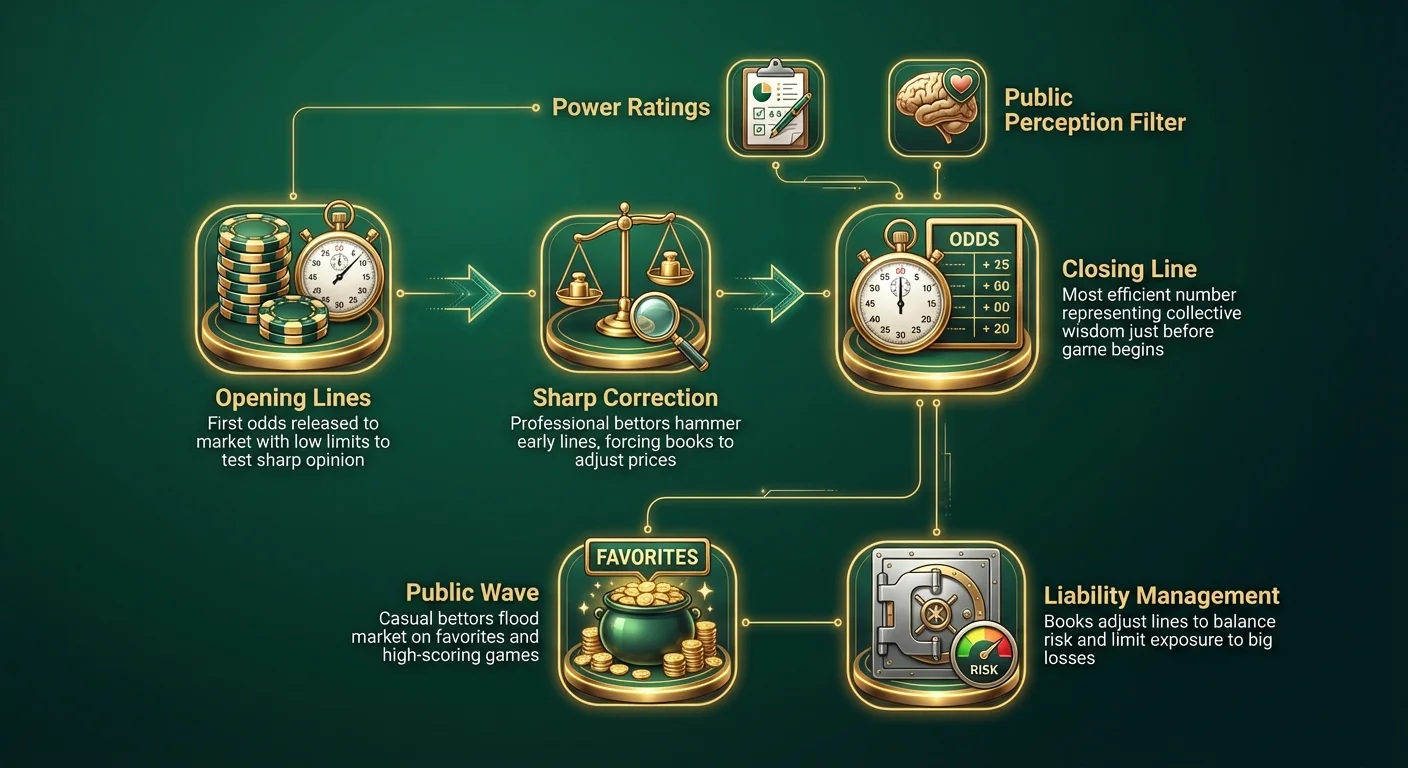
The Lifecycle of a Betting Line
To find value, you must understand where you are in the timeline of a wager. A bet placed on Tuesday is fundamentally different from a bet placed five minutes before kickoff on Sunday.
1. The Opening Lines
Opening lines are the first odds released to the market. In the crypto betting space, these often appear earlier than at traditional fiat books.
- Characteristics: Low betting limits (often capped at $500 or $1,000).
- The Goal: The book is "fishing." They put out a tentative number to see what the sharpest bettors in the world think of it.
- The Opportunity: This is where the most value exists. If the book makes a mistake, sharps pounce immediately. If you can bet openers, you are playing against the raw math, not the efficient market.
2. The Discovery Phase (Sharp Correction)
Once the openers are live, the "Sharps" (professional bettors) enter the chat. If the line opens at -3 but the sharps' models say it should be -4.5, they will hammer the -3 for the maximum limit.
The sportsbook sees this one-sided action from winning accounts and immediately moves the line. This is not the book balancing the money; this is the book admitting, "We got the price wrong, and these smart guys are telling us where it should be."
3. The Public Wave
As the game approaches (usually the weekend for football), the general public begins to bet. This is "Square" money. The public almost always favors:
- Favorites
- Overs (high scoring games)
- Star players (Prop bets)
If the sharps pushed a line from -3 to -5, and the public starts betting the underdog at +5, the book might not move the line back. They are happy to hold the sharps' money at -3 and the public's money at +5, creating a "middle" where the book could lose both sides, but it is rare.
4. The Closing Line
The Closing Line is the odds available at the exact moment the game begins. This is widely considered the most "efficient" number. It represents the collective wisdom of thousands of bettors, millions of dollars, and all available news.
Pro Tip: If you consistently bet lines that are better than the Closing Line (e.g., you bet -3, and it closes -4.5), you will be profitable long-term, even if that specific bet loses. This is called Closing Line Value (CLV).
Understanding Line Movement
Line movement is the shift in odds or point spreads. Understanding why a line moved is more important than seeing that it moved.
There are three primary causes for movement:
1. Steam Moves (Sharp Money)
This occurs when a syndicate or well-respected betting group unloads on a specific side across multiple sportsbooks simultaneously.
- What it looks like: The line moves universally across the entire screen instantly.
- Strategy: "Chasing steam" involves trying to bet the old number at a slow-moving sportsbook before they update their odds. Crypto sportsbooks with high-speed APIs are often the leaders of these moves.
2. Reverse Line Movement (RLM)
This is the holy grail for intermediate bettors. It happens when the majority of bets are on one team, but the line moves in the opposite direction.
- Scenario: 80% of betting tickets are on the Dallas Cowboys (-4). However, the line drops to Cowboys (-3).
- Analysis: The book is taking heavy public money on -4 but is terrified of the sharp money coming in on the opponent at +4. They drop the line to encourage even more public money on Dallas while respecting the sharp opinion.
- Takeaway: Follow the movement, not the percentages.
3. Liability Management vs. News
Sometimes lines move because a quarterback tweaks an ankle in practice (News). Other times, a whale (a wealthy but unskilled bettor) dumps $100,000 in Bitcoin on a team. The book moves the line simply to limit their risk exposure, not because the probability of the outcome changed.
The Crypto Sportsbook Difference
If you are betting on CryptoGambling.com recommended sites, you are interacting with a different ecosystem than state-sponsored fiat sportsbooks. Understanding these nuances gives you an edge.
Reduced Juice and Margins
Traditional books generally operate with a "standard vig" of -110. This means you must bet $110 to win $100. The extra $10 is the house fee. Learn more about understanding juice and vig.
Many top-tier crypto sportsbooks operate on Reduced Juice models because their overhead is lower (no physical casinos, lower payment processing fees via blockchain).
Comparison of Betting $1,000 to Win:
| Odds Type | Odds | Amount Risked | Potential Profit | Implied Probability (Break-even) |
|---|---|---|---|---|
| Standard Book | -110 | $1,100 | $1,000 | 52.38% |
| Crypto Reduced Juice | -105 | $1,050 | $1,000 | 51.22% |
| Pinnacle/Sharp | -103 | $1,030 | $1,000 | 50.73% |
Over the course of a season, paying -105 instead of -110 can turn a losing bettor into a breakeven one, and a breakeven one into a winner.
Global Liquidity and Anonymity
Crypto sportsbooks accept action from all over the world. A line at a US-regulated book might be heavily influenced by regional bias (e.g., New York books overvaluing the Giants). A crypto book reflects a global market.
Furthermore, the "Provably Fair" concept in crypto casinos is trickling into sports betting via on-chain betting exchanges. These platforms allow peer-to-peer betting where the "line" is set purely by supply and demand, eliminating the oddsmaker entirely.
High Limits and Instant Settlements
One major factor in how lines settle at crypto books is the velocity of money. Because Bitcoin, Ethereum, and USDT payouts are near-instant, sharps can recycle their bankroll rapidly. This leads to a more efficient market. If a crypto book posts a bad line, it gets hammered and corrected faster than a fiat book where a bettor might wait 3 days for a withdrawal to re-bet.
Practical Strategy: How to Use Line Knowledge
Now that you know how the sausage is made, here is how to eat.
1. Shop for the "Hook"
In football, key numbers are 3 and 7 (the most common margins of victory).
- Book A: Team X is -3.5 (-110)
- Book B (Crypto): Team X is -3 (-120)
Buying that half-point (the hook) off of the 3.5 is massive. If the game lands on 3, you push at Book B but lose at Book A. Always have accounts at multiple crypto sportsbooks to find the outlier line.
2. Identify the "Fake" Favorite
Check the opening lines against the current lines.
- Opener: Team A (-150)
- Current: Team A (-130)
Even though Team A is still the favorite, the market is telling you they are weaker than initially thought. Be wary of betting favorites that are "drifting" (odds getting better for the favorite). There is usually a reason the smart money is staying away.
3. Timing Your Bet
- Betting Favorites: generally, bet them early. The public loves favorites and will drive the line up (e.g., from -6 to -7) by Sunday.
- Betting Underdogs: Generally, wait until late. Let the public inflate the favorite's line, giving you extra points on the dog right before kickoff.
4. Avoiding the Parlay Trap
Sportsbooks spend millions analyzing straight bets (spreads/totals) to set accurate lines. They spend much less effort on correlating parlay odds because the mathematical edge is so heavily in their favor. While parlays are fun, the "line" you are getting is essentially a compound tax. Focus on straight bets to exploit line inefficiencies.
Key Takeaways
- Lines are fluid: They are not predictions; they are prices driven by math, liability, and sharp money.
- Respect the Market Makers: When a sharp book moves a line, the rest of the world usually follows. Watch the market leaders to predict movement at your local book.
- Value the Opening Line: The earliest number is often the most vulnerable. If you have a strong opinion, bet early before the market corrects.
- Crypto is Efficient: The speed of crypto transactions creates highly efficient markets with often lower juice (-105). Utilizing these books is an instant ROI boost.
- Track CLV: Your goal is to beat the closing line. If you consistently bet -2.5 and the game closes at -3.5, you are a winning bettor, regardless of the game result.
Understanding how sportsbooks set betting lines transforms you from a gambler hoping for luck into a trader capitalizing on market inefficiencies. The house always has an edge, but by reading the lines correctly, you can chip that edge away until the field is level.