
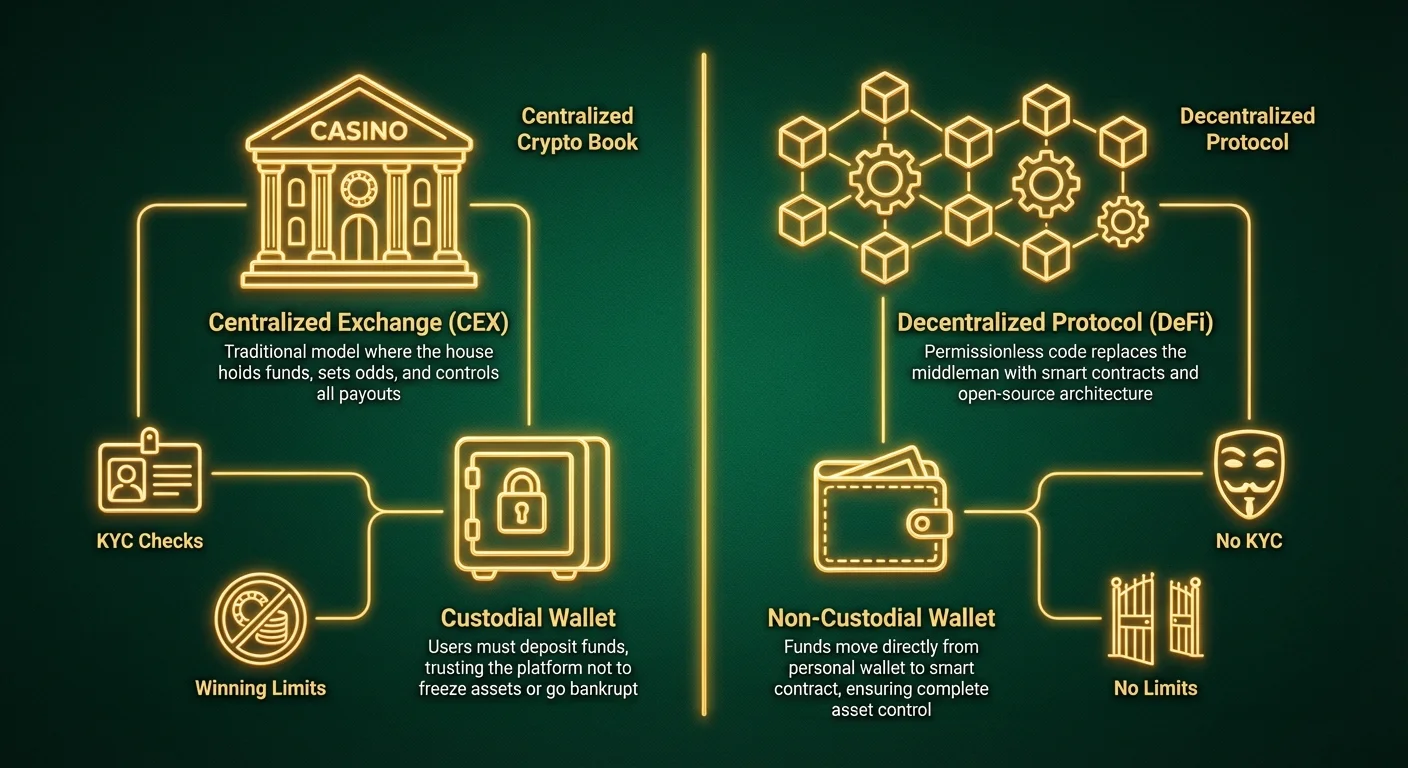
The sports betting landscape is undergoing a tectonic shift. For years, "crypto betting" simply meant depositing Bitcoin into a centralized website that otherwise operated exactly like a traditional Las Vegas sportsbook. You still had to trust the house, endure KYC (Know Your Customer) checks, and worry about your account being limited if you won too much.
DeFi (Decentralized Finance) betting is different. It is the frontier of sports betting on blockchain. It removes the middleman entirely, replacing the bookmaker with open-source code and smart contracts.
In this guide, we will move beyond the basics of depositing crypto. We are diving deep into the architecture of decentralized sportsbooks, how liquidity pools replace the house, and how sophisticated bettors can exploit these protocols for better odds, yield farming, and true censorship resistance.
The Architecture of Trust: How DeFi Betting Works
To understand DeFi betting, you must first unlearn the traditional sportsbook model. In the centralized world, you bet against a company. That company sets the odds, holds your money, and decides the outcome.
In a decentralized sportsbook, the "house" is a piece of code called a Smart Contract residing on a blockchain (like Ethereum, Solana, or Polygon).
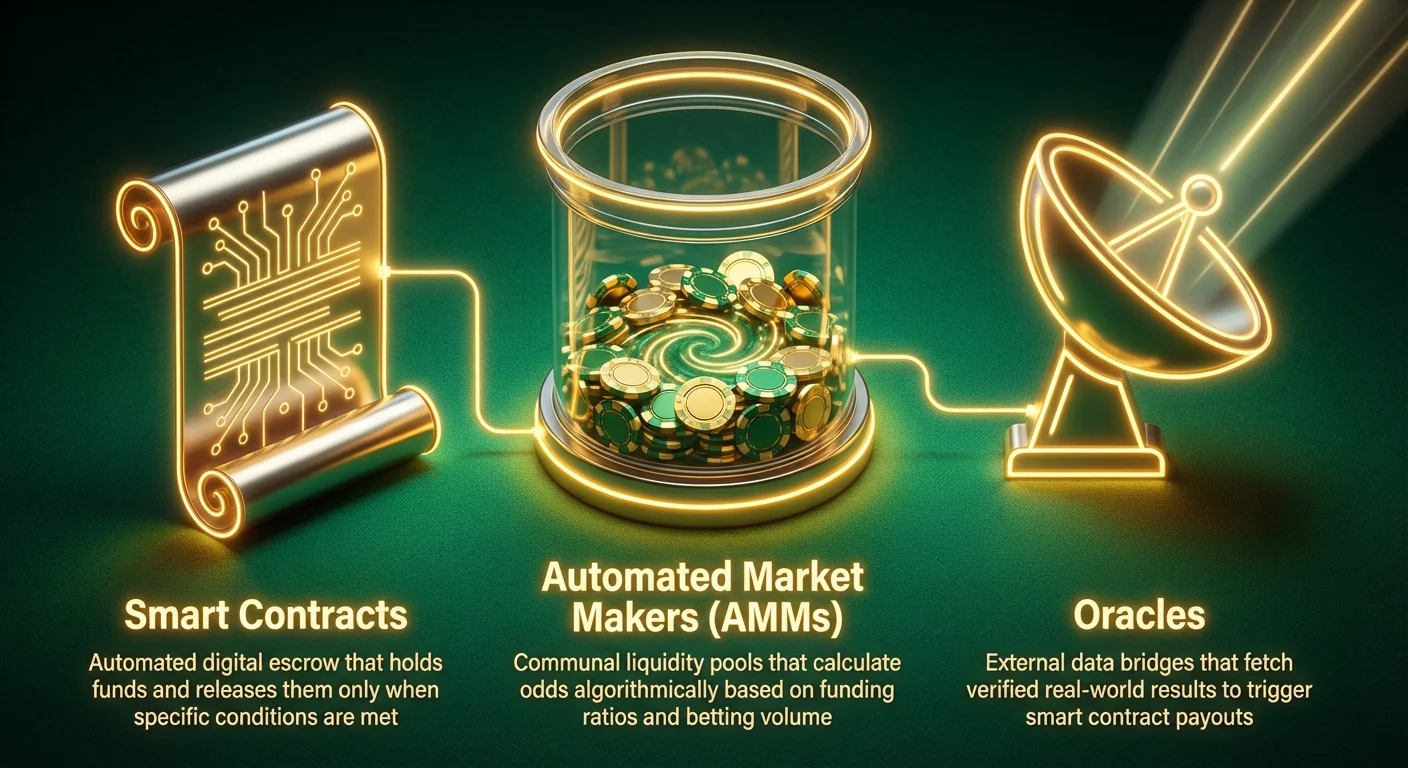
The Three Pillars of Blockchain Wagering
Smart Contracts (The Escrow):
When you place a wager, you aren't sending money to a company bank account. You are sending tokens to a smart contract. This contract acts as an automated escrow agent. It holds the funds and is programmed to release them only when specific conditions are met (e.g., "If Team A wins, send funds to Wallet X").Automated Market Makers (AMMs) vs. Order Books:
- Order Book Model: Similar to a betting exchange (like Betfair). You place an offer to back a team at specific odds, and you wait for another user (a peer) to take the other side (lay the bet).
- AMM Model: This is the DeFi innovation. Instead of waiting for a peer, you bet against a Liquidity Pool. Users deposit funds (USDC, USDT, ETH) into a communal pool to act as "the house." When you bet, you are trading against this pool. The odds are calculated algorithmically based on the ratio of funds in the pool and the betting volume.
Oracles (The Referee):Blockchains are isolated; they don't know who won the Super Bowl or the outcome of a Premier League match. They need external data. This is where Oracles (like Chainlink or Pyth Network) come in. Oracles act as a bridge, fetching verified real-world data and feeding it to the smart contract. Once the Oracle confirms the score, the smart contract executes the payout automatically.
Advantages of Decentralized Protocols
Why should an advanced bettor navigate the complexities of DeFi rather than using a polished centralized site? The benefits are rooted in sovereignty and mathematics.
1. True Censorship Resistance and No Limits
Centralized books utilize "soft limits" on winning players. If you display sharp behavior or positive EV (Expected Value), you will eventually be limited to betting pennies. DeFi protocols are permissionless. The code does not care who you are. As long as there is liquidity in the pool or a peer to take your bet, you can wager.
2. Non-Custodial Betting
The mantra "Not your keys, not your coins" applies here. In DeFi betting, funds move directly from your personal wallet (like MetaMask or Phantom) to the smart contract escrow. You never hold a balance on a website that could go bankrupt or freeze your assets. Winnings are claimed directly back to your wallet.
3. Transparent Odds and Margins
Traditional books hide their "vig" (juice) and move lines manually to manage risk. In AMM-based DeFi betting, the odds are determined by transparent algorithms. You can audit the smart contract to see exactly how the payout is calculated and how much the protocol takes as a fee (which is often significantly lower than the 5-10% vig of centralized books).
4. Global Accessibility
There are no geo-restrictions embedded in the blockchain layers. While front-end websites might block certain IP addresses to comply with local laws, the underlying smart contracts are accessible to anyone with an internet connection and a wallet.
The Mechanics: Order Books vs. AMMs
For the advanced bettor, understanding the mechanism determines your strategy.
Peer-to-Peer Order Books
These offer the fairest odds because the market sets the price, not a bookmaker. However, they suffer from the "Chicken and Egg" liquidity problem. If you want to bet $5,000 on an NBA game, there must be someone willing to risk that same amount on the other side. On newer decentralized platforms, finding a counter-party for niche sports or high stakes can be difficult.
Strategy Tip: Use Order Book protocols for major events (Super Bowl, World Cup) where volume is high. For obscure leagues, you will likely struggle to get filled.
The AMM (Automated Market Maker) Solution
To solve the liquidity issue, protocols like Azuro or Overtime Markets use AMMs.
- Liquidity Providers (LPs) deposit stablecoins (USDC) into a pool.
- Bettors bet against the pool.
- Odds shift automatically based on how much money is on each side (similar to how Uniswap prices tokens).
The Spread Risk: In AMMs, if too much money flows on one side (e.g., everyone bets on the Favorite), the pool becomes unbalanced. To protect LPs, the algorithm drastically shortens the odds on the popular side. This creates slippage.
Pro Tip: Always check the "Price Impact" or "Slippage" before confirming a large bet on an AMM. A $1,000 bet might have great odds, but a $10,000 bet might crash the odds significantly because you are draining the pool's balance for that outcome.
Comparison: Centralized Crypto Books vs. Decentralized Protocols
| Feature | Centralized Crypto Book (e.g., Stake, BC.Game) | Decentralized Protocol (e.g., SX Bet, Overtime) |
|---|---|---|
| Custody | Site holds your funds | You hold funds until bet acts |
| KYC | Often required for large withdrawals | No KYC (Wallet address only) |
| Odds Source | Trader/Risk team managed | Market (Peer-to-Peer) or Algorithmic (AMM) |
| Winning Limits | Accounts can be banned/limited | No limits (constrained only by liquidity) |
| Fees/Vig | High (5% - 10%) | Low (1% - 3%) |
| User Experience | Polished, Web2 feel | Can be clunky, requires wallet knowledge |
| Speed | Instant | Dependent on blockchain block times |
| Disputes | Customer Support decides | Smart Contract/Oracle decides |
Advanced Strategies: Yield Farming the House
One of the most unique aspects of blockchain wagering is that you can stop being the gambler and start being the house.
Becoming a Liquidity Provider (LP)
Most AMM-based sportsbooks allow you to deposit USDC or DAI into their liquidity pools. When bettors lose, the pool grows. When bettors win, the pool shrinks. Over time, because the odds include a built-in margin (the edge), the pool is statistically likely to grow.
The Strategy:
- Identify a protocol with high betting volume but lower liquidity (this results in higher APY for LPs).
- Deposit stablecoins into the "Sports Liquidity Pool."
- Earn a share of the platform's trading fees plus the "House Edge" winnings.
The Risk:
This is known as Impermanent Loss in DeFi, but in sports, it's just "Gambler's Ruin" in reverse. If the betting public goes on a massive winning streak (e.g., all favorites cover the spread for two weeks straight), the liquidity pool - and your deposit - will shrink. You are essentially taking the other side of every single bet placed on the platform.
Arbitrage Between CeFi and DeFi
DeFi odds move differently than Las Vegas odds. Vegas moves lines based on sharp bettors and injury news. DeFi AMMs move lines based on money flow into the specific pool.
This creates massive arbitrage opportunities.
- Scenario: Team A is -150 on DraftKings.
- DeFi Reality: A "whale" (large bettor) just dumped $50k on Team B in a DeFi pool.
- Result: To balance the pool, the AMM algorithm automatically improves the odds for Team A to -110 to attract money to that side.
- The Arb: You can bet Team A at -110 on the DeFi protocol and arbitrage against the centralized book.
Risks and Limitations
DeFi betting is not without its perils. It requires a higher degree of technical literacy.
1. Smart Contract Vulnerabilities
If the code governing the sportsbook has a bug, hackers can drain the liquidity pool. Unlike a centralized casino that might have insurance or cold storage, a drained smart contract usually means total loss of funds. Always check if the protocol has been audited by reputable firms (like Certik or Trail of Bits).
2. Oracle Failure
If the Oracle (the data feed) is manipulated or goes offline, the market cannot resolve. While Chainlink is highly robust, smaller or proprietary oracles can be exploited, leading to incorrect payouts or stuck funds.
3. Transaction Costs (Gas Fees)
Betting on the Ethereum Mainnet is suicide for a sports bettor due to gas fees ($10-$50 per transaction).
- Solution: Only use protocols on Layer 2 solutions (Arbitrum, Optimism) or high-throughput chains (Solana, Polygon). Transaction fees there are usually pennies.
4. The Complexity Barrier
There is no "Forgot Password" button. If you lose your wallet seed phrase, your funds are gone. You are solely responsible for your own security.
Practical Guide: How to Place Your First DeFi Bet
If you are ready to try decentralized wagering, follow these steps to ensure safety and efficiency.
Step 1: Choose Your Network
Avoid Ethereum Mainnet. Look for sportsbooks on:
- Arbitrum/Optimism: Best for security and Ethereum compatibility.
- Polygon (MATIC): Very low fees, high number of apps.
- Solana: Fastest speed, feels like a centralized site due to instant finality.
Step 2: Fund Your Wallet
You will need:
- Native Token: A small amount of ETH (for Arbitrum/Optimism/Polygon) or SOL (for Solana) to pay for "gas" (transaction fees).
- Betting Currency: Usually USDC, USDT, or DAI.
Step 3: Connect and Approve
Navigate to the decentralized sportsbook app (dApp). Click "Connect Wallet."
- First Transaction: You must "Approve" the protocol to spend your USDC. This is a one-time security feature.
- Second Transaction: Place the bet. You will sign a transaction in your wallet confirming the amount and the destination contract.
Step 4: Monitoring
Your bet is now a transaction hash on the blockchain. You can track it via a Block Explorer (like Etherscan). Once the game ends, the Oracle will report the score.
- Claiming: Some protocols send winnings automatically. Others require you to return to the site and click "Claim" to pull funds from the contract to your wallet.
The Future: Prediction Markets vs. Sportsbooks
As you explore this space, you will encounter Prediction Markets (like Polymarket). While they function similarly to sportsbooks (using AMMs and order books), they cover broader topics - politics, crypto prices, and culture.
For the pure sports bettor, specialized decentralized sportsbooks are often superior to general prediction markets because:
- They handle parlay bets (accumulators), which are difficult to execute on general prediction markets.
- They offer more specific markets (player props, quarter lines) rather than just "Who will win?"
Summary
DeFi betting represents the democratization of the sportsbook. It replaces corporate profit motives with open-source code and liquidity pools.
Key Takeaways for the Advanced Bettor:
- Trust Code, Not Companies: Your funds are safer in a verified smart contract than in an unregulated offshore casino account.
- Watch for Slippage: On AMM platforms, large bets move the odds. Bet small or look for deep liquidity pools.
- Be the House: Consider allocating a portion of your bankroll to providing liquidity (LPing) to earn yield from other people's gambling.
- Arb the Spread: Exploit the disconnect between algorithmic DeFi odds and centralized bookmaker odds.
The learning curve is steep, involving wallets, gas fees, and chain selection. However, for those willing to learn, blockchain wagering offers the only way to bet with zero limits, instant payouts, and complete self-custody.