
Logging into a premier crypto sportsbook for the first time can feel like walking onto the floor of the New York Stock Exchange. Numbers are flashing, colors are changing, and data is densely packed into rows and columns. For a beginner, this sensory overload can be intimidating. However, beneath the chaotic surface lies a highly organized, logical system designed to give you precise information about risk and reward.
Understanding how to read betting lines is the absolute foundation of profitable sports betting. Whether you are depositing Bitcoin for the NFL season or using Ethereum to bet on Premier League soccer, the interface remains largely consistent across the industry. This guide will strip away the confusion, walking you through the visual hierarchy of a sportsbook, decoding the odds, and teaching you how to navigate your bet slip with the confidence of a sharp bettor.
The Anatomy of a Sportsbook Interface
Before we dive into the math, we need to understand the geography of the screen. While every crypto betting site has its own branding, 95% of them utilize a standard three-column layout. Understanding this layout is crucial for efficient navigation.
1. The Left Rail: Navigation
This is your menu. On desktop interfaces, the left side of the screen usually lists the available sports (Football, Basketball, Baseball, eSports, etc.).
- Live/In-Play: usually at the top, showing games currently in progress.
- Major Leagues: The most popular leagues (NFL, NBA, EPL) are often pinned here.
- A-Z Sports: A dropdown of every sport offered.
2. The Center Board: The Lines
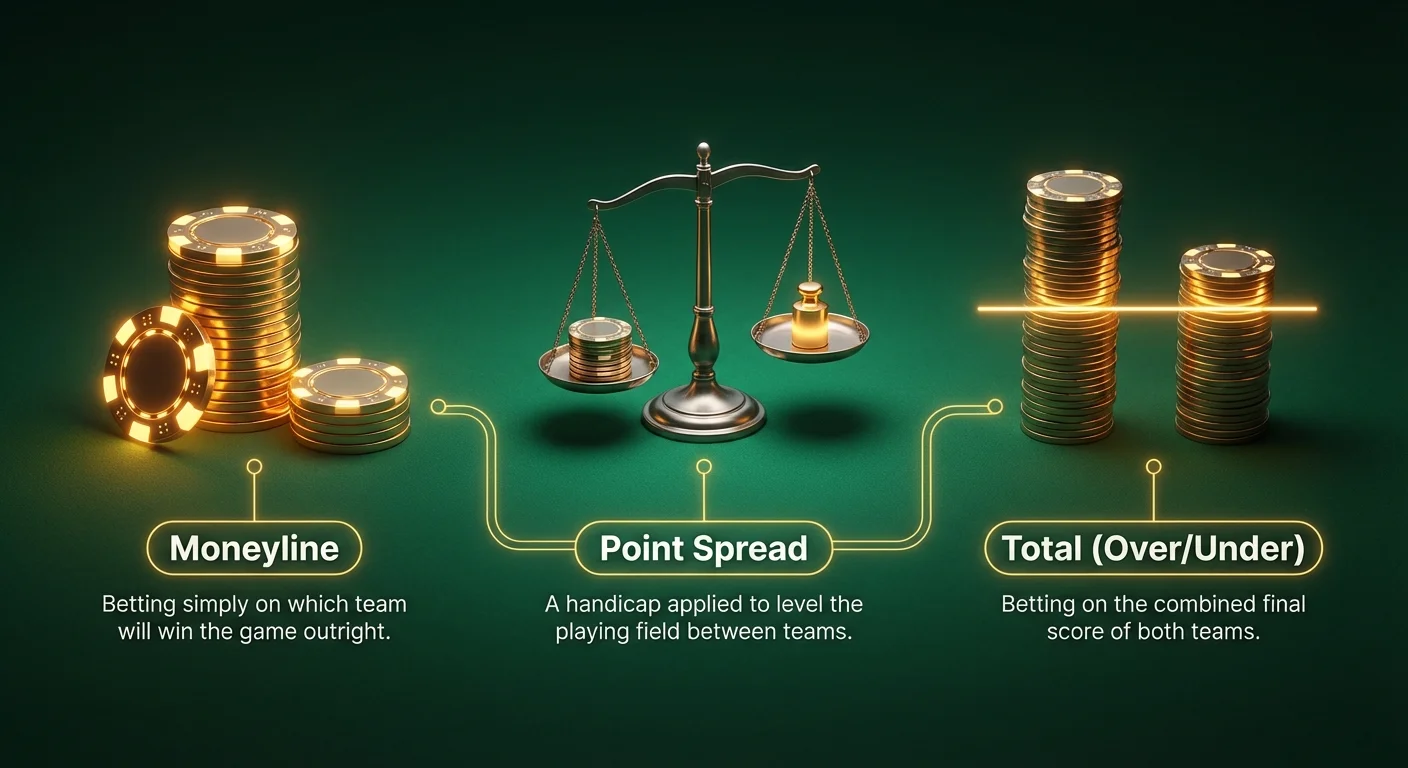
This is where the action happens. The center of the screen displays the specific matchups, the teams playing, the start times, and the three main betting markets (Spread, Total, Moneyline).
3. The Right Rail: The Bet Slip
Think of this as your shopping cart. Nothing happens until you click a line in the center board; once you do, it moves to the bet slip on the right (or pops up from the bottom on mobile). This is where you enter your wager amount and confirm the bet.
4. The Header: Your Crypto Bankroll
In a standard sportsbook, you see a dollar amount. In a crypto sportsbook, this section is more dynamic. You will often see your balance displayed in mBTC (milli-Bitcoin), Satoshi, ETH, or a stablecoin like USDT.
- Tip: If you are uncomfortable calculating crypto denominations in your head, look for a "Display in Fiat" toggle in the settings. This allows you to bet in USD/EUR values while the backend still processes in crypto.
Decoding the Numbers: The "Big Three" Markets
When you click on a specific league, such as the NFL, you will see a list of games. Each game is defined by a Rotation Number (a unique ID number for that bet, primarily used for in-person betting but still visible online) and the team names.
Next to the teams, you will see three distinct columns. These represent the three most common ways to bet. Let's analyze a hypothetical NFL matchup between the Kansas City Chiefs and the Buffalo Bills.
| Rotation | Team | Spread | Total | Moneyline |
|---|---|---|---|---|
| 301 | Kansas City Chiefs | -3.5 (-110) | O 54.5 (-110) | -180 |
| 302 | Buffalo Bills | +3.5 (-110) | U 54.5 (-110) | +155 |
This table represents exactly what you will see on your screen. Let's break down each column.
1. The Moneyline (Who will win?)
The Moneyline is the simplest bet in sports: you are just picking the winner. There are no point spreads involved. However, because teams are rarely perfectly equal in skill, the payout changes based on the favorite and the underdog.
The Minus (-): The Favorite.
- In the example above, the Chiefs are -180.
- The minus sign indicates they are favored to win.
- The number (180) represents how much you must bet to win $100.
- Math: You must bet $180 to make $100 in profit.
The Plus (+): The Underdog.
- The Bills are +155.
- The plus sign indicates they are the underdog.
- The number (155) represents how much profit you make on a $100 bet.
- Math: A $100 bet results in $155 profit.
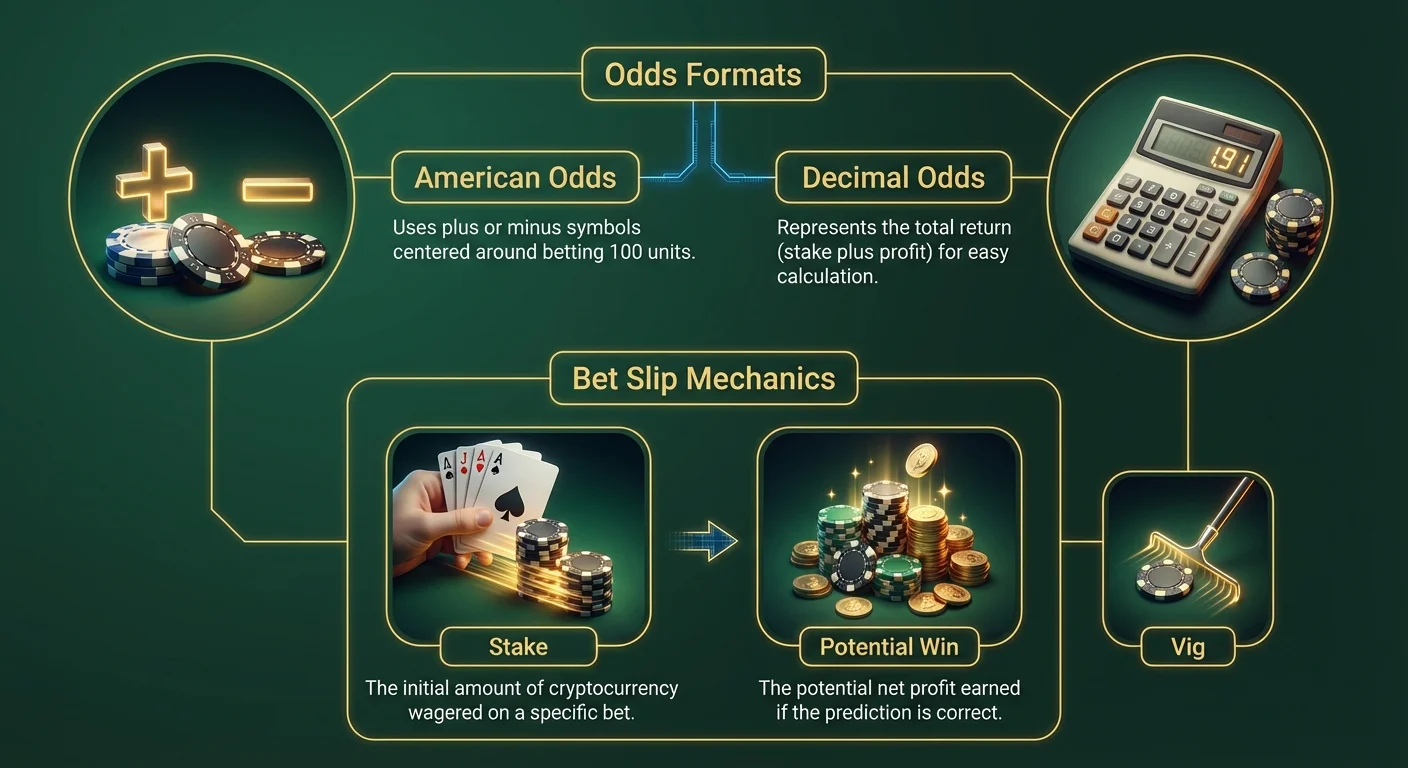
Crypto Note: On many crypto-native sites, the default odds format might be Decimal (e.g., 1.91) rather than American (+/-). We will cover how to convert these later, but most sites allow you to toggle back to American odds in the preferences menu.
2. The Point Spread (The Handicap)
This is the most popular way to bet on football and basketball. The sportsbook attempts to level the playing field by giving the underdog a head start.
Looking at the table: Kansas City -3.5 vs. Buffalo +3.5.
The Spread Number (-3.5 / +3.5):
- Kansas City (-3.5): They must win the game by more than 3.5 points (i.e., 4 points or more). If they win by 3, you lose the bet.
- Buffalo (+3.5): They can either win the game outright OR lose by less than 3.5 points (i.e., 1, 2, or 3 points).
The "Juice" or "Vig" (-110):
- You will see a smaller number next to the spread, usually -110. This is the price of the bet.
- Just like the moneyline, -110 means you must bet $110 to win $100. This 10% extra cost is the sportsbook's commission.
3. The Total (Over/Under)
The third column focuses on the score, not the winner. The bookmaker sets a predicted combined score for both teams.
- O 54.5: You are betting that the Chiefs and Bills will combine to score 55 points or more.
- U 54.5: You are betting the combined score will be 54 points or less.
- Like the spread, this usually comes with a -110 price tag (vig).
Understanding Odds Formats: American vs. Decimal
Because the crypto betting world is global, you will frequently encounter Decimal odds. While American odds usually center around the number 100, Decimal odds center around the number 1.
Decimal odds represent the total return (Stake + Profit), whereas American odds usually just indicate the profit.
Conversion Table
| Probability | American Odds | Decimal Odds | Description |
|---|---|---|---|
| High | -200 | 1.50 | Strong Favorite |
| Standard | -110 | 1.91 | Standard Spread/Total Price |
| Even | +100 (Even) | 2.00 | Double your money |
| Low | +200 | 3.00 | 2-to-1 Underdog |
Why Crypto Sites Love Decimals:
Calculating crypto returns is easier with decimals. If you bet 0.05 BTC on odds of 1.91, the math is simple:
If you use American odds (-110), calculating the return on 0.0034 BTC requires a much more complex formula. If you are serious about crypto betting, learning to read Decimal odds is a valuable skill.
Mastering the Bet Slip
Once you have identified a line you like - let's say you believe the Bills will cover the +3.5 spread - you click the cell. The Bet Slip will populate. This is the final checkpoint before your crypto leaves your wallet.
1. Single vs. Parlay
- Single (Straight Bet): A bet on one specific outcome. This is the professional standard for long-term profitability.
- Parlay (Accumulator/Multi): You select multiple bets (legs). All of them must win for you to get paid. The odds multiply, leading to massive payouts, but the risk increases exponentially.
2. Stake vs. Win Amount
The slip usually has two boxes: "Stake" (Risk) and "To Win" (Profit).
- If you type 0.01 BTC in the Stake box, the "To Win" box will automatically calculate your potential profit based on the odds.
- If you type a target profit in the To Win box, the slip will calculate how much you need to bet.
3. Odds Changes Warning
Sports betting markets move fast. In the seconds between adding a bet to your slip and clicking "Place Bet," the odds might change from -110 to -115.
- Checkbox: Most slips have a setting: "Accept All Odds Changes," "Accept Better Odds," or "Ask for Approval."
- Safety Tip: As a beginner, set this to "Ask for Approval." You don't want to accidentally place a bet after the line has moved significantly against you.
Visual Indicators of Line Movement
Advanced sportsbooks give you visual cues about how the market is moving. Understanding these subtle graphics can prevent you from betting on a "stale" line.
Color Flashes
- Red Border/Flash: Usually indicates the odds have worsened (e.g., going from +150 to +140).
- Green Border/Flash: Usually indicates the odds have improved (e.g., going from +150 to +160).
Locked Lines
Sometimes you will see a "Lock" icon or the odds will be greyed out. This happens frequently during Live (In-Play) betting. It means a significant event (touchdown, red card, injury) has occurred, and the algorithm is recalculating the probability. You cannot bet until the lock disappears.
Crypto-Specific Interface Features
Betting at a site like Stake, Cloudbet, or Sportsbet.io offers features you won't find on traditional fiat sites.
1. The Asset Toggle
You might hold balances in Bitcoin, Litecoin, and USDT simultaneously. The interface will have a wallet dropdown (usually top center or top right). Crucial: Ensure you have the correct currency selected before building your bet slip. Betting 1 BTC is very different from betting 1 USDT!
2. "Buy Crypto" Integration
Many modern sportsbooks have a "Buy Crypto" button integrated directly into the cashier or sidebar, allowing you to use a credit card via a third-party processor (like MoonPay) to top up your balance instantly if you run out of liquidity during a game.
3. Provably Fair Verification
While this applies mostly to casino games, some "Dice" style sports games exist. If you see a hash string at the bottom of a bet slip, this is a cryptographic proof that the result was generated fairly. This is rare in live sports (since the game result is public record) but common in simulated sports leagues.
Practical Strategy: Tips for Reading the Board
Now that you know what the numbers mean, here is how to use the interface to your advantage.
1. Always Check the "Vig"
Don't just look at the spread number (-3.5). Look at the odds in parentheses (-110).
Sometimes, a book will keep the spread at -3.5 but change the juice to -125. This makes the bet much more expensive. A -3.5 (-125) line is significantly worse than a -3.5 (-105) line. Always read the fine print.
2. Shop for Lines (Open Multiple Tabs)
One of the beauties of crypto betting is the speed of movement. Because deposits are instant, you can keep accounts at 2 or 3 different sportsbooks.
- Site A might have the Chiefs at -3.5.
- Site B might have the Chiefs at -3.
- If you want to bet the Chiefs, Site B is the better option (since a 3-point win is a "push" or refund on Site B, but a loss on Site A).
- Visually scanning multiple interfaces to find the best number is called "Line Shopping."
3. Beware the "Teaser" Interface
Many sportsbooks have a tab on the bet slip labeled "Teaser." This allows you to adjust the point spread in your favor (e.g., moving -3.5 to +2.5) in exchange for lower odds. While tempting for beginners, the visual interface often makes the payout look better than the actual mathematical probability warrants. Stick to straight bets while learning.
4. Verify the Time Zone
Crypto sportsbooks are global. A game listed as starting at "18:00" might be in UTC, EST, or CET depending on your settings. Always check your account settings to align the sportsbook time with your local time to avoid missing kickoff.
Summary: Your Checklist Before Confirming the Bet
Reading betting lines becomes second nature with practice. Before you click "Place Bet" on your next wager, run through this mental checklist:
- Market Check: Am I betting on the Moneyline (winner), Spread (handicap), or Total (score)?
- Odds Format: Am I reading this in American or Decimal format? Do I understand the potential payout?
- Currency Check: Is my wallet set to the correct crypto asset?
- Slip Verification: Did I accidentally click the line twice? (Ensure your bet slip doesn't say "2x").
- Vig Check: Am I paying standard price (-110 / 1.91) or inflated price (-125 / 1.80)?
By mastering the visual language of the sportsbook, you move from being a gambler guessing at outcomes to a bettor making calculated decisions. The interface is your dashboard; learn to read the gauges, and you'll navigate the volatile world of sports betting with precision.