
Instant gratification is the hallmark of the modern crypto betting landscape. With micro-betting and live in-play markets, you can wager on the outcome of a single drive in football or the next point in tennis and receive your payout in Bitcoin within seconds. However, the sophisticated bettor knows that while day trading games can be profitable, true value often lies in playing the long game.
Futures betting represents the "buy and hold" strategy of the sports gambling world. It requires patience, foresight, and a distinct set of capital management skills that differ wildly from betting on tonight's spreads. Whether you are looking to predict the next Super Bowl champion, the NBA MVP, or whether a team will go over their season win total, futures markets offer high-ceiling payouts that can compound your crypto stack significantly.
This guide is designed for intermediate bettors who understand the basics of odds but want to master the strategic nuances of futures betting. We will explore how to identify value in championship odds, how to leverage crypto-specific advantages, and most importantly, how to manage the opportunity cost of tying up your digital assets for months at a time.
What is Futures Betting?
At its core, a futures bet is a wager placed on an event that will be decided in the distant future - usually at the end of a season or a tournament. Unlike a single-game wager where the result is known in hours, season long bets can remain open for weeks or months.
The Three Pillars of Futures Markets
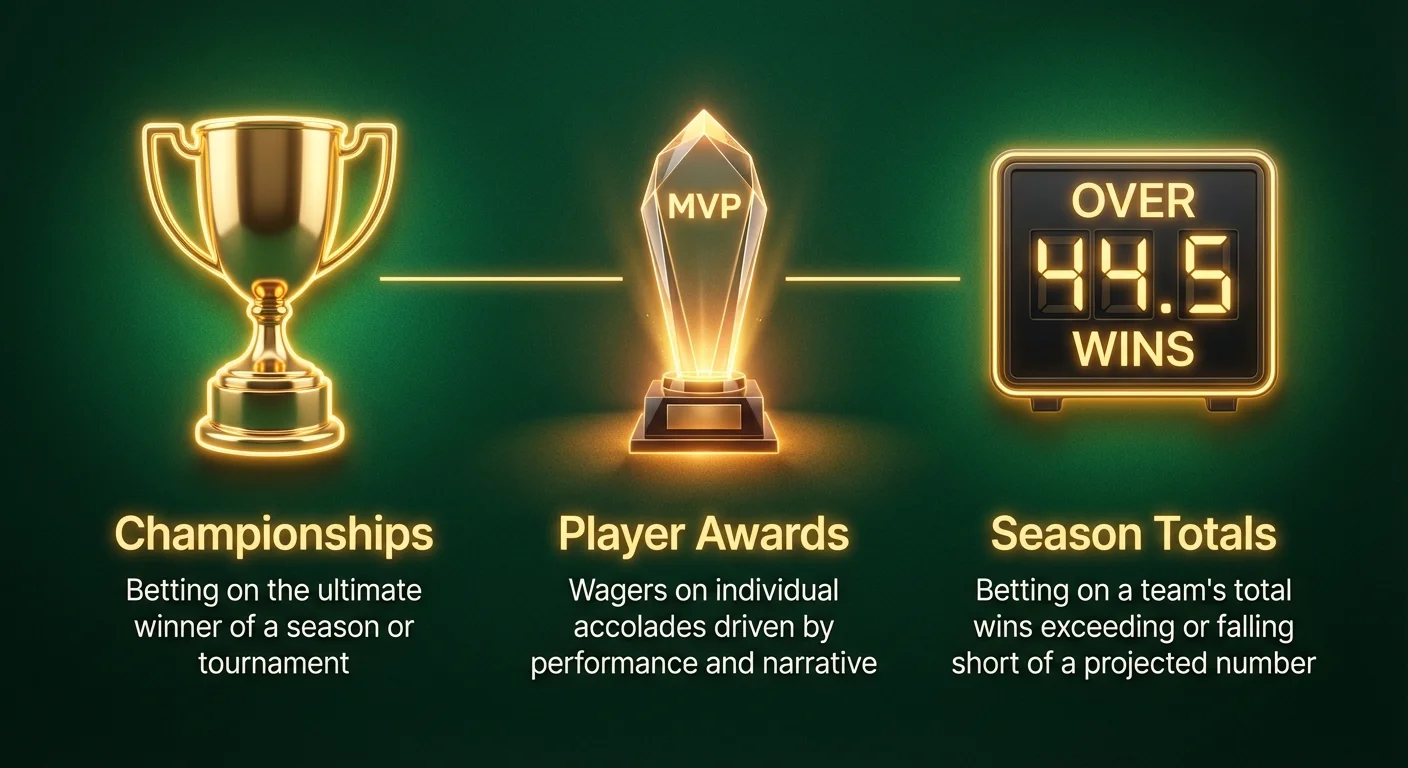
While sportsbooks offer hundreds of exotic markets, most futures fall into three primary categories:
- Championships and Team Achievements: The most common form of futures. Who will hoist the Lombardi Trophy? Who will win the World Cup? Who will win the Eastern Conference?
- Player Awards: Individual accolades such as the MVP, Rookie of the Year, Cy Young, or the Golden Boot. These markets are often more volatile than team markets as they rely on narrative and voter fatigue as much as statistical performance.
- Season Totals (Over/Unders): Bookmakers set a projected win total for a team (e.g., Los Angeles Lakers: 44.5 Wins). You bet on whether the actual result will be Over or Under that number.
Understanding the Odds Format
Futures are almost exclusively presented in moneyline format. Because it is difficult to predict a champion among 30+ teams, the payouts are generally "plus-money" (+).
- Kansas City Chiefs: +600 (Bet $100 to win $600)
- Buffalo Bills: +1200 (Bet $100 to win $1,200)
- Carolina Panthers: +25000 (Bet $100 to win $25,000)
The high potential ROI (Return on Investment) is the primary allure. However, as we will discuss, the "vig" (bookmaker's fee) on futures markets is significantly higher than single-game bets, meaning you must be much more selective.
The Crypto Component: Volatility and Stability
When betting futures on a standard fiat sportsbook, a dollar is a dollar. When betting futures on a crypto sportsbook, the underlying asset adds a layer of complexity - and opportunity - that you must account for.
The Asset Volatility Trap
Imagine you place a 1 BTC bet on the Super Bowl in September when Bitcoin is trading at $30,000. The bet is on a team with +1000 odds.
- Scenario A: Your team wins, but BTC drops to $15,000 in February. You win 10 BTC, but the fiat value is less impactful than you hoped.
- Scenario B: Your team loses, and BTC pumps to $60,000. You didn't just lose the bet; you lost the appreciation of that asset.
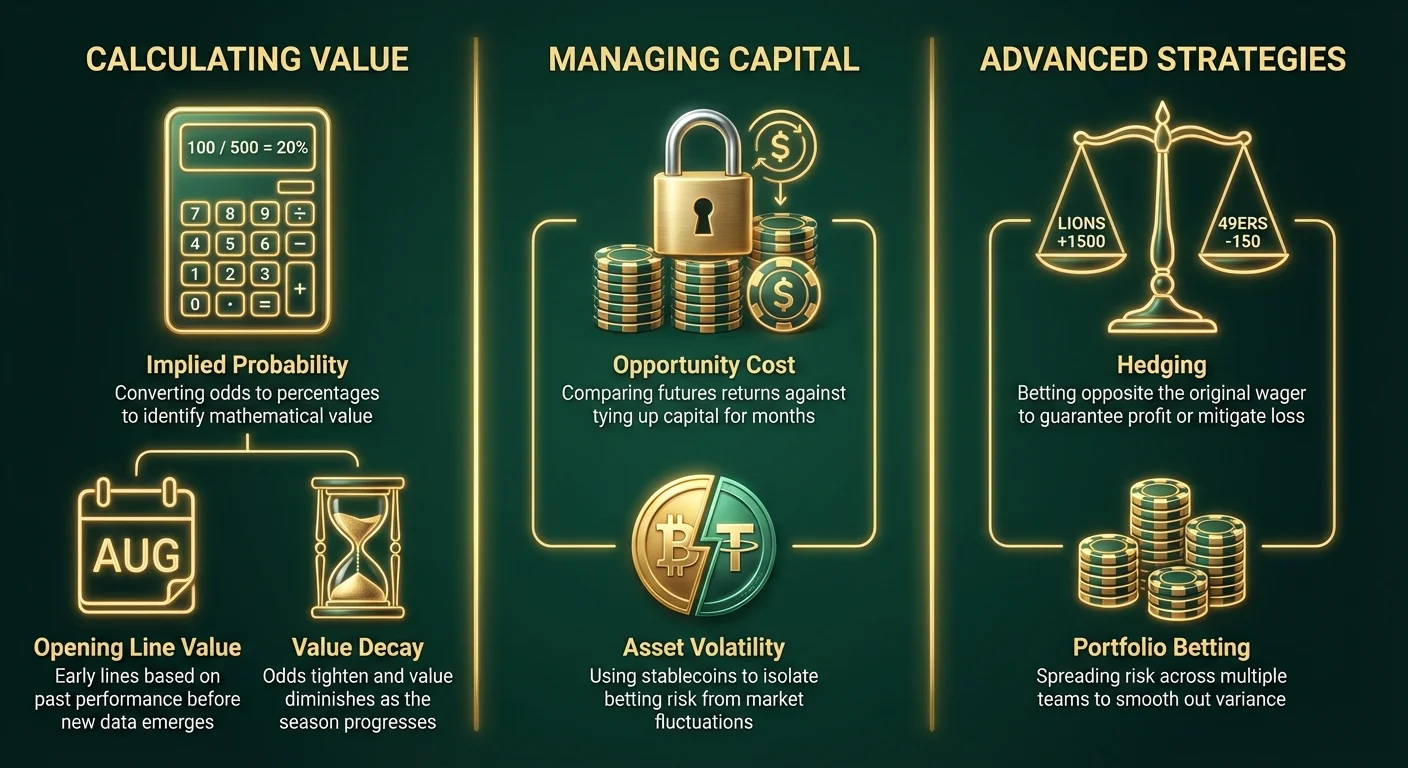
Strategy Tip: For long-term futures, consider using Stablecoins (USDT, USDC). This isolates your sports risk from market risk. By betting in stablecoins, you ensure that your bankroll management remains mathematical rather than speculative on the price of the token.
Provably Fair and Liquidity
Crypto sportsbooks often have higher ceilings for payouts and faster settlement times. In traditional betting, withdrawing a massive futures win can trigger KYC audits and bank delays. In crypto, a smart contract or automated payout system sends your winnings to your wallet instantly upon market settlement.
Calculating Value: When to Buy the Ticket
The biggest mistake intermediate bettors make with championship odds is ignoring timing. A bet placed in August is fundamentally different from the same bet placed in November.
The "Opening Line" Value
Sportsbooks release opening lines shortly after the previous season concludes. These lines are often "soft," meaning they rely on past performance and haven't yet adjusted for the draft, trades, or schedule difficulty.
- Pro: If you anticipate a major trade (e.g., a star Quarterback moving teams), betting before the news breaks offers massive value.
- Con: You have zero information regarding injuries or training camp performance.
The "Mid-Season" Adjustment
As the season progresses, the odds tighten. The favorites drop from +1000 to +350. However, value often emerges on teams that start slow due to a tough schedule but have easy games remaining.
Example of Value Decay:
| Time of Season | Team Status | Odds | Implied Probability | Verdict |
|---|---|---|---|---|
| Pre-Season | Full Health, Hyped | +800 | 11.1% | High Risk / High Reward |
| Week 6 | 4-2 Record, Star injured | +1400 | 6.6% | Value Buy (if star returns) |
| Week 16 | Clinched Playoffs | +350 | 22.2% | Poor Value (Buying at the top) |
Identifying Implied Probability
To be a successful futures bettor, you must convert odds to percentages to see if the math makes sense.
- Formula:
100 / (Odds + 100) * 100 - Example: Odds of +400.
100 / 500 * 100 = 20%. - Analysis: If you believe the team has a greater than 20% chance of winning, the bet is EV+ (Expected Value Positive). If you think they only have a 15% chance, it is a bad bet, even if they eventually win.
The Opportunity Cost of Locked Capital
This is the section that separates the novices from the pros. When you place a futures bet, you are locking that liquidity up for 6 to 9 months.
In the crypto world, where staking yields, DeFi protocols, and trading opportunities are abundant, capital efficiency is key.
The "Time Value" Calculation
If you lock up 1 ETH on a futures bet with a potential 20% return over 8 months, you must compare that against:
- Staking Rewards: Could that ETH earn 4-5% risk-free in a validator pool?
- Compound Betting: Could you turn over that 1 ETH ten times in daily games with a 2% edge, resulting in higher total profit?
Rule of Thumb: Because of opportunity cost, the potential payout on a season-long future needs to be significantly higher than a standard game bet. Avoid betting "Heavy Favorites" in futures. Tying up your bankroll for 6 months to bet a team at -150 (winning $66 on a $100 bet) is usually a mathematical error. Look for odds of +500 or higher to justify the liquidity lock.
Advanced Strategy: The Art of Hedging
Hedging is the practice of betting on the opposite side of your original wager to guarantee a profit or mitigate a loss. Futures are the best vehicle for hedging because the odds shift drastically over time.
The Scenario
- August: You bet $100 on the Detroit Lions to win the NFC at +1500.
- Potential Payout: $1,600 ($1,500 profit + $100 stake).
- January: The Lions make it to the NFC Championship game. They are playing the 49ers.
- Current Game Odds: The 49ers are favorites (-150). The Lions are underdogs (+130).
The Hedge
You stand to win $1,600 if the Lions win. If they lose, you get $0.
To lock in profit, you place a wager on the 49ers moneyline.
- Hedge Bet: You bet $600 on the 49ers at -150.
- If 49ers win: You win $400 profit on the hedge. You lose the $100 futures bet. Net Profit: $300.
- If Lions win: You win $1,500 on the future. You lose the $600 hedge bet. Net Profit: $900.
By hedging, you have guaranteed a profit regardless of the outcome. You sacrificed the "maximum" upside ($1,500) for security.
When NOT to Hedge
Many aggressive bettors argue against hedging, citing that it reduces Expected Value (EV). If you have a mathematical edge, you should let it ride. However, if the amount of money represents a significant portion of your crypto bankroll, hedging is a wise risk management tool.
Portfolio Betting: Diversifying the Risk
Rather than putting all your eggs in one basket (one team), consider a portfolio approach. This mimics venture capital: you expect most bets to lose, but the winners pay for the losers.
Sample Championship Portfolio ($500 Budget):
- The Contender (40%): $200 on a Top 3 team at +500. (Potential Return: $1,200)
- The Dark Horse (30%): $150 on a mid-tier team at +1200. (Potential Return: $1,950)
- The Longshot (30%): $150 on a talented but unproven team at +2500. (Potential Return: $3,900)
If any of these teams win, you are profitable.
- If the Contender wins: $1,200 Return - $500 Total Stake = $700 Profit.
- If the Longshot wins: $3,900 Return - $500 Total Stake = $3,400 Profit.
This strategy smoothes out variance and keeps you engaged with multiple teams throughout the season.
Sport-Specific Nuances for Futures
Different sports have different variables that affect long-term markets.
NFL (Football)
- The Quarterback Factor: NFL futures are 80% reliant on QB health. If a starting QB goes down, the ticket is likely dead.
- The Path: Look at the division. It is easier to make the playoffs in a weak division (like the NFC South in recent years) than a loaded one (AFC North). An easier path to the playoffs provides better hedging opportunities later.
NBA (Basketball)
- Load Management: Regular season win totals can be tricky because stars often sit out back-to-backs.
- Trade Deadline: The NBA trade deadline changes the landscape more than any other sport. A mid-tier team can become a favorite overnight by acquiring a superstar.
- Player Awards: MVP voting is heavily narrative-driven. Look for players who have not won recently; voters suffer from "voter fatigue" (refusing to vote for the same guy 3 years in a row).
European Soccer (Premier League / Champions League)
- Transfer Windows: January transfers can make or break a season.
- Depth: In leagues like the EPL, only teams with massive squad depth (like Man City) can sustain performance over 38 games. Longshots rarely win league titles (Leicester City being the anomaly), but they often offer value in "Top 4 Finish" or "Relegation" markets.
Practical Tips for Crypto Futures Bettors
If you are ready to place your wagers, follow this checklist to ensure you aren't leaving money on the table.
- Line Shopping is Mandatory: Futures odds vary wildly between sportsbooks. One crypto book might have the Celtics at +300, while another has them at +450. On a 1 ETH bet, that is a difference of 1.5 ETH in profit. Always hold accounts at multiple crypto sportsbooks to grab the best price.
- Beware of "Dead Heat" Rules: In player markets (like Top Goalscorer), if two players tie, some books cut the payout in half. Read the Terms & Conditions.
- Check Max Payout Caps: Some smaller crypto books have maximum win limits per bet slip. Ensure your longshot parlay doesn't exceed the book's payout cap, or you are betting for free.
- Avoid Parlaying Futures: While combining the Chiefs to win the Super Bowl and the Celtics to win the NBA Finals pays astronomical odds, the compound vig (house edge) makes this a mathematically terrible bet. It also ties up your money for the maximum amount of time.
- Monitor "Cash Out" Offers: Many modern crypto books offer a "Cash Out" button. If your longshot team makes the playoffs, the book may offer you a profit to cancel the bet early. Compare this offer to your Hedge math; usually, hedging manually yields more money than the book's low-ball cash-out offer.
Summary: The Patient Sniper
Futures betting is the ultimate test of a sports bettor's knowledge and discipline. It removes the noise of daily variance - a bad referee call, a lucky bounce - and focuses on the quality of a team over a large sample size.
By utilizing crypto, specifically stablecoins, you can move in and out of positions with speed and handle larger transaction volumes. However, success requires respecting the opportunity cost of your bankroll.
Key Takeaways:
- Value Entry: Bet early on soft lines or buy the dip on good teams with bad schedules.
- Bankroll: Never lock up more than 10-15% of your bankroll in futures due to liquidity constraints.
- Asset Class: Use stablecoins to avoid double-gambling on token prices.
- Hedge: Use the playoffs as an opportunity to lock in green on your longshot tickets.
Playing the long game isn't about the adrenaline rush of tonight's kickoff; it's about looking at the board, seeing what the rest of the market is missing, and waiting for the rest of the world to catch up to your prediction.