
Walking up to a roulette table - whether it's the felt of a Las Vegas high-roller room or the crisp interface of a crypto casino - can feel like standing at the edge of a battlefield. The layout is divided into two distinct territories, each offering a completely different engagement with Lady Luck. To the uninitiated, placing chips might seem random, but the intermediate player knows that the grid is a map of volatility.
Understanding the fundamental difference between Inside and Outside bets is more than just knowing where to place your chips; it is about defining your identity as a gambler. Are you a sniper looking for a high-value target, or are you a grinder looking to slowly build a stack?
This guide dives deep into the mechanics of the betting grid. We will strip away the superstition and look at the math, the volatility, and the strategies that define these two zones. By balancing the risk of Inside bets with the stability of Outside bets, you can tailor a strategy that protects your bankroll while leaving the door open for those adrenaline-fueled payouts.
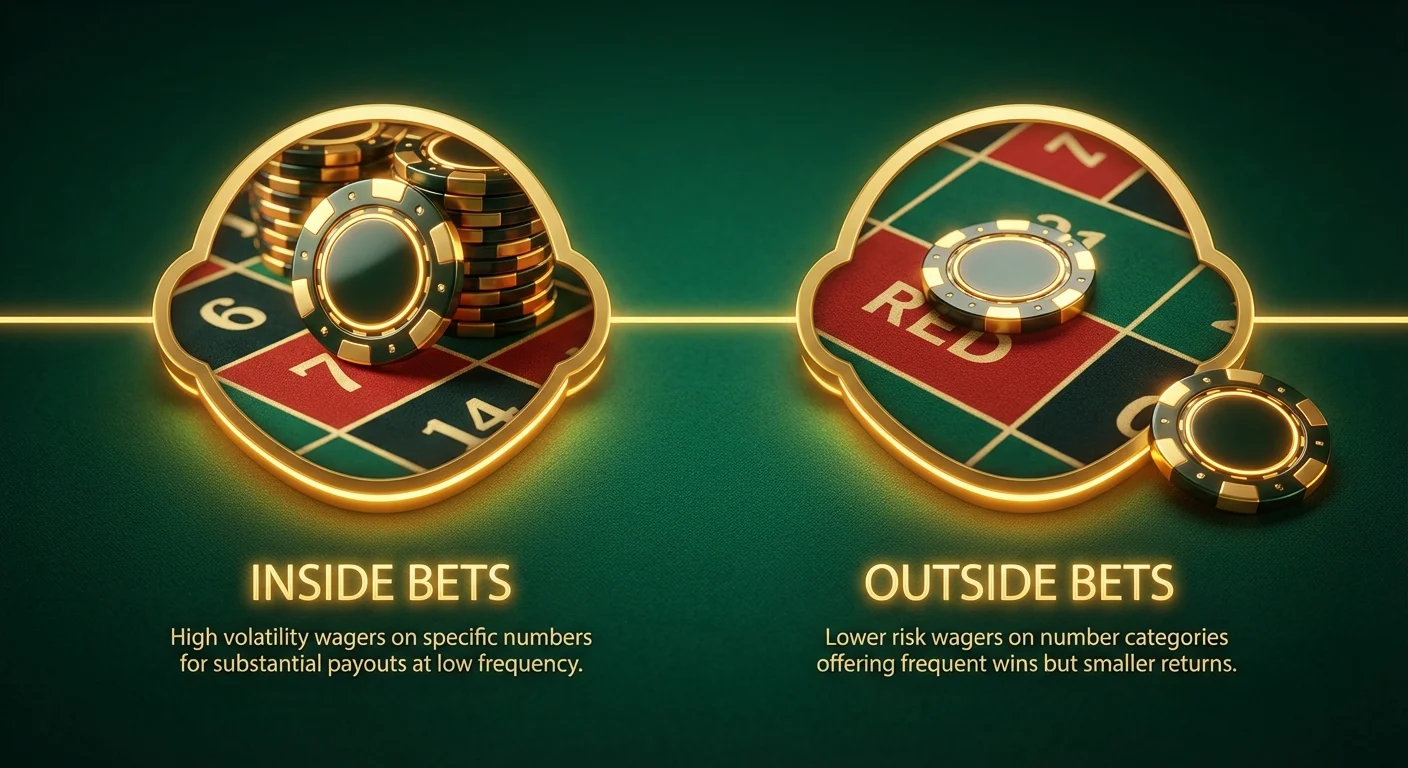
The Anatomy of the Roulette Grid
Before we discuss strategy, we must clearly define the territories. The roulette layout is not just a jumble of numbers; it is a mathematical matrix designed to offer varying degrees of risk.
The layout consists of numbers 1 through 36, plus a single zero (0) in European/French Roulette, and an additional double zero (00) in American Roulette.
- The Inside: This is the inner grid containing the individual numbers (0-36). Chips placed directly on numbers or on the lines between them are "Inside Bets."
- The Outside: These are the boxes surrounding the number grid. They represent categories of numbers (Red, Black, Odd, Even, Dozens, Columns). Chips placed here never touch specific numbers; they touch concepts.
The core trade-off here is simple but profound: Frequency vs. Magnitude. Inside bets offer low frequency of winning but high magnitude of payout. Outside bets offer high frequency of winning but low magnitude of payout.
Deep Dive: Inside Bets (The High-Volatility Zone)
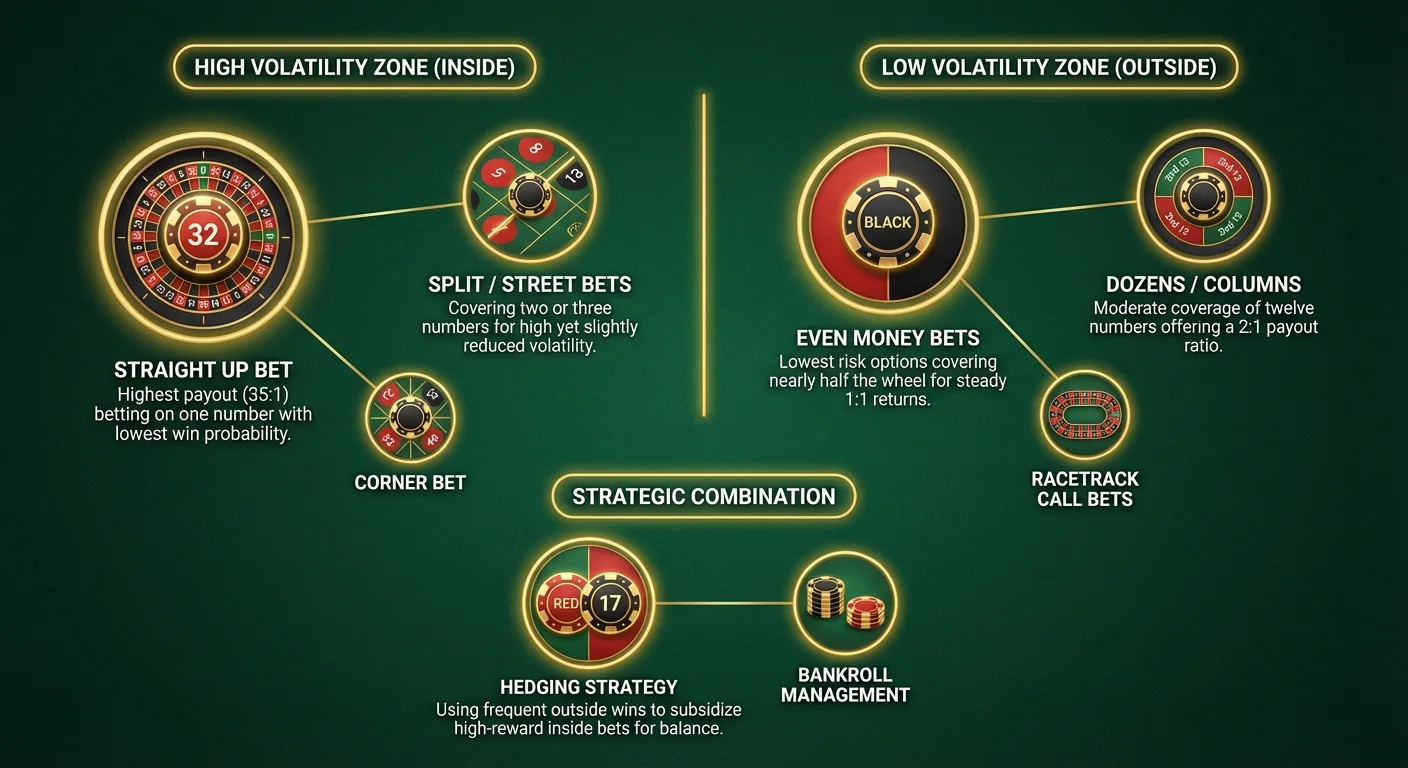
Inside bets are the heart-pounding center of the game. This is where fortunes are made in a single spin, and where bankrolls can vanish if managed poorly. When you bet Inside, you are accepting high volatility. You will lose far more spins than you win, but when you win, the payoff is substantial.
The Types of Inside Bets
Straight Up (The Sniper):
- Description: A bet on a single number (e.g., Red 7).
- Payout: 35:1.
- Risk Profile: Extremely High.
- Why play it: This is the only way to turn a small amount of crypto into a massive stack instantly. If you bet 1 mBTC and win, you walk away with 36 mBTC.
Split Bet:
- Description: A bet placed on the line dividing two adjacent numbers (e.g., 14/17).
- Payout: 17:1.
- Risk Profile: High.
- Nuance: This effectively halves your variance compared to a Straight Up, but keeps you in the high-reward zone.
Street Bet (The Trio):
- Description: A bet on a row of three numbers (e.g., 19, 20, 21). You place your chip on the outer boundary line of the row.
- Payout: 11:1.
- Risk Profile: Medium-High.
- Strategy Note: Street bets are excellent for "sector coverage." By placing consecutive street bets, you can cover large chunks of the table while retaining a double-digit payout ratio.
Corner (Square) Bet:
- Description: A bet placed at the intersection of four numbers (e.g., 25, 26, 28, 29).
- Payout: 8:1.
- Risk Profile: Medium.
- Why play it: This is often considered the "anchor" of an Inside strategy. It offers a reasonable chance of hitting (roughly 10.8%) while still paying significantly better than even money.
The Six Line (Double Street):
- Description: A bet covering two adjacent rows of numbers (6 numbers total).
- Payout: 5:1.
- Risk Profile: Low-Medium (for an Inside bet).
- Nuance: This bridges the gap between Inside and Outside. You are covering about 16% of the wheel.
The Volatility Trap of Inside Bets
The biggest mistake intermediate players make with Inside bets is bankroll sizing. If you are betting Straight Ups, you must have a bankroll that can withstand long losing streaks. On a European wheel, the odds of hitting a single number are 2.7%. This means you could statistically go 50 or 60 spins without a win.
Pro Tip: If you prefer Inside bets, avoid the "American Basket" bet (0, 00, 1, 2, 3). It is the only bet in roulette that carries a statistically worse House Edge (7.89%) than the standard 5.26% on American wheels. Stick to European (Single Zero) wheels whenever possible, especially when playing at crypto casinos where game selection is vast.
Deep Dive: Outside Bets (The Grinder's Zone)
Outside bets are the realm of the strategist, the grinder, and the system player. These bets are designed to keep you in the game longer. While they won't make you rich in one spin, they are essential for bankroll preservation and meeting wagering requirements on casino bonuses.
The Types of Outside Bets
Even Money Bets:
- Options: Red/Black, Odd/Even, High (19-36)/Low (1-18).
- Payout: 1:1.
- Coverage: 18 numbers (48.6% chance on Euro wheels).
- Risk Profile: Low.
- Strategy: These are the only bets where specific rules like La Partage or En Prison apply (mostly in French Roulette), which can lower the house edge to a miniscule 1.35%.
Dozens and Columns:
- Options: 1st 12, 2nd 12, 3rd 12 (Dozens) or the three vertical lines (Columns).
- Payout: 2:1.
- Coverage: 12 numbers (32.4% chance on Euro wheels).
- Risk Profile: Low-Medium.
- Why play it: This is the sweet spot for many professionals. A 2:1 payout allows you to cover losses more easily than 1:1 bets, but you still cover nearly a third of the Outside bets are heavily favored by players using progressive betting systems like the Martingale (doubling after a loss) or D'Alembert (adding a unit after a loss).'Alembert (adding a unit after a loss). Because the win frequency is high, players feel safer increasing their stakes.
However, be warned: The "Outside" offers a false sense of security. While you win more often, the House Edge remains the same (2.7% or 5.26%). You are simply trading the thrill of a big win for the comfort of small wins.
Mathematical Comparison: Risk vs. Reward
To truly balance your strategy, you must visualize the relationship between the probability of winning and the payout. Note how the House Edge remains constant (on a European Wheel), proving that the casino doesn't care where you bet, only that you bet.
Bet Type Category Numbers Covered Payout Probability (European) House Edge (European) Volatility Straight Up Inside 1 35:1 2.70% 2.70% Extreme Split Inside 2 17:1 5.40% 2.70% Very High Street Inside 3 11:1 8.10% 2.70% High Corner Inside 4 8:1 10.81% 2.70% Medium-High Six Line Inside 6 5:1 16.22% 2.70% Medium Column/Dozen Outside 12 2:1 32.43% 2.70% Low-Medium Even Money Outside 18 1:1 48.65% 2.70%* Low *Note: If playing French Roulette with La Partage rules, the House Edge on Even Money bets drops to 1.35%.
Strategic Volatility: Combining the Two Worlds
The true "intermediate" skill in roulette is not choosing one side over the other, but learning how to combine them to hedge risk. By mixing Inside and Outside bets, you can create a payout structure that covers your losses on bad spins while offering a "jackpot" potential on lucky spins.
Strategy 1: The "Cover the Table" (insurance Method)
In this strategy, you use an Outside bet to pay for your Inside bets.
- The Setup: Bet 5 units on Black.
- The Sniper Shots: Bet 1 unit each on 5 specific Red numbers.
- The Logic:
- If Black hits (48.6% chance): You win 5 units on the outside, lose 5 units on the inside. Result: Push (Break Even). You live to spin again.
- If one of your Red Numbers hits: You lose the 5 units on Black and 4 units on the other reds (Total loss: 9), but you win 35 units on the specific number. Result: Net Win of 26 units.
- The Risk: The ball lands on a Red number you didn't pick, or Zero. You lose everything (10 units).
Strategy 2: The "2/3rds Coverage"
This utilizes the Dozens (Outside) to grind, while using Straight Ups (Inside) to spike the variance.
- The Setup: Place 5 units on the 1st Dozen and 5 units on the 2nd Dozen. You have now covered numbers 1-24.
- The Kicker: Place 1 unit on three specific numbers in the 3rd Dozen (e.g., 26, 29, 35).
- The Logic: You are covering roughly 70% of the table. If the ball lands in the first two dozens, you make a small profit or break even (depending on unit sizing). If it lands on your specific numbers in the third dozen, you hit the 35:1 payout.
Strategy 3: The "Bond" Strategy (Modified)
James Bond (or rather, the strategy attributed to him) is a classic example of balancing Inside and Outside bets.
- 140 units on High (19-36) -> Outside Bet
- 50 units on the Six Line (13-18) -> Inside Bet
- 10 units on Zero -> Insurance/Inside Bet
- Analysis: This covers over two-thirds of the table. It is designed to look like you are winning frequently, though mathematically, it is still subject to the standard house edge.
The Crypto Advantage in Roulette
Playing roulette on a crypto gambling platform introduces features that change how you approach these betting zones compared to a land-based casino.
1. Provably Fair and RNG
When betting Inside (Straight Ups), trust is paramount. You are betting on a 2.7% probability event. In a physical casino, you might worry the wheel is biased. In standard online casinos, you trust the audit.In Crypto Roulette, the "Provably Fair algorithm" allows you to verify the Random Number Generator (RNG) seed after every spin. You can mathematically prove that the result was not manipulated. For high-volatility Inside bettors, this transparency is non-negotiable.
2. Micro-Betting for Testing
Inside betting strategies usually require a larger bankroll to sustain the "droughts" between wins. Crypto casinos often allow betting in Satoshis (fractions of Bitcoin) or small amounts of altcoins. This allows you to test aggressive Inside betting strategies (like betting 10 numbers at once) with cents rather than dollars, perfecting your system before scaling up.
3. Instant Volatility Management
If you hit a massive 35:1 Straight Up bet with Bitcoin, the value can be substantial. Crypto casinos typically offer instant withdrawals. The ability to hit a high-volatility win and immediately move those funds to your secure wallet prevents the "gambler's fallacy" of playing until you give it all back.
Practical Tips for Your Next Session
Know Your Volatility Tolerance
Before you sit down, ask yourself: Does losing 10 spins in a row make me angry or panic?
- If YES: Stick to Outside Bets (Red/Black, Columns). You need the dopamine hit of frequent wins to stay rational.
- If NO: You might be suited for Inside Bets. You have the patience to wait for the big payout.
The "Bankroll Split" Rule
If you bring $200 to the table, allocate it based on the zone:
- Inside Bankroll: Needs at least 50-100 units (chips). If you bet $5 straight ups, you need a substantial stack to weather the variance.
- Outside Bankroll: Can work with 20-30 units. Since you win close to 50% of the time, you can churn the money longer.
Avoid the "Gambler's Fallacy"
Just because Red has hit 10 times in a row does not mean Black is "due." The wheel has no memory. This is especially dangerous for Outside bettors who use the Martingale system. The table limit will crush you before the law of averages saves you.
Look for the "Racetrack"
On European layouts, there is often a secondary betting grid called the Racetrack. This allows you to place "Call Bets" (like Voisins du Zéro or Tiers). These are essentially bundles of Inside Bets that cover specific physical sections of the wheel. This is the pro way to bet "Inside" because it correlates to wheel mechanics rather than the numerical grid.
Conclusion: Finding Your Balance
Roulette is a game of beautiful geometry and brutal mathematics. The Inside offers the glory of the long shot, the thrill of the 35:1 payout, and the agonizing suspense of the bouncing ball. The Outside offers the steady grind, the tug-of-war with the house, and the ability to extend your playtime.
The best players do not strictly adhere to one side. They understand the table dynamics. they might grind the Outside to build a profit, then use that "house money" to take sniper shots on the Inside.
When playing on CryptoGambling.com recommended sites, leverage the speed and transparency of blockchain technology to execute these strategies. Remember, whether you are betting on Red or Number 32, the House always has an edge - but by balancing risk and reward, you ensure that when luck does strike, you are positioned to maximize it.
Key Takeaway: Use Outside bets to stay in the game; use Inside bets to win the game. Manage your bankroll accordingly, and never bet more crypto than you can afford to lose.