
For decades, the sports betting industry remained relatively stagnant in how it processed money. You deposited via credit card (if you were lucky and it wasn't declined), placed your bets, and then waited - sometimes weeks - for a paper check or a bank wire to clear when it was time to cash out.
The introduction of blockchain technology has fundamentally disrupted this model. Shifting from fiat currency to cryptocurrency isn't just a trend for tech enthusiasts; it is a strategic move that offers tangible value to the bettor. For the beginner looking to maximize their return on investment (ROI), protect their data, and access better odds, Bitcoin sportsbooks represent the next evolutionary step in wagering.
This guide explores the crypto betting advantages that are causing millions of punters to leave traditional sportsbooks behind. We will break down the financial, logistical, and strategic benefits of betting with Bitcoin, Ethereum, Litecoin, and Stablecoins, helping you understand why "going crypto" might be the smartest play you make this season.

1. Speed of Transactions: The End of the Waiting Game
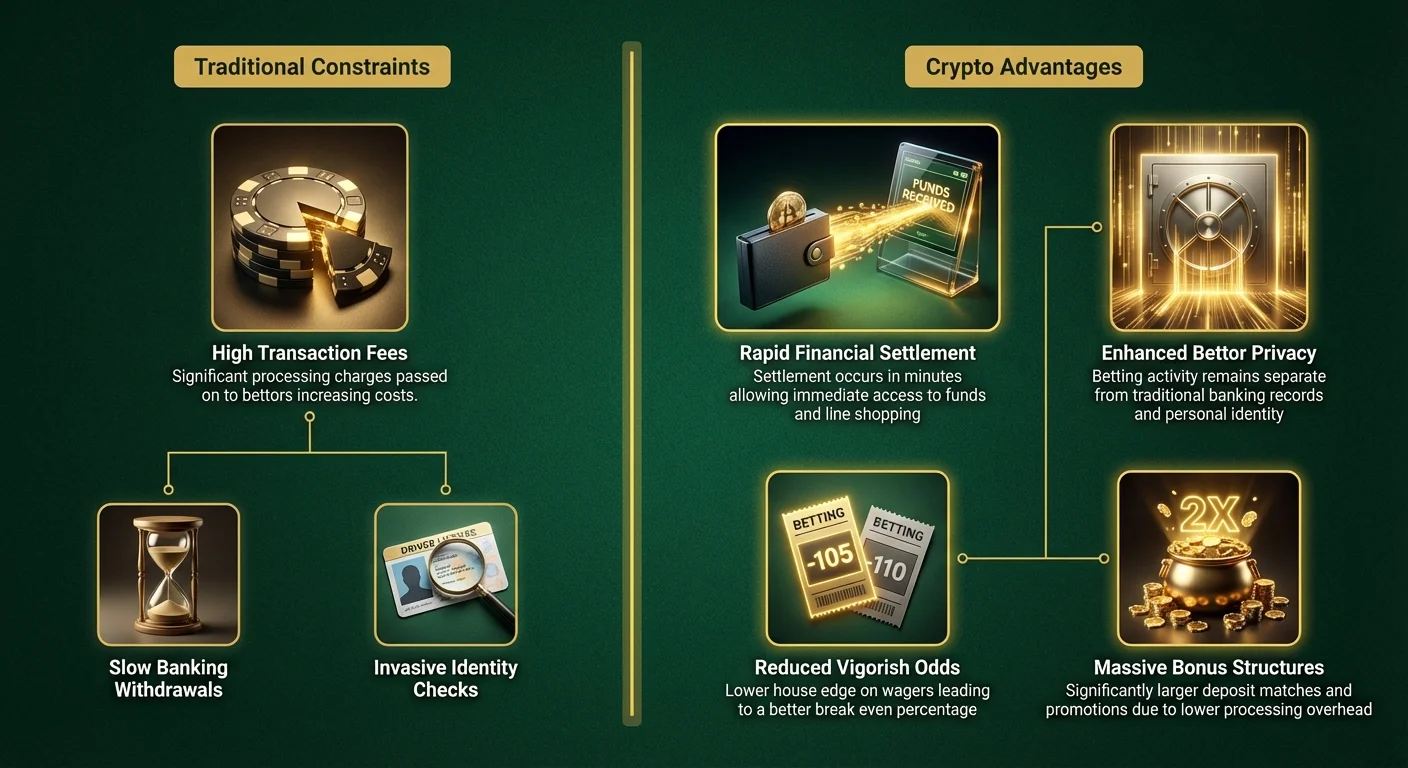
The most immediate difference between a traditional sportsbook and a crypto-centric book is the speed of financial settlement. In the fiat world, the banking system acts as a slow-moving middleman. When you withdraw winnings via bank wire, the request passes through clearing houses, international swift networks, and internal bank reviews.
With Bitcoin sportsbook benefits, the middleman is removed. You are sending funds directly from the sportsbook's wallet to your private wallet.
Comparison: Withdrawal Timelines
The following table illustrates the disparity in withdrawal speeds between traditional methods and cryptocurrency:
| Withdrawal Method | Average Processing Time | Verification Required | Weekend Processing |
|---|---|---|---|
| Paper Check | 7-14 Business Days | High | No |
| Bank Wire | 3-7 Business Days | High | No |
| Credit Card Refund | 3-5 Business Days | High | No |
| Bitcoin (BTC) | 10 Minutes - 4 Hours | Low/None | Yes |
| Litecoin (LTC) | 2 - 15 Minutes | Low/None | Yes |
| Tether (USDT) | Instant - 10 Minutes | Low/None | Yes |
Strategic Advantage: Accessing your liquidity faster allows you to move money between books to shop for lines. If Book A pays out in 15 minutes, you can move those funds to Book B to catch a better line on the late afternoon games.
2. Reduced "Juice" and Better Odds
To understand the financial edge of crypto, you must understand "juice" (also known as the vig or vigorish). This is the fee the bookmaker charges for taking your bet.
At a standard sportsbook, the standard line is -110. This means you must bet $110 to win $100. The extra $10 is the house edge.
Because crypto sportsbooks avoid expensive credit card processing fees (which can range from 3% to 8% for high-risk merchants) and chargeback risks, they operate with lower overhead. Many pass these savings on to the bettor in the form of "reduced juice."
The Math of Reduced Juice
Some crypto books offer -105 lines as their standard, rather than -110.
- Scenario: You are a .500 bettor (you win exactly 50% of your bets).
- At -110 odds: You will lose money over time because the tax on your losses exceeds your winnings. You need to win 52.38% of your bets just to break even.
- At -105 odds: The break-even point drops to approximately 51.2%.
This difference may seem small, but over the course of an NFL season involving hundreds of bets, reduced juice is often the difference between a losing season and a profitable one.
3. Privacy and Anonymous Betting
In an era of increasing digital surveillance, financial privacy is a luxury. Traditional sportsbooks require invasive Know Your Customer (KYC) procedures. Before you can withdraw a single dollar, you often have to upload a driver's license, a utility bill, and photos of your credit card.
Furthermore, depositing into a betting site via a bank account creates a permanent record on your bank statement. This can have adverse effects if you apply for a mortgage or a loan, as some lenders view gambling transactions as high-risk behavior, regardless of whether you win or lose.
Anonymous betting is a core feature of many crypto-exclusive sportsbooks (often called "End-to-End" crypto books).
- Registration: Often requires only an email address and a password.
- Verification: While some may request info for massive suspicious withdrawals, the vast majority process standard payouts without demanding personal documents.
- Financial Footprint: Your bank sees a transaction to a crypto exchange (like Coinbase or Kraken), which is a standard investment activity. They do not see that the funds were subsequently sent to a sportsbook.
4. Massive Bonuses and Promotions
Sportsbooks are desperate to avoid credit card processing fees. When you deposit with Visa or Mastercard, the book pays a fee. When you deposit with Bitcoin, the transaction cost is negligible for them (and paid by you, the sender).
To incentivize you to use crypto, books offer significantly higher bonuses.
Fiat vs. Crypto Bonus Structure
- Standard Fiat Bonus: 50% match up to $500. Rollover: 10x.
- Crypto Bonus: 100% match up to 1 BTC (approx $30,000+ depending on market value). Rollover: 14x.
Strategy Tip: Always read the "Rollover" or "Playthrough" requirements. While crypto bonuses are larger, ensure the rollover is achievable. A 5x to 10x rollover is fair; anything above 20x makes it very difficult to actually cash out the bonus money.
5. Higher Limits for High Rollers
Traditional sportsbooks often limit successful bettors quickly. If you go on a hot streak, you might find your maximum bet limited to $50. Additionally, deposit limits on credit cards are often capped at $1,000 or $2,000 per transaction to prevent fraud.
Crypto betting advantages include massive ceilings for deposits and wagers.
- Deposits: It is not uncommon to see deposit limits of $100,000 or more (or unlimited) per transaction with Bitcoin.
- Wagers: Because settlement is final and guaranteed (no chargebacks), books are more willing to take five-figure or six-figure action on major sporting events.
6. Access to Global Markets and "Grey" Areas
Geographical restrictions in sports betting are often enforced at the payment processor level. If you are traveling abroad, your bank may block a transaction to your favorite sportsbook because the transaction originates from a restricted jurisdiction, or simply because the bank's internal policy prohibits gambling.
Cryptocurrency is borderless. The Bitcoin network does not know or care which country you are in.
- Accessibility: Crypto allows you to access offshore sportsbooks that offer markets unavailable locally (e.g., eSports, politics, specialized prop bets).
- Warning: While crypto allows you to bypass payment blocks, you should always be aware of the legal regulations in your specific jurisdiction regarding online betting.
7. Understanding the Coins: Which Should You Use?
Not all cryptocurrencies are created equal when it comes to betting. While Bitcoin is the most famous, it isn't always the most practical for smaller bets due to network fees.
Bitcoin (BTC)
- Pros: Accepted everywhere, highest limits, most secure.
- Cons: Transaction fees can be high ($5-$20) during network congestion; slower confirmation times (10-60 mins).
- Best For: High rollers and large deposits.
Litecoin (LTC)
- Pros: The "Silver to Bitcoin's Gold." accepted at 99% of crypto books. Extremely low fees (often pennies) and very fast confirmations (2-5 mins).
- Cons: Slightly lower limits than BTC at some books.
- Best For: Everyday bettors and smaller bankrolls.
Ethereum (ETH)
- Pros: Fast and widely accepted.
- Cons: "Gas fees" (transaction fees) can be extremely volatile and expensive.
- Best For: Bettors who already hold ETH for investment.
Stablecoins (USDT / USDC)
- Pros: Pegged to the US Dollar. This eliminates Volatility Risk (the risk that the value of your crypto drops while it is sitting in your sportsbook account).
- Cons: Requires understanding of different networks (ERC20 vs TRC20).
- Best For: Bettors who want the speed of crypto but the stability of fiat currency.
8. Provably Fair Gaming
While this applies more to casino games than sports betting, many crypto sportsbooks act as hybrids, offering casino products alongside the sportsbook.
Crypto gambling introduces the concept of Provably Fair algorithms. This allows players to verify the randomness of a game (like dice or blackjack) using cryptographic hashes. In traditional setups, you simply have to trust the casino. In crypto setups, you can mathematically prove that the result wasn't manipulated.
Practical Guide: How to Start Betting with Crypto
If you are new to the space, the process can seem daunting. Here is a simplified workflow to get you from zero to betting.
Step 1: Set Up a Digital Wallet
Do not send money directly from an exchange (like Coinbase) to a sportsbook. Exchanges often ban accounts associated with gambling. You need a private intermediary wallet.
- Software Wallets (Free): Exodus, Trust Wallet, MetaMask.
- Hardware Wallets (Secure): Trezor, Ledger.
Step 2: Buy Your Crypto
Create an account on a reputable exchange (Coinbase, Kraken, Binance). Link your bank account and purchase your desired coin (LTC is recommended for beginners due to low fees).
Step 3: Transfer to Your Private Wallet
Withdraw the crypto from the exchange to your private wallet address. This puts the funds in your control.
Step 4: Deposit to the Sportsbook
- Log in to your sportsbook.
- Go to the "Deposit" section and select your cryptocurrency.
- The book will generate a unique address (a long string of alphanumeric characters) and a QR code.
- Open your private wallet, select "Send," and paste the sportsbook's address (or scan the QR code).
- Crucial: Double-check the first and last 4 characters of the address to ensure it matches.
- Send the funds.
Step 5: Betting and Withdrawing
Once the blockchain confirms the transaction (usually minutes), the funds appear in your sports account. When you win, simply reverse the process: Withdraw from Book -> Private Wallet -> Exchange -> Sell for Fiat -> Bank Account.
Risks and How to Mitigate Them
To provide a balanced guide, we must address the risks inherent to crypto betting advantages.
Price Volatility
The value of Bitcoin fluctuates. If you deposit $500 worth of BTC, and BTC drops 10% the next day, your betting bankroll is now worth $450, even if you haven't made a bet.
- The Fix: Use Stablecoins (USDT or USDC) if you want to avoid market fluctuations. Alternatively, treat the volatility as part of the gamble - if BTC goes up, your winnings increase in value.
Irreversible Transactions
There is no "undo" button on the blockchain. If you send money to the wrong address, it is gone forever.
- The Fix: Always use "Copy and Paste" for addresses. Never type them manually. Send a small test transaction ($10) first before sending a large amount.
Learning Curve
Understanding wallets, exchanges, and gas fees takes time.
- The Fix: Stick to Litecoin (LTC) initially. It is user-friendly, cheap, and forgiving of errors compared to complex Ethereum smart contracts.
Summary: Is Crypto Betting Right for You?
The shift to Bitcoin sportsbooks is not just about using "internet money." It is about reclaiming control over your funds.
Key Takeaways:
- Speed: Get paid in minutes, not weeks.
- Value: Benefit from reduced juice (-105 odds) and massive deposit bonuses.
- Privacy: Engage in anonymous betting without sharing sensitive bank data.
- Freedom: Bet from anywhere with higher limits.
For the beginner, the initial setup of a wallet and exchange may feel like a hurdle. However, once that infrastructure is in place, the friction of betting disappears. You are no longer at the mercy of banking hours or slow processing centers. You are operating on the blockchain - fast, secure, and efficient.
If you are serious about sports betting, the question isn't why you should use crypto, but rather why aren't you using it already?