
The image of a smoke-filled hall, the smell of felt-tip daubers, and the echo of a caller shouting "Two Little Ducks, 22!" is a nostalgic memory for many. However, the world of bingo has undergone a radical transformation. It moved from the church hall to the desktop computer, and now, it has migrated to the blockchain.
Welcome to the era of Crypto Bingo.
If you are reading this, you are likely intrigued by the intersection of traditional gaming and digital currency. Perhaps you hold Bitcoin, Ethereum, or Litecoin and are looking for a way to utilize your assets for entertainment. This guide is designed to take you from the "Hall to the Hash," providing a comprehensive introduction to how to play crypto bingo. We will explore how digital interfaces differ from physical cards, the mechanics of auto-daubing, and the specific advantages that blockchain technology brings to this classic game.
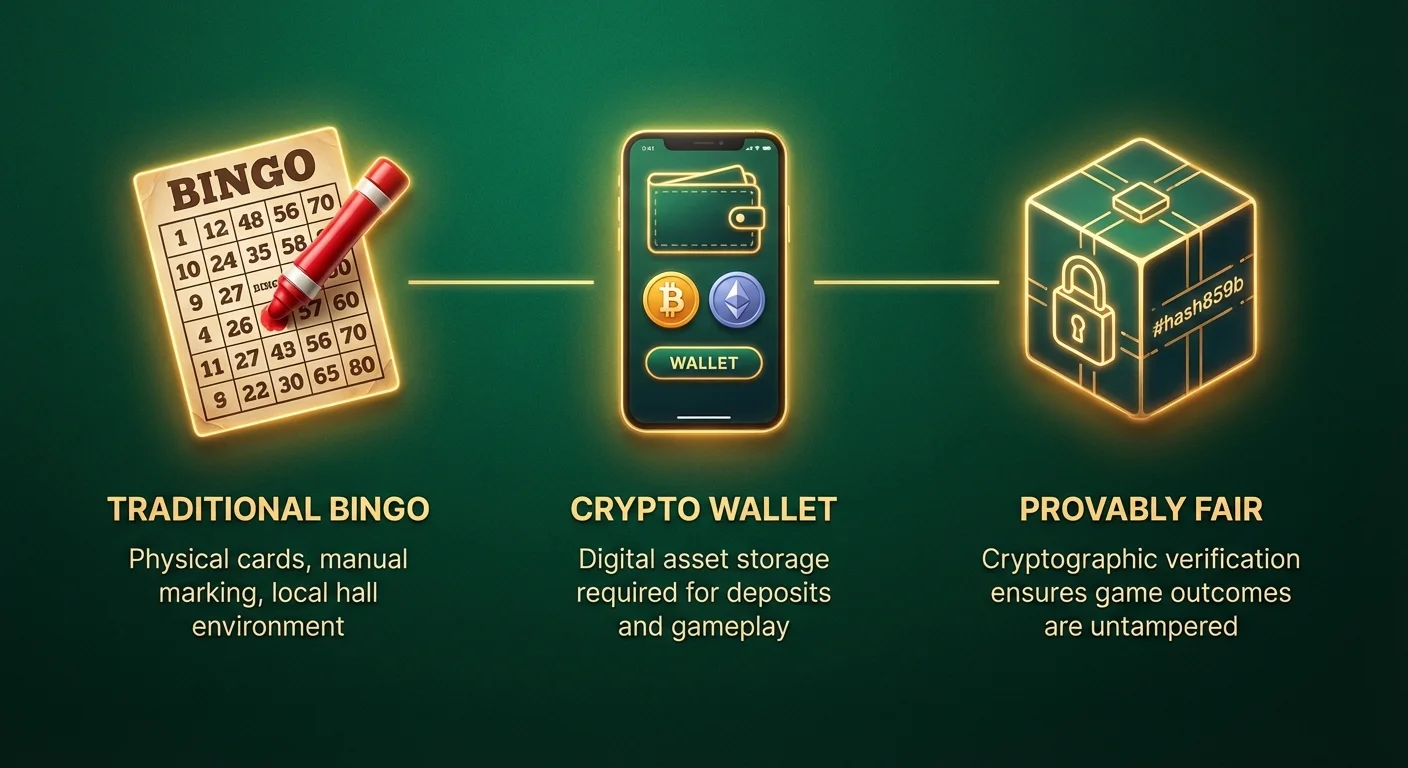
What is Crypto Bingo?
At its core, bitcoin bingo basics remain the same as the game played by your grandmother: you buy a card with numbers, numbers are drawn randomly, and you mark them off to achieve a pattern. However, the infrastructure supporting the game is entirely different.
In traditional online bingo, you deposit fiat currency (USD, EUR, GBP) via credit card or bank transfer. In crypto bingo, you deposit digital assets. But the difference goes deeper than just the currency used.
The "Hash" Factor: Provably Fair Gaming
One of the most significant terms you will encounter in crypto gambling is "Provably Fair." In a physical hall, you trust the caller and the ball machine. In standard online bingo, you trust the casino's software.
In crypto bingo, you trust mathematics.
A "Hash" is a cryptographic string of characters. When a game starts, the server generates a random seed (the outcome of the draw) and sends you a hashed (encrypted) version of it. Because you have this hash before the game begins, the casino cannot alter the numbers halfway through the game to prevent you from winning. After the game, the seed is revealed, and you can verify that it matches the hash you were given. This transparency is the "Ultimate" advantage of playing with blockchain technology.
Getting Started: The Digital Setup
Before you can shout "Bingo!" (or simply watch the screen flash "WIN"), you need to set up the technical side. Unlike walking into a hall with a $20 bill, you need a digital wallet.
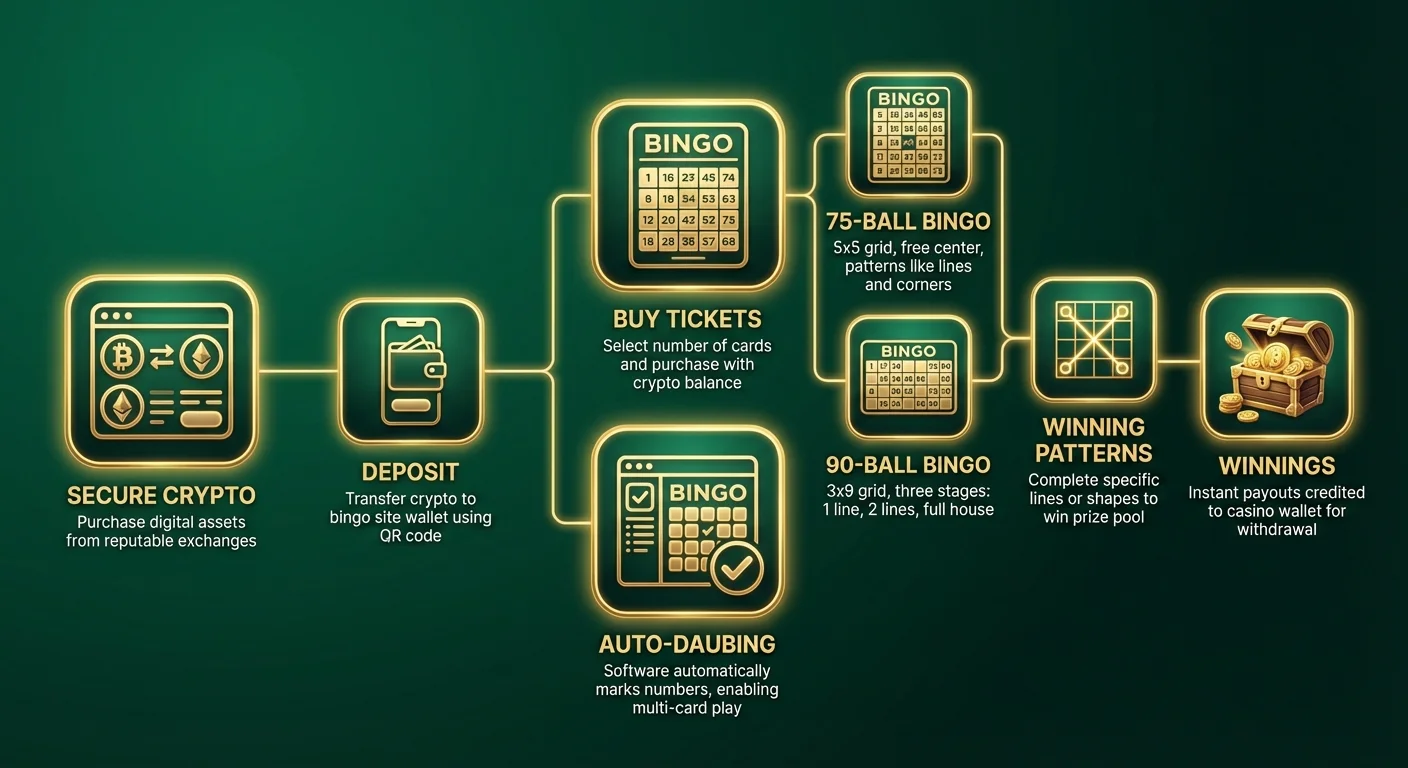
Step 1: Secure Your Crypto
To play, you need cryptocurrency. Most bingo sites accept major coins like:
- Bitcoin (BTC): The gold standard, though sometimes has higher transaction fees.
- Ethereum (ETH): Fast, but gas fees can vary.
- Litecoin (LTC) & Dogecoin (DOGE): Often preferred for gambling due to low fees and fast transfer speeds.
- Tether (USDT): A stablecoin pegged to the dollar, perfect if you want to avoid crypto price volatility while playing.
Step 2: Choosing a Venue
Not all crypto casinos are created equal. Look for sites that offer online bingo rules that favor the player, legitimate licensing, and verifiable Provably Fair algorithms.
Step 3: Depositing
- Navigate to the "Wallet" or "Deposit" section of the bingo site.
- Select your currency (e.g., Bitcoin).
- The site will generate a unique address (a long string of characters) and a QR code.
- Open your personal crypto wallet, scan the QR code, and send the amount you wish to play with.
- Pro Tip: Crypto transactions are irreversible. Always double-check the address.
The Interface: From Daubers to Algorithms
For a beginner, the screen of a crypto bingo game can look busy. Understanding the interface is key to mastering how to play crypto bingo.
The Ticket Purchase Area
In a physical hall, you buy a booklet. Online, you usually see a slider or a set of buttons allowing you to purchase tickets.
- Card Price: Usually denominated in milli-Bitcoin (mBTC) or credits pegged to fiat.
- Max Buy: Many games allow you to buy 50+ cards at once. Be careful here; it is easy to overspend with a single click.
The Grid (The Card)
This is your 5x5 (or 3x9) playing area. In crypto bingo, you can often customize the color of your dauber or the card theme, but the layout remains standard.
Auto-Daubing: The Digital Assistant
In a live hall, if you sneeze, you might miss a number. If you miss a number, you don't win. This creates a limit on how many cards a human can play physically.
In crypto bingo, auto-daubing is the standard. The software automatically marks the numbers on your cards as they are called.
- Advantages: You can play 100 cards simultaneously without missing a beat. You can even step away from the computer to make a coffee while the game runs.
- Disadvantages: It removes the tactile skill of scanning cards. The game becomes purely about the math and the buy-in strategy.
The Chat Room
The social element hasn't vanished; it just moved to the sidebar. Crypto bingo chat rooms are vibrant. "Chat Hosts" (CMs) often run chat games (trivia, number guessing) where you can win small amounts of crypto just for participating while the main game runs.
Game Variations: 75-Ball vs. 90-Ball
While developers are constantly inventing new "speed bingo" variants, the two pillars of the game remain the 75-ball and 90-ball formats.
75-Ball Bingo (The American Style)
This is the most common format on many crypto sites.
- The Card: A 5x5 grid. The center square is usually "Free."
- The Columns: Labeled B-I-N-G-O.
- B: 1-15
- I: 16-30
- N: 31-45
- G: 46-60
- O: 61-75
- Winning: You can win by completing lines (horizontal, vertical, diagonal) or specific patterns (shapes like an arrow, a letter, or four corners).
90-Ball Bingo (The UK/Australian Style)
- The Card: A ticket with 3 rows and 9 columns. Each row has 5 numbers and 4 empty spots.
- Winning: The game is usually played in three stages:
- 1 Line: Marking all numbers in any single horizontal row.
- 2 Lines: Marking all numbers in any two horizontal rows.
- Full House: Marking all 15 numbers on the ticket.
| Feature | 75-Ball Bingo | 90-Ball Bingo |
|---|---|---|
| Grid Size | 5x5 | 3x9 |
| Numbers Used | 1-75 | 1-90 |
| Free Space | Yes (Center) | No |
| Winning Ways | Patterns, Lines, Blackout | 1 Line, 2 Lines, Full House |
| Pace | Faster, variable patterns | Longer, structured stages |
Understanding Winning Patterns
To understand how to play crypto bingo effectively, you must know what you are aiming for. Unlike slots where the machine tells you if you won, in bingo, watching the pattern develop adds to the excitement.
Standard Patterns
- Single Line: A straight line of 5 numbers (horizontal, vertical, or diagonal in 75-ball).
- Two Lines: Two complete horizontal lines (common in 90-ball).
- Four Corners: The top-left, top-right, bottom-left, and bottom-right numbers. This is a very fast game mode.
Complex and "Crypto" Patterns
Because digital cards are flexible, crypto bingo sites often run "Pattern Games."
- The Blackout / Full House: Covering every single number on the card. This usually carries the highest jackpot.
- Letter Patterns: Numbers forming an 'X', 'T', or 'H'.
- The Frame: Covering all border numbers (the "Outside Edge").
Note: In auto-daub environments, the software will usually highlight your best-performing card and move it to the top of the screen so you can watch your closest winning chance.
Strategy: Can You Beat the House?
It is vital to remember a core truth: Bingo is a game of probability and luck. As noted in professional gambling guides, the odds of hitting a Full House in a 90-ball game are astronomical. However, while you cannot alter the random number generation (RNG), you can manage your gameplay to improve your experience and potential return on investment (ROI).
1. The Tippett Theory (Simplified)
A British statistician named L.H.C. Tippett suggested that the longer a 75-ball game goes on, the more likely the drawn numbers will gravitate toward the "median" number (38).
- Short Games: If playing a pattern like "4 Corners" (which ends quickly), choose cards with numbers closer to 1 and 75.
- Long Games: If playing for a "Blackout" (which takes time), choose cards with numbers clustered around 38.
- Digital Reality: Most crypto sites auto-assign cards, but if you have a "Swap Card" feature, this theory is worth testing.
2. The Granville Strategy
Joseph Granville, a financial writer, argued that a winning bingo card should have an even distribution. In a perfect card:
- You have an equal mix of high and low numbers.
- You have an equal mix of even and odd numbers.
- You have an equal mix of numbers ending in 1, 2, 3, 4, 5, 6, 7, 8, and 9.
3. Bankroll Management with Crypto
This is the most critical strategy for bitcoin bingo basics. Crypto is volatile. Setting clear, unbreakable limits on how much you spend per session and understanding your 'risk of ruin' is paramount. Never chase losses, especially when the underlying asset you are betting with (Bitcoin or Ethereum) is itself experiencing price swings.
- Set a Fiat Limit: Decide "I will play with $50 worth of Bitcoin." Do not think in terms of "0.001 BTC," as the value of that coin fluctuates.
- Calculated Ticket Purchases: If your budget is $50, do not buy $10 tickets. You will be out of the game in five rounds. Buy $0.50 tickets to extend your playtime and variance.
- Check the Exchange Rate: Ensure you aren't accidentally spending $100 on a ticket because you misread the decimal place in the crypto amount.
4. Playing the Crowd
In bingo, you are playing against other players, not just the house. The prize pool is often fixed or split.
- The Logic: If 100 people are playing, you have a 1 in 100 chance (assuming everyone has 1 card). If 10 people are playing, you have a 1 in 10 chance.
- The Strategy: Play at "off-peak" times. Since crypto is global, this can be tricky, but try to find times when the room count is low. The jackpots might be smaller, but your win frequency will likely increase.
Step-by-Step Guide: Your First Game
Ready to dive in? Here is a walkthrough of a typical session.
1. Log In and Load Wallet:
Ensure your balance is visible.
2. Select a Room:
Lobbies usually list rooms by ticket price and prize pool. A "Micro-stakes" room might cost 100 Satoshi per ticket, while a "High Roller" room might cost 0.01 BTC.
3. Buy Tickets:
A timer will count down to the next game (e.g., "Game starts in 30 seconds"). Use the slider to select how many cards you want.
- Beginner Tip: Start with 1 to 5 cards to get a feel for the visual interface.
4. The Game Begins:
The "Buy" buttons will lock. The RNG will start drawing numbers.
- Watch: Your cards will auto-daub.
- Listen: Most sites have sound effects for balls drawn and numbers hit.
5. The Win:
If you complete the required pattern, the system instantly validates your win.
- Tie Breakers: If you and another player get Bingo on the exact same number call, the prize is split between you. This is standard online bingo rules.
6. Payout:
Winnings are instantly credited to your casino wallet. You can then use them to buy into the next round or withdraw them to your private crypto wallet.
The Pros and Cons of Crypto Bingo
Why switch from standard online bingo to crypto?
The Advantages
- Speed: Deposits and withdrawals are often near-instant. No waiting 3-5 days for a bank transfer.
- Privacy: Most crypto casinos require less intrusive KYC (Know Your Customer) data than traditional fiat casinos.
- Bonuses: Crypto sites often offer massive welcome bonuses (e.g., "100% match up to 1 BTC").
- Micro-betting: With Bitcoin (Satoshis), you can play for fractions of a cent, allowing for very long play sessions on a small budget.
The Risks
- Volatility: You could win a jackpot in Bitcoin, but if the price of Bitcoin drops by 20% the next day, your real-world purchasing power drops too.
- Technical Barrier: If you lose your wallet password or send money to the wrong address, there is no customer support to reverse the transaction.
- Regulation: Crypto gambling exists in a gray area in some jurisdictions. Always ensure you are playing on a licensed site that accepts players from your region.
Practical Tips for the Beginner
To wrap up this guide, here is a checklist for your first time playing how to play crypto bingo:
- Start Free: Many crypto casinos offer "faucet" games or demo modes. Play these first to understand the interface without risking money.
- Don't Chase Losses: If you don't win a Line or Full House after 10 games, take a break. The RNG does not "owe" you a win.
- Check the RTP: Look for the Return to Player percentage. Good bingo games should have an RTP of around 95% or higher, though bingo is notoriously lower RTP than slots.
- Look for Guaranteed Jackpots: Some games have a prize pool based on ticket sales. Others have a "Guaranteed Prize Pot" regardless of how many people play. The latter offers better value if the room is quiet.
Conclusion
From the physical halls of the 20th century to the cryptographic hashes of today, Bingo has remained a beloved game for a reason: it is simple, social, and thrilling.
Crypto bingo offers a modern twist on this classic, providing transparency through Provably Fair technology and the financial freedom of digital currency. By understanding the interface, utilizing auto-daubing, and applying basic bankroll management, you can enjoy the game safely.
Remember, whether you are playing with beans on cardboard or Satoshis on a blockchain, the golden rule remains: play for fun, play responsibly, and may the next number called be the one you need. B-I-N-G-O!