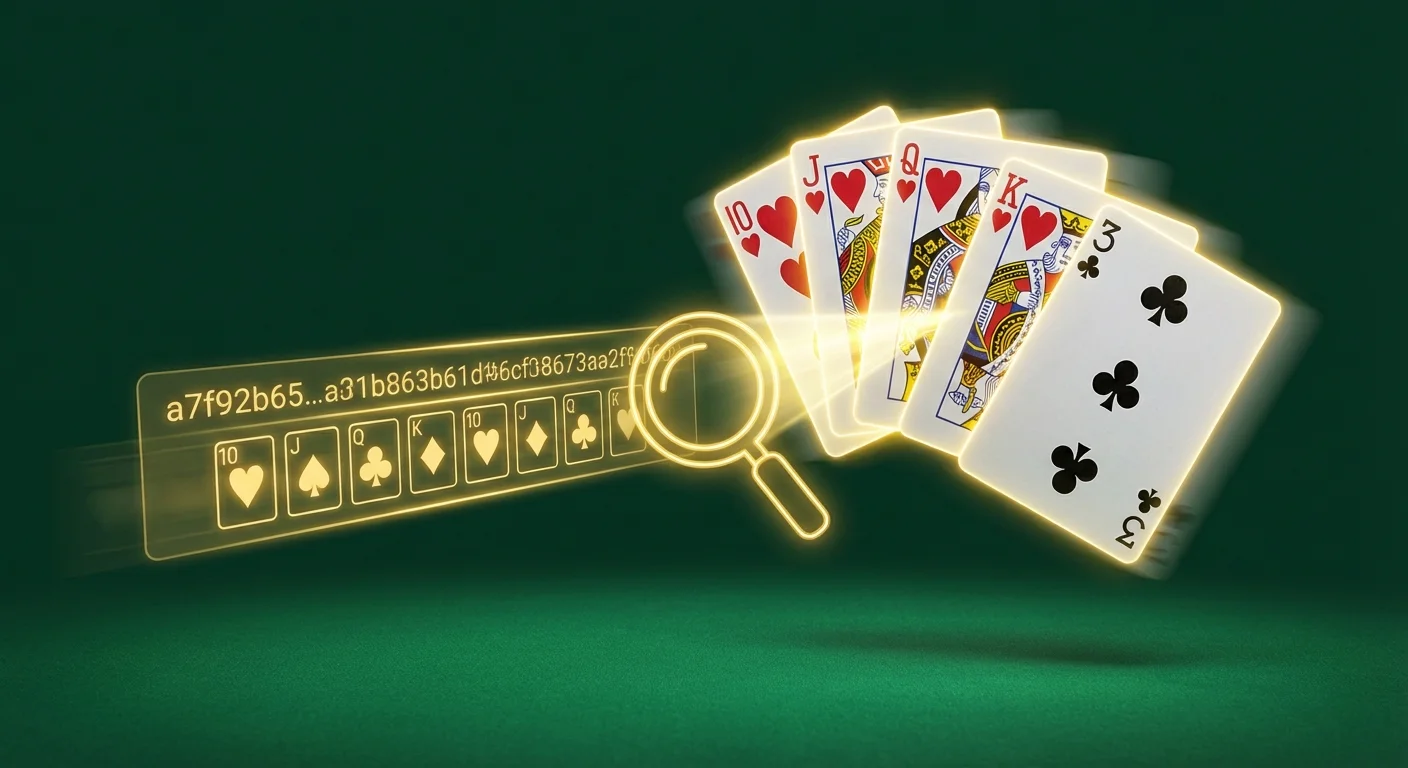
Every Video Poker player knows the feeling. You are dealt four cards to a Royal Flush. Your heart races. You hold the Ten, Jack, Queen, and King of Hearts. You hit "Draw," needing only the Ace of Hearts to secure the jackpot.
The card flips... it's a Three of Clubs.
Disappointment is natural, but in the back of your mind, a nagging question often arises: Was that Ace even in the deck? Did the software know I was betting max coins and decide to block the win?
In the world of traditional online casinos, these questions are met with a "trust us" policy. In the world of crypto gambling, however, we don't need trust. We have code.
This guide explores the engine room of crypto Video Poker. We will dismantle the difference between traditional Random Number Generators (RNG) and the blockchain-native "Provably Fair" technology. We will explain how the digital deck is shuffled and, most importantly, how you can mathematically verify that the house didn't cheat you out of that Royal Flush.
The Black Box: How Traditional RNG Works
To understand why Provably Fair is a revolution, you must first understand the standard that preceded it. For decades, online video poker has been powered by Random Number Generators (RNGs).
In a traditional online casino (fiat currency casinos), the RNG is a software algorithm running on the casino's server (or their game provider's server). When you press "Deal," the software generates a sequence of numbers that correspond to cards in a 52-card deck.
The "Trust Me" Model
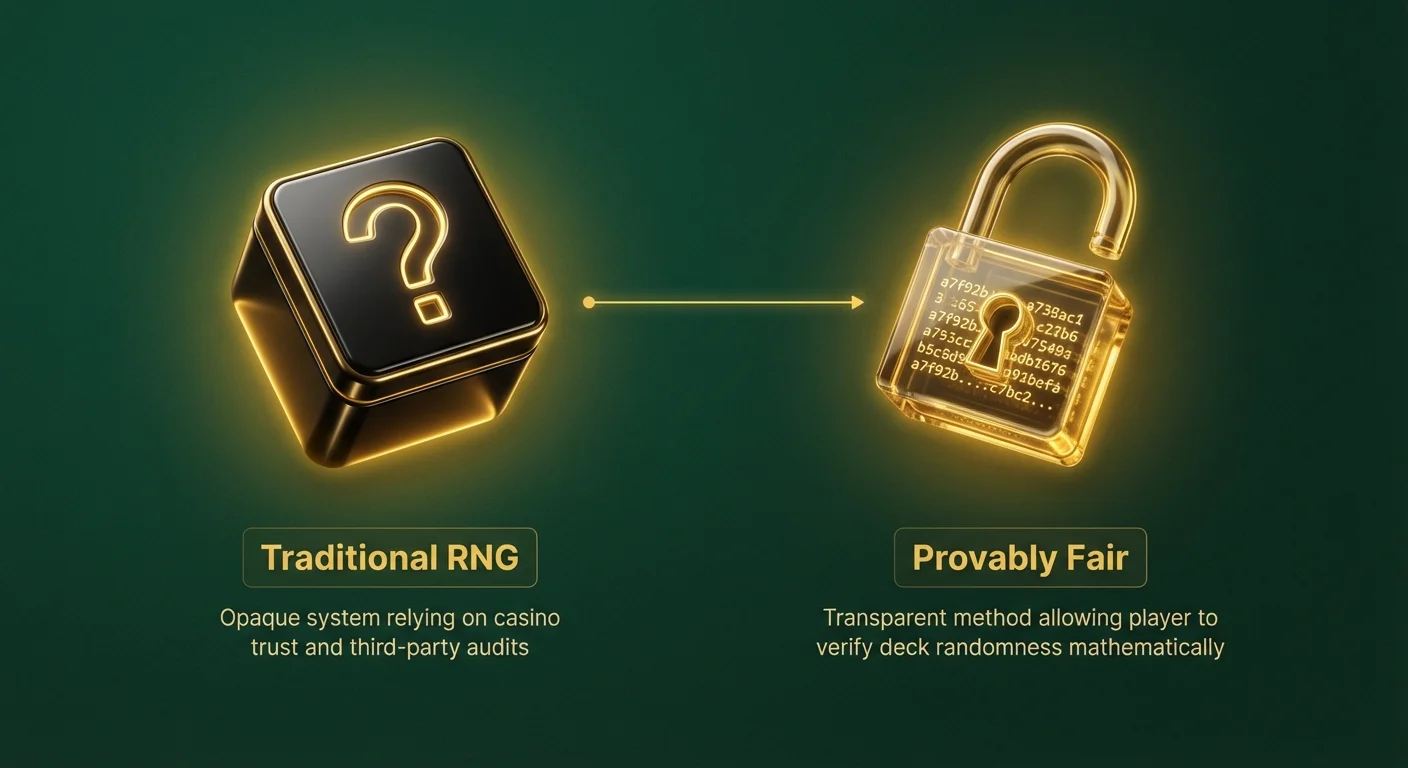
The issue with traditional RNG is not that it isn't random - top-tier casinos use sophisticated algorithms that simulate randomness effectively. The issue is transparency.
When you play at a standard casino, the generation of the cards happens inside a "black box." You send a request (Deal), and the server sends back a result (Your Hand). You have no way of knowing:
- If the deck was shuffled fairly.
- If the outcome was altered based on your bet size.
- If the "draw" cards were predetermined or changed after you selected your holds.
To mitigate this, traditional casinos hire third-party auditing firms (like eCOGRA or iTech Labs) to test their RNGs periodically. While this provides a layer of security, you are still relying on a chain of trust: trusting the casino, trusting the software provider, and trusting the auditor.
The Revolution: What is Provably Fair?
Crypto gambling introduced a paradigm shift known as Provably Fair. This system allows the player to verify the fairness of every single hand, individually, in real-time. It moves the industry from "Don't be evil" (Google's old motto) to "Can't be evil."
In the context of Video Poker, Provably Fair technology ensures that the deck is shuffled using cryptographic variables that you contribute to. The casino literally cannot know the order of the deck until you provide your input, and they cannot change the deck once the hand begins.
The Three Pillars of Provably Fair
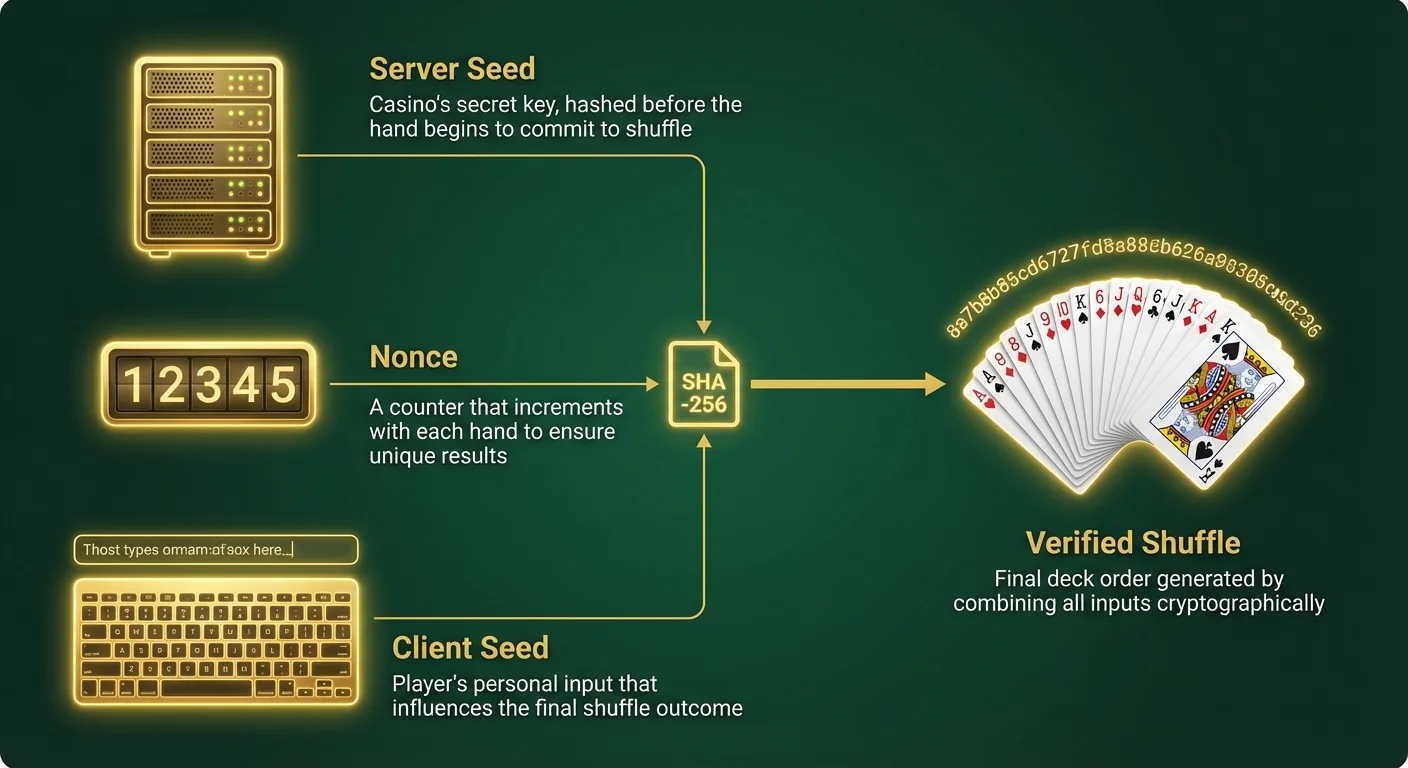
To verify a shuffle, three distinct pieces of data are required. Think of this like a digital safe that requires two keys and a counter to open.
- Server Seed (The Casino's Key): The casino generates a random string of text. Before the hand starts, they show you a "hashed" (encrypted) version of this seed. This proves they have already created the shuffle and cannot change it later.
- Client Seed (Your Key): This is a string of text that you control. You can use the default one provided by your browser, or you can type in your own lucky phrase, random numbers, or emoji string. Because the casino doesn't know what you will type, they cannot rig the shuffle to favor themselves.
- Nonce (The Counter): This is a simple number that increases by 1 with every hand you play (0, 1, 2, 3...). It ensures that every hand generates a unique outcome, even if the seeds stay the same.
The Technology of the Shuffle
How do these three text strings turn into a Five-Card Draw hand? The process typically uses a cryptographic hash function (usually SHA-256) and a shuffling algorithm (usually Fisher-Yates).
Here is the simplified workflow of a Provably Fair Video Poker hand:
1. The Pre-Commitment
Before you even place your bet, the casino generates the Server Seed. They hash it (scramble it) and display the hash to you.
- Why this matters: By showing you the hash, the casino is "committing" to the deck order. If they try to swap the deck later, the hash won't match, and you will know they cheated.
2. The Interaction
You set your Client Seed and place your bet. The game software combines the Server Seed + Client Seed + Nonce.
3. The Generation
The combined string is run through the SHA-256 algorithm. This produces a long string of hexadecimal characters (e.g., a7f92b...).This hexadecimal string is converted into decimal numbers, which are then used to perform a Fisher-Yates Shuffle on a virtual 52-card deck.
Note on the Fisher-Yates Shuffle: This is the gold standard for coding card games. It iterates through the list of 52 cards and swaps them randomly based on the numbers generated from the hash. The result is a completely randomized deck order (1 through 52).
4. The Deal and Draw
- Cards 1-5: Dealt to your hand.
- Cards 6-10: Sitting at the top of the remaining deck, waiting for the Draw.
Crucial Distinction: In Provably Fair Video Poker, the entire deck order is established before the deal. When you discard two cards and draw two new ones, you are strictly receiving cards #6 and #7 from that pre-shuffled list. The software does not "decide" what to give you based on what you held; it simply deals the next cards in the sequence.
Comparative Analysis: RNG vs. Provably Fair
To visualize the difference, let's compare the two technologies side-by-side.
| Feature | Traditional RNG (Standard Casino) | Provably Fair (Crypto Casino) |
|---|---|---|
| Trust Mechanism | Third-party Audit Certificates | Cryptographic Verification |
| Transparency | Black Box (Code is hidden) | Open Source (Algorithm is public) |
| Player Influence | None (Passive observer) | High (Client seed affects outcome) |
| Verification | Impossible for the player | Available instantly for every hand |
| Deck Generation | Server-side only | Hybrid (Server + Client inputs) |
| Cheating Detection | Requires forensic audit | Instantaneous math check |
Strategy and Fairness: Why It Matters
You might ask, "I'm not a coder, so why should I care about hashes?"
The answer lies in Strategy. Video Poker is unique among casino games because it has a high Return to Player (RTP) - often over 99% - but only if you play mathematically perfect strategy.
Source materials often cite the importance of knowing hand rankings and paytables. For example, in Deuces Wild, the presence of four Wild cards fundamentally changes the math. You are often advised to hold a lone Deuce and discard four other cards, or to discard a pair to chase a Straight Flush.
These strategic decisions are based on probability.
- Discarding a pair to chase a Flush assumes there are exactly 9 cards of that suit remaining in the 47 unseen cards.
- If the RNG is "rigged" or "adaptive" (meaning it lowers your odds when you are winning), Basic Strategy becomes useless.
Provably Fair technology validates the strategy. Because you can verify that the deck was truly random and determined by your Client Seed, you can play with the confidence that the odds are exactly what the mathematics dictate.
Step-by-Step: How to Verify a Hand
You've just played a hand of Jacks or Better and lost a big bet. You want to check if the game was fair. Here is how you do it on most crypto gambling sites.
Step 1: Copy the Data
Go to your bet history or the "Fairness" tab at the bottom of the game window. You need to copy three things:
- Server Seed (The unhashed version, which is revealed after the hand).
- Client Seed (The one you used).
- Nonce (The hand number).
Step 2: Use a Verifier
You don't need to do the math in your head. Most crypto casinos provide an on-site verifier, but for true independence, use a third-party tool. Search for "Provably Fair Verifier" (GitHub has many open-source options) or use a site like ProvablyFair.me.
Step 3: Input and Calculate
Paste your seeds and nonce into the verifier.
Step 4: Compare the Output
The verifier will replicate the shuffle process. It will output a list of cards (e.g., Ah, Ks, 2d...).
- Check the first 5 cards: Do they match your initial deal?
- Check the next set of cards: Do they match the cards you drew?
If the cards generated by the verifier match the cards that appeared on your screen, it is mathematically impossible for the casino to have cheated you. The casino could not have predicted your Client Seed, and they could not have changed the Server Seed without breaking the hash commitment.
Common Myths About Provably Fair
Even with transparent technology, misconceptions persist. Let's debunk a few.
Myth 1: "Provably Fair means I will win more."
False. Fairness is not the same as charity. A fair game of Video Poker still has a House Edge (usually between 0.5% and 3%, depending on the variant). Provably Fair ensures the randomness is legitimate, not that the randomness favors you. You will still experience losing streaks.
Myth 2: "I can reverse-engineer the seed to predict the next hand."
False. The hash function used (SHA-256) is a one-way function. Even the world's most powerful supercomputers cannot take a Hash and decipher the original Server Seed before it is revealed. You can verify the past, but you cannot predict the future.
Myth 3: "If I change my Client Seed, I change my luck."
Technically True, practically irrelevant. Changing your Client Seed definitely changes the outcome of the shuffle. However, since you cannot know what the new outcome will be, you are simply trading one random result for another. It stops the superstition of a "cold deck" but doesn't guarantee a "hot" one.
Choosing the Right Crypto Video Poker Game
Not all crypto casinos are created equal. When looking for a place to play your strategy, look for these indicators:
- Accessible Fairness Tab: You shouldn't have to dig through T&Cs to find your seeds. The seeds should be visible on the game screen.
- Third-Party Verifiers: The casino should link to or allow verification through external, open-source tools.
- Detailed Paytables: As mentioned in traditional strategy guides, always check the paytable. A Provably Fair game with a terrible paytable (e.g., 6/5 Jacks or Better) is fair, but it's still a bad bet. Look for "Full Pay" tables (e.g., 9/6 Jacks or Better).
Conclusion: Trust, but Verify
Video Poker has always been the thinking player's game. It bridges the gap between the mindless spin of a slot machine and the intense skill of table poker. It rewards those who learn the rules, study the hand rankings, and apply strict strategy.
Crypto gambling adds the final piece to this puzzle: Verification.
With Provably Fair technology, you no longer have to wonder if the machine is "tight" or if the digital deck is rigged against you. You hold the keys to the shuffle. By understanding and utilizing Provably Fair tools, you elevate yourself from a gambler hoping for luck to a player demanding fairness.
So, the next time you draw for that Royal Flush and miss, you can check the hash. You might still be disappointed by the result, but you'll sleep soundly knowing the game was honest.