
The evolution of the modern casino has been nothing short of revolutionary. We have moved from the velvet ropes of Monte Carlo to the digital frontiers of the blockchain. For the modern crypto gambler, the roulette wheel isn't just a physical object of wood and brass - it is a choice between two distinct technological philosophies: the algorithmic precision of Random Number Generators (RNG) and the immersive reality of Live Dealer streams.
While the payouts (35:1 for a straight-up bet) and the wheel layouts (European vs. American) remain consistent, the mechanics driving the ball are fundamentally different. Understanding these differences is not just a matter of curiosity; it is a crucial component of bankroll management, strategy application, and ensuring fair play in the crypto gambling ecosystem.
This guide dissects the mechanics of both RNG "Provably Fair" roulette and Live Dealer games, helping you decide which format aligns best with your betting style.
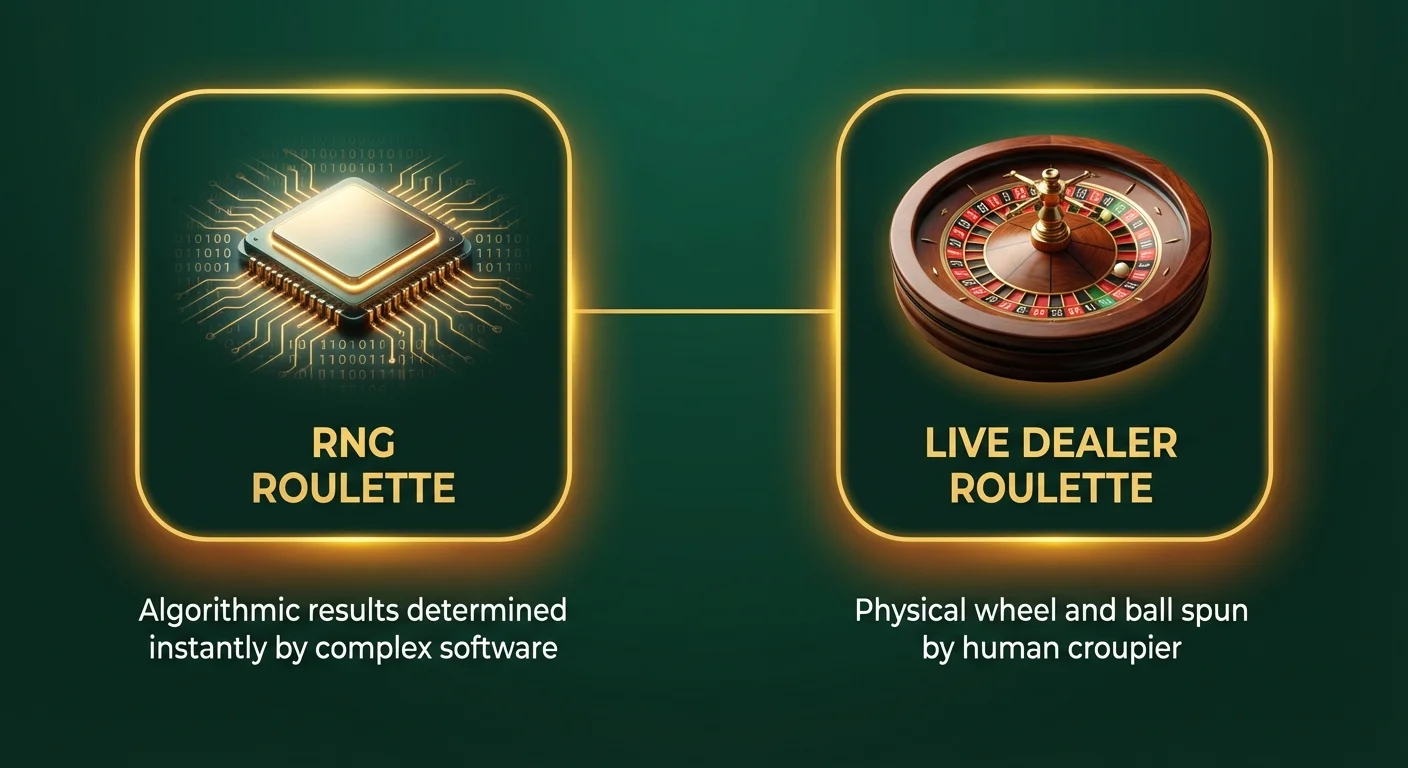
The Digital Wheel: How RNG and Provably Fair Work
In the realm of crypto casinos, the vast majority of "software-based" roulette games are powered by Random Number Generators (RNG). When you look at an RNG roulette table, you are looking at a graphical representation of a mathematical outcome. There is no physical ball, no friction, and no gravity.
The Algorithm Behind the Spin
In a standard online casino, an RNG is a sophisticated algorithm that produces a sequence of numbers that lacks any discernible pattern. This software is perpetually churning out numbers - thousands per second - even when no one is playing.
When you hit the "Spin" button, the software instantly grabs the latest number generated by the algorithm. That number corresponds to a specific pocket on the virtual wheel (0 through 36). The graphical animation of the wheel spinning and the ball bouncing is merely for entertainment; the result was determined the millisecond you clicked the mouse.
The Crypto Innovation: Provably Fair Technology
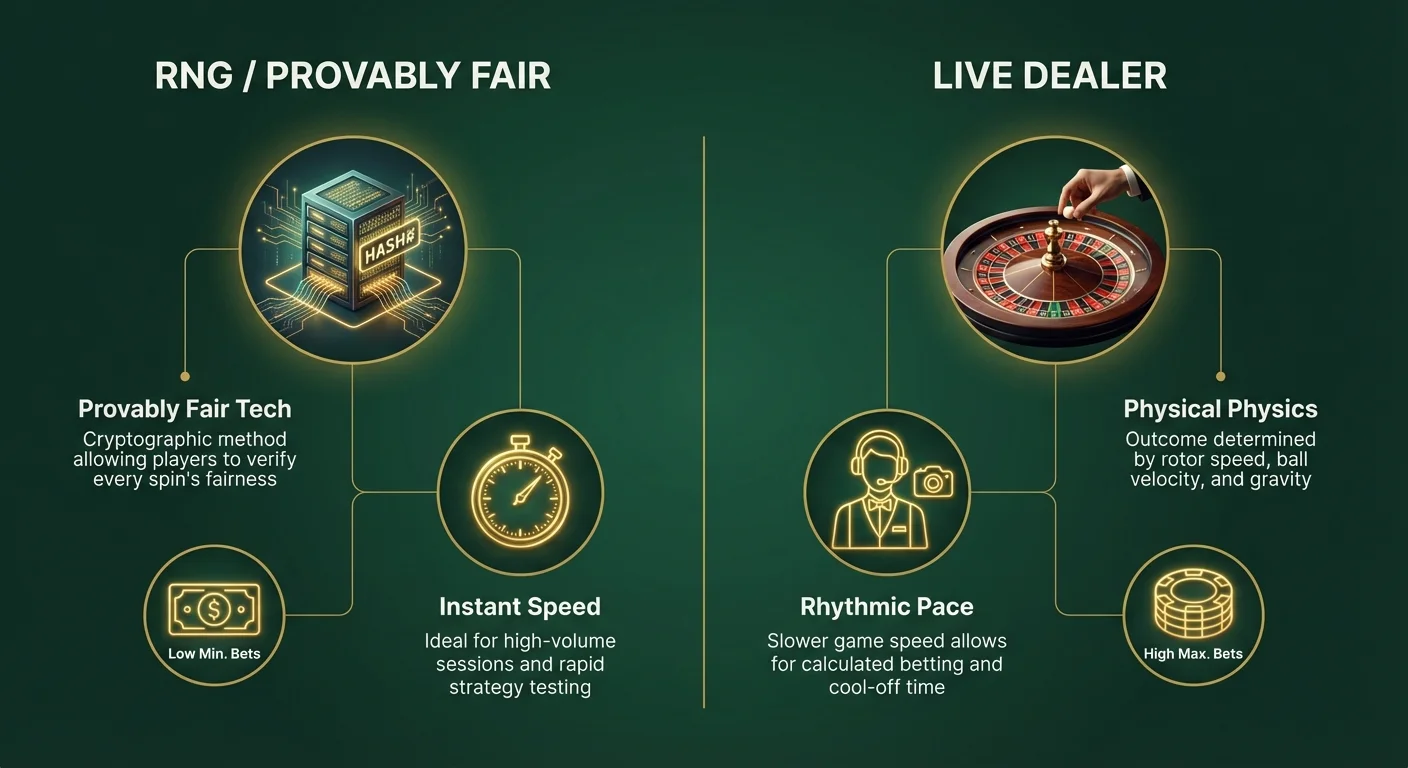
For the crypto gambler, standard RNG often requires blind trust in the casino's license. Enter Provably Fair technology. This is a cryptographic method unique to blockchain-based gambling that allows players to verify the fairness of every single spin manually.
Here is how Provably Fair roulette works mechanically:
- Server Seed: Before the round starts, the casino generates a random string of text (the seed). They hash this seed (encrypt it) and show you the hash. This proves they cannot change the outcome later.
- Client Seed: You (the player) or your browser generates a random seed. In many crypto casinos, you can actually type in your own custom word or phrase here.
- The Interaction: When you press spin, the casino combines the Server Seed and the Client Seed to calculate the result.
- Verification: After the spin, the casino reveals the unhashed Server Seed. You can enter both seeds into a third-party verifier to confirm that the outcome matches exactly what was dictated by the code.
This level of transparency eliminates the "black box" fear that the software is rigged to force losses after a winning streak.
The Human Element: Mechanics of Live Dealer Roulette
Live Dealer roulette bridges the gap between the convenience of home play and the atmosphere of a land-based floor. However, the technology required to make this work is surprisingly complex.
Optical Character Recognition (OCR)
In a Live Dealer game, a human croupier spins a physical wheel. The outcome is determined by physics - rotor speed, ball velocity, and diamond deflectors.
To translate this physical event into data that the crypto casino platform can understand (to pay out your Bitcoin or Ethereum), studios use Game Control Units (GCU) attached to the table. These units use Optical Character Recognition (OCR) technology. Sensors and cameras track the ball's position to the millimeter. The instant the ball settles into a pocket, the OCR software reads the number and transmits the data to the casino software, which instantly resolves all bets on the interface.
The Physics Factor
Unlike RNG games, Live Dealer roulette is subject to the laws of physics.
- Dealer Signatures: Some veteran players believe that dealers develop "muscle memory," spinning the wheel and ball at consistent speeds, leading to the ball landing in specific sectors of the wheel repeatedly.
- Wheel Bias: While rare in modern, high-maintenance studios (like Evolution Gaming or Pragmatic Play), physical wheels can theoretically develop slight imperfections that favor certain numbers over time.
In an RNG game, "wheel bias" is impossible unless the code is malicious. In a Live game, the randomness comes from the chaotic motion of the ball bouncing against the deflectors.
Speed and Pacing: The Strategic Divide
The most practical difference between RNG and Live Dealer roulette is the speed of gameplay. This has massive implications for the type of strategy you should employ.
RNG: The High-Velocity Game
RNG roulette is instant. You place your bets, click spin, and the result is immediate. You can disable animations in many crypto games (often called "Turbo Mode"), allowing for a spin every 2 or 3 seconds.
- Pros: Ideal for testing strategies or playing high-volume sessions.
- Cons: Extremely dangerous for negative progression strategies like the Martingale.
The Martingale Risk in RNG:As detailed in strategy guides, the Martingale system involves doubling your bet after every loss to recover the bankroll.
Example: Bet 1 mBTC (Lose) -> Bet 2 mBTC (Lose) -> Bet 4 mBTC (Lose) -> Bet 8 mBTC (Win).
In a Live Dealer game, a 7-spin losing streak might take 10 minutes to unfold, giving you time to cool off or reconsider. In an RNG game, you can hit a 7-spin losing streak in under 20 seconds. The psychological pressure of "chasing losses" is significantly higher when the game moves at the speed of a click.
Live Dealer: The Rhythmic Game
Live Dealer games are paced by the croupier. There is usually a betting window of 15 to 20 seconds, followed by the spin. A typical round takes about 45 to 60 seconds.
- Pros: Natural breaks prevent "tilt" (emotional betting). You have time to calculate complex bets.
- Cons: Too slow for players looking to grind through a wagering requirement for a bonus.
Game Fairness and House Edge
Regardless of whether the wheel is digital or physical, the mathematics of the game - the House Edge - should remain the same, provided you are playing the same variant.
European vs. American Variants
As noted in foundational roulette texts, the wheel layout dictates your odds.
- European Roulette (Single Zero): Has 37 pockets (0-36). The House Edge is 2.70%.
- American Roulette (Double Zero): Has 38 pockets (0, 00, 1-36). The House Edge is 5.26%.
Crucial Tip: In crypto casinos, RNG libraries often offer dozens of versions. Always check the "Help" or "Info" file to ensure you are playing European Roulette. There is absolutely no strategic reason to play American RNG roulette, as the payouts are identical (35:1) despite the worse odds.
French Roulette Availability
French Roulette offers the La Partage or En Prison rules, where you get half your even-money bet back if the ball lands on Zero. This lowers the house edge to 1.35%.
- RNG: French variants are common and easy to find.
- Live Dealer: French tables are often reserved for VIPs or high-rollers, though some providers offer standard French tables.
Placing Bets: Interface vs. Racetrack
The mechanics of placing chips differ slightly, which affects how complex your betting patterns can be.
The "Street" and Complex Bets in RNG
Placing a Street Bet (a bet on three consecutive numbers, paying 11:1) in an RNG game is effortless. You simply hover your mouse over the end of a row.
- Mechanics: You can take as long as you want. If you want to cover 6 different streets, 4 corners, and 5 straight-up numbers, you can take 5 minutes to set the layout.
- Features: RNG games often have a "Save Layout" button, allowing you to repeat complex patterns instantly.
Time Management in Live Games
In Live Dealer roulette, you are racing the clock. When the dealer waves their hand and the interface says "No More Bets," the software locks.
- The Racetrack: To help players place "Call Bets" (bets covering sections of the wheel like Voisins du Zéro or Tiers du Cylindre), Live interfaces provide a "Racetrack" graphic.
- Implication: If you are using a complex strategy that requires placing chips on specific, non-connected numbers (like the Chaos Theory approach), Live Dealer can be stressful. You might miss placing a chip before the timer runs out.
Comparison: RNG vs. Live Dealer
| Feature | RNG / Provably Fair Roulette | Live Dealer Roulette |
|---|---|---|
| Speed | Instant (Player controlled) | Slow (~50 spins per hour) |
| Fairness Source | Cryptographic Algorithms (SHA-256) | Physics & Regulatory Audits |
| Verification | User-verifiable (Provably Fair) | Trust in Casino License/Auditor |
| Time to Bet | Unlimited | ~15-20 Seconds |
| Min. Bet (Crypto) | Very Low (often < $0.10 equiv.) | Higher (often $1.00 - $5.00 min) |
| Max. Bet | Variable, usually lower | High (VIP tables available) |
| Atmosphere | Solitary, Focused | Social, Chatty, Immersive |
| Bonuses | Often contribute 5-10% to wagering | Often contribute 0-5% to wagering |
Which Should You Choose?
The choice between RNG and Live Dealer ultimately depends on your goals for the session.
Choose RNG / Provably Fair if:
- You are using a specific betting system: If you are testing the D'Alembert system (increasing bets by one unit after a loss, decreasing after a win), the RNG interface makes it easy to track units and adjust bet sizes instantly without time pressure.
- You have a small bankroll: Crypto RNG games often allow micro-betting (e.g., 100 Satoshis or fractions of a cent). This allows you to enjoy the thrill of gambling with minimal financial risk.
- You value privacy and speed: You want to play a quick session on your mobile device without streaming high-definition video data or interacting with a chat room.
Choose Live Dealer if:
- You suspect algorithmic patterns: Even though Provably Fair is secure, some players simply trust gravity more than code. Seeing the ball bounce provides peace of mind.
- You are a High Roller: Live tables generally offer much higher maximum bet limits, sometimes accepting up to 1 BTC per spin on VIP tables.
- You want the "Casino Experience": If you enjoy the banter of a host, the sound of the ball, and seeing other players win (via the winners' list on screen), the immersive nature of Live Dealer is unmatched.
Practical Strategy: The Hybrid Approach
Many professional crypto gamblers use a hybrid approach to maximize their efficiency.
The "Testing Ground" Method:
Use Provably Fair RNG Roulette to test a new strategy or betting pattern. Play with minimum stakes to see how the variance feels. Does the strategy survive a 500-spin session? Does the volatility wipe out your bankroll?
Once you are confident in the betting pattern and have defined your stop-loss limits, move to the Live Dealer tables. Apply the strategy there with your actual session bankroll. The slower pace of the Live game will help you maintain discipline, while the previous RNG testing gives you confidence in your mathematical approach.
Summary
Roulette remains a game of chance, whether the wheel is generated by a server seed or spun by a human hand. However, the mechanics define the experience.
- RNG is the realm of efficiency, low barriers to entry, and mathematical verification.
- Live Dealer is the realm of atmosphere, high limits, and physical trust.
For the crypto player, the distinct advantage lies in Provably Fair RNG games, which offer a level of transparency that traditional land-based casinos cannot match. However, never underestimate the bankroll-preserving power of the slower, more deliberate pace found at the Live tables. Choose the mechanics that fit your mindset, verify your odds, and always gamble responsibly.