
If you have ever walked into a massive, glittering sportsbook in Las Vegas or logged onto a top-tier crypto betting platform, you have likely noticed one undeniable truth: these businesses are not built on winners. They are built on the predictable, consistent losses of the general betting public.
For the intermediate sports bettor looking to evolve from a recreational hobbyist to a profitable strategist, understanding the behavior of the "public" is the first step toward finding genuine value. This strategy is known as contrarian betting, or simply "fading the public."
The concept is deceptively simple: find out who everyone else is betting on, and bet the opposite way. However, if it were truly that easy, everyone would be rich. Successful contrarian betting requires a nuanced understanding of market mechanics, psychology, and the ability to interpret data beyond the surface level.
This guide will walk you through the art of fading the public, how to interpret betting percentages, and why using cryptocurrency sportsbooks can give you the necessary edge to execute this strategy effectively.
The Philosophy: Why the Public Loses
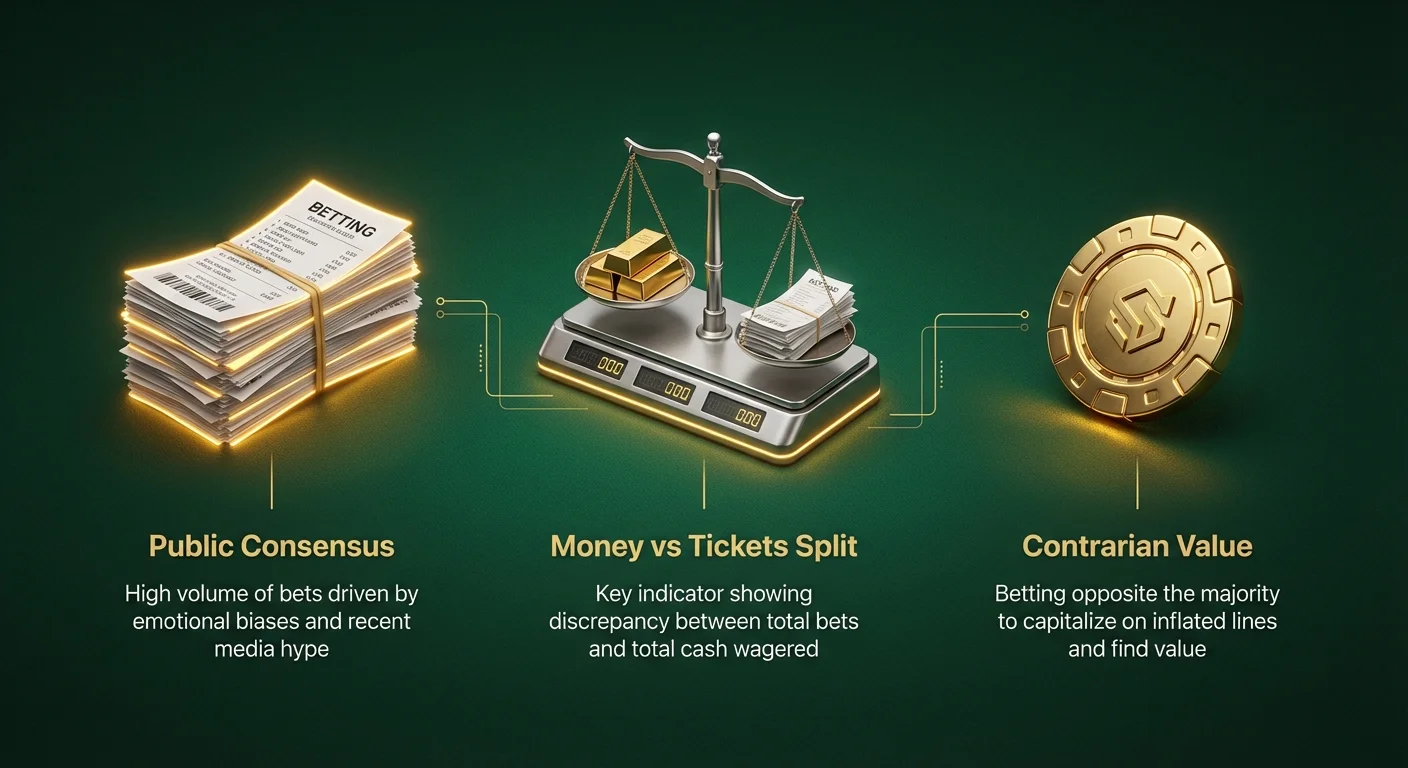
To understand why betting against the public works, you must first understand the mindset of the "Square" (recreational) bettor. The average sports fan bets with their heart, their gut, or the most recent highlight reel they saw on social media. They suffer from biases that sportsbooks are experts at exploiting.
The Biases of the Public
- Recency Bias: If a team won by 30 points last week, the public assumes they will dominate again this week.
- The "Over" Obsession: Psychologically, people want to see scoring. It is uncomfortable to root for a defensive struggle. Therefore, the public overwhelmingly bets the "Over" on point totals.
- Favorite Bias: Casual bettors prefer backing superior teams. They dislike taking the points with an "ugly" underdog because it feels counterintuitive to bet on a team they expect to lose the game straight up.
- Star Power: Teams with superstars (e.g., the Chiefs, Lakers, or Yankees) attract significantly more money regardless of the point spread, simply due to media exposure.
The Bookmaker's Reaction
Sportsbooks and oddsmakers are aware of these biases. In high-profile games, they often "shade" the line. If the true mathematical spread of a game should be -6, but the bookmaker knows the public loves the favorite, they might open the line at -7 or -7.5.
If you bet on the favorite, you are paying a "public tax" - betting into an inflated line with no value. The contrarian bettor recognizes this inflation and bets the underdog, gaining points that statistically shouldn't exist.

Understanding Public Betting Percentages
The primary tool for a contrarian bettor is data - specifically, public betting percentages. Most major tracking sites and some advanced crypto sportsbooks display the percentage of bets placed on each side of a matchup.
However, seeing "80% of bets on Team A" is only half the story. You must distinguish between the Ticket Count and the Money Handle.
Ticket Count vs. Money Handle
- Ticket Count (% of Bets): This represents the raw number of individual bets placed. This is the best indicator of what "Joe Public" is doing. If 85% of the tickets are on one team, that is the "public side."
- Money Handle (% of Cash): This represents the total amount of money wagered. This figure often includes large wagers from professional ("sharp") bettors.
The "Golden Rule" of contrarian betting is to look for a discrepancy between these two numbers.
Interpreting the Split
The table below illustrates how to read the relationship between ticket percentages and money percentages.
| Scenario | Ticket % | Money % | Implication | Strategy |
|---|---|---|---|---|
| Public Consensus | 80% on Team A | 85% on Team A | The public and pros agree, or the public volume is overwhelming. | Stay Away (or tread carefully). |
| Sharp Split | 75% on Team A | 40% on Team A | The public loves Team A, but big money is on Team B. | Bet Team B (Fade the public). |
| The "Pros vs. Joes" | 60% on Team A | 80% on Team A | Fewer bets, but massive money on Team A. Sharps are backing the public side. | Follow the Money (Bet Team A). |
| The No-Play | 50% on Team A | 50% on Team A | Perfectly balanced action. | Handicap normally (No contrarian edge). |
When you see a high percentage of tickets on Team A, but the majority of the money on Team B, this is a clear signal that professional bettors are fading the public. You should consider joining them.
Reverse Line Movement: The Holy Grail
If you are looking for the strongest possible signal to fade the public, look for Reverse Line Movement (RLM).
In a standard market, if 80% of the bets are on the New York Giants, the sportsbook should move the line to make the Giants less attractive (e.g., moving from -3 to -4) to encourage betting on the other side and balance their books.
Reverse Line Movement occurs when the betting majority is on one team, but the line moves in the opposite direction (favoring the unpopular team).
Example of RLM
- Opening Line: Dallas Cowboys (-4) vs. Washington Commanders.
- The Action: 75% of public bets are on the Cowboys.
- The Movement: Despite heavy betting on Dallas, the line drops from -4 to -3.
Analysis: Why would the bookmaker make it easier for the public to win by lowering the spread? Because they are respecting "Sharp" money hitting Washington. The bookmaker is taking a position against the public. In this scenario, you bet on Washington.
High-Value Contrarian Spots
Not every game is a candidate for fading the public. If you blindly bet against the public on every match, the "vig" (juice) will eventually eat your bankroll. You must be selective. Here are the specific scenarios where contrarian betting offers the highest expected value (EV).
1. Primetime and TV Games
The more eyeballs on a game, the more "square" money floods the market. The Super Bowl, Monday Night Football, or NBA Christmas Day games attract casual fans who bet just to have "action" on the game.
- Strategy: In heavily hyped games, look specifically to fade the narrative. If the media has spent all week talking about how great the Quarterback of Team A is, the value is likely on Team B.
2. Inflated Divisional Rivalries
In sports like the NFL or MLB, familiarity breeds closeness. Divisional underdogs often perform well because the teams know each other's playbooks intimately, neutralizing the talent gap.
- Strategy: When a divisional underdog is receiving less than 30% of the bets, they historically cover the spread at a profitable rate.
3. The "Over" Trap in Bad Weather
As mentioned, the public loves betting the "Over." When weather conditions are poor (windy, cold, or rainy), the public often ignores these factors, assuming the offenses will adjust.
- Strategy: If 70%+ of tickets are on the Over in a game with high wind speeds (10mph+), bet the Under. You are betting with physics against public optimism.
4. Recency Bias Fades
When a team ranked in the Top 5 loses to an unranked team, the public panics. In the next game, the public will likely bet against that team, assuming they are "overrated."
- Strategy: This is often the best time to buy low on a good team. Betting on a powerhouse team coming off a loss (when the public has abandoned them) is a classic contrarian play.
The Crypto Advantage in Contrarian Betting
Using a crypto-based sportsbook (Bitcoin, Ethereum, USDT) offers distinct logistical advantages for the contrarian bettor compared to traditional fiat sportsbooks.
1. Timing and Liquidity
Contrarian betting is often about timing. You may need to wait until just before kickoff to see where the final public percentages settle.
- The Crypto Edge: Crypto deposits are near-instant. If you spot Reverse Line Movement 10 minutes before the game, you can move funds from your wallet to the book and place the wager immediately, without waiting for bank authorizations.
2. Market Anonymity and Limits
If you consistently beat the closing line by betting with sharps and fading the public, traditional sportsbooks may limit your wager amounts. They flag "sharp" accounts quickly.
- The Crypto Edge: Many crypto sportsbooks operate with a focus on volume and anonymity, offering higher limits and less scrutiny on winning accounts. This allows you to scale your contrarian strategy without fear of being banned.
3. Shopping for the Best Line
Contrarian betting relies on thin margins. Gaining an extra half-point on a spread is vital.
- The Crypto Edge: Because you can move crypto between different sportsbooks rapidly with low fees (especially using LTC, DOGE, or USDT on Tron), you can keep accounts at multiple books and instantly fund the one offering the best line on your contrarian pick.
The Psychological Barrier: Why It's Hard
The biggest hurdle in contrarian betting isn't math; it's psychology.
Fading the public feels terrible. You will often find yourself betting on:
- Teams on a losing streak.
- Teams with injured star players.
- Teams with terrible offensive statistics.
- The "Under" in a game everyone expects to be a shootout.
You have to be comfortable being uncomfortable. When you place a bet and think, "This feels like a guaranteed loss," you are often on the right side. Remember: If it looks too easy, it's a trap. The public loses because they bet on what looks easy.
Practical Steps to Execute a Fade
Ready to start fading? Follow this checklist for your next betting session:
- Check the Percentages: Visit a reliable odds aggregation site. Look for games where one side has >70% of the ticket count.
- Compare Handle vs. Tickets: Is the money percentage lower than the ticket percentage? If yes, proceed.
- Check Line Movement: Has the line moved toward the popular team? If yes, it's a standard public play (less value). Has the line moved against the popular team (RLM)? Green light.
- Identify the Narrative: Ask yourself why the public loves this team. Is it just because they won last week? If the reasoning is shallow, the fade is strong.
- Shop for the Best Number: Use your crypto accounts to find the book offering the most points for your underdog.
- Place the Bet: Stick to your bankroll management strategy (usually 1-3% of your bankroll).
When NOT to Fade the Public
Being a contrarian does not mean blindly betting against every favorite. There are times when the "Square" bettors are right.
- When the Line Matches the Percentages: If 80% of bets are on a team and the line moves from -3 to -6, the bookmakers are adjusting to the liability. There is no RLM. Betting against this is like standing in front of a freight train.
- Extreme Competence: Sometimes a team is just historically dominant (e.g., the 2007 Patriots or 2017 Warriors). Fading them simply because they are popular is financial suicide.
- Low Volume Games: Fading the public works best in high-volume markets (NFL, NBA, EPL). In niche sports (Table Tennis, lower division soccer), the "public" doesn't exist. The volume is low, and line movement is usually driven entirely by sharps.
Summary: The Contrarian Mindset
Fading the public is an intermediate-to-advanced strategy that shifts your perspective from "Who will win?" to "Where is the value?"
By leveraging public betting percentages, identifying Reverse Line Movement, and utilizing the speed and flexibility of crypto sportsbooks, you position yourself on the side of the house. You stop paying the "public tax" on inflated lines and start capitalizing on the emotional biases of the average bettor.
Key Takeaways:
- Fade the noise: Ignore media narratives and hype.
- Trust the math: Look for high ticket counts but low money handles.
- Hunt for RLM: Reverse Line Movement is the strongest indicator of sharp action.
- Embrace the ugly: The best bets often feel the most uncomfortable to place.
The next time you see the whole world betting on a "lock," take a pause. Look at the data. And consider that the smartest play might just be betting on the team nobody else wants.