
While algorithms, spreadsheets, and advanced metrics like EPA (Expected Points Added) or PER (Player Efficiency Rating) dominate the modern betting landscape, they often fail to capture the human and environmental elements of sport. A spreadsheet cannot calculate how stiff joints feel after a cross-country flight, how a quarterback grips a football in torrential rain, or how a team mentally checks out before a massive rivalry game.
To move from a casual hobbyist to an intermediate or sharp bettor, you must learn to handicap the intangibles. These "non-statistical" factors - weather betting, travel factors, and situational spots - are often where the true edge lies against the sportsbooks. While the oddsmakers adjust lines for obvious injuries, they can sometimes be slow to react to subtle schedule disadvantages or rapidly changing weather patterns.
This guide explores how to quantify these qualitative factors and integrate them into your betting strategy.
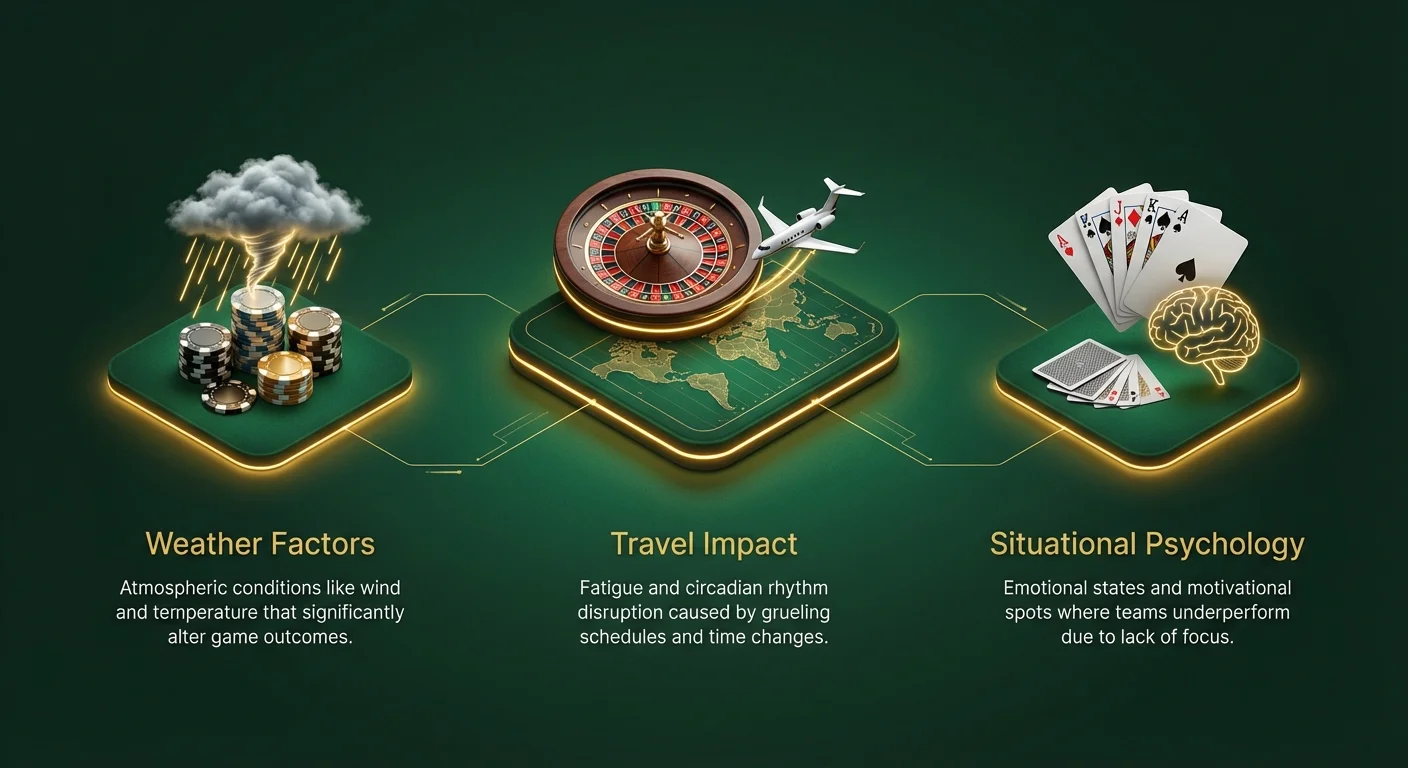
The Atmospheric Edge: Weather Betting
Weather is the ultimate variable in outdoor sports. However, novice bettors often overestimate the impact of certain conditions while vastly underestimating others. Understanding the physics of weather is crucial for finding value on totals (Over/Under) and handicapping specific team matchups.
1. Wind: The Silent Killer of Offense
Most bettors look for rain or snow when betting the "Under," but wind is statistically the most significant weather factor in the NFL and NCAA football.
- The Passing Game: Wind speeds over 15 mph begin to significantly alter a quarterback's accuracy, particularly on deep throws. It forces teams to become one-dimensional, relying on the run game, which keeps the clock moving and reduces scoring.
- The Kicking Game: Crosswinds are a kicker's nightmare. In a game decided by a field goal, a 20 mph crosswind effectively shrinks the scoring range of an offense by 10-15 yards.
- Betting Strategy: If sustained winds are forecast to be 20+ mph, look seriously at the Under. However, be wary of betting early; wait to see if the line plummets. If the public panics and drops the total by 4-5 points, the value might flip to the Over if the wind isn't as bad as predicted.
2. Temperature and Air Density
Temperature affects air density, which dictates how far a ball travels. This is a massive factor in MLB betting and football.
- Heat (Low Density): In hot, humid weather, the air is thinner. Baseballs carry further, and curveballs break less. This creates an environment ripe for Overs.
- Cold (High Density): In freezing temperatures, the air is dense. The ball essentially hits a wall of resistance. In the NFL, a frozen football is also harder to grip, throw, and catch, leading to conservative play-calling.
- The "Frozen Tundra" Narrative: Be careful betting solely on "cold weather teams" dominating "warm weather teams." While the narrative suggests a team from Miami will freeze up in Green Bay, historical data suggests the spread often over-adjusts for this, giving value to the warm-weather underdog.
3. Precipitation: Rain vs. Snow
Visually, snow is dramatic. For betting, it is tricky.
- Rain: Slick surfaces favor the offense in one specific area: reaction time. A receiver knows where he is going; the defender must react. On a wet field, the defender is more likely to slip. However, heavy rain causes fumbles and drops.
- Snow: Light snow often has little impact on scoring. In fact, traction can be better on frozen snow than wet grass. However, accumulating snow slows the game down significantly, making it difficult for players to cut. This favors the Under.
Weather Impact Cheat Sheet
| Weather Condition | Primary Impact | Betting Lean |
|---|---|---|
| Wind 15-20 mph | Disrupts deep passing | Slight Lean Under |
| Wind 20+ mph | Kills passing & kicking | Strong Lean Under |
| Extreme Heat | Ball travels further, fatigue sets in | Lean Over (especially MLB) |
| Extreme Cold | Ball travels less, hard to grip | Lean Under |
| Heavy Rain | Fumbles, conservative play | Lean Under / Lean Underdog |
| Light Snow | Visual obstruction mostly | Neutral / No Edge |
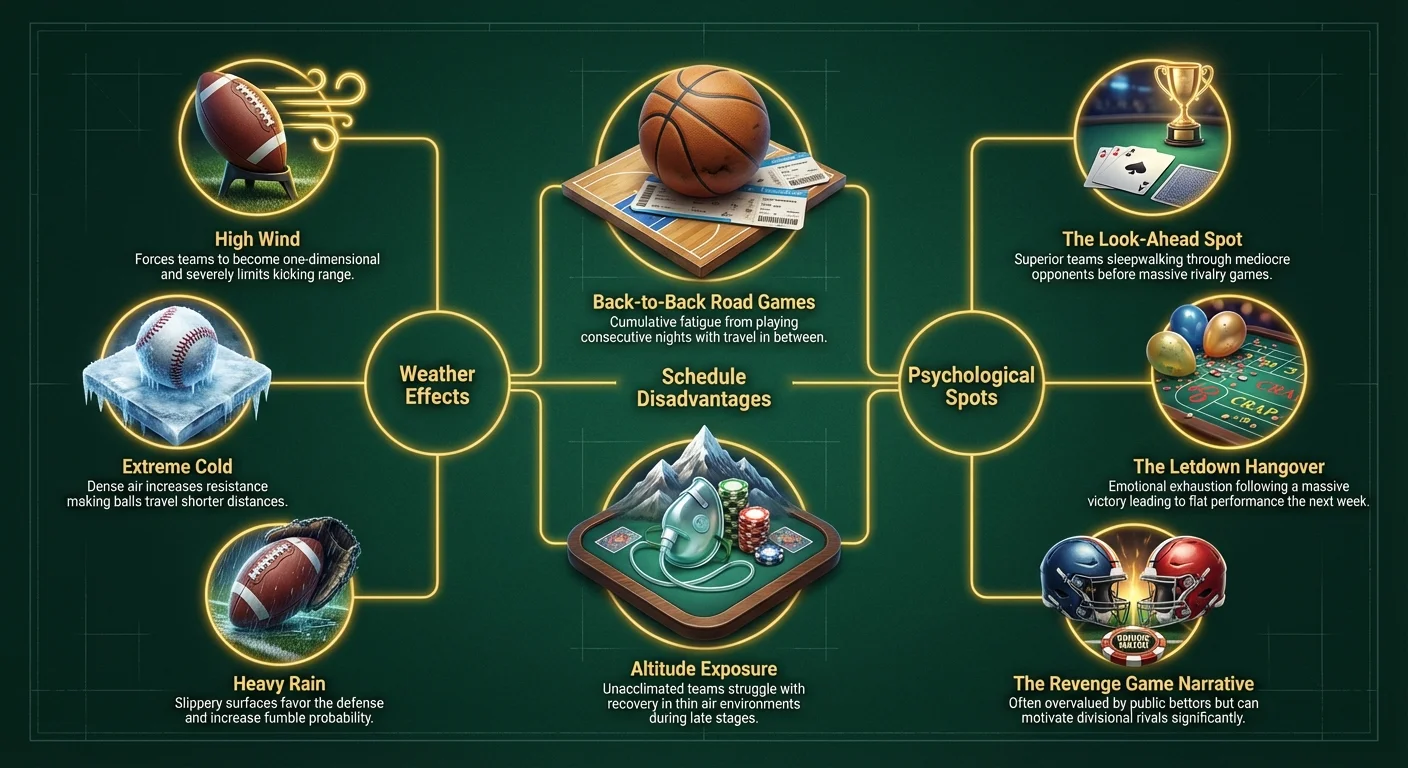
Travel Factors and Circadian Rhythms
In an era of private jets and five-star hotels, does travel still matter? Absolutely. Fatigue is cumulative, and body clocks are biological facts that cannot be ignored.
The East vs. West Coast Bias
This is most prevalent in the NFL and NBA. When a West Coast team travels to the East Coast for a 1:00 PM ET kickoff, their internal body clock believes it is 10:00 AM.
- The Data: Historically, West Coast teams playing early games on the East Coast have underperformed against the spread (ATS), though the market has tightened on this in recent years.
- The Reverse: East Coast teams traveling West for late-night games (10:00 PM ET starts) often face fatigue in the fourth quarter, as their bodies feel like it is 1:00 AM.
The NBA/NHL "Schedule Loss"
In sports with 82-game seasons, travel factors create what sharp bettors call "scheduled losses." You can often predict a team's lack of energy simply by looking at the calendar.
- 3-in-4 (Three games in four nights): The third game is a prime spot to bet against a team (fade them), especially if the third game is on the road.
- The Back-to-Back: Playing two nights in a row is tough. It is even tougher if the team had to fly between cities and clear customs (e.g., playing in Toronto one night and Boston the next).
- The "Getaway" Game: In MLB, the last game of a long road trip before the team flies home is often played with less intensity. Players are mentally packing their bags.
Altitude Advantages
The altitude in Denver (Mile High) and Salt Lake City is a legitimate physiological weapon.
- The Edge: Teams unacclimated to the thin air struggle with oxygen recovery. This edge is magnified in the second half of games or on the second night of a back-to-back.
- The Strategy: Look to bet on Denver or Utah in the second half (2H lines) or live betting if the game is close, as the opposing team is likely to fade physically.
Situational Spots: The Psychology of Betting
Situational handicapping involves identifying spots where a team's motivation, focus, or emotional state does not align with their statistical ability. Teams are composed of humans, and humans are prone to distraction and emotional variance.
1. The Look-Ahead Spot
A superior team plays a mediocre opponent, but they have a massive rivalry game or championship rematch scheduled for the following week.
- The Risk: The superior team may "sleepwalk" through the current game, doing just enough to win but failing to cover the spread.
- The Bet: Take the points with the underdog.
2. The Letdown Spot (Hangover)
This occurs immediately after a team achieves a massive, emotional victory - usually an upset against a rival or a last-second win.
- The Psychology: The team has expended all their emotional energy. The following week, they often come out flat.
- The Bet: Fade the team coming off the massive win, especially if they are playing a disciplined, "boring" opponent.
3. The Sandwich Spot
This combines the Look-Ahead and the Letdown. A team plays a weak opponent between two powerhouse opponents.
- Example: The Georgia Bulldogs play Alabama (Week 4), then Vanderbilt (Week 5), then Auburn (Week 6).
- The Play: Vanderbilt is in the "sandwich spot." Georgia is exhausted from Bama and looking ahead to Auburn. This is a prime spot for the underdog to cover.
4. The Revenge Game
Media loves the "Revenge Game" narrative, but you must be careful.
- Divisional Revenge: In the NFL, if a team gets blown out by a division rival, they historically perform well ATS in the second meeting later that season.
- Player Revenge: A star player facing their former team often tries too hard, leading to forced shots or turnovers. Be cautious betting player props on "revenge" narratives unless the player is a calm veteran.
Leveraging Crypto for Situational Betting
Using cryptocurrency for sports betting offers distinct advantages when trading on weather and situational factors. Because these markets move fast, the infrastructure of your sportsbook matters.
Speed of Execution
Weather reports change rapidly. If a sudden blizzard warning hits Buffalo 30 minutes before kickoff, the "Under" line will crash within minutes.
- Fiat Lag: Traditional sportsbooks may delay deposits or require credit card verifications that take time.
- Crypto Speed: Bitcoin, Litecoin, or USDT deposits are usually instant. This allows you to fund your account and hit a favorable line before the market adjusts to the new weather data.
High Limits and Anonymity
Situational betting is often a strategy used by "sharps" (professional bettors). Frequent winning on niche markets (like betting unders on windy days) can lead to traditional books limiting your account.
- Crypto Advantages: Many top-tier crypto sportsbooks operate with a "No-KYC" (Know Your Customer) model or higher tolerance for winning players. They offer higher betting limits and faster withdrawals, ensuring that if you identify a "Letdown Spot" and hit a big parlay, you receive your funds instantly.
Global Market Access
Some of the best value in situational betting comes from niche leagues where travel schedules are grueling (e.g., EuroLeague Basketball or KHL Hockey). Crypto sportsbooks often provide broader global coverage than localized fiat books, giving you access to more "schedule loss" opportunities.
Practical Strategy: Your Pre-Bet Checklist
Before placing a wager, run through this checklist to ensure you aren't walking into a situational trap.
- The Schedule Check:
- Is this team on a back-to-back?
- Is this their 3rd road game in a row?
- Did they play overtime in their last game?
- The Weather Check (Outdoor Sports):
- Is wind projected over 15 mph?
- Is the temperature significantly different from the team's home city?
- The Motivation Check:
- Is this a "sandwich game"?
- Did they just win the "Game of the Year" last week?
- Is the team tanking for a draft pick?
- The Roster Check:
- Are key players resting? (Common in NBA/European Soccer).
- Pro Tip: In the NFL, pay attention to Offensive Line injuries. A missing Left Tackle affects the game more than a missing Wide Receiver, yet the betting public rarely notices.
Summary
Handicapping isn't just about who has the better Quarterback or which team shoots a higher percentage from three-point range. It is about understanding the context in which the game is played.
- Respect the Wind: It is the most influential weather factor.
- Respect the Calendar: Fatigue is real. Bet against teams in terrible travel spots (3-in-4 nights, cross-country flights).
- Respect Human Nature: Teams let their guard down after big wins and look past weak opponents.
By combining statistical analysis with these situational factors, you create a holistic view of the game. Using crypto sportsbooks enhances this strategy by providing the speed and liquidity needed to attack these spots the moment they arise. Don't just bet on the team; bet on the situation.