
Doyle Brunson, the Godfather of Poker, famously called No-Limit Texas Hold'em "The Cadillac of Poker." It is a game that takes a minute to learn but a lifetime to master. Unlike other casino games where you play against the house, in poker, you play against other people. It is a contest of strategy, psychology, mathematics, and yes, a little bit of luck.
Whether you are sitting down at a high-stakes table in Las Vegas or loading up a crypto poker room to play with Bitcoin, the fundamentals remain the same. To be profitable, you must understand not just the hierarchy of hands, but the flow of the game, the importance of position, and the mathematics of betting.
This guide is designed for beginners who want to move beyond merely knowing the hand rankings to understanding how the game is actually played. We will dissect the rules, the blind structure, the betting rounds, and the core strategies that separate the fish from the sharks.
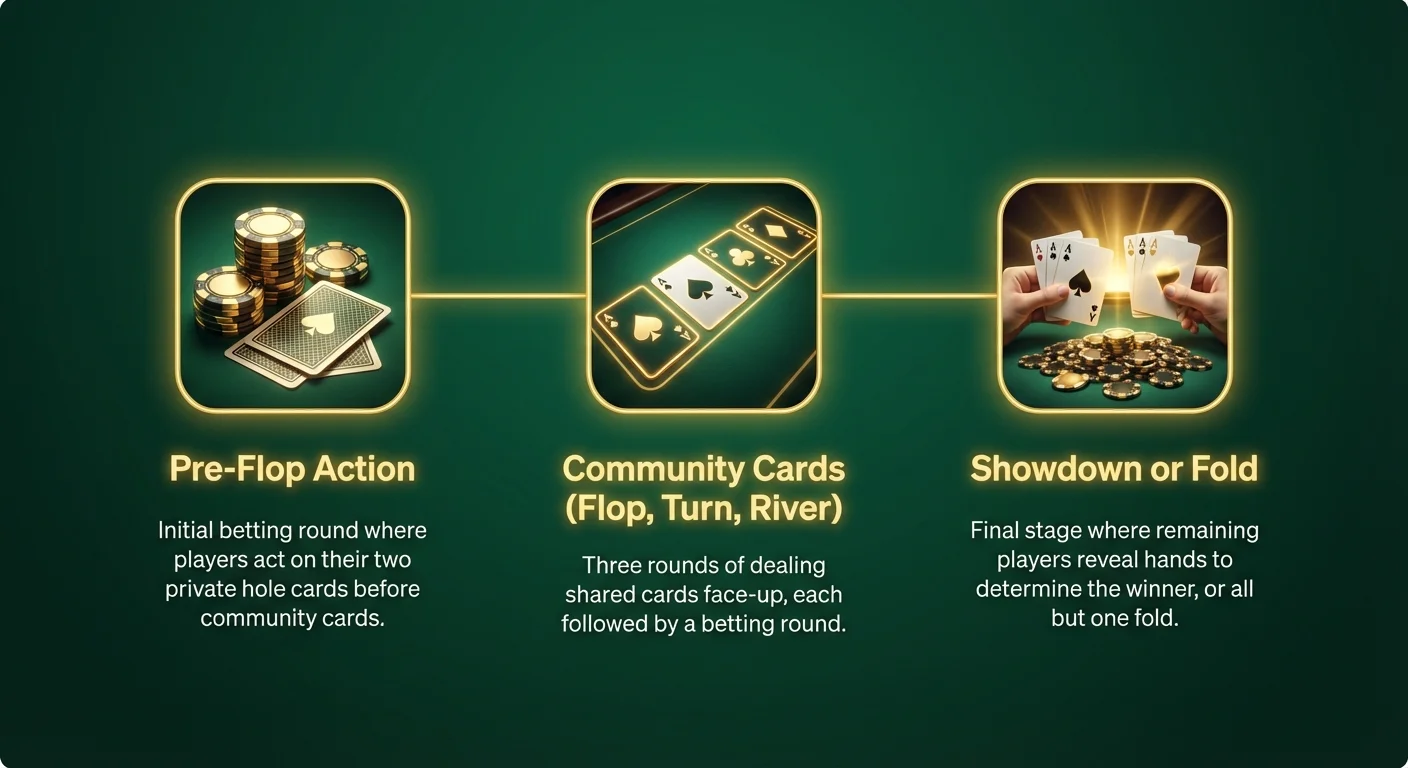
The Objective: How to Win
In Texas Hold'em, there are two ways to win a pot:
- Showdown: Have the best five-card hand at the end of the final betting round.
- Aggression: Force all other players to fold their hands before the showdown, awarding you the pot regardless of what cards you hold.
This dual path to victory is what makes how to play poker so nuanced. You don't always need the best cards to win; you just need to convince your opponents that you do. This concept is often referred to as "Fold Equity," a critical strategic element we will explore later in this guide.
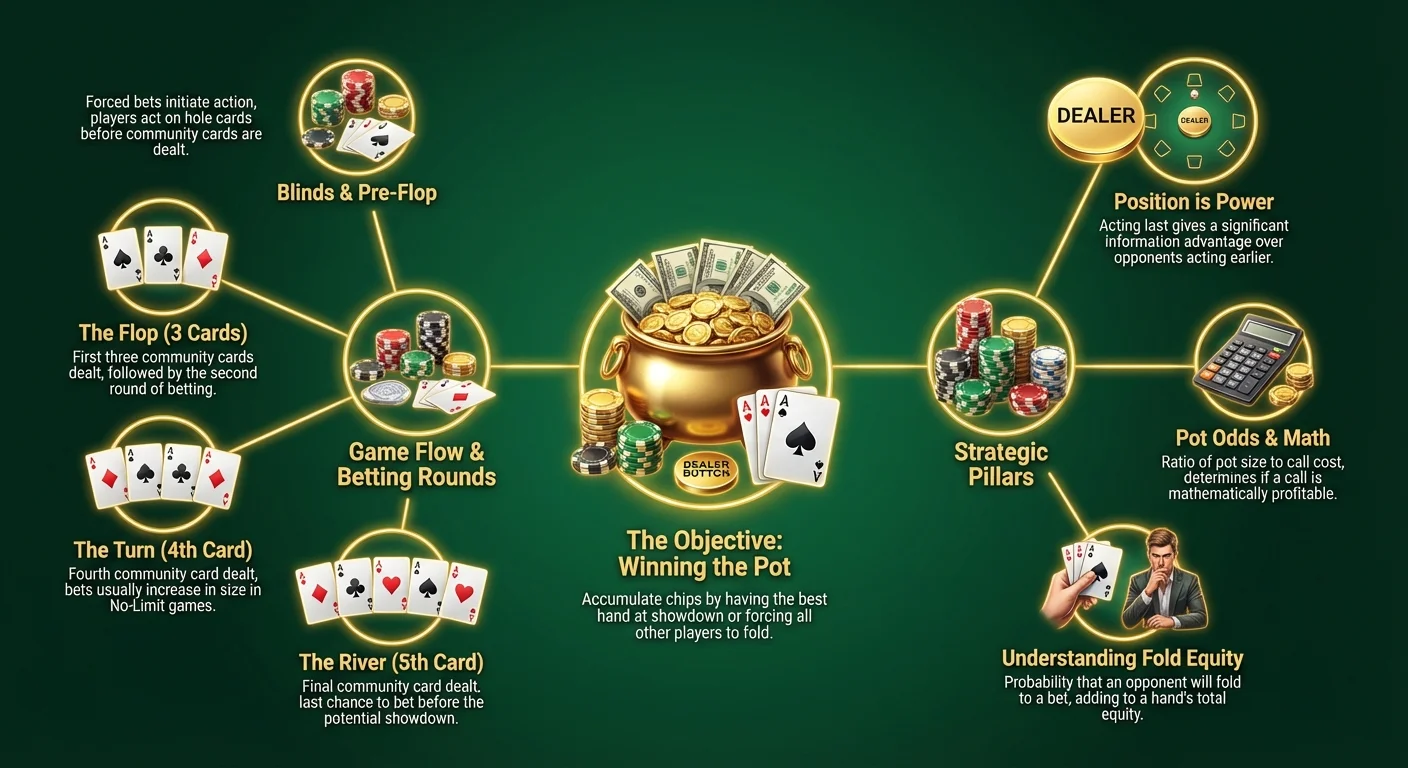
The Setup and The Blind Structure
Before cards are dealt, the stage must be set. Texas Hold'em is played with a standard 52-card deck. A "Dealer Button" (a white disc) moves clockwise around the table after every hand to indicate who the nominal dealer is. This button determines the order of action.
Understanding Blinds
The defining characteristic of Hold'em is the blind structure. Blinds are forced bets that initiate the action. Without them, players would simply sit and wait for Aces all day, resulting in a boring game with zero profit potential.
- The Small Blind (SB): The player immediately to the left of the dealer button. They typically post half of the minimum bet.
- The Big Blind (BB): The player to the left of the Small Blind. They post the full minimum bet.
For example, in a $1/$2 No-Limit game:
- Player A (Button)
- Player B (Small Blind) puts in $1.
- Player C (Big Blind) puts in $2.
These bets are "live," meaning they count toward the player's contribution to the pot for the first betting round.
The Straddle
In many live games and some crypto poker rooms, you may encounter a "Straddle." This is a voluntary blind bet made by the player to the left of the Big Blind (essentially a third blind). It is usually double the Big Blind. The straddler buys the privilege of acting last pre-flop. While risky, it bloats the pot and creates more action.
Hand Rankings: The Hierarchy of Power
Before diving into the gameplay rounds, you must memorize the hand rankings. In Texas Hold'em, you make the best 5-card hand possible using any combination of your two private "hole cards" and the five community cards.
| Rank | Hand Name | Description | Example |
|---|---|---|---|
| 1 | Royal Flush | A, K, Q, J, 10, all of the same suit. | A♠ K♠ Q♠ J♠ 10♠ |
| 2 | Straight Flush | Five consecutive cards of the same suit. | 8♥ 7♥ 6♥ 5♥ 4♥ |
| 3 | Four of a Kind | Four cards of the same rank. | Q♣ Q♦ Q♥ Q♠ 4♦ |
| 4 | Full House | Three of a kind plus a pair. | J♦ J♣ J♠ 9♥ 9♣ |
| 5 | Flush | Any five cards of the same suit (not consecutive). | K♣ 10♣ 7♣ 6♣ 2♣ |
| 6 | Straight | Five consecutive cards of different suits. | 9♦ 8♣ 7♠ 6♦ 5♥ |
| 7 | Three of a Kind | Three cards of the same rank (also called a "Set" or "Trips"). | 7♠ 7♥ 7♣ K♦ Q♠ |
| 8 | Two Pair | Two different pairs. | 10♥ 10♣ 4♦ 4♠ A♥ |
| 9 | One Pair | Two cards of the same rank. | A♦ A♣ J♥ 8♠ 3♦ |
| 10 | High Card | No made hand; the highest card plays. | A♠ J♦ 8♣ 6♥ 2♦ |
Game Flow: From Pre-Flop to The River
A full hand of Texas Hold'em is broken down into four distinct bPre-Flop: The Deal Each player is dealt two cards face down.er is dealt two cards face down. These are your "hole cards." You are the only one who sees them.
The Action:
Action begins with the player to the left of the Big Blind (a position called "Under the Gun"). Because the blinds are forced bets, players acting after them have three options:
- Fold: Discard the hand and wait for the next deal.
- Call: Match the amount of the Big Blind.
- Raise: Increase the bet. In No-Limit, you can raise any amount up to all of your chips.
Unique Rule: The Big Blind has a special option. If the action folds around to the BB, or if other players simply "limp" (call) the blind, the Big Blind has the option to "Check" (end the betting round) or "Raise." This is the only time a player can raise their own blind bet without a previous raise occurring.
2. The Flop: The First 3 Community Cards
Once pre-flop betting is complete, the dealer burns a card (discards the top card) and deals three cards face-up in the middle of the table. This is The Flop.
The Action:
Action now starts with the Small Blind (or the first active player to the left of the button). Players can Check (pass the action to the next player without betting) or Bet. Once a bet is made, subsequent players must Call, Raise, or Fold.
3. The Turn: Fourth Street
After the flop betting round, the dealer burns another card and deals a fourth community card face-up. This is The Turn.
The Action:
The betting rules are identical to the flop. However, in No-Limit games, the bets usually get larger here. The pot is bigger, and players are committing more of their stack.
4. The River: Fifth Street
The dealer burns a final card and places the fifth community card face-up. This is The River. There are no more cards to come. Players now know exactly what their best 5-card hand is.
The Action:
This is the final betting round. The pressure is highest here. You are either value betting (hoping a worse hand calls you) or bluffing (hoping a better hand folds).
5. The Showdown
If two or more players remain after the river betting round, they flip their cards. The player with the best hand wins the pot. If the hands are identical, the pot is "chopped" (split equally).
Mastering the "No-Limit" Mechanics
When discussing Texas Holdem rules, the term "No-Limit" is often misunderstood. It doesn't mean you can buy in for an infinite amount of money; it refers to the betting structure.
The All-In
In No-Limit Hold'em, a player can bet all of their remaining chips at any point when it is their turn to act. This is called going "All-In."
- Table Stakes: You can only win what you have in front of you. If you have $50 and your opponent goes All-In for $200, you can call. If you win, you win your $50 plus $50 from the opponent (total $100 pot). The opponent gets their remaining $150 back.
- Side Pots: If three players are in a hand with different stack sizes (e.g., $50, $100, and $200), and all go All-In, a main pot and side pots are created. The player with $50 competes only for the main pot.
Buy-In Limits
While the betting is no-limit, the buy-in is usually capped. In a standard $1/$2 game, the max buy-in might be $300 (150 big blinds). This protects the game ecosystem. However, in Crypto Poker, you can often find deep-stack tables where buy-ins are much larger, allowing for more complex post-flop strategy.
Key Strategic Concepts for Beginners
Knowing the rules allows you to play; knowing the strategy allows you to profit. Here are the thrPosition is Power Where you sit relative to the dealer button is arguably more important than your cards.ably more important than your cards.
- Early Position (Blinds/Under the Gun): You have to act first on every betting round. This is a disadvantage because you lack information. You should play very few hands here (only premium cards like AA, KK, AK).
- Late Position (Button/Cutoff): You act last. You get to see what everyone else does before you make a decision. You can play a wider range of hands here because you have an information advantage.
Tip: A mediocre hand on the Button is often more profitable than a strong hand in the Small Blind.
2. Pot Odds and Math
You don't need to be a calculus professor, but you must understand Pot Odds. This helps you decide if a bet is "good" or "bad."
Definition: Pot odds are the ratio of the current size of the pot to the cost of a call.
- Example: The pot is $100. Your opponent bets $50. The total pot is now $150. It costs you $50 to call.
- The Math: You are paying $50 to win $150. That is a ratio of 3:1.
- The Decision: If your hand has a better than 1-in-4 chance (25%) of winning, you should call. If you are drawing to a flush (rougAs noted in our reference material, winning poker isn't about winning every hand; it's about making bets that offer a positive expected return in the long run.it's about making bets that offer a positive expected return in the long run.
3. Understanding Fold Equity
One of the sources in our research highlights Fold Equity as a vital concept. Simply put, this is the probability that your opponent will fold to your bet.
- Equation: Total Equity = Hand Equity (chance your cards win) + Fold Equity (chance opponent folds).
- Application: If you have a drawing hand (like a flush draw), betting aggressively is often better than calling. Why? Because you can win two ways: hitting your flush OR making the opponent fold. If you just call, you can only win by hitting the flush.
Estimating Fold Equity:
This is subjective, but you can assign percentages based on player types:- The Rock: Plays only nuts. High fold equity. You can bluff them.
- The Calling Station: Calls everything. Zero fold equity. Never bluff them; just value bet.
Why Play Texas Hold'em with Crypto?
The rules of Texas Hold'em don't change when you switch from fiat currency to cryptocurrency, but the environment improves significantly.
- Speed of Transactions: Traditional poker sites can take days to process withdrawals. Crypto poker sites (using Bitcoin, Ethereum, or Litecoin) often process cashouts in minutes.
- Provably Fair Technology: One major concern for online players is the RNG (Random Number Generator). Is the deck rigged? Many crypto casinos use "Provably Fair" algorithms that allow players to cryptographically verify that the deck was shuffled randomly and not tampered with.
- Global Access: Crypto bypasses many banking restrictions, allowing for a truly global player pool. This often means softer games and larger tournament prize pools.
- Micro-Stakes and Mega-Stakes: Because crypto is divisible, you can play for fractions of a cent (Satoshis) or millions of dollars, catering to every bankroll size.
Cheat Sheet: Top 5 Tips for Beginners
Based on expert advice, here is a quick cheat sheet to keep you on the right track:
- Be Selective (VPIP): VPIP stands for "Voluntarily Put Money In Pot." Beginners often play too many hands. Aim to play only 15-20% of the hands dealt to you. If you are playing every other hand, you will lose money.
- Aggression Pays: When youBeing the "pre-flop aggressor" gives you the initiative to win the pot on the flop with a "continuation bet" (C-Bet), even if you miss.a "continuation bet" (C-Bet), even if you miss.
- Don't Fall in Love with Aces: A pair of Aces is the best starting hand, but it's just one pair. If the board comes
8-9-10-Jand your opponent goes all-in, your Aces are likely beaten. Learn to fold big pairs when the board gets scary. - Observe When Folded: Don't look at your phone when you aren't in a hand. Watch your opponents. Who bluffs? Who only bets with the nuts? Information gathered now earnsVariance in No-Limit Hold'em is high; you need a cushion to survive the high variance downswings.ankroll on a single table. Variance in No-Limit Hold'em is high; you need a cushion to survive the downswings.
Conclusion
No-Limit Texas Hold'em is a game of incomplete information. You will never know exactly what your opponent holds, but by understanding the blind structure, leveraging position, calculating pot odds, and applying pressure, you can solve the puzzle more often than not.
The game offers a unique blend of adrenaline and intellect. Whether you are grinding micro-stakes on a crypto site or playing a home game with friends, the journey from "fish" to "shark" begins with these fundamentals. Remember, the goal isn't to win every pot - it's to make the best decision every time. The cards will fall where they may, but over time, skill always rises to the top.
Ready to test your skills? Check out our reviews of the top Crypto Poker sites to find the best tables, rakeback deals, and welcome bonuses.
Glossary of Essential Poker Terms
- Angle Shooting: Unethical behavior that isn't technically against the rules but violates the spirit of the game (e.g., acting out of turn intentionally).
- Bad Beat: Losing a hand where you were the statistical favorite (e.g., your Aces losing to a pair of 2s that hits a third 2 on the river).
- Burn Card: The card discarded by the dealer before the Flop, Turn, and River to prevent cheating/marked cards.
- Check-Raise: Checking when it is your turn, then raising after an opponent bets. A powerful move of strength.
- Donk Bet: Betting into the aggressor from the previous round (usually considered a weak play, but can be strategic).
- Nuts: The best possible hand at that specific moment.
- Outs: Cards left in the deck that will improve your hand to a winner.
- Tilt: Playing emotionally or irrationally after a bad loss. Avoiding tilt is crucial for protecting your bankroll.