
Keno is one of the oldest games in the casino ecosystem, tracing its roots back to ancient China. For centuries, the premise has remained the same: select numbers from a grid, wait for the draw, and hope for a match. However, the mechanism behind the game has undergone a radical transformation. While land-based lounges and traditional online casinos still attract players, a significant migration is underway toward blockchain-based gaming.
The debate of online keno vs crypto keno is not just about the currency you use to bet; it is about the fundamental architecture of the game. From the transparency of the algorithms to the speed of the payouts, switching to blockchain offers distinct advantages that traditional fiat platforms struggle to match. This guide explores the technological and financial leaps that Crypto Keno has taken, analyzing why modern players are trading their paper tickets for digital hashes.
The Evolution of Keno: From Lounges to Blockchain
To understand the benefits of switching, we must first look at where Keno started and where it currently stagnates in the traditional sector.
The Land-Based Experience
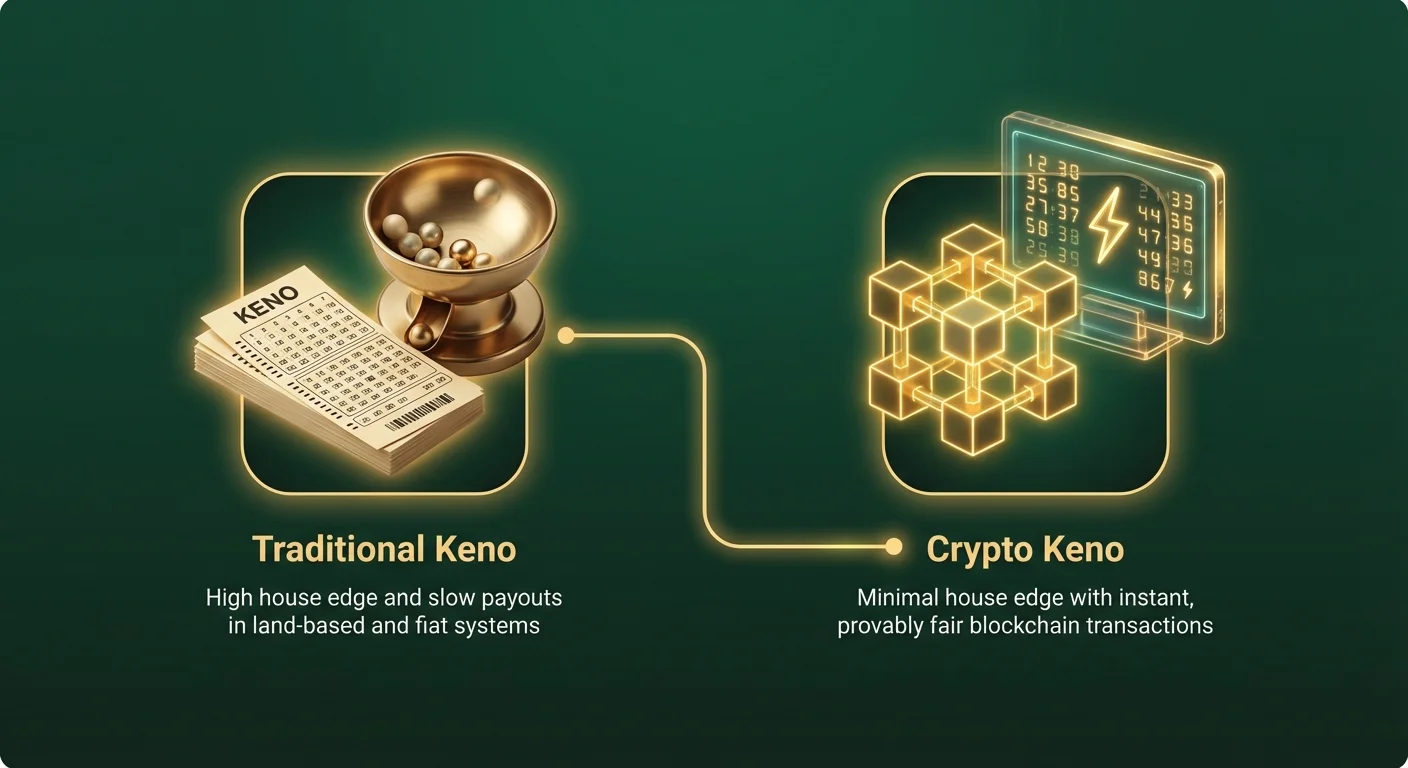
In a brick-and-mortar casino, Keno is often a social, slow-paced game. It is designed to keep you seated. The house edge in land-based Keno is notoriously high - often ranging between 20% and 40%. The draw is physical (balls in a hopper) or digital, but the pace is leisurely. You mark a card with a crayon, hand it to a runner, and wait for the next scheduled game, which might start every 5 to 10 minutes.
The Fiat Online Experience
Online casinos improved this by introducing "Video Keno." Here, the Random Number Generator (RNG) replaced the hopper, allowing for instant games. However, players using credit cards or bank transfers still face the opacity of the software. You have to trust that the casino's certification is valid and that the software hasn't been tweaked in the house's favor. Furthermore, while the game is faster, the banking usually isn't.
The Crypto Keno Solution
Crypto Keno takes the speed of online play and integrates the trustless nature of blockchain technology. It strips away the high house edge, often reducing it to as low as 1%, and introduces features like "Provably Fair verifiability." This is not just a digital version of the same game; it is a mathematically superior iteration.
Provably Fair: The End of "Trust Us"
The single biggest argument for switching to blockchain Keno is the concept of Provably Fair gaming.
In traditional online Keno, the RNG is a "black box." You press "Play," the server calculates a result, and tells you if you won or lost. You have no way of verifying if that result was truly random or if it was predetermined to make you lose based on your recent win streak. You rely entirely on third-party auditors.
Crypto Keno changes this dynamic through cryptographic hashing.
How Provably Fair Works in Keno
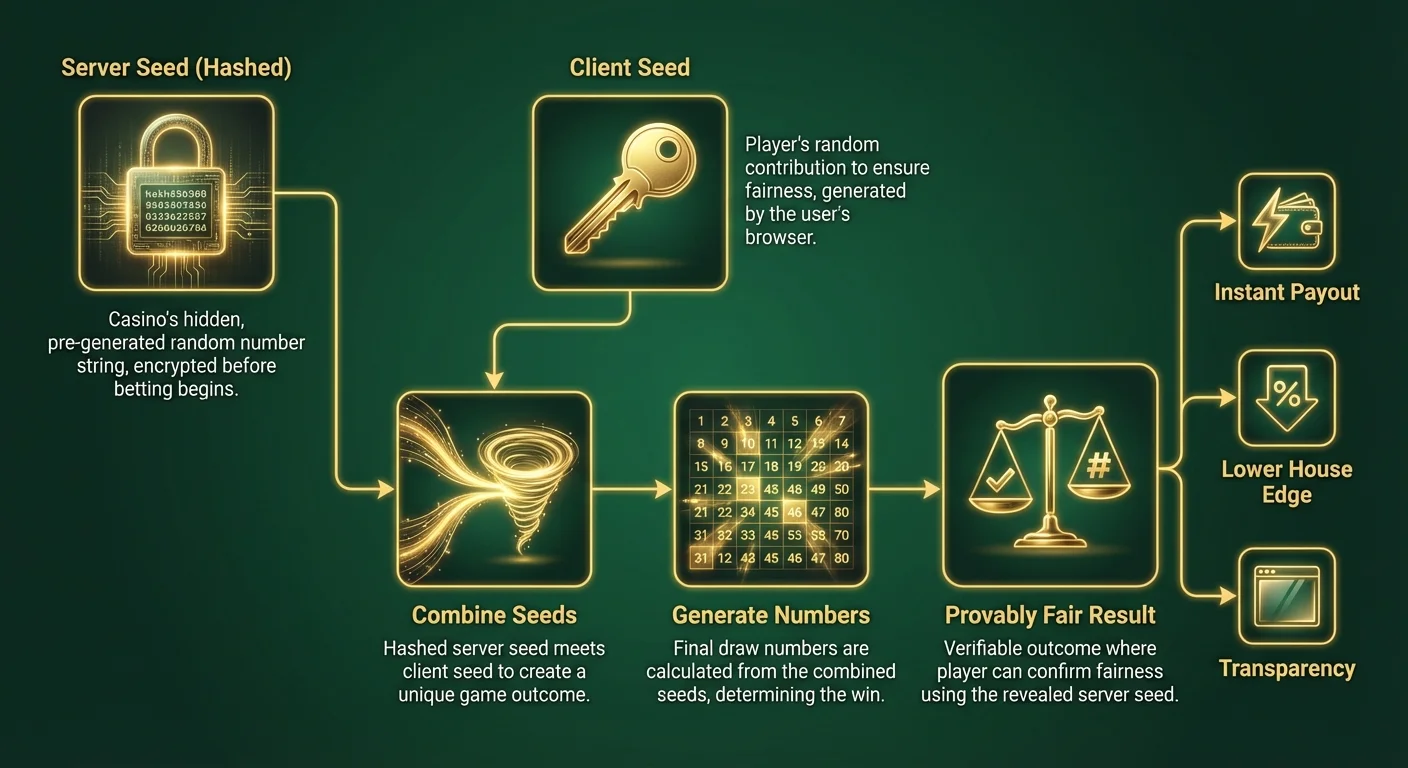
- Server Seed: Before the round starts, the casino generates a random number (the Server Seed). They hash this number (turn it into a string of encrypted characters) and show it to you before you bet. This proves they cannot change the outcome later.
- Client Seed: You (or your browser) generate a random seed. This ensures that the casino cannot know the final outcome in advance because they don't know your seed yet.
- The Result: The game combines the Server Seed and Client Seed to generate the random numbers for the Keno draw.
- Verification: After the round, the casino reveals the unhashed Server Seed. You can enter these seeds into a third-party verifier to prove that the outcome was mathematically fair and not manipulated.
This level of transparency is nonexistent in traditional fiat casinos.
House Edge and Financial Efficiency
One of the primary benefits of bitcoin gambling is the dramatic reduction in the "House Edge." The House Edge is the mathematical advantage the casino has over the player over time.
The Cost of Playing
- Land-Based Keno: 20% to 35% House Edge. (For every $100 bet, the casino keeps $20-$35).
- Fiat Online Keno: 5% to 15% House Edge.
- Crypto Keno: 1% to 2% House Edge.
Why is the difference so stark? Crypto casinos have lower overheads. They don't pay high processing fees to Visa or Mastercard, and they don't require the same massive physical infrastructure as land-based venues. These savings are passed to the player in the form of higher Return to Player (RTP) percentages.
Instant Payouts vs. Banking Delays
Keno payouts speed is a major friction point for traditional players. If you hit a lucky 10-spot pattern in a standard online casino, you might wait 3 to 5 business days for a bank transfer to clear. Worse, large wins often trigger manual reviews and "Pending" periods designed to tempt you into canceling the withdrawal and gambling the money back.
Blockchain transactions are automated. In Crypto Keno:
- You win the round.
- The smart contract or internal ledger credits your balance instantly.
- You request a withdrawal to your private wallet.
- The funds arrive in minutes (depending on the blockchain speed, e.g., Bitcoin takes ~10 minutes, Litecoin or Ripple takes seconds).
Comparative Analysis: Traditional vs. Crypto Keno
The following table highlights the operational differences between the three main ways to play Keno.
| Feature | Land-Based Keno | Fiat Online Keno | Crypto/Blockchain Keno |
|---|---|---|---|
| Trust Mechanism | Physical Balls / Regulatory Audit | Third-Party Audit Certificates | Provably Fair (User Verifiable) |
| House Edge | High (20-40%) | Moderate (5-15%) | Very Low (1-3%) |
| Game Speed | Very Slow (draws every few mins) | Fast (instant results) | Lightning (Auto-bet supported) |
| Payout Speed | Immediate (Cash) | Slow (1-5 Days Bank Transfer) | Instant (Minutes to Wallet) |
| Betting Limits | Usually Fixed Min/Max | Standard | Flexible (Micro-bets to High Roller) |
| Anonymity | None (Cameras/ID) | Low (Full KYC Required) | High (Often Email-only or minimal KYC) |
Gameplay Dynamics: Speed and Auto-Betting
Crypto Keno platforms are built for the modern internet user. The interface is usually stripped back, focusing on raw efficiency rather than flashy graphics that slow down the browser.
The Power of Auto-Bet
While traditional Keno requires manual input for every ticket, crypto platforms offer sophisticated Auto-Bet tools. This allows players to execute strategies that would be impossible manually.
You can configure the game to:
- Play 1,000 rounds instantly.
- Increase the bet size by 50% after a loss (Martingale strategy).
- Stop betting once you hit a profit of $50.
- Switch number patterns automatically.
This automation allows players to test volatility and patterns at a volume that provides statistically significant data, something you cannot do filling out paper tickets.
Adapting Strategies for the Blockchain
Even though the platform changes, the math of Keno remains rooted in probability. However, the tools available in crypto casinos allow you to apply traditional strategies more effectively.
1. The High-Volatility Cluster Strategy
As noted in traditional Keno theory, "clusters" are groups of numbers that touch or form lines. A common pattern is the 4x5 Corner strategy.
- The Concept: You select a cluster of numbers in the corners of the grid (e.g., 1, 2, 11, 12).
- Crypto Adaptation: Instead of playing this once, set your auto-bet to run this pattern for 50 rounds at a low wager. Because crypto allows for micro-betting (fractions of a cent), you can hunt for this pattern without burning your bankroll, waiting for the high multiplier to hit.
2. Playing the "Hot" Numbers
Statistics from thousands of sessions often highlight numbers like 1, 4, 23, 34, and 72 as frequent hitters. In a Provably Fair environment, the previous results do not influence the future (the Gambler's Fallacy), yet many players prefer betting on numbers that appear "hot."
- Crypto Adaptation: Most crypto Keno interfaces have a live "Hot/Cold" tab built directly into the dashboard. You don't need to manually track the last 50 games; the software does it for you. You can click a button to "Bet on Hot Numbers," instantly populating your card with the most drawn numbers of the current session.
3. The 4-to-8 Spot Sweet Spot
Payout charts indicate that picking between 4 and 8 numbers offers the best balance of risk and reward.
- The Math: Hitting 5 out of 5 is rare, but hitting 3 out of 5 pays decently.
- Crypto Adaptation: Because Crypto Keno often has a configurable "Risk" setting (Low, Medium, High), you can adjust the volatility.
- Low Risk: Pays out smaller amounts more frequently. Good for preserving a balance.
- High Risk: Hitting a 5-spot pays massive multipliers, but dry streaks are longer.
- Tip: Use the "Medium" risk setting on a 6-number selection. This usually offers the highest Return to Player (RTP) in crypto versions of the game.
Bonuses and Community
The culture surrounding crypto gambling is distinct from traditional casinos.
Faucets and Rakeback
Traditional casinos give you a "Deposit Match" (e.g., Deposit $100, get $100) which comes with massive wagering requirements (often 40x) that lock your funds.
Crypto casinos operate differently:
- Faucets: Small amounts of free crypto given daily to let you try the game.
- Rakeback: Instead of complex bonuses, many crypto sites give you raw cash back on every bet you place, win or lose. If you wager 1 BTC over a month, you might get a percentage back instantly, with no strings attached.
- Rain: In the chat rooms of crypto casinos, players or the site administrators often "make it rain," distributing small amounts of crypto to active users.
Community Chat
Crypto Keno is rarely played in isolation. The interface usually includes a live chat where players share their current seeds, show off big wins, and discuss patterns. This replicates the social aspect of the land-based Keno lounge but at the speed of the internet.
How to Switch to Crypto Keno: A Quick Start Guide
If you are ready to move away from low-payout traditional Keno, here is how to get started safely.
- Acquire Cryptocurrency: You will need a digital wallet and some coins. Bitcoin (BTC) is the standard, but for Keno, coins like Litecoin (LTC), Dogecoin (DOGE), or Tether (USDT) are recommended because they have lower transaction fees.
- Choose a Reputable Casino: Look for a site that displays its "Provably Fair" algorithm openly. Check forums like Bitcointalk or Trustpilot for payout history.
- Check the House Edge: Look for the "Information" icon on the Keno game. Ensure the House Edge is below 3% (or the RTP is above 97%).
- Deposit and Play: Send funds to your casino wallet address. Start with small bets to test the interface.
- Verify Your Results: After your first few sessions, copy the hash seeds and use a verifier to confirm the fairness. This builds trust in the platform.
Summary: The Verdict
The question of online keno vs crypto keno ultimately comes down to control.
Traditional Keno asks you to trust the casino completely: trust their speed, trust their payout timelines, and trust their hidden software. In exchange, you often receive a higher house edge and slower service.
Crypto Keno shifts the power back to the player. It offers:
- Verification: You can prove you weren't cheated.
- Value: You keep more of your money thanks to a lower house edge.
- Speed: You play and get paid instantly.
While the game rules - 80 numbers, 20 balls - remain a timeless classic, the blockchain has modernized the engine under the hood. For players looking to maximize their odds and minimize their wait times, the switch to blockchain Keno is not just a trend; it is the logical next step in the evolution of gambling.
Key Takeaways
- Switch for Odds: Crypto Keno often has a ~1% House Edge vs. ~25% in land-based casinos.
- Switch for Speed: Automated payouts mean your winnings are in your wallet in minutes, not days.
- Verify Everything: Use the Provably Fair tools to ensure game integrity.
- Use Automation: Leverage auto-betting tools to run strategies like Martingale or Pattern Hunting efficiently.