
The spinning wheel, the dancing white ball, and the anticipation of where it will land - roulette is the heartbeat of the casino floor. For centuries, it has been a symbol of glamour and chance. Today, that tradition has migrated to the blockchain. Entering a crypto casino offers the same thrill, but with the added benefits of instant transactions, enhanced privacy, and the transparency of blockchain technology.
However, for a beginner, looking at a roulette table can feel like reading a map in a foreign language. There are grids of numbers, different colors, and various sections that look complicated but are actually quite logical once understood.
This guide is designed to take you from a complete novice to a confident player. We will break down the roulette table layout, explain the specific roulette rules governing play, and guide you through placing your first wager using cryptocurrency. Whether you are playing a digital RNG (Random Number Generator) version or a live dealer stream, the fundamentals remain the same.
The Objective: How to Play Roulette
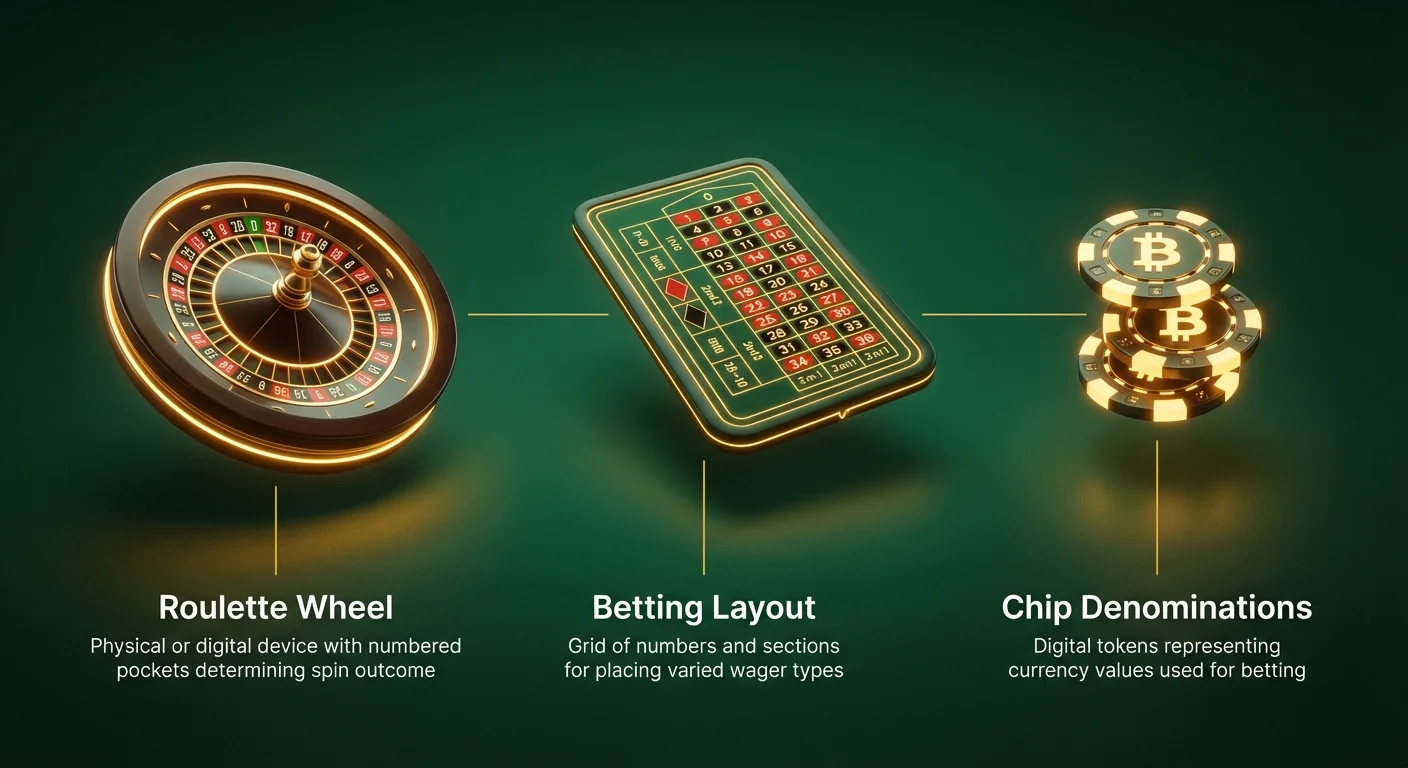
At its core, roulette is beautifully simple. The game consists of a wheel containing numbered pockets (1 through 36) and one or two zero pockets (0 and 00). The objective is to predict which pocket the ball will land in after the wheel is spun.
You are not restricted to picking just one number. You can bet on:
- Specific numbers.
- Groups of numbers.
- The color of the winning pocket (Red or Black).
- Whether the number will be Odd or Even.
- Whether the number will be High (19-36) or Low (1-18).
If your prediction correlates with the outcome of the spin, you win. The amount you win depends on the risk level of your bet - predicting a single number pays far more than predicting the color red, simply because it is much harder to get right.
Understanding the Hardware: Wheels and Tables
Before you deposit your Bitcoin or Ethereum, you must understand the battlefield. Not all roulette wheels are created equal. In the crypto gambling world, you will primarily encounter three variants: European, American, and French.
The Wheel Types
The physical (or digital) structure of the wheel dictates your odds of winning.
- European Roulette (The Standard): This wheel has 37 pockets: numbers 1-36 and a single green Zero (0). The house edge here is 2.7%. This is the version most experts recommend for beginners.
- American Roulette (The Riskier Option): This wheel has 38 pockets: numbers 1-36, a single green Zero (0), and a double green Zero (00). That extra pocket increases the house edge to 5.26%, making it mathematically harder to win compared to the European version.
- French Roulette (The Player's Friend): Uses the same single-zero wheel as European roulette but includes special rules like La Partage or En Prison. If you place an even-money bet (like Red/Black) and the ball lands on Zero, you may get half your bet back or have it "imprisoned" for the next spin. This lowers the house edge to a typically unrivaled 1.35%.
Expert Tip: Always check which version you are loading. In a crypto casino lobby, if you see "American Roulette" and "European Roulette" side-by-side, always choose European. There is no strategic benefit to playing against a double-zero wheel when a single-zero option is available.
The Roulette Table Layout
The betting table is a grid that corresponds to the wheel. It is divided into two main sections: the Inside and the Outside.
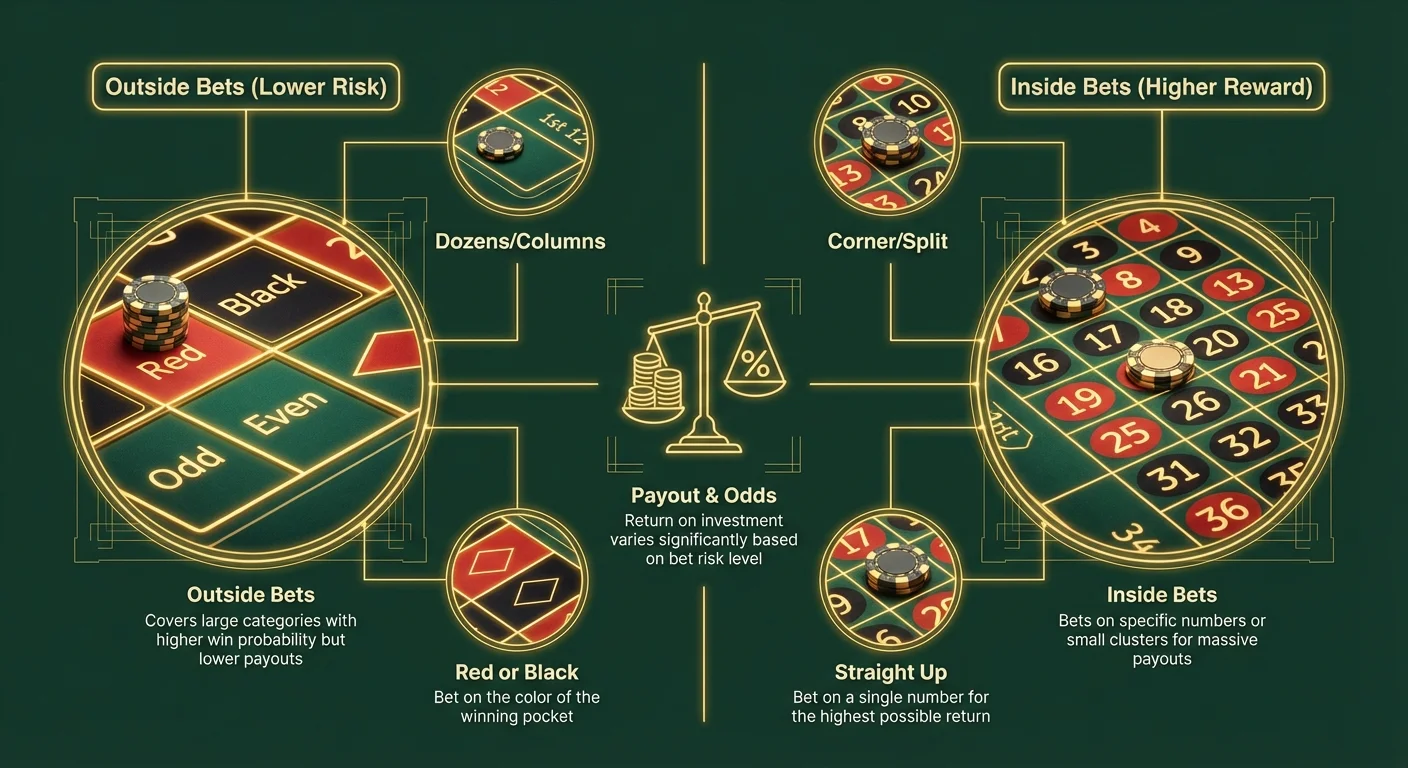
- The Inside: This is the grid of numbers (0 to 36). Bets placed here are on specific numbers or small clusters of numbers. These are high-risk, high-reward bets.
- The Outside: These are the boxes surrounding the number grid. They represent larger categories like "Red," "Black," "1st 12," or "Even." These bets cover large portions of the wheel, offering lower payouts but higher chances of winning.
Betting 101: Types of Bets and Payouts
Understanding roulette rules requires memorizing the different types of bets. In crypto casinos, you simply click your chip value and then click the area of the board you want to cover.
Outside Bets (Best for Beginners)
These bets are the safest way to learn how to play roulette. They generally offer close to a 50/50 chance of winning (excluding the zero).
- Red or Black: Betting on the color of the winning number.
- Odd or Even: Betting on whether the number is odd or even.
- High or Low: Low is 1-18; High is 19-36.
- Dozens: The board is split into three dozens: 1-12, 13-24, and 25-36.
- Columns: Betting on one of the three vertical lines of numbers running down the table.
Inside Bets (For Higher Variance)
These bets offer massive payouts but hit less frequently.
- Straight Up: A bet on a single number (e.g., placing a chip directly on 7).
- Split: A bet on two adjacent numbers (placing a chip on the line separating 5 and 8).
- Street: A bet on a row of three numbers (e.g., 1, 2, 3). You place the chip on the outer edge line of the row.
- Corner (or Square): A bet on four numbers that meet at a corner (e.g., 10, 11, 13, 14).
- Six Line (Double Street): A bet on two adjacent rows of numbers (6 total numbers).
Payout Chart
Here is a breakdown of what you can expect to win. Note that "1:1" means you win an amount equal to your bet (bet 1 mBTC, get your 1 mBTC back + 1 mBTC profit).
| Bet Type | Numbers Covered | Payout | Probability (European) | Probability (American) |
|---|---|---|---|---|
| Straight Up | 1 | 35 to 1 | 2.70% | 2.63% |
| Split | 2 | 17 to 1 | 5.40% | 5.26% |
| Street | 3 | 11 to 1 | 8.10% | 7.89% |
| Corner | 4 | 8 to 1 | 10.81% | 10.53% |
| Six Line | 6 | 5 to 1 | 16.22% | 15.79% |
| Column / Dozen | 12 | 2 to 1 | 32.43% | 31.58% |
| Red / Black | 18 | 1 to 1 | 48.65% | 47.37% |
| Odd / Even | 18 | 1 to 1 | 48.65% | 47.37% |
| High / Low | 18 | 1 to 1 | 48.65% | 47.37% |
The Crypto Casino Difference: Provably Fair and Interface
Transitioning from a land-based casino or a standard online casino to a crypto platform introduces a few unique elements.
1. Provably Fair Technology
In traditional online roulette, you rely on a third-party auditor to ensure the RanIn crypto roulette, many games use Provably Fair algorithms.ny games use Provably Fair algorithms. This allows you to verify the fairness of every spin yourself.
- Before the spin, you receive a "hashed" (encrypted) seed number.
- After the spin, the casino reveals the unencrypted seed.
- You can check that the outcome was pre-determined by the algorithm and not altered after you placed your bet.
2. Chip Denominations
Instead of $5 or $25 chips, you might be betting in mBTC (millibitcoin), ETH, or USDT.
- Tip: Always double-check the fiat value of your crypto bet. 0.01 BTC sounds small, but it is a significant amount of money. Many crypto casinos allow you to toggle the display to show USD/EUR values to help with bankroll management.
3. Speed and Automation
Crypto roulette tables, specifically the non-live software versions, are incredibly fast. There is no dealer waiting for other players. You can spin, clear bets, and re-bet in seconds. This requires discipline to ensure you don't burn through your bankroll too quickly.
Step-by-Step: Placing Your First Crypto Bet
Ready to play? Here is the sequence of a standard round of crypto roulette.
Step 1: Deposit and Choose Your Table
Ensure your casino wallet is funded. Navigate to the "Table Games" or "Live Casino" section. As a beginner, look for "European Roulette" or "French Roulette." Avoid "American Roulette" or gimmicky variants like "Double Ball Roulette" until you understand the basics.
Step 2: Select Your Chip Size
At the bottom of the screen, you will see a stack of virtual chips with different values (e.g., 0.1, 0.5, 1, 5). Click the chip value that repStrategy Note: A good rule of thumb is to bet no more than 1% to 2% of your total bankroll on a single spin. to 2% of your total bankroll on a single spin.
Step 3: Place Your Bets
Move your cursor over the roulette table layout.
- To bet on Red, click the red diamond shape on the Outside.
- To bet on Number 17, click directly on the "17" on the Inside.
- To bet a Street (e.g., 1, 2, 3), place your chip on the outer line of the "3" (or "1" depending on layout orientation) at the edge of the row.
Step 4: Initiate the Spin
- RNG Games: Click the "Spin" button when you are ready. You are in total control of the pacing.
- Live Dealer: You have a timer (usually 15-20 seconds). The dealer will announce "No More Bets," and the software will lock the layout.
Step 5: The Outcome
The ball will drop into a pocket. The interface will zoom in on the winning number.
- Losing bets are swept away (digitally removed).
- Winning bets are paid instantly to your balance.
- You can now choose to "Rebet" (repeat the same bet) or "Clear" (start fresh).
Basic Strategies for Beginners
Roulette is a game of chance, and no strategy can overcome the house edge in the long run. However, using a system can help structure your play and manage your funds. Here are two popular methods adapted for beginners.
The Martingale System
This is the most famous strategy, best used on Even Money bets (Red/Black, Odd/Even).
- The Concept: You double your bet after every loss. When you eventually win, you recover all previous losses plus a profit equal to your original stake.
- The Risk: If you hit a long losing streak (e.g., 7 Blacks in a row when you bet Red), you may hit the table limit or run out of crypto.
- How to Play: Bet 1 unit on Red. Lose? Bet 2 units on Red. Lose? Bet 4 units. Win? Return to betting 1 unit.
The D'Alembert System
This is a lower-risk alternative to the Martingale, also for Even Money bets.
- The Concept: Instead of doubling, you increase your bet by one unit after a loss and decrease it by one unit after a win.
- The Benefit: The bet sizes don't grow as terrifyingly fast as they do in the Martingale.
- How to Play: Start with 5 units. Lose? Bet 6. Lose? Bet 7. Win? Bet 6. Win? Bet 5.
The Street Bet Strategy
If you want to play the Inside numbers without relying on a single "lucky number," Street bets are a good compromise.
- The Concept: A Street bet covers three numbers and pays 11:1. The odds of hitting are roughly 8.1%.
- How to Play: Place small bets on multiple streets (e.g., four different streets). This covers 12 numbers (almost a third of the wheel) while offering a higher payout than a standard Column bet.
Common Mistakes to Avoid
As you begin your crypto casino basics journey, watch out for these pitfalls:
- The Gambler's Fallacy: Just because the ball landed on Red ten times in a row does not mean Black is "due." The wheel has no memory. Every spin is an independent event with the same odds.
- Playing the Wrong Wheel: We cannot stress this enough - avoid the American wheel. The "00" pocket exists solely to take more money from you.
- Ignoring Table Limits: Every table has a minimum and maximum bet. If you are playing a progressive strategy like Martingale, a low maximum limit can bust your system during a losing streak.
- Misunderstanding "Basket Bets": In American roulette, there is a bet covering 0, 00, 1, 2, and 3. This is often called the "Basket" or "Top Line." It carries the worst house edge in the entire game (7.89%). Never make this bet.
Summary
Roulette remains the queen of the casino because it perfectly balances simplicity with depth. You can have fun placing a single chip on Red, or you can utilize complex systems covering various sectors of the wheel.
Key Takeaways:
- Stick to European Roulette: The single zero offers better odds.
- Know Your Layout: Use Outside bets to make your bankroll last longer; use Inside bets for excitement and big wins.
- Leverage Crypto: Use the transparency of Provably Fair games to ensure you are getting a fair shake.
- Manage Your Bankroll: Set a budget in crypto and stick to it.
Now that you understand how to play roulette, the table layout, and the betting options, you are ready to place your first digital chip. Watch the wheel spin, enjoy the thrill, and may the ball land in your favor.