In the high-octane world of online crypto poker, the romanticized image of a smoky backroom game is replaced by crisp graphics, Bitcoin denominations, and anonymous avatars. You cannot see the vein throbbing in your opponent's neck when they are bluffing. You cannot see their hands shaking as they push a stack of chips into the center. You cannot hear the waver in their voice.
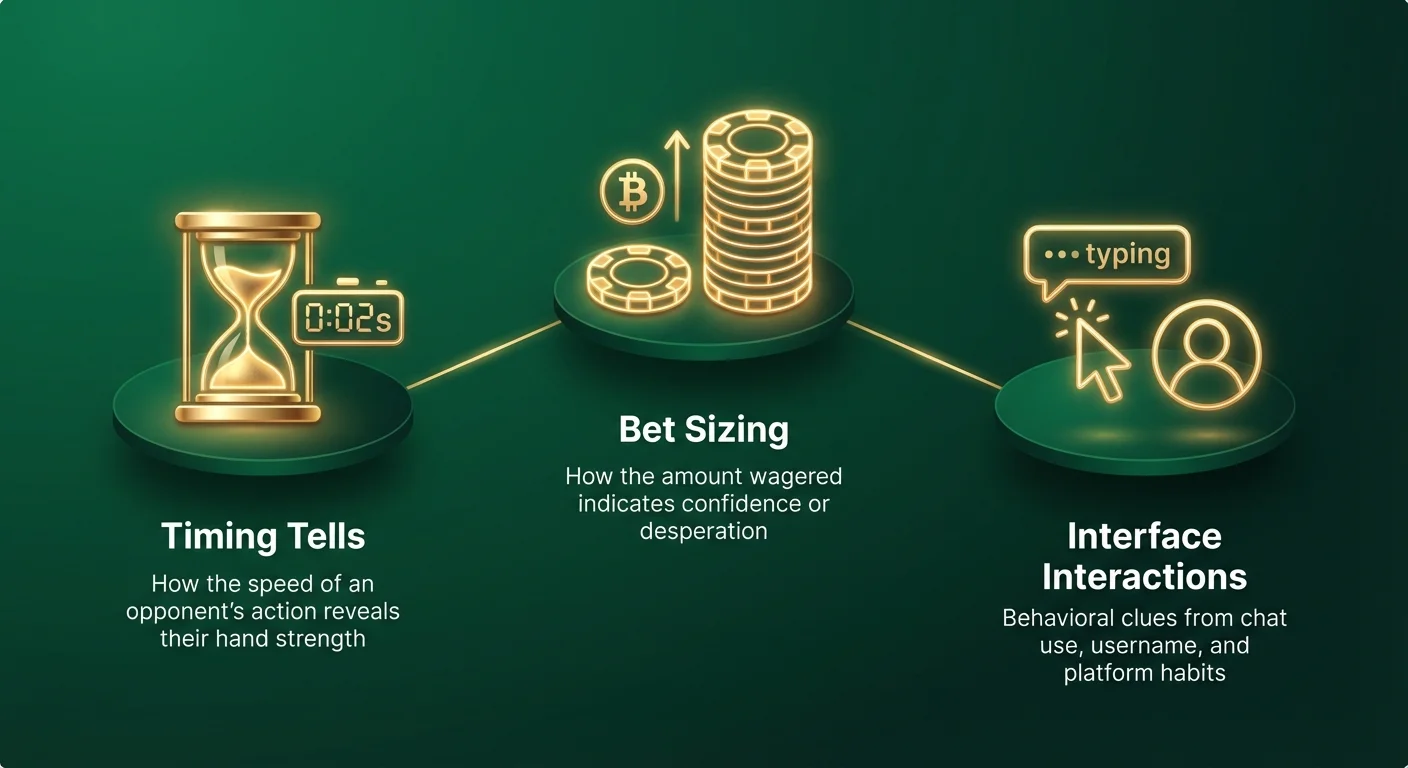
However, the human element remains. Behind every avatar - whether it's a generic silhouette or a customized NFT profile picture - is a human being making decisions based on fear, greed, confidence, or anxiety. Because they cannot communicate physically, these emotions manifest in the only ways the software allows: through the speed of their clicks, the size of their bets, and their interactions in the chat box.
These are Digital Tells.
Mastering the art of reading these invisible signals is what separates break-even players from the sharks who feast on the volatility of crypto poker tables. This guide will move beyond basic hand strength and explore the psychology of the interface, teaching you how to read the minds of opponents you will never meet.
The Psychology of the Interface
Before diving into specific tells, it is vital to understand the environment. In crypto poker, transactions are instant, and the ability to deposit Bitcoin or Ethereum allows for a global player base ranging from recreational gamblers to math-heavy grinders.
The interface acts as a filter. It strips away body language but amplifies timing and patterns. When a player feels stress, they may pause. When they feel confident, they may act instantly. When they are frustrated (tilted), they may bet irrationally large amounts. Your goal is to function as a profiler, gathering data points on how your opponents interact with the software to build a psychological profile.
The Reliability of Digital Tells
Digital tells are not 100% accurate. A player might disconnect, get distracted by a phone call, or simply be multi-tabling (playing several games at once). However, at the intermediate level, spotting deviations from a player's "baseline" behavior provides a massive edge.
Timing Tells: The Tick-Tock of Truth
The most reliable digital tell is the time it takes a player to act. In live poker, players are trained to standardize their movements. In online poker, few players have the discipline to standardize their click speed.
1. The Instant Check
When an opponent checks immediately upon the flop or turn appearing, it is almost universally a sign of weakness or disinterest.
- The Meaning: "I have nothing, and I don't want to think about this hand. Next card, please."
- The Strategy: This is a prime opportunity to float (call a bet with the intention of bluffing later) or probe with a small bet. If they had a strong hand or a strong draw, they would usually take at least a moment to consider a bet or a check-raise.
2. The Instant Call
Conversely, an immediate call often indicates a draw or a medium-strength hand (like middle pair).
- The Meaning: The player has already decided, "If he bets, I call." They didn't pause to consider raising (which takes time to input the amount) and they didn't pause to consider folding.
- The Strategy: Do not bluff the instant caller on the next street unless a scare card (like an Ace or a flush completer) hits. They are sticky and want to see a showdown.
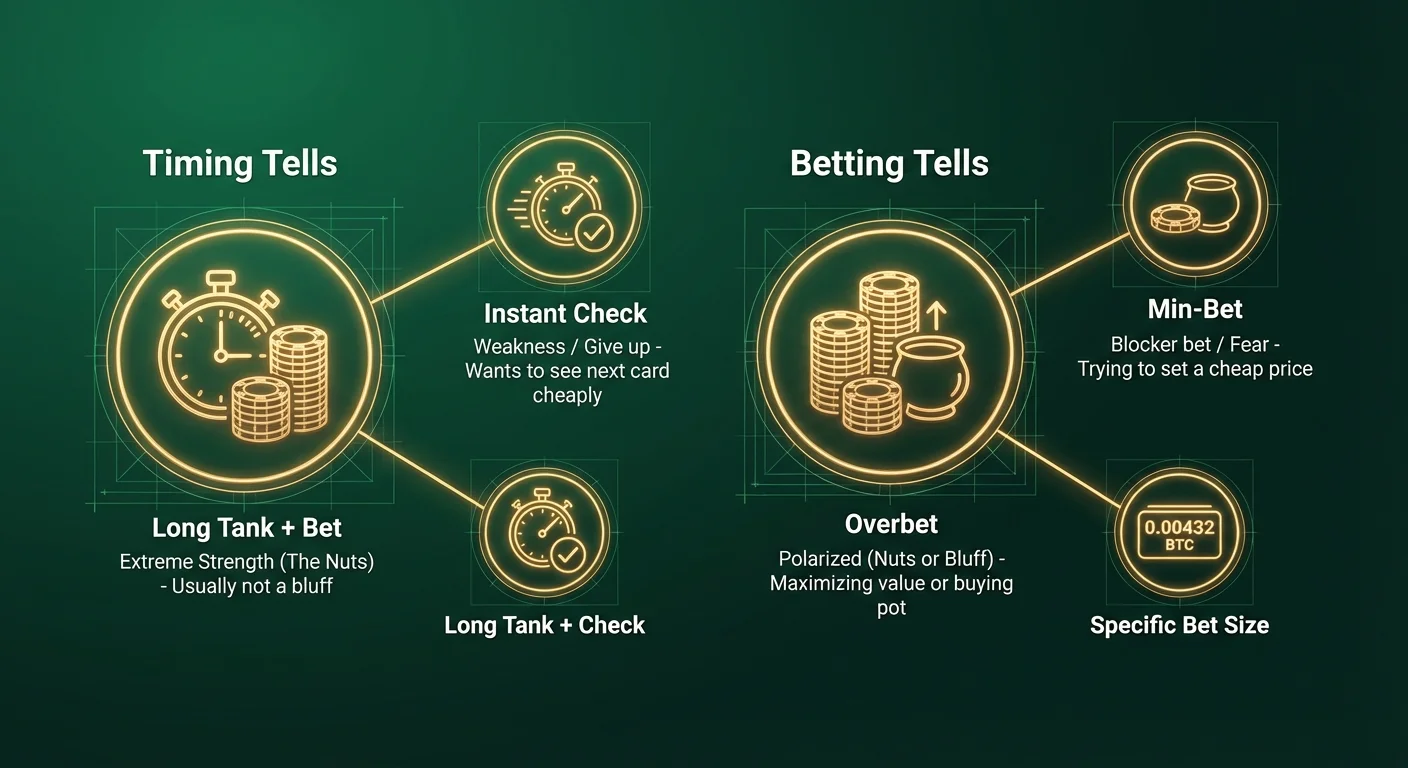
3. The Long Tank (Pause) followed by a Check
If an opponent pauses for a long time and then checks, it is often a sign of a weak-medium hand that they debated bluffing with but chickened out.
- The Meaning: "I missed the flop... should I bet? No, that's risky. I'll check."
- The Strategy: This is often a green light to bet. They have already signaled a lack of confidence.
4. The Long Tank followed by a Raise
Warning: This is the classic "Hollywood" play. If a player tanks for 10 seconds and then raises you big, or shoves All-In, they usually have the nuts (the best possible hand).
- The Meaning: They are pretending to have a tough decision ("Should I call? Is it worth it?") to lure you in, while actually preparing a massive trap.
- The Strategy: Fold unless you have a monster. This is rarely a bluff at low-to-mid stakes crypto games.
Timing Tells Summary
| Action | Timing | Likely Meaning | Recommended Counter-Play |
|---|---|---|---|
| Check | Instant | Weakness / Give up | Bet small to steal the pot |
| Call | Instant | Drawing / Middle Pair | Value bet thin, avoid bluffing |
| Bet | Instant | Polarized (Bluff or Monster) | Assess board texture carefully |
| Check | Long Pause | Weak / Indecision | Aggressive bluffing |
| Raise | Long Pause | Extreme Strength (The Nuts) | Fold marginal hands |
Bet Sizing Anomalies
In No-Limit Hold'em, playBecause crypto poker allows for granular betting (down to fractions of a mBTC), looking at how much someone bets is as important as if they bet.mportant as if they bet.
The Min-Bet (The Button Clicker)
A player betting the minimum possible amount (1BB) into a pot of 10BB is a glaring tell.
- The Interpretation: This is usually a "blocker bet." The player has a weak draw or a weak pair and is terrified of facing a large bet from you. They bet small hoping to "set the price" for the next card.
- The Exploit: Raise them. Punish the min-bet. If you raise, you deny them their cheap price and force them to fold their equity.
The Overbet
An overbet is a bet larger than the current size of the pot.
- The Interpretation: Overbets are polarized. The player either has the absolute nuts and is trying to maximize value, or they have absolutely nothing and are trying to buy the pot with fear.
- The Exploit: Look at the board texture. If the flush draw just missed and they overbet, it's likely a bluff. If the board is paired and connected, they likely have a full house.
Specific Numerical Bets
Watch for players who bet odd numbers (e.g., 0.00432 BTC).
- The Mathematical Grinder: These players are often using pot-odds calculators or scripts. They are betting an exact percentage of the pot to give you bad mathematical odds to call.
- The Strategy: These players are rigid. They play "ABC Poker" (see terms list). You can bluff them if the board runs out scary, as they will fold if the math doesn't make sense for them.
Betting Patterns and "Fold Equity"
As discussed in various poker guides, Fold Equity is the likelihood that an opponent will fold to your bet. You can estimate your fold equity by reading the betting patterns (lines) your opponent takes.
The "Donk" Lead
A "Donk Bet" occurs when a player calls a raise pre-flop, but then bets into the aggressor on the flop (out of position).
- The Tell: In standard strategy, you check to the pre-flop raiser. A Donk bet usually signals, "I hit a piece of this flop, but I'm scared you will check back." It often indicates a vulnerable top pair or bottom two-pair.
The Check-Raise
This is the most powerful move in poker. A player checks, waits for you to bet, and then raises.
- The Tell: Online, this signifies massive strength. Unlike a Donk bet, which is impatient, a Check-Raise requires patience and the confidence that you Sticky Pre-Flop, Aggressive Post-Flop If a player has a high VPIP (Voluntarily Put Money In Pot) - meaning they call many hands pre-flop - but they suddenly wake up with aggression on the Turn or River, believe them.n the Turn or River, believe them. Loose-passive players ("calling stations") generally do not bluff on the big streets. If the passive player starts firing big bets, your Aces might be cracked.
The Chat Box and Avatar Psychology
While you should never berate players (it's bad etiquette and bad strategy), you should keep the chat box open. It is a goldmine of information.
The "Speech Play"
- "Will you show if I fold?"
- Translation: They are weak and want a reason to fold. If you bet big, they will fold.
- Justification Typing: "I knew you had it, I just called to see."
- Translation: This player is insecure about their skill level. They are likely to tilt easily if you pressure them.
- Complaining about "Rigged" Crypto Sites:
- Translation: This is a loser's mindset. This player likely plays too many hands and blames "bad luck" or the "algorithm" rather than their own poor strategy. They are prime targets for value betting.
The Username and Avatar
While not a definitive tell, stereotypes often hold true in the anonymous crypto world:
- "CryptoKing" / "BTC_Maxi": Often aggressive, high variance players who treat poker like a trading chart. They might bluff more often.
- Generic Usernames / No Avatar: Often multi-tabling grinders who are playing a solid, mathematical game. They are less likely to tilt but harder to exploit.
- "All-In" in the name: Ironically, usually tighter players trying to project a loose image.
Digital Tells Cheat Sheet
Use this quick reference guide during your next session at a crypto poker table.
The Tell What You See What It Usually Means The Timing Tell Instant Check Weak hand, ready to fold. The Timing Tell Long Tank + Check Weak hand, considered bluffing but gave up. The Timing Tell Long Tank + Big Bet Monster hand (The Nuts). The Betting Tell Min-bet (1BB) Blocker bet / Drawing hand. The Betting Tell 3x Pot Bet Polarized (Nuts or Stone Cold Bluff). The Chat Tell "Show?" / "I fold" Anxiety, looking for validation. The Chat Tell Angry/Tilted Rant Emotionally compromised; will call too light. The Stats Tell High VPIP / Low PFR Loose Passive (Calling Station). Never bluff them. The Stats Tell High VPIP / High PFR Loose Aggressive (Maniac). Wait for a hand and trap. Crypto-Specific Considerations
Playing on crypto-native platforms introduces unique nuances to digital tells compared to traditional fiat sites.
1. The Denomination Effect
Players often dissociate from the value of money when playing in BTC or ETH. A bet of 0.005 BTC might look small on screen, but it represents hundreds of dollars.
- The Tell: Players who are new to crypto poker often miscalculate bet sizes or call off huge amounts because the nProvably Fair Verification Some crypto casinos allow players to check the "Provably Fair" hash of a hand to ensure the deck wasn't manipulated. Provably Fair Poker explained.
Some crypto casinos allow players to check the "Provably Fair" hash of a hand to ensure the deck wasn't manipulated.
- The Tell: If a player is constantly pausing the game to check hashes or discusses it in chat, they are likely paranoid and risk-averse ("Nits"). You can often bluff these players off pots because they are terrified of "bad beats."
3. Auto-Top Up
Watch a player's stack size.
- Auto-Rebuy On: If a player loses a pot and instantly tops up to the maximum buy-in, they are usually a serious player or a regular.
- No Auto-Rebuy: If a player's stack dwindles (Short Stacking) and they don't reload, they are likely playing with "scared money" (their last funds). They will play extremely tight, waiting for a premium hand to go All-In.
How to Disguise Your Own Tells
To be a shark, you must not only read others but also become unreadable yourself.
- Standardize Your Timing: Try to take exactly 3 to 5 seconds for every decision, whether it is an easy fold or an easy call. This removes timing tells from your game.
- Hide the Chat: Don't type. Giving away information about your mental state never helps you win the pot.
- Balance Your Sizing: Don't only bet big when you have it and small when you don't. Occasionally bet small with big hands to trap, and big with bluffs to balance your range.
- Use the "Time Bank": If you have a difficult decision, use your time bank, but do the same occasionally when you have an easy decision to confuse observant opponents.
Conclusion
In the digital arena of crypto poker, you are not reading faces; you are reading data. Every pause, every click, and every Satoshi wagered tells a story.
The "Instant Check" screams weakness. The "Tank-Shove" screams strength. The "Min-Bet" screams fear. By tuning into these frequencies, you stop playing just your cards and start playing the player.
Remember, however, that tells are just one piece of the puzzle. They must be combined with pot odds, position, and hand strength. A tell gives you a hint, but math gives you the foundation. Start observing these patterns today, and you will find yourself calling down bluffs and folding to traps with the precision of a pro - all without ever seeing your opponent's face.
- "Will you show if I fold?"