
In the high-stakes world of poker, there is a saying that rivals the golden rule of real estate: "Location, location, location." While beginners obsess over the strength of their hole cards, seasoned professionals know that poker position is often the deciding factor between a winning session and a busted bankroll. You can lose money with Pocket Aces if you play them poorly from early position, and you can print money with 7-2 offsuit if you play it masterfully from the button.
If you are playing on modern crypto poker platforms, where the pace is lightning-fast and the players are aggressive, understanding positional awareness is not just a luxury - it is a survival requirement. This guide delves into the mechanics of table position, explaining why the dealer button is the throne of the table and how to adjust your betting ranges to exploit your seat.
The Anatomy of the Poker Table
Before dissecting the strategy, we must define the battlefield. In a standard full-ring (9 players) or 6-max game (popular in crypto casinos for its speed), the table is divided into distinct zones relative to the dealer button.
The dealer button (BTN) rotates one spot clockwise after every hand. This rotation ensures fair play, as positional advantage shifts equally among all players over time.
The Zones of Influence
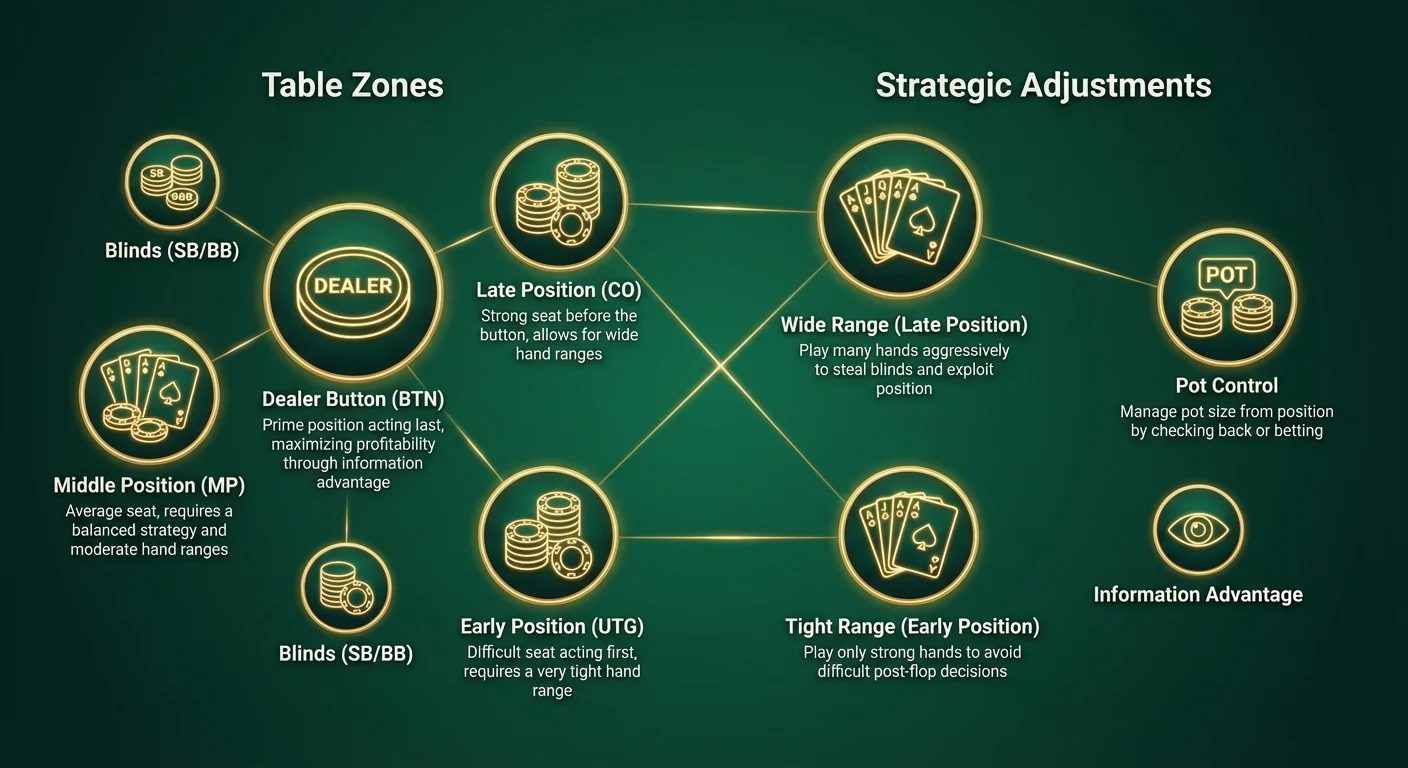
- Early Position (EP/UTG): "Under the Gun" (UTG) is the player to the immediate left of the Big Blind. In 6-max, this is the first player to act pre-flop. In full-ring, UTG is followed by UTG+1 and UTG+2.
- Middle Position (MP): These players sit between the early positions and the late positions. They have a slight advantage over UTG but are still vulnerable to the players behind them.
- Late Position (CO/BTN): The Cutoff (CO) sits to the right of the button, and the Button (BTN) is the dealer. These are the "power seats."
- The Blinds (SB/BB): The Small Blind and Big Blind act last pre-flop but must act first on every subsequent betting round (flop, turn, and river).
The Dealer Button: The Most Profitable Seat
If you analyze a database of millions of poker hands, one trend is undeniable: players make the vast majority of their profit from the dealer button. Conversely, most players lose money (or break even) from the blinds.
Why is the button so powerful? It comes down to one fundamental concept: Information.
The Information Advantage
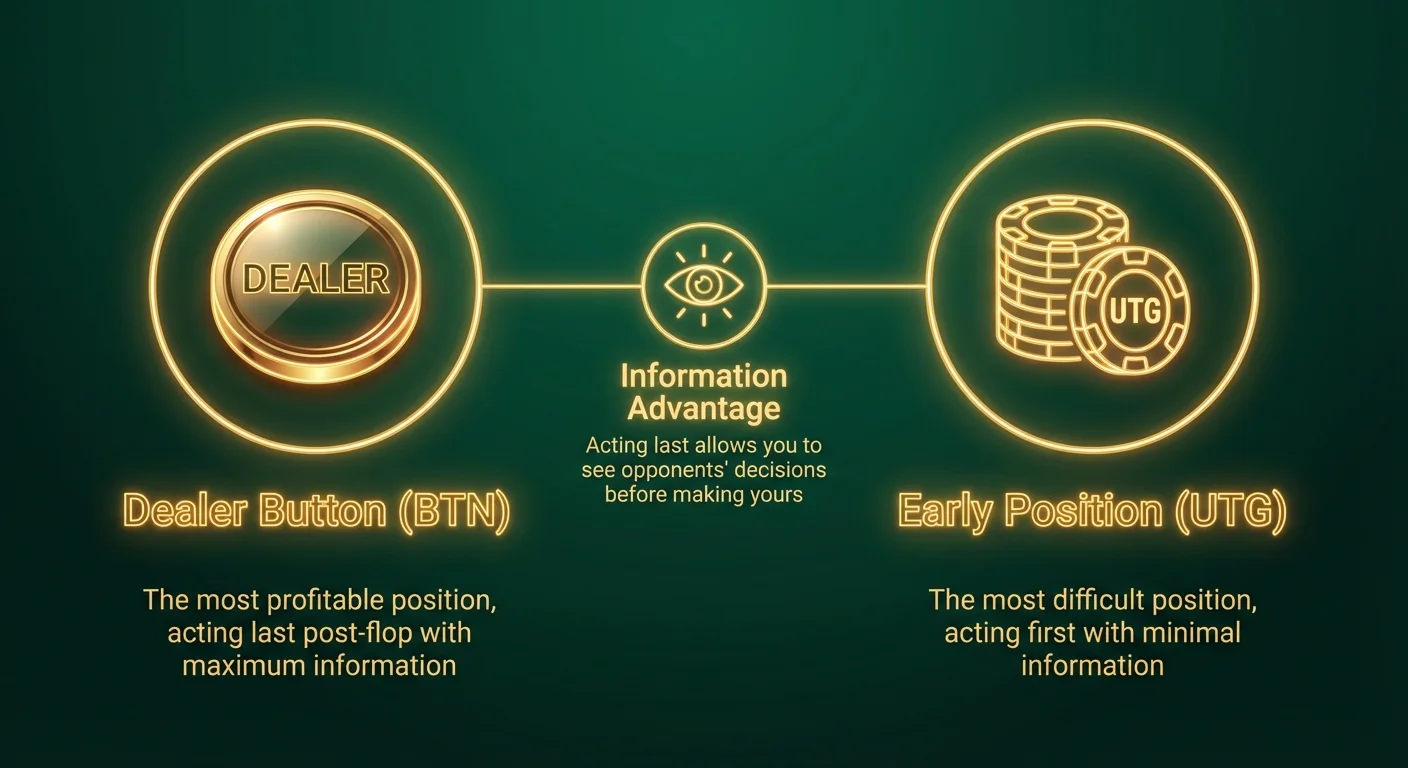
In poker, information is currency. When you are on the button, you are the last to act post-flop. This means you get to see every other player's decision before you have to make one.
- If opponents check: This signals weakness. You can bet to steal the pot (bluffing) or bet for value.
- If opponents bet: You know they likely have strength. You can fold without losing more chips, call to see a card, or raise if you have a monster.
When you act first (Out of Position or OOP), you are guessing. When you act last (In Position or IP), you are reacting.
Pot Control
Acting last allows you to dictate the size of the pot.
- Scenario: You have a medium-strength hand, like a second pair. Your opponent checks to you. You can check back, taking a "free card" to try and improve on the turn or river without putting more money in the pot.
- Scenario: You have the nuts (the best possible hand). Your opponent checks. You can bet to build the pot.
If you were out of position, you would have to decide whether to check (risking the opponent checking back and the pot staying small) or bet (risking a raise that blows you off your hand).
Strategic Adjustments: Ranges by Position
An "intermediate" poker player understands that you cannot play the same hands from every seat. Your "range" - the spectrum of hands you are willing to play - must expand and contract based on your position.
Early Position (UTG): The Iron Shield
When you are Under the Gun, you have the entire table left to act behind you. The likelihood that one of them has a premium hand (AA, KK, AK) is high. Therefore, your opening range must be incredibly tight.
- Strategy: Open-raise only with premium hands.
- Typical Range: 77+, ATs+, KJs+, AQo+, AKo.
- Goal: Survival and value. You rarely bluff from UTG because your range is perceived as strong.
Middle Position (MP): Shifting Gears
As you move closer to the button, the number of players left to act decreases. You can add a few more hands to your opening range, specifically hands that play well post-flop.
- Strategy: Mix in suited connectors and broadway cards.
- Typical Range: 55+, A2s+, KTs+, QJs+, JTs.
Late Position (CO & BTN): The Attack Dog
Here is where the money is made. From the Cutoff and Button, you should be playing your widest ranges. This is essentially "stealing" territory. If everyone folds to you, a raise here puts immense pressure on the blinds to defend with weak hands.
- Strategy: Raise widely to steal the blinds. Punish limpers.
- Typical Range: 22+, Any Ace, Suited Kings, Suited Connectors, Suited Gappers (e.g., 8-6s), Off-suit broadways.
- Why? Even if your hand is mediocre (like J-9 offsuit), your positional advantage post-flop makes the hand profitable. You can win the pot simply by betting when your opponent checks, regardless of your cards.
Visualizing Range Expansion
| Position | Open Raise % (Approx.) | Hand Categories | Primary Goal |
|---|---|---|---|
| UTG (Early) | 15% | Premiums, High Pairs | Value |
| MP (Middle) | 20-25% | Premiums + Good Suited Connectors | Value + Playability |
| CO (Cutoff) | 30-35% | Above + Broadways + Suited Gappers | Isolation + Stealing |
| BTN (Button) | 40-50%+ | Above + Weak Suited + Any Pair | Stealing + Post-flop Control |
Blind Defense: The Art of Losing Less
While the button is about maximizing wins, the blinds are about minimizing losses. Blind defense is one of the most difficult aspects of intermediate poker strategy.
The Disadvantage of the Blinds
Many players mistakenly believe that because they have already put money in the pot (the forced blind bet), they are "priced in" to call almost any raise. This is a leak in your game.
- Post-Flop Nightmare: If you call a raise from the Big Blind, you must play the rest of the hand Out of Position. You will have to check or bet into the aggressor on every street.
- Range Disadvantage: The player who raised pre-flop usually has a stronger range than the player just calling from the blind.
Defending Strategy
- 3-Bet or Fold (Small Blind): The Small Blind is the worst position on the table. If you call, the Big Blind gets a great price to call too, and you are sandwiched between players. Generally, you should either re-raise (3-bet) to try and take the pot immediately or fold. Avoid "flat calling" from the SB.
- Defending the Big Blind: You can call wider here because you close the action pre-flop and get a discount (you already have 1 blind in). However, do not defend with "trash" like 8-3 offsuit just because it's cheap. Defend with hands that can flop well, such as suited connectors or low pairs.
Fold Equity and Position
Fold equity is the probability that your opponent will fold to your bet. Position amplifies fold equity significantly.
When you are acting last (on the Button), and an opponent checks to you, they have signaled a lack of immediate aggression. If you bet now, you force them to make a decision with a capped range (likely a medium-strength hand or a draw). Because it is difficult to play "check-call, check-call, check-call" with a mediocre hand, they are more likely to fold.
Practical Application:
Imagine the board is K - 8 - 3.
- Scenario A (You are UTG): You bet. The Button calls. The Button could have a King, an 8, a set of 3s, or be floating you. You are in the dark.
- Scenario B (You are Button): The UTG checks. You bet. The UTG likely does not have a King (or they would have bet). You can represent the King even if you hold
6 - 7. Your fold equity is higher because the check provided information.
The Crypto Poker Context
How does position apply specifically to CryptoGambling.com readers using Bitcoin, Ethereum, or USDT?
1. Speed and Multi-Tabling
Crypto poker sites often feature "fast-fold" variants or highly responsive software. When playing multiple tables to clear a deposit bonus, you cannot deeply analyze every player. Relying on positional charts (playing tight UTG, loose BTN) is the most efficient way to multi-table without making costly errors.
2. HUDs vs. Anonymity
Some crypto poker sites allow Heads-Up Displays (HUDs), while others prioritize anonymity to protect recreational players.
- With HUDs: Position helps you exploit specific stats. If the player in the Big Blind has a high "Fold to Steal" percentage, you should raise 100% of hands from the Button.
- Anonymous Tables: Position becomes more important. Without read history on specific villains, the structural advantage of acting last is your only reliable edge.
3. Aggressive Dynamics
Crypto poker pools often skew more aggressive than traditional fiat sites. You will encounter more bluffs and over-bets. Being In Position allows you to control these aggressive players (pot control) rather than being forced to guess for your entire stack.
Advanced Concepts: The Squeeze and The Straddle
The Squeeze Play
This is a move best executed from late position or the blinds.
- The Setup: A loose player opens (bets) from early position, and another player calls (flat calls).
- The Move: You are on the Button or in the Blinds. You make a large re-raise (3-bet).
- The Logic: The original raiser is worried about the caller and you. The caller has already admitted their hand isn't premium (or they would have raised). By squeezing, you use your position to pick up all the "dead money" in the pot without seeing a flop.
The Straddle
In some cash games, players can post a voluntary "straddle" (usually 2x the Big Blind) from UTG.
- Positional Impact: The straddle effectively becomes the new Big Blind pre-flop, and the action starts at UTG+1.
- Warning: Straddling effectively cuts your stack size in half (in terms of big blinds) and forces you to play big pots out of position. From a purely mathematical standpoint (EV), straddling is usually a losing play, though it creates action.
5 Practical Tips for Positional Mastery
- Tighten Up Early: If you find yourself constantly facing difficult decisions post-flop, you are likely playing too many hands from Early Position. Fold the A-J offsuit from UTG. Just do it.
- Isolate Limpers: If a player in Middle Position limps (just calls the blind), and you are on the Button, do not just call. Raise! You want to play the pot heads-up against the weak player, using your positional advantage to outplay them.
- Beware the Check-Raise: When you bet from position and a player calls, you are in control. If they Check-Raise you (check, then raise your bet), proceed with extreme caution. This is one of the few power moves an Out of Position player has, and it usually signifies a monster hand (two pair or better).
- Don't "Donk Bet": A "donk bet" is when you are Out of Position and you lead into the pre-flop raiser on the flop. Usually, you should check to the pre-flop aggressor. Donk betting denies you information and prevents the opponent from bluffing.
- Review Your Button Win Rate: If you use tracking software, check your win rate by position. If you aren't winning significantly from the Button, you are likely playing too passively (checking back too often) or not stealing the blinds enough.
Summary
In the landscape of poker, seats are not created equal. The dealer button is prime real estate, offering a panoramic view of the action before you have to commit a single chip. The blinds are the rent you pay to sit at the table, defending them only when necessary.
To transition from a beginner to a profitable intermediate player, stop looking at your cards in a vacuum. A pair of tens is a monster on the Button and a trouble hand Under the Gun.
Key Takeaways:
- Act Last, Win Most: Information is the greatest edge in poker; acting last provides the most information.
- Wide Button, Tight UTG: Adjust your starting hand requirements strictly based on your seat.
- Positional Aggression: Use your position to steal blinds and control pot size.
- Avoid OOP Bloat: Do not build massive pots when you are out of position unless you have the nuts.
By respecting the power of position, you turn the game from a gamble into a strategic calculation. Next time the dealer button slides in front of you, remember: you are in the driver's seat. Drive aggressively.