
If you grew up watching Western movies, your idea of poker is likely five rough-looking cowboys sitting in a saloon, holding five cards, discarding a few, and hoping to hit a big hand. That game is 5-Card Draw. It is the oldest, purest form of poker, yet if you walk into a modern casino today, you will rarely find it played at a physical table.
However, the spirit of 5-Card Draw is alive and well - and it is likely the most profitable game on the casino floor. It lives on in Video Poker.
For beginners entering the world of crypto gambling, the transition from understanding the basic rules of Draw Poker to mastering the high-RTP (Return to Player) mechanics of Video Poker is the smartest move you can make. While slot machines are pure luck, Video Poker allows you to influence the outcome with strategy.
This guide will take you from the kitchen table rules of 5-Card Draw to the digital felt of crypto video poker machines, teaching you the optimal strategies to maximize your winnings.

The Foundation: Understanding 5-Card Draw
Before you can beat the machine, you must understand the game that built it. 5-Card Draw is deceptively simple, which is why it became the standard for home games and early American gambling.
The Basic Rules
The mechanics of 5-Card Draw serve as the engine for Video Poker. Whether you are playing a friendly game with chips or a digital game with Bitcoin, the flow is identical:
- The Deal: Every player receives five cards face down.
- The Draw: Players evaluate their hands. You may choose to discard any number of cards (usually up to 3, or 4 if you hold an Ace) and receive replacements from the deck.
- The Showdown: The objective is to make the best possible five-card poker hand according to standard rankings (High Card up to Royal Flush).
In a live home game (Source 4), there are betting rounds before and after the draw. This introduces elements of Fold Equity (Source 1) - the concept that you can win the pot just by getting your opponent to fold through aggressive betting.
The Hierarchy of Hands
To play Video Poker effectively, you must have the hand rankings memorized instantly. In descending order of value:
- Royal Flush: A, K, Q, J, 10, all of the same suit.
- Straight Flush: Five consecutive cards of the same suit (e.g., 5, 6, 7, 8, 9 of Hearts).
- Four of a Kind: Four cards of the same rank (e.g., Q, Q, Q, Q).
- Full House: Three of a kind plus a pair (e.g., K, K, K, 2, 2).
- Flush: Five cards of the same suit, not in order.
- Straight: Five consecutive cards of mixed suits.
- Three of a Kind: Three cards of the same rank.
- Two Pair: Two different pairs.
- Pair: Two cards of the same rank.
- High Card: No matching combinations.
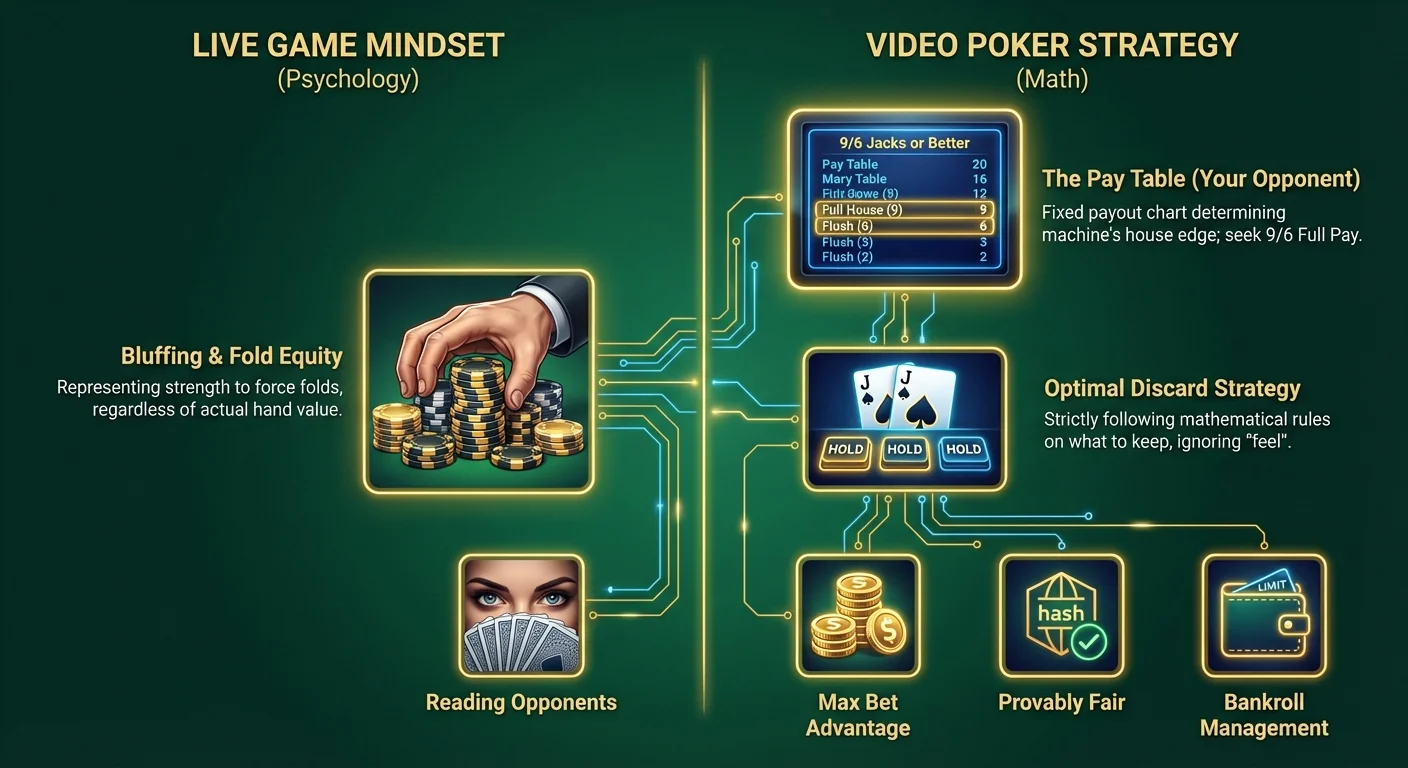
From Table to Machine: The Strategic Shift
Here is where the game changes. In a live game of 5-Card Draw, you are playing the player. In Video Poker, you are playing the math.
No More Bluffing
In a live game, if you hold a pair of Twos, you might bet aggressively to represent a Full House. This is utilizing fold equity. In Video Poker, bluffing is impossible. The machine does not care how hard you press the "Draw" button. You are paid strictly on the strength of your final hand.
The Pay Table is Your Opponent
Instead of looking at another player's face, your eyes should be glued to the Pay Table. This chart tells you exactly what each hand is worth.
In the crypto gambling world, machines often offer higher RTPs than physical casinos because they have lower overhead costs. However, you must identify the machine's payouts. The gold standard is "Jacks or Better", specifically the 9/6 variation.
Comparison of Pay Tables (Per 1 Coin Bet):
| Hand | 9/6 Full Pay (RTP ~99.54%) | 8/5 Short Pay (RTP ~97.30%) |
|---|---|---|
| Royal Flush | 250 (800 if max bet) | 250 |
| Straight Flush | 50 | 50 |
| Four of a Kind | 25 | 25 |
| Full House | 9 | 8 |
| Flush | 6 | 5 |
| Straight | 4 | 4 |
| Three of a Kind | 3 | 3 |
| Two Pair | 2 | 2 |
| Jacks or Better | 1 | 1 |
Strategy Tip: Always check the payout for a Full House and a Flush. If they pay 9 and 6 respectively, you are at a "Full Pay" machine. If they pay 8 and 5 (or lower), the house edge is significantly higher.
Optimal Discard Strategy: The Cheat Sheet
The biggest mistake beginners make when moving from table poker to Video Poker is relying on "feel." In 5-Card Draw, you might keep a "kicker" (a high card along with a pair) to deceive your opponent. In Video Poker, never keep a kicker. It reduces your mathematical probability of hitting Three of a Kind or Four of a Kind.
To play optimally, you must follow a strict hierarchy of what to hold. Read this list from top to bottom. Stop at the first rule that applies to your hand and discard everything else.
1. The "Pat" Hands (Do Not Draw)
If you are dealt any of the following, hold all five cards (unless you are one card away from a Royal Flush and the prize justifies the risk, though this is rare math):
- Royal Flush
- Straight Flush
- Four of a Kind
- Full House
- Flush
- Straight
2. The "Breakable" Hands (Drawing for Gold)
If you don't have a "Pat" hand, look for these combinations. Prioritize them strictly in this order:
- 4 Cards to a Royal Flush: (e.g., Ah, Kh, Qh, Jh). Discard the fifth card, even if it gives you a pair or a flush. The payout for a Royal Flush is so massive it overrides almost everything else.
- Three of a Kind: Keep the three matching cards. Discard the other two.
- 4 Cards to a Straight Flush: A powerful draw. Hold the four, discard the one.
- Two Pair: Keep both pairs. Discard the fifth card. Note: This guarantees a return of your bet, with a chance at a Full House.
- Pair of Jacks or Higher: This is a "paying pair." It guarantees your money back. Keep the pair, discard the other three.
- 3 Cards to a Royal Flush: (e.g., Kh, Qh, Jh).
- 4 Cards to a Flush: Hold the four suited cards.
- Low Pair (Tens or lower): Keep the pair. Discard the other three. Note: Do not keep a high card "kicker" with a low pair.
- 4 Cards to an Open-Ended Straight: (e.g., 5, 6, 7, 8). You can hit the straight with a 4 or a 9.
- 2 Suited High Cards (Jack or higher): (e.g., Q of spades, K of spades).
- 1 High Card (Jack or higher): Keep the high card to try and hit a high pair.
- Discard Everything: If you have none of the above, toss all five cards and pray for a better deal.
Practical Scenarios: Home Game vs. Crypto Machine
To illustrate the difference in strategy, let's look at how you would play the same hand in a home game of 5-Card Draw versus a Crypto Video Poker machine.
Scenario A: Small Pair + Flush Draw
The Hand: 4♠, 4♥, 9♦, J♦, 2♦ (Wait, this example is poor. Let's use a clearer one).
The Hand: Pair of 4s, and 3 cards to a Flush. (4♠, 4♥, 9♥, J♥, A♥). Wait, that's 4 cards to a flush if we ignore the pair.
Let's try: 4♠, 4♥, 9♥, J♥, K♥.
- Home Game: You might keep the pair of 4s and draw three cards to try and make three of a kind. Or, you might fold if the betting is heavy.
- Video Poker: You have a Low Pair (4s) and 4 cards to a flush. The strategy says keep the Low Pair. Why? Because drawing one card to hit a flush is statistically harder (approx 19% equity) than improving a pair to two pair or trips, and a flush on a video poker machine usually only pays 6x, whereas sustained play requires hitting frequent small wins (like pairs and two pairs) to keep your bankroll alive.
Scenario B: The Inside Straight
The Hand: 4, 5, 6, 8, K (Mixed suits).
- Home Game: A beginner might discard the King and try to catch the 7 (an "inside straight draw").
- Video Poker: Never draw to an inside straight. You need exactly one card (a 7) to win. There are only four 7s in the deck. The odds are roughly 1 in 11. The payout for a straight is usually 4 to 1. This is a "bad bet" (Source 7). In this scenario, you hold the King (High Card) and discard the rest, or discard everything if the King were a 10 or lower.
Why Play Crypto Video Poker?
If you enjoy the strategy of 5-Card Draw, playing Video Poker on crypto platforms offers distinct advantages over traditional online casinos or physical machines.
1. Provably Fair Gaming
In a physical casino, you have to trust the machine's chip. In crypto gambling, many Video Poker games utilize Provably Fair technology. This uses cryptographic hashes to prove that the shuffle of the deck was generated before the hand started and was not altered based on your bet size or discard choices. It ensures the "deck" is truly random.
2. The "Max Bet" Advantage
In almost all Video Poker games, the Royal Flush payout jumps disproportionately if you bet the maximum number of coins (usually 5).
- Bet 1 coin: Royal pays 250.
- Bet 4 coins: Royal pays 1000.
- Bet 5 coins: Royal pays 4000.
Because crypto allows for micro-denominations (Satoshi bets), you can bet "Max Coins" without risking huge sums of fiat currency. You can play 5 coins for mere cents, ensuring you qualify for the jackpot payout structure without breaking the bank.
3. Instant Withdrawals
Nothing kills the thrill of a big poker win like a 3-day bank transfer wait. Crypto transactions (Bitcoin, Litecoin, USDT) are settled on the blockchain, meaning your winnings are often in your wallet within minutes of hitting "Cash Out."
Bankroll Management for Video Poker
Even with optimal strategy, Video Poker has variance. You need a bankroll strategy to survive the swings.
The Variance Reality
Unlike 5-Card Draw where you can control pot size, Video Poker is a volume game. You will play hundreds of hands per hour.
- Standard Deviation: You will lose small hands frequently. The goal is to stretch your bankroll until you hit a premium hand (4 of a Kind or better).
- Stop-Loss Limits: Set a strict limit. If you lose your allocated crypto for the session, stop. Do not "rage bet" to win it back.
Tips for Beginners (Source 6 inspired)
- Take Breaks: Video Poker is hypnotic. It is easy to zone out and make a strategy error. Step away every 30 minutes.
- Don't Fall in Love with a Kicker: We repeat this because it is vital. Holding an Ace with a pair of 8s reduces your expected value (EV). Let the Ace go.
- Preparation: Have a cheat sheet (like the hierarchy above) open in a separate tab while you play. There is no time limit in Video Poker - take your time to make the mathematically correct decision.
Conclusion
5-Card Draw is the romantic ancestor of poker, a game of psychology and guts. Video Poker is its modern, scientific evolution. While you may rarely find a 5-Card Draw table game today, the skills of hand recognition and draw probabilities transfer directly to the machine.
By stripping away the bluffing and focusing purely on the probability of improving your hand, you can turn Video Poker into one of the most favorable games in the casino. Remember the golden rules: Check the Pay Table for 9/6 payouts, always bet Max Coins (even at low denominations), and stick to the mathematical discard hierarchy.
The cards are dealt. The machine is waiting. Will you draw for the inside straight, or play the odds like a pro? The choice is yours.