
Baccarat is often portrayed as a game of mystery, reserved for high rollers in tuxedo-filled salons. However, beneath the glamour and the ritual of "squeezing" the cards lies a rigid mathematical foundation. Unlike Blackjack, where player decisions shift the odds, or Poker, where psychology reigns supreme, Baccarat is a game of pure probability determined by fixed drawing rules.
For the intelligent gambler, Baccarat is arguably the best game in the casino. It offers some of the lowest House Edges available, provided you understand the mathematics at play. This guide moves beyond basic rules to analyze the Return-to-Player (RTP) percentages, the impact of the Third Card Rule, and why the math dictates that you should almost always back the Banker.
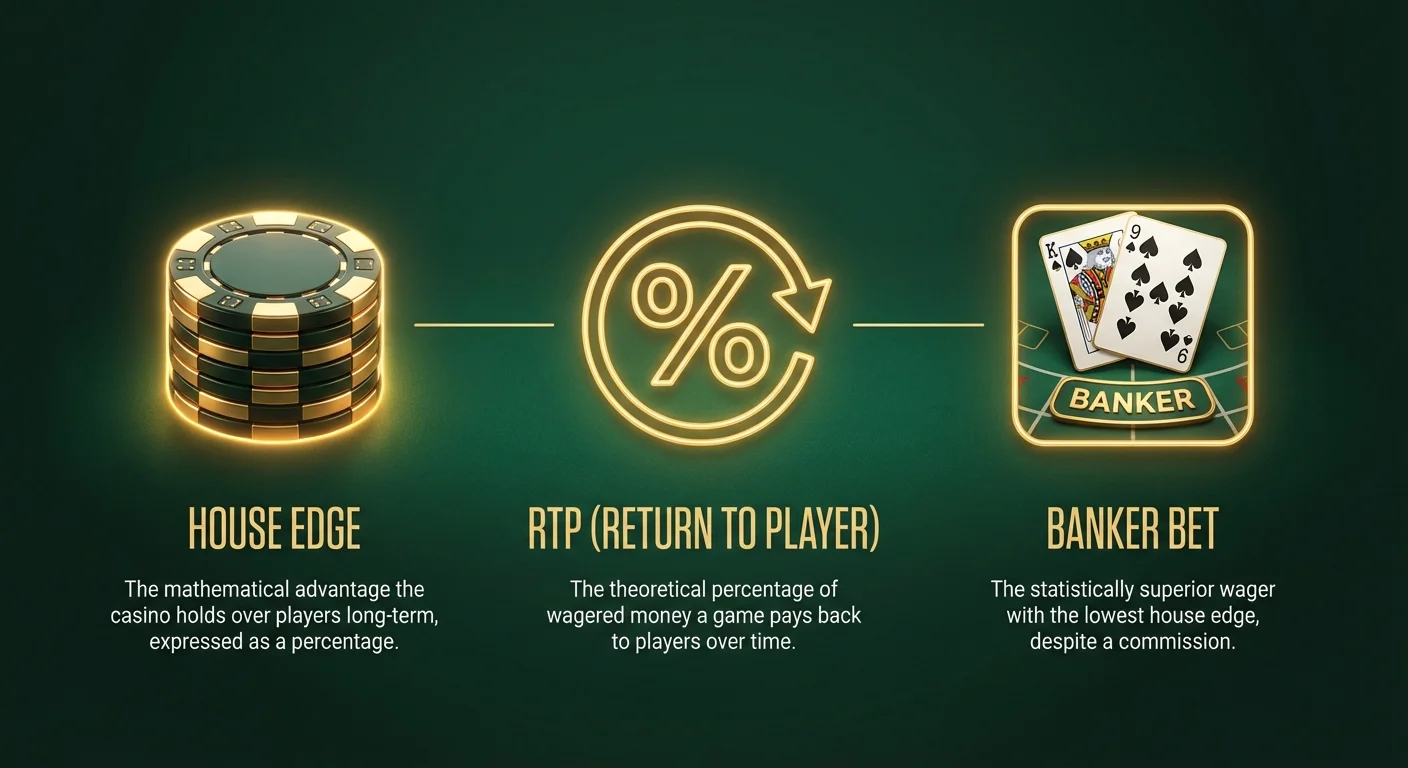
The Core Metrics: House Edge and RTP
Before dissecting specific bets, you must understand the two metrics that define your long-term success in crypto gambling.
- House Edge: This is the mathematical advantage the casino holds over the player, expressed as a percentage of the player's original bet. If a game has a 1% house edge, the casino expects to keep $1 for every $100 wagered over the long run.
- RTP (Return to Player): This is the inverse of the House Edge. It represents the percentage of all wagered money a game will pay back to players over time. An RTP of 99% means the game returns $99 for every $100 wagered.
In online crypto casinos, where you can play hundreds of hands per hour, a difference of 0.5% in RTP can significantly impact your bankroll longevity.
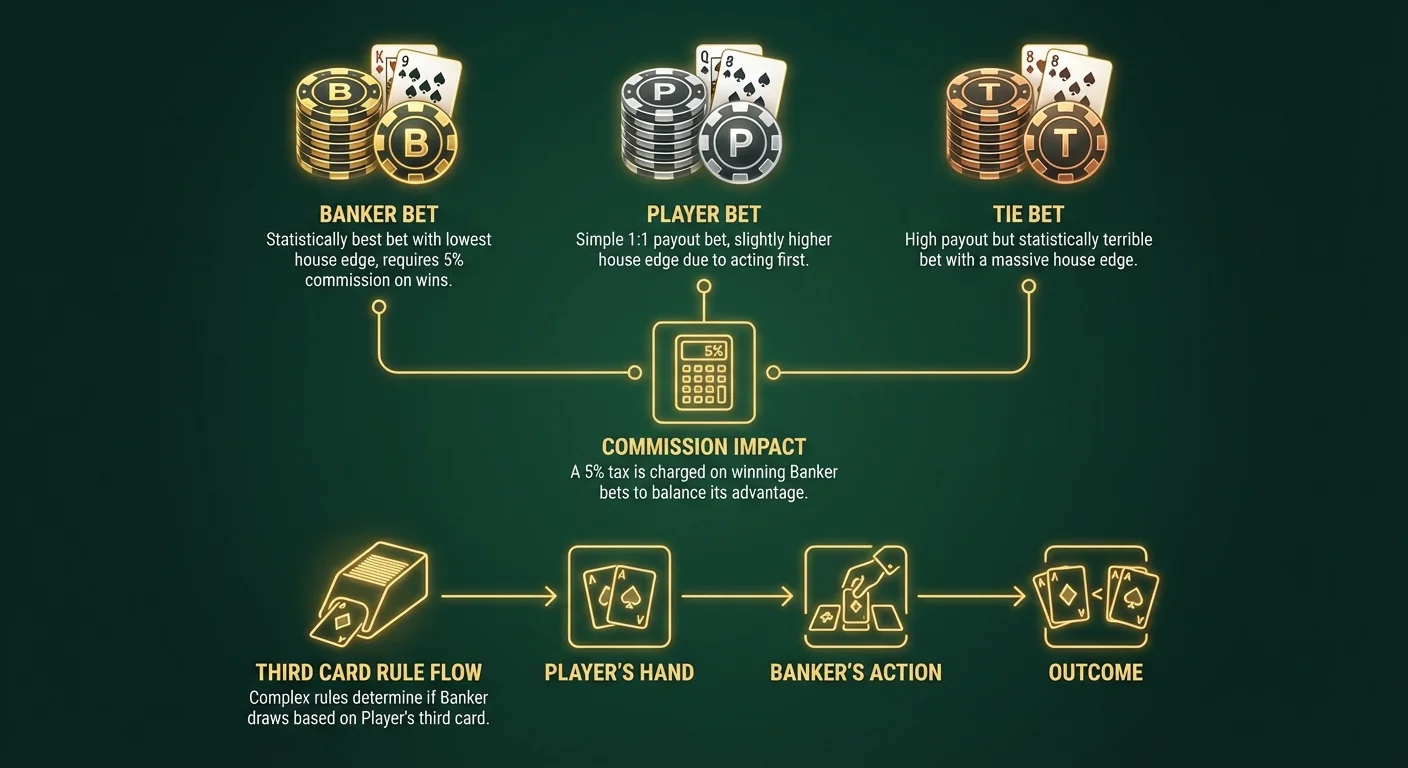
The Banker Bet: The Mathematical Favorite
If you ask a casual player why the Banker bet comes with a 5% commission, they might shrug and say, "That's just the rules." A mathematician, however, knows the commission exists because the Banker bet is too good without it.
Due to the asymmetric drawing rules (which we will explore later), the Banker hand wins more often than the Player hand.
The Probabilities
When we exclude Tie hands (since they result in a push for main bets), the probabilities look like this:
- Banker Wins: 50.68%
- Player Wins: 49.32%
If the casino paid even money (1:1) on the Banker, the player would have a 1.36% advantage over the house. The casino would go bankrupt. To counter this, they charge a 5% commission on winning Banker bets.
The True Cost
Even with the 5% "tax" on winnings, the Banker bet remains the statistically superior option.
- House Edge: 1.06%
- RTP: 98.94%
This 1.06% house edge makes the Banker bet one of the most favorable wagers in the entire gambling industry, superior to European Roulette (2.7%) and most slot machines (typically 94-96%).
The Player Bet: Simplicity with a Cost
The Player bet is attractive to those who dislike the complexity of calculating the 5% commission or seeing their winnings taxed. It pays strict 1:1.
However, because the Player hand acts first and stands more often, it loses slightly more than it wins.
- House Edge: 1.24%
- RTP: 98.76%
While a 1.24% edge is still excellent compared to other casino games, it is mathematically inferior to the Banker bet. Over a session of 1,000 hands at $10 per hand ($10,000 total action), a gambler betting solely on the Player expects to lose roughly $124. The Banker bettor expects to lose only $106.
The Tie Bet: The Mathematics of a "Sucker Bet"
The Tie bet is the siren song of Baccarat. It usually offers a payout of 8:1 (sometimes 9:1 in specific crypto variants), promising massive returns for a small stake. Mathematically, however, it is a disaster for your bankroll.
Ties occur approximately 9.5% of the time.
- At 8:1 Payout: The House Edge is a staggering 14.36%.
- RTP: 85.64%
To put this in perspective, playing the Tie bet is statistically three times worse than playing American Roulette. It turns a game of low margins into a slot machine with terrible odds. Unless you are chasing volatility for entertainment, the math explicitly forbids the Tie bet.
Summary of Odds
| Bet Type | Payout | Win Probability (approx.) | House Edge | RTP |
|---|---|---|---|---|
| Banker | 0.95 : 1 | 45.86% | 1.06% | 98.94% |
| Player | 1 : 1 | 44.62% | 1.24% | 98.76% |
| Tie | 8 : 1 | 9.52% | 14.36% | 85.64% |
(Note: Win probabilities in this table include the possibility of a Tie outcome).
The "Why": Analyzing the Third Card Rule
Why does the Banker win more often? The secret lies in the Third Card Rule.
In Baccarat, the Player's hand is straightforward:
- If the Player has 0-5, they draw.
- If the Player has 6-7, they stand.
The Banker, however, plays reactively. If the Player stands, the Banker plays by the same simple rules. But if the Player draws a third card, the Banker's decision to draw is determined by a complex matrix based on the specific value of the Player's third card.
The Positional Advantage
This is similar to the dealer acting last in Blackjack, but with a twist. The specific rules governing when the Banker draws are mathematically designed to maximize the Banker's chance of beating the Player's new total.
For example:
- If the Banker has a total of 6 and the Player stands, the Banker stands.
- However, if the Player draws a third card and receives a 6 or 7, the Banker (holding a 6) will also draw a third card to try and beat the Player.
This informational advantage, reacting to the Player's draw, creates the statistical gap that requires the 5% commission to balance.
Side Bets and Variance: A Mathematical Trap
Modern crypto Baccarat tables, especially live dealer versions, often feature an array of side bets like "Perfect Pair," "Either Pair," or "Big/Small."
While these bets add excitement, they dilute the effectiveness of your strategy.
- Player/Banker Pair: Usually pays 11:1. The probability of the first two cards being a pair is low. The house edge on these bets typically hovers around 10% to 11%.
- EZ Baccarat Side Bets (Dragon 7 / Panda 8): In "No Commission" or EZ Baccarat, the Banker bet pays 1:1 unless the Banker wins with a specific hand (e.g., a three-card 7), which results in a push. This variant often includes side bets with house edges ranging from 7% to 10%.
Strategic Advice: If your goal is to maximize your return on investment (ROI), treat Baccarat as a binary choice between Banker and Player. Ignore the flashing lights of the side betting areas.
Card Counting: Why Math Says "No"
Since Baccarat is played from a shoe of 6 or 8 decks, many players assume it can be beaten via card counting, similar to Blackjack.
In Blackjack, low cards (2-6) are bad for the player, and high cards (10-A) are good. When low cards are removed, the player's advantage skyrockets because high cards lead to blackjacks (3:2 payout).
In Baccarat, there is no such asymmetry in payouts.
- Symmetry: High cards and low cards benefit the Player and Banker relatively equally.
- No Strategy Shift: In Blackjack, a high count changes how you play the hand. In Baccarat, the drawing rules are fixed; you cannot choose to "stand" on a 5 just because the count is high.
Expert mathematicians like Dr. Ed Thorp and Michael Shackleford have analyzed this in detail. While it is theoretically possible to gain a microscopic edge by counting cards in Baccarat, you would find a betting opportunity roughly once every 400 hands. The effort yields an advantage so small it is useless relative to the time spent.
Crypto Baccarat: The Provably Fair Advantage
When playing at crypto casinos, the mathematics of Baccarat are enhanced by Provably Fair technology.
In a traditional online casino, you trust a third-party auditor that the Random Number Generator (RNG) is fair. In Provably Fair crypto Baccarat:
- Server Seed & Client Seed: The casino provides a hashed server seed, and you (the player) provide a client seed.
- The Result: The result of the hand is generated by combining these seeds.
- Verification: After the hand, you can unhash the server seed and verify that the outcome was pre-determined by the code and not manipulated based on your bet size.
This transparency ensures that the RTP percentages analyzed in this article are strictly adhered to, eliminating the fear of "rigged" software.
Instant Payouts and High Limits
Math implies variance. Even with a 98.94% RTP, you will experience losing streaks. Crypto casinos often offer:
- Higher Table Limits: Allowing for negative progression systems (like Martingale), though these are risky.
- Micro-betting: Allowing you to test strategies with fractions of a cent (Satoshis) before committing real volume.
Practical Strategy: Applying the Math
Now that we understand the numbers, how do we apply them to a live session?
1. The Golden Rule: Bet Banker
It is boring, but it is mathematically optimal. Over the long haul, the 1.06% House Edge is the hurdle you must overcome. Switching to Player increases that hurdle to 1.24%. Switching to Tie increases it to 14.36%.
2. Beware "No Commission" Baccarat
Some casinos offer "No Commission" Baccarat where the Banker pays 1:1. However, the catch is usually that if the Banker wins with a specific number (like 6), you only get paid 50%, or it counts as a push.
- Analysis: Often, the math on these variants results in a House Edge significantly higher than the standard 1.06% (usually around 1.46%). Always read the paytable. If the standard 5% commission game is available, play that one.
3. Ignoring Trends
Baccarat scoreboards (the "Roads") look like mathematical patterns. They show "Big Eye Boy," "Small Road," and "Cockroach Pig."
- The Math: Past results in Baccarat have zero influence on future results (unlike Blackjack where deck depletion matters). The fact that the Banker has won 5 times in a row does not increase or decrease the probability of the Banker winning the 6th hand. It remains ~50.68%. Do not bet based on the visual patterns on the screen; they are cognitive biases, not mathematical indicators.
Summary
Baccarat is a game where the casino is willing to surrender one of the lowest edges in the house in exchange for volume and speed. By stripping away the superstition and focusing on the RTP, the winning strategy becomes clear:
- Avoid the Tie: It is the most mathematically expensive bet on the table.
- Embrace the Commission: The 5% tax is the price of admission for the statistically superior Banker bet.
- Trust the Math, Not the Streak: Each hand is an independent event (mostly).
- Verify with Crypto: Use Provably Fair tools to ensure the game is adhering to the statistical probabilities.
For the disciplined gambler, Baccarat offers the closest thing to a coin flip the casino will allow. The goal is not to outsmart the game, but to survive the variance long enough for the probabilities to play out.