
In the vast, flashing universe of online casino games, Video Poker occupies a unique middle ground. It sits right between the solitary, rapid-fire nature of slots and the calculated, skill-based world of table poker. Among the many variants available, Jacks or Better is widely considered the "Hello World" of the Video Poker 101 genre. It is the gold standard, the baseline from which all other variants are derived, and arguably the most consistent game for players looking to grind out bonuses or maintain a steady bankroll.
For crypto gamblers, Jacks or Better offers a distinct advantage. When combined with the transparency of Provably Fair algorithms and the speed of Bitcoin or Ethereum transactions, this low-volatility game becomes a powerful tool for the strategic player. Unlike slots, where you are at the mercy of the RNG (Random Number Generator) entirely, Jacks or Better allows your decisions to directly influence the outcome.
This guide will strip away the mystery of the game. We will move beyond the basic rules and dive into the mathematical "Hold" tactics that professional players use to reduce the house edge to a razor-thin margin, sometimes under 0.5% when played optimally.

Why Jacks or Better is the Pro's Choice
Before diving into the cards, it is essential to understand why this specific variant is the go-to for serious players.
Low Volatility and High RTP
In gambling terms, volatility refers to the risk level and the swing of your bankroll. High volatility games (like progressive slots) pay out rarely but in massive amounts. Low volatility games pay out frequently but in smaller amounts.
Jacks or Better is the definition of low volatility. Because the minimum winning hand is a pair of Jacks (which usually returns your original bet), you can play for long periods without seeing your bankroll vanish. This makes it the perfect vehicle for meeting wagering requirements on crypto casino welcome bonuses.
Furthermore, the RTP (Return to Player) on a full-pay Jacks or Better machine is 99.54%. This means for every $100 wagered, the machine is mathematically programmed to return $99.54 over the long run - if you play with perfect strategy.
The Crypto Advantage
Playing Jacks or Better on a crypto platform enhances the experience in three ways:
- Provably Fair Technology: Many crypto casinos allow you to verify the "seed" of the shuffle, ensuring the deck is truly random and not manipulated to block winning hands.
- Instant Settlements: When you hit a Royal Flush, you don't want to wait days for a bank wire. Crypto payouts are often instant.
- Higher Betting Limits: Crypto casinos often support higher denominations for high rollers compared to traditional fiat sites.
The First Rule of Strategy: The Paytable
Strategy in video poker begins before you are even dealt a card. You must learn to identify the machine you are playing. Not all Jacks or Better games are created equal. The strategy we are discussing today is based on the "9/6" Full Pay table.
You identify a machine by looking at the payout for a Full House and a Flush (based on a 1-coin bet).
| Hand | 9/6 (Full Pay) | 9/5 (Poor Pay) | 8/6 (Poor Pay) | 8/5 (The Trap) |
|---|---|---|---|---|
| Royal Flush | 800 | 800 | 800 | 800 |
| Straight Flush | 50 | 50 | 50 | 50 |
| 4 of a Kind | 25 | 25 | 25 | 25 |
| Full House | 9 | 9 | 8 | 8 |
| Flush | 6 | 5 | 6 | 5 |
| Straight | 4 | 4 | 4 | 4 |
| 3 of a Kind | 3 | 3 | 3 | 3 |
| Two Pair | 2 | 2 | 2 | 2 |
| Jacks or Better | 1 | 1 | 1 | 1 |
| RTP % | 99.54% | 98.45% | 98.39% | 97.30% |
Strategic Tip: Always look for the 9 and the 6. If you are playing on a machine that pays 8 for a Full House and 5 for a Flush, the house edge has increased significantly. In the crypto gambling world, you have endless choices - never settle for a bad paytable.
The Golden Rule: Always Bet Max Coins
Beginners often try to conserve money by betting 1, 2, or 3 coins. This is a mathematical disaster.
If you look at the paytable for a Royal Flush:
- 1 Coin Bet Pays: 250
- 2 Coin Bet Pays: 500
- 3 Coin Bet Pays: 750
- 4 Coin Bet Pays: 1000
- 5 Coin Bet Pays: 4000
There is a massive disproportionate jump at the 5-coin mark. If you hit a Royal Flush betting 4 coins, you are robbing yourself of the bulk of the jackpot. If your bankroll is tight, lower the denomination (e.g., from $1 to $0.25) but always bet 5 coins.
The Master Strategy: The Decision Hierarchy
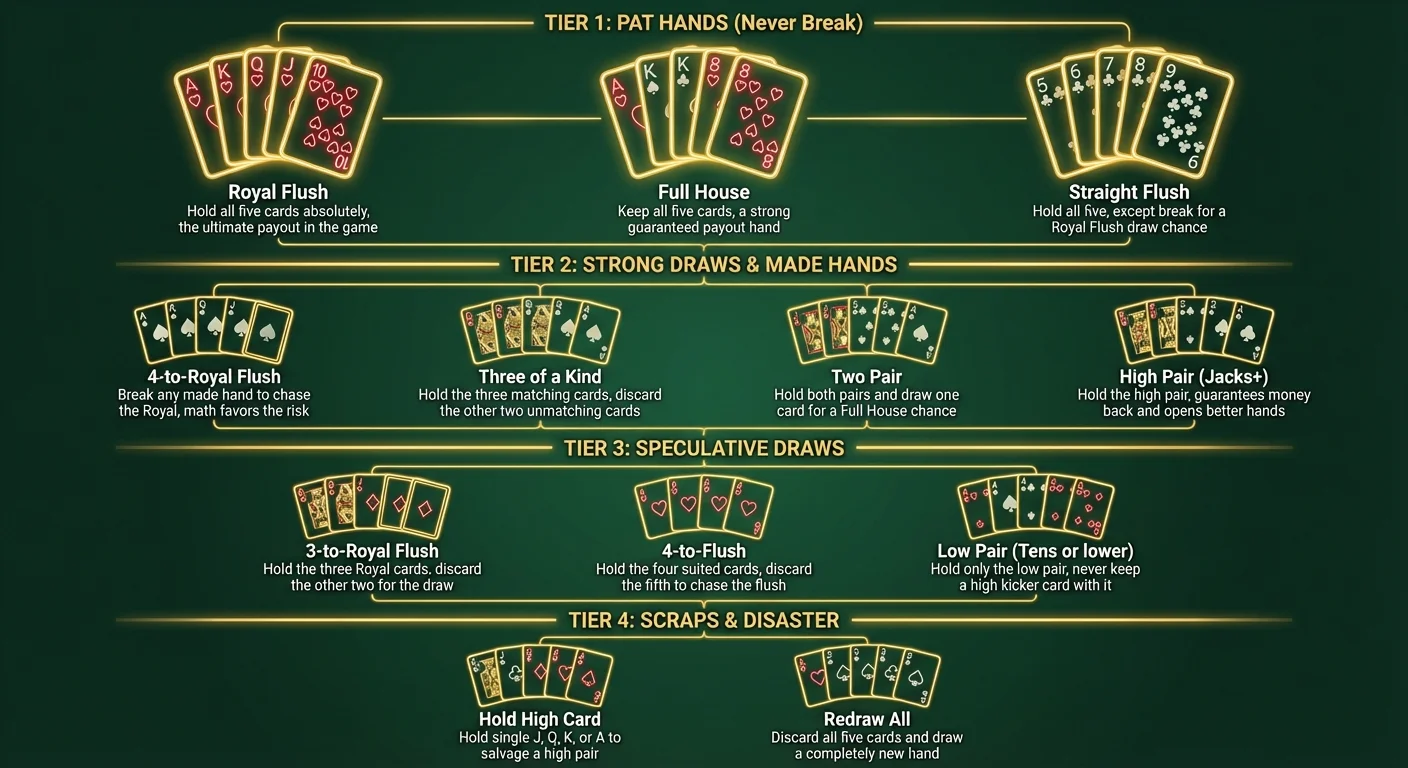
The core of Jacks or Better strategy is a hierarchy of hands. You look at your initial five cards, start at the top of this list, and move down until you find a match. The first category that matches your hand dictates what you hold.
Note: "High Cards" in Jacks or Better are Jack, Queen, King, and Ace.
Tier 1: The "Pat Hands" (Never Break These)
If you are dealt these, hold all five cards. The only exception is if you have 4 cards to a Royal Flush inside a made hand (very rare).
- Royal Flush: (Hold all 5. Celebrate.)
- Straight Flush: (Hold all 5.)
- Four of a Kind: (Hold all 5. It cannot be improved.)
- Full House: (Hold all 5.)
- Flush: (Hold all 5. Exception: If you have 4 cards to a Royal Flush, break the Flush to go for the Royal.)
- Straight: (Hold all 5. Exception: If you have 4 cards to a Royal Flush, break the Straight.)
Tier 2: The Strong Draws and Made Hands
If you don't have Tier 1, look for these.
- 4 Cards to a Royal Flush: This is the most exciting draw in the game. You discard the fifth card, even if it breaks a Flush or a Straight. The math dictates the potential reward of the Royal outweighs the guaranteed smaller win.
- Three of a Kind: Hold the three matching cards. Discard the other two. Do not keep a "kicker" (a high card).
- 4 Cards to a Straight Flush: Hold the four suited, connected cards.
- Two Pair: Hold both pairs. Discard the fifth card. This creates a chance for a Full House.
- High Pair (Jacks or Better): Hold the pair. Discard the other three. This guarantees your money back and opens the door for 3 of a Kind or 4 of a Kind.
Tier 3: The Speculative Draws
This is where beginners make the most mistakes. If you have none of the above, look for these.
- 3 Cards to a Royal Flush: Hold the three cards that make up the Royal. Discard the other two.
- 4 Cards to a Flush: Hold the four suited cards.
- Low Pair (Tens or lower): Hold the pair. Discard the other three. Crucial: Never keep a "kicker" (a high card) with a low pair. It reduces your expected value.
- 4 Cards to an Outside Straight: An "outside" straight means it can be completed on either end (e.g., 4, 5, 6, 7 can be completed by a 3 or an 8).
- 2 Suited High Cards: (e.g., Queen and King of Hearts). This gives you a shot at a Royal Flush, a Flush, a High Pair, or a Straight.
Tier 4: The Scraps
If your hand is truly garbage, try to salvage it with high cards.
- 3 Cards to a Straight Flush: (Only specific types, usually connected and open-ended).
- 2 Unsuited High Cards: Ideally, hold the lowest two high cards if you have more than two (mathematically slightly better due to straight potential).
- Suited 10/J, 10/Q, or 10/K: Hold these two.
- One High Card: Hold the single Jack, Queen, King, or Ace.
- Disaster: If you have absolutely none of the above, discard all five cards and redraw.
Detailed Tactical Explanations
To truly master the beginner strategy, you need to understand the logic behind the "Hold" button. Here are the most common scenarios that trip up new players.
The "Kicker" Mistake
Scenario: You are dealt 4-4-K-8-2.
Beginner Move: Hold the Pair of 4s and the King (the kicker), thinking the King might pair up later.
Pro Move: Hold only the 4s.
Why: In standard Draw Poker, holding a kicker makes sense. In Video Poker, you are playing against a paytable, not a person. By holding the King, you reduce your chances of drawing a third 4 (Three of a Kind) or a second pair (Two Pair). The math proves that holding a kicker with a pair drastically lowers your Expected Value (EV) over time.
The Low Pair vs. The Flush Draw
Scenario: You are dealt 3♥-3♣-9♥-J♥-A♥.
The Dilemma: You have a low pair of 3s, but you also have 4 cards to a flush (Hearts).
Pro Move: Hold the Low Pair.
Why: This often surprises players. In Jacks or Better, a made Low Pair is mathematically superior to a 4-card Flush draw. The Low Pair can turn into Three of a Kind, Four of a Kind, or a Full House. The Flush draw misses more often than it hits. Note: This rule changes if you have 4 to a Royal Flush, in which case you always chase the Royal.
Breaking the High Pair
Scenario: You are dealt J♦-J♠-10♠-Q♠-K♠.
The Dilemma: You have a guaranteed win with the Pair of Jacks, but you also have 4 cards to a Royal Flush (10, J, Q, K of Spades).
Pro Move: Break the Pair. Hold the 4 suited cards.
Why: This is one of the rare instances where you sacrifice a guaranteed win. The payout for a Royal Flush (4000 coins) is so massive that it is worth the risk of losing the 1-coin payout from the Jacks.
Crypto-Specific Tips for Grinding
When playing Jacks or Better at a crypto casino, your goal is often to "wager" a certain amount to unlock a Bitcoin bonus or climb a VIP leaderboard.
1. Check the "Game Contribution"
Before you start grinding, read the Terms & Conditions of your bonus. Because Video Poker has such a high RTP (99.54%), casinos often limit its contribution to wagering requirements.
- Slots: Usually contribute 100%.
- Video Poker: Often contributes 5%, 10%, or sometimes 0%.
If the contribution is 0%, do not play JoB to unlock a bonus. If it is 5% or 10%, calculate if the grind is worth the time.
2. The Auto-Hold Feature
Many modern crypto video poker interfaces have an "Auto-Hold" feature.
- Warning: Do not blindly trust this. While it usually identifies made hands (like a Flush), it often fails to identify complex optimal strategies, like breaking a pair to chase a Royal. Always verify the hold before clicking Draw.
3. Bankroll Management for Grinding
Even with low volatility, variance exists. A standard rule of thumb for a beginner strategy bankroll is to have 50 to 100 bets available.
- If you bet $1.25 per hand (5 quarters), you should have at least $65 - $125 in your account. This ensures you can weather a temporary losing streak without busting before the math swings back in your favor.
Common Beginner Mistakes to Avoid
To wrap up your strategic foundation, here is a checklist of errors to avoid immediately.
- Betting Less than 5 Coins: We cannot stress this enough. You are voluntarily increasing the house edge by doing this.
- Holding a 10 with a High Card: If you have
K-10-4-2-8(unsuited), just hold the King. The 10 is not considered a "High Card" in terms of holding value unless it is part of a Royal Flush draw. - Chasing "Inside" Straights: If you have
4-5-7-8, you need exactly a 6 to win. This is an "inside" straight draw. The probability of hitting it is too low to justify holding the cards. Discard them unless you have nothing else. - Overvaluing Aces: An Ace is just a high card. A pair of Aces pays the same as a pair of Jacks. Do not treat Aces as "special" unless they are part of a Royal Flush.
Conclusion
Jacks or Better is the foundation of winning video poker strategy. It offers a blend of low risk, high return, and genuine decision-making that slot machines simply cannot match. By mastering the paytable, sticking to the 5-coin rule, and memorizing the decision hierarchy, you move from a gambler to a strategic player.
In the world of crypto gambling, where fairness and speed are paramount, Jacks or Better represents one of the best opportunities to protect your bankroll while aiming for that 4,000-coin jackpot. The cards are dealt, the strategy is set - the rest is up to you.