
Keno is often misunderstood as a simple game of luck where you blindly select numbers and hope for the best. While luck is undoubtedly the driving force, the structure of the game allows for a surprising amount of strategic depth. The single most important decision you make in Keno isn't which numbers you pick (hot, cold, or birthdays), but rather how many numbers you pick.
This decision - choosing between a 1-spot ticket and a 15-spot ticket - fundamentally alters the DNA of the game. It shifts Keno from a low-volatility, grinder-friendly game into a high-variance, jackpot-hunting pursuit similar to a national lottery.
For crypto gamblers, understanding this "Risk Spectrum" is vital. With the enhanced RTP (Return to Player) often found in blockchain Keno and the transparency of Provably Fair algorithms, applying the right pick strategy can significantly extend your playtime and align the game with your bankroll goals. This guide explores the mathematics and psychology behind the number count, helping you choose a strategy that matches your risk tolerance.
The Mechanics of the Pick
Before diving into specific strategies, it is crucial to understand how the number of picks alters the game's probability engine. In standard Keno, 80 balls are in the virtual hopper, and 20 are drawn.
When you select your "spots" (the numbers you want to hit), you are effectively choosing your own paytable.
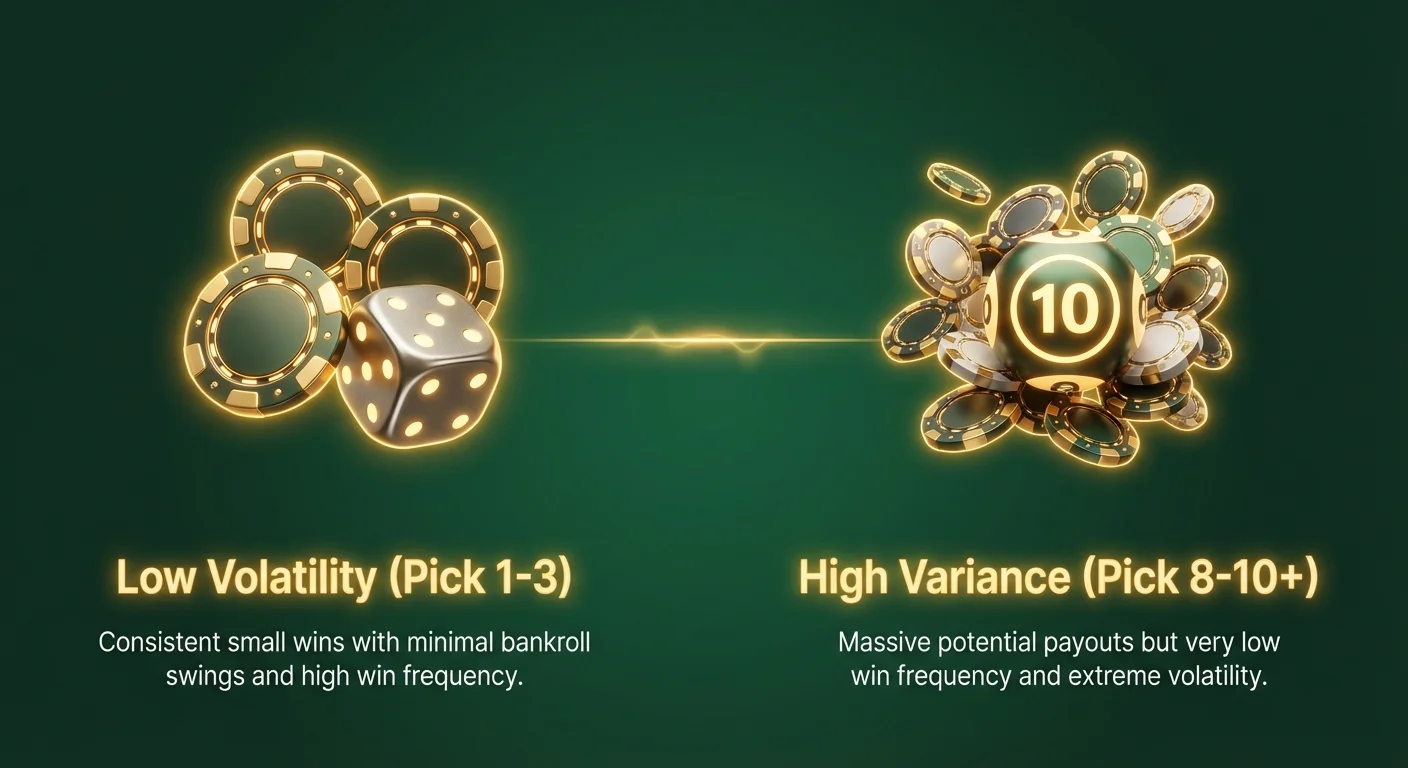
- Fewer Spots: You need to hit a high percentage of your numbers to win, but it is statistically easier to do so. The payouts are smaller, but frequent.
- More Spots: You do not need to hit all your numbers to get a payout (e.g., hitting 0 out of 10 might pay, and hitting 5 out of 10 might break even), but hitting the top prize becomes exponentially more difficult.
This trade-off is what we call the Risk Spectrum.
Low Volatility Keno: The "Pick 1-3" Strategy
At the lowest end of the risk spectrum lies the "Pick 1" to "Pick 3" strategy. This approach is favored by players who prefer consistent, small wins over the stress of long losing streaks. It is the "tortoise" approach to the race.
The Characteristics
- Win Frequency: High.
- Payout Potential: Low (usually 3x to 45x max).
- Bankroll Swing: Minimal.
The Math Behind the Grind
If you play a Pick 1 game, you are simply betting that your single number will be among the 20 drawn from the 80 available.
- Probability: You have a 1 in 4 (25%) chance of winning on every single draw.
- Typical Payout: 3x or 3.5x your wager.
This is exceptionally high consistency for a casino game. For comparison, a single number bet in Roulette offers a 1 in 37 chance. In Pick 1 Keno, you are winning roughly every fourth game.
Moving up to a Pick 2, the volatility increases slightly. You need both numbers to hit. The odds of hitting 2 out of 2 are approximately 1 in 16. The payout usually jumps to around 12x-15x.
Who is this for?
- Bonus Clearers: If you are playing at a crypto casino with a wagering requirement on a welcome bonus, low volatility Keno is excellent. The frequent wins keep your balance stable while you churn through the required wager volume.
- Small Bankrolls: If you only have $20 worth of Bitcoin to play with, betting on Pick 10s could wipe you out in minutes. Pick 1-3 extends your playtime significantly.
- Martingale Players: Because the win rate is 25% for Pick 1, some players utilize negative progression systems (increasing bets after losses), though this is always risky and requires a substantial stop-loss limit.
The Sweet Spot: The "Pick 4-7" Strategy
This is the middle of the spectrum and arguably the most popular way to play Keno. It offers a balance: the payouts are large enough to be exciting (hundreds of times your bet), but the odds aren't so astronomical that you feel like you're throwing money into a void.
The Characteristics
- Win Frequency: Moderate.
- Payout Potential: Moderate to High (100x to 2000x).
- Bankroll Swing: Manageable chops.
The "Pick 5" Benchmark
Let's look at the Pick 5 strategy, a favorite among seasoned players.
- Goal: Catch 5 out of 5.
- Odds: roughly 1 in 1,550.
- Secondary Prizes: You usually get your money back for catching 3, and a small profit for catching 4.
While 1 in 1,550 sounds high compared to Pick 1, it is frequent enough that a regular player will likely see a 5/5 hit eventually. The payout for a 5-spot hit typically hovers around 400x to 500x. If you are betting 0.001 BTC, a win of 0.5 BTC is a substantial bankroll booster.
Strategic Tips for the Mid-Range
- Look for "Catch 0" Payouts: Some crypto Keno variants offer a payout if you pick 7 numbers and hit none of them. This acts as a form of insurance and lowers volatility.
- Cluster Betting: As referenced in many Keno guides, players often use patterns like "4x5 Corners" or "Top Half" clusters. While the RNG is random, selecting a group of neighboring numbers (e.g., 1, 2, 11, 12) makes it easier to visually track your hits on the board, adding to the excitement of the mid-range game.
High Variance Keno: The "Pick 8-10+" Strategy
Welcome to the deep end. This is the "Moonshot" territory. This strategy effectively turns Keno into a mini-lottery. You are accepting that you will lose the vast majority of your rounds in exchange for the slim chance of a life-changing multiplier.
The Characteristics
- Win Frequency: Very Low.
- Payout Potential: Massive (10,000x to 1,000,000x).
- Bankroll Swing: Extreme.
The Odds Reality Check
It is vital to be realistic here. The odds of hitting 10 out of 10 numbers are approximately 1 in 8.9 million.
To put that in perspective, you are more likely to be struck by lightning than to hit a 10-spot in a single session. However, high-variance Keno isn't just about the perfect hit. It's about the tiered payouts.
In a Pick 10 game:
- Hitting 7/10 pays well (often ~100x).
- Hitting 8/10 pays great (often ~1000x).
- Hitting 9/10 pays a jackpot (often ~10,000x).
The "Catch All" Fallacy
Many beginners select 10 numbers thinking, "I just need to catch some of them." However, because the payouts are top-heavy, you usually get nothing for catching 1, 2, 3, or even 4 numbers. You generally need to catch at least 5 to break even. This results in long "dry spells" where your balance slowly drains while you wait for a big hit.
Who is this for?
- Jackpot Hunters: Players who view Keno as a lottery ticket rather than a table game.
- High Rollers: Players with large crypto balances who can weather 50 or 100 losing rounds in a row without panic.
- "Feature" Players: Those playing video Keno slots that offer bonus rounds or free spins for hitting specific high-number combinations.
Comparative Analysis: The Pick Spectrum
The following table breaks down the risk profile for Crypto Keno. Note that payouts vary by casino, but these are standard averages.
| Pick Strategy | Volatility | Hit Frequency (Any Win) | Top Prize Odds | Ideal Bankroll | Strategy Name |
|---|---|---|---|---|---|
| Pick 1 | Very Low | 25% | 1 in 4 | Small / Bonus | The Coin Flip |
| Pick 2 | Low | ~6% | 1 in 16 | Small / Conservative | The Double Up |
| Pick 5 | Medium | ~10% (for 3+ catches) | 1 in 1,550 | Medium | The Golden Mean |
| Pick 7 | High | ~15% (for 4+ catches) | 1 in 40,979 | Medium / Large | The Gambler |
| Pick 10 | Extreme | ~20% (for 5+ catches) | 1 in 8.9 Million | Large / High Risk | The Moonshot |
Note: "Hit Frequency" for high picks often includes "money back" wins which technically reset your bet but don't generate profit.
Why Crypto Keno Changes the Math
Playing Keno at a standard online casino or a land-based lounge is one thing; playing at a dedicated Crypto Casino is another. The platform you choose impacts your strategy.
1. Provably Fair Verification
In high-variance strategies (Pick 10), losing streaks can feel suspicious. "Is the machine rigged to avoid my numbers?" With Provably Fair crypto games, you can verify the "seed" of the random number generator. You can mathematically prove that the result was pre-determined before you hit "Bet" and was not altered based on your wager. This peace of mind is essential for high-risk strategies.
2. Higher RTP (Return to Player)
Land-based Keno is notorious for terrible odds, often carrying a house edge of 20-30% (RTP of 70-80%). Crypto Keno games typically operate with an RTP of 97% to 99%.
- Impact: A higher RTP is most beneficial for Low Volatility strategies. If you are grinding Pick 1 or Pick 2, a 99% RTP means your bankroll will last significantly longer, giving you more chances to hit a lucky streak.
3. Adjustable Volatility
Many crypto-native Keno games (like those found on BC.Game or Stake) allow you to adjust the "Risk" setting of the game itself, independent of the number of picks. You can set a "Classic" risk or "High" risk.
- Classic: Standard payouts.
- High: The payouts for hitting 0/10 or 1/10 drop to zero, but the payout for hitting 10/10 skyrockets. This allows you to fine-tune your volatility even further.
Practical Strategy: Building Your Playbook
Now that you understand the spectrum, how should you actually play? Here are three actionable playbooks.
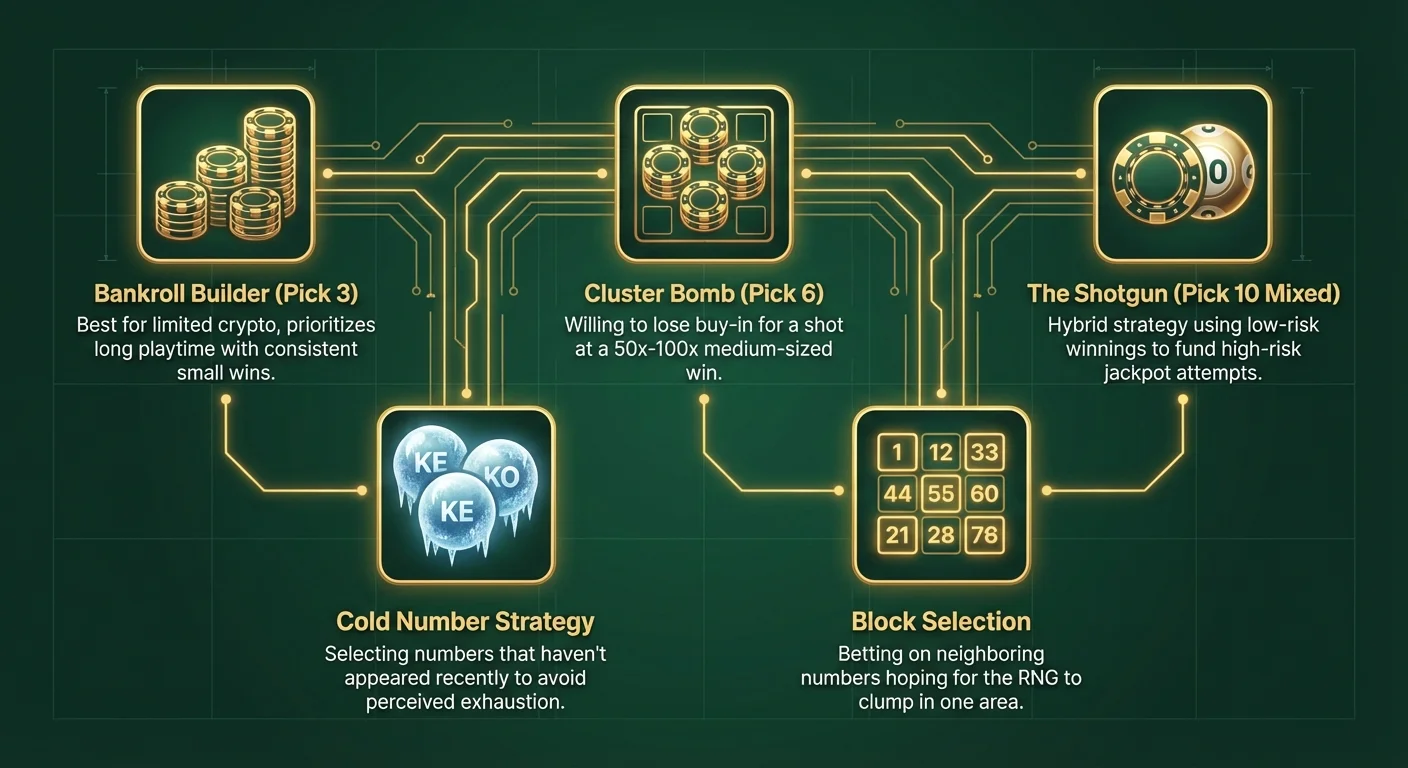
Playbook A: The "Bankroll Builder" (Pick 3)
Use this when you have a limited amount of crypto and want to play for a long time.
- Selection: Pick 3 numbers.
- Bet: 1% of your total bankroll.
- Pattern: Use a "Cold Number" strategy. Look at the last 50 draws and pick the 3 numbers that haven't appeared. While statistically random, this prevents you from betting on numbers that (superstitiously) seem "exhausted."
- Goal: Stop once you have doubled your initial buy-in.
Playbook B: The "Cluster Bomb" (Pick 6)
Use this when you are willing to lose your buy-in for a shot at a 50x-100x win.
- Selection: Pick 6 numbers.
- Bet: 0.5% of your bankroll.
- Pattern: Select two rows of 3 numbers (e.g., 21, 22, 23 and 31, 32, 33). This is known as a "block" or "cluster."
- Why: You are looking for the RNG to "clump" in a specific area of the board. If the draw favors the twenties, you maximize your catches.
Playbook C: The "Shotgun" (Pick 10 Mixed)
This is a hybrid strategy for managing variance. You will play multiple cards (if the game allows) or alternate rounds.
- Round 1: Play a Pick 10 ticket (The Moonshot).
- Round 2-5: Play four rounds of Pick 1 (The Grinder) to recoup the cost of the Pick 10 ticket.
- Repeat: This effectively allows you to hunt for the jackpot for "free" by using the winnings from the low-risk bets to fund the high-risk bets.
Common Pitfalls to Avoid
Regardless of where you land on the risk spectrum, avoid these common errors:
1. The "Must Win" Fallacy
Do not assume that because a Pick 10 payout is massive, it is the "best" way to play. The best way to play is the one that allows your bankroll to survive. If you have 0.01 BTC, betting 0.001 per round on a Pick 10 strategy will likely result in a zero balance within 15 minutes.
2. Ignoring the Paytable
Not all Keno games are created equal. Some pay 3x for a Pick 1 win; others pay 3.8x. Some pay for hitting 0 out of 10; others don't.
Always check the paytable before betting. A small difference in the multiplier makes a massive difference in House Edge over 1,000 rounds.
3. Chasing Patterns Blindly
While Chipy.com resources mention lucky numbers like 1, 4, 23, and 34, remember that crypto Keno uses RNGs that cycle millions of times per second. Yesterday's "Hot Numbers" have zero mathematical bearing on today's draw. Use patterns for fun and organization, but never bet more than you can afford because you "feel" a pattern is due.
Summary
The question "How many Keno numbers should I pick?" is synonymous with asking "What kind of gambler do I want to be today?"
- Pick 1-3: You are a strategic grinder, valuing time-on-device and consistent small wins. You are minimizing risk.
- Pick 4-7: You are a balanced player, looking for a decent payday without enduring agonizing losing streaks.
- Pick 8-10+: You are a thrill-seeker, willing to sacrifice consistency for the adrenaline of a potential jackpot.
The beauty of Keno lies in its flexibility. You can start your session with a Pick 3 strategy to build a profit buffer, and then use those profits to fund a few Pick 10 "Moonshots." By matching your pick count to your bankroll and risk tolerance, you stop gambling blindly and start playing with purpose.