
Roulette is often called the "Queen of Casino Games." It represents the quintessential gambling experience: the hypnotic spin of the wheel, the rattle of the ivory ball, and the rush of adrenaline as gravity decides your fate. In the world of cryptocurrency gambling, this classic game has found a new home, offering faster payouts, anonymity, and the transparency of blockchain technology.
However, the simplicity of roulette is deceptive. Beneath the red and black surface lies a mathematical engine designed to slowly - or sometimes very quickly - siphon your funds. For new players using Bitcoin, Ethereum, or Tether, the stakes can feel even higher due to the inherent value and volatility of the assets being wagered.
Many beginners dive into crypto roulette assuming it is purely a game of luck. While luck plays a massive role, how you manage that luck is determined by math and strategy. Making fundamental errors can turn a fun session into a financial disaster.
In this guide, we will dissect the 7 most dangerous roulette mistakes that drain crypto bankrolls. We will move beyond simple advice and look at the mathematics of the wheel, the fallacy of "perfect" systems, and specific pitfalls unique to the crypto gambling environment.

Mistake #1: Playing the American Wheel (The Double-Zero Trap)
The single most common mistake beginners make happens before the first chip is even placed. It is the error of table selection. In most crypto casino lobbies, you will see thumbnails for "American Roulette," "European Roulette," and sometimes "French Roulette."
Many players choose American Roulette simply because it sounds familiar or because it is the first option listed. This is a mathematical disaster.
The Mathematics of the Zeros
The difference lies in the zeros.
- European Roulette: Has 37 pockets (Numbers 1-36 and a single 0).
- American Roulette: Has 38 pockets (Numbers 1-36, a single 0, and a double 00).
That extra "00" might look harmless, but it drastically alters the House Edge (the mathematical advantage the casino holds over you).
| Game Type | Total Pockets | House Edge | Return to Player (RTP) |
|---|---|---|---|
| European Roulette | 37 | 2.70% | 97.30% |
| American Roulette | 38 | 5.26% | 94.74% |
Why this drains your bankroll:
The payouts for winning a single number are the same in both games (35 to 1). However, your chances of winning are lower on the American wheel because there is an extra pocket for the ball to land in. By playing the American version, you are voluntarily giving the casino nearly double the advantage. Over a long session with a crypto bankroll, this statistical drag will deplete your funds much faster.
The Fix: Always verify the wheel layout before betting. If you see a "00" pocket, close the window and find a European table.
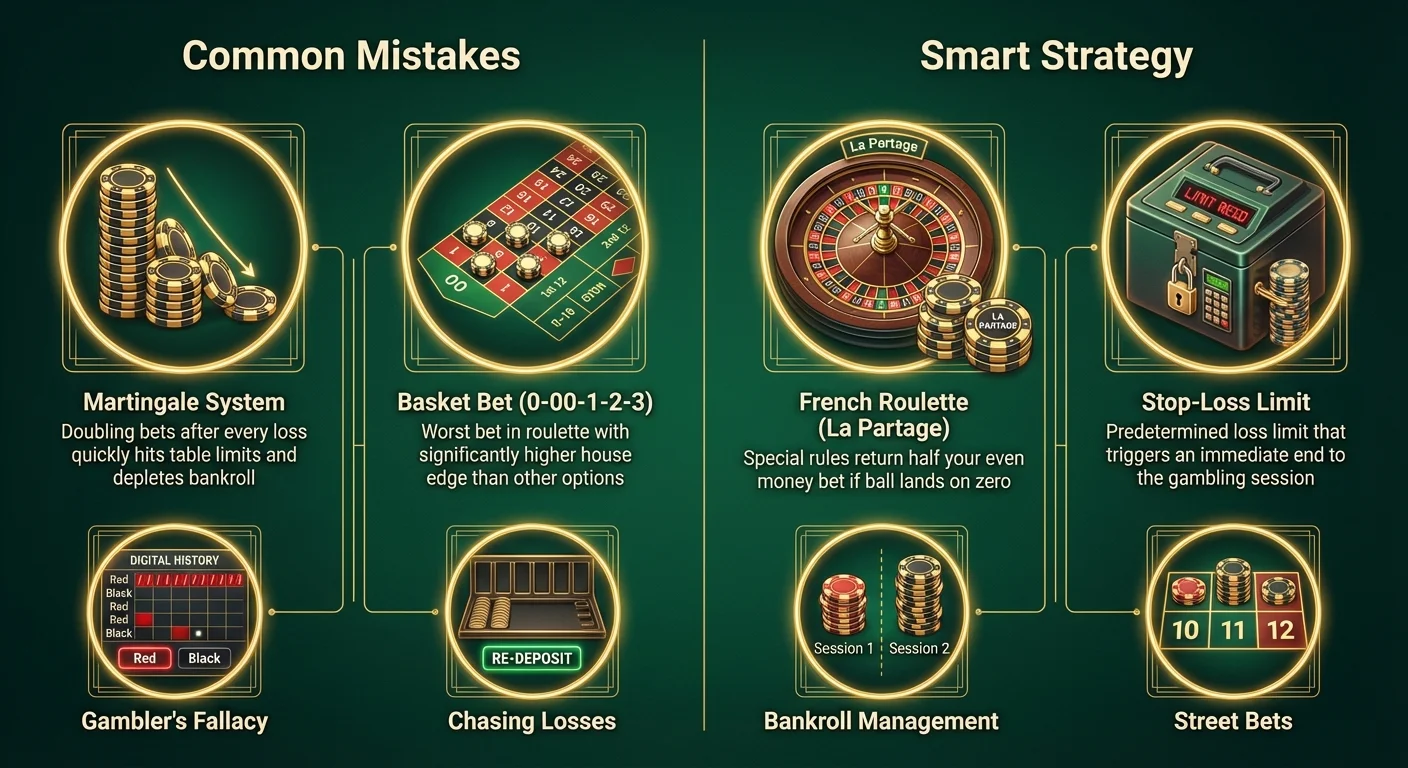
Mistake #2: Falling for the Martingale System
If you have searched for "how to win at roulette" on YouTube or gambling forums, you have undoubtedly encountered the Martingale Strategy. It is the oldest betting system in existence, and it is also the primary reason confident beginners lose their entire stack in minutes.
How it Works (The Theory)
The premise is seductive: You bet on an even-money outcome (like Red or Black). If you lose, you double your bet. The theory is that eventually, you must win, and when you do, the win will cover all previous losses plus a profit equal to your original stake.
Why it Fails (The Reality)
The Martingale fails for two reasons: Bankroll limitations and Table Limits.
Exponential growth is difficult for the human brain to visualize. Let's look at how quickly a $10 equivalent bet spirals out of control during a losing streak.
- Bet 1: $10 (Loss)
- Bet 2: $20 (Loss)
- Bet 3: $40 (Loss)
- Bet 4: $80 (Loss)
- Bet 5: $160 (Loss)
- Bet 6: $320 (Loss)
- Bet 7: $640 (Loss)
- Bet 8: $1,280 (Loss)
By the 8th spin, you are risking $1,280 just to win back your original $10.
The Crypto Danger:
In crypto roulette, where transactions are fast and auto-bet features are common, you can hit a 10-spin losing streak in under two minutes. Furthermore, every casino has a "Maximum Bet" limit. Even if you have 10 Bitcoin in your wallet, if the table limit is $1,000, the Martingale system mathematically breaks once you need to bet $1,280. You cannot double down, and your previous losses are locked in.
The Fix: Avoid negative progression systems that require doubling after losses. Instead, look at flatter betting structures or "positive progression" (increasing bets slightly when you are winning, not losing).
Mistake #3: Ignoring Bankroll Volatility (The Crypto Factor)
This mistake is specific to our audience at CryptoGambling.com. When you play with fiat currency (USD, EUR), a $100 chip is always worth $100. When you play with cryptocurrency, the underlying asset is moving while you play.
The Double Gamble
Imagine you deposit 0.05 BTC when Bitcoin is trading at $60,000. You play roulette for an hour and break even. However, during that hour, the price of Bitcoin drops by 5%. When you withdraw, you have the same amount of BTC, but you have lost purchasing power.
Conversely, you might be winning small amounts at the table, but if you are betting in a volatile altcoin that crashes during your session, your gambling "wins" are negated by the market "loss."
Emotional Tilt:Volatility also affects your psychology. If you see the value of your Bitcoin holdings drop, you might start betting more aggressively at the roulette table to "make up" the difference. This is a form of chasing losses that rarely ends well.
The Fix:
- Use Stablecoins: If you want to focus purely on your roulette strategy without worrying about market crashes, play using USDT or USDC.
- Denomination Blindness: Be aware of the fiat value of your crypto bets. Betting "0.01" ETH looks small, but it is a significant amount of money. Always calculate the fiat equivalent of your unit size before you start spinning.
Mistake #4: The "Basket Bet" (The Worst Odds in the Game)
There is one specific bet in American Roulette that acts as a tax on the uninformed. It is often called the "Basket Bet," the "Top Line," or the "Sucker Bet."
This bet covers the numbers 0, 00, 1, 2, and 3.
On the surface, it looks like a good way to cover the green pockets and the lowest numbers. However, the payout for this bet is 6 to 1. When you run the math on the probability of hitting these 5 numbers versus the payout, the House Edge skyrockets.
- Standard American Roulette House Edge: 5.26%
- Basket Bet House Edge: 7.89%
This is the only bet on the roulette table where the house edge is significantly worse than the standard game. By placing this bet, you are voluntarily handing the casino nearly 8% of your expected value.
The Fix: Never place a chip on the Top Line (0-00-1-2-3) on an American table. If you must bet on zero, bet it Straight Up or as part of a Trio on a European table.
Mistake #5: Believing in the "Gambler's Fallacy" (Sleeping Numbers)
"Red has hit six times in a row. Black is due!"
This sentence has bankrupted more gamblers than any other phrase in history. This belief is known as the Gambler's Fallacy. It is the mistaken belief that if an event happens frequently during a certain period, it will happen less frequently in the future (or vice versa).
The Wheel Has No Memory
In both physical casinos and Provably Fair crypto games, every spin is an independent event.
- The odds of hitting Red on spin #1 are 48.6%.
- The odds of hitting Red on spin #10, even after 9 consecutive Reds, are still 48.6%.
The universe does not care about "evening out" the results in the short term. It is statistically possible (though rare) to see Red hit 20 times in a row. If you keep betting increasing amounts on Black because it is "due," you are fighting a mathematical impossibility.
The Crypto Angle:In crypto casinos, many interfaces show a "History" bar displaying the last 500 numbers, highlighting "Hot" and "Cold" numbers. These are purely cosmetic. They are designed to trigger your pattern-recognition brain and encourage you to bet based on the Gambler's Fallacy.
The Fix: Treat every spin as a fresh start. Do not base your bet size on what happened three spins ago.
Mistake #6: Overlooking French Bets (La Partage & En Prison)
We established in Mistake #1 that European Roulette is better than American. However, there is a tier above European Roulette that many beginners miss: French Roulette.
While French Roulette uses the same wheel as the European version (single zero), it often includes two special rules that are incredibly favorable to the player: La Partage and En Prison.
How they help you:
These rules apply only to Even Money bets (Red/Black, Odd/Even, High/Low).
- La Partage: If the ball lands on Zero, you get half your bet back.
- En Prison: If the ball lands on Zero, your bet is "imprisoned" for the next spin. If it wins on the next spin, you get your original bet back.
The Impact on House Edge:
These rules cut the standard European House Edge of 2.70% in half, down to 1.35%. This makes French Roulette one of the best odds games in the entire casino, rivaling Blackjack and Baccarat.
The Fix: actively search your crypto casino for "French Roulette." If you are betting on Red or Black, playing on a table without La Partage is literally throwing money away.
Mistake #7: Betting Without a "Stop-Loss" (Bankroll Discipline)
Crypto gambling is incredibly fast. With "Instant Bet" features, you can play 100 rounds in the time it takes a land-based dealer to spin the wheel twice. This speed is exhilarating, but it is dangerous for your bankroll.
The most fatal error is playing without a hard exit strategy. This is often called "chasing losses." After a bad run, a player might deposit "just a little more" to try and get back to even. This usually leads to a depleted wallet.
Setting the Limit
Before you open the casino software, you must define two numbers:
- Stop-Loss: The exact amount of crypto you are willing to lose today. If you hit this number, you quit. No exceptions.
- Take-Profit: A goal for winning. If you turn 0.01 BTC into 0.015 BTC, do you cash out? Greed often turns a winning session into a losing one because the player didn't know when to leave.
The Fix:
- Divide your monthly gambling budget into session bankrolls.
- Never re-deposit in the same session to chase a loss.
- Use the "Responsible Gambling" tools provided by many crypto casinos to set daily deposit or loss limits on your account.
Bonus: A Better Way to Play (Simple Strategy)
Now that we have covered what not to do, here is a simple, balanced approach for a beginner looking to enjoy roulette without burning through their crypto immediately.
The "Street Bet" Compromise
Rather than betting on single numbers (high volatility) or just Red/Black (lower payout), consider the Street Bet.
- What it is: A bet on a row of three numbers (e.g., 10, 11, 12).
- The Payout: 11 to 1.
- The Strategy: You can place small bets on multiple streets to cover a section of the board.
For example, placing four separate Street bets covers 12 numbers (almost 1/3 of the wheel). If one hits, you get a substantial payout that covers the losing bets and provides a profit. This offers a nice balance between the excitement of hitting a specific section and the safety of board coverage.
Summary Checklist for Crypto Roulette
- Check the Wheel: Is there a double zero? If yes, leave.
- Check the Rules: Does the table offer La Partage?
- Check the Price: What is the fiat value of my crypto bet?
- Check the Hash: Are you playing on a reputable site? (Optional: Verify Provably Fair seeds).
- Set the Limit: What is my Stop-Loss number?
Final Thoughts
Roulette is a game of chance, and the house always has an edge. No amount of crypto wizardry or betting systems can mathematically overcome the house edge in the long run. The goal of the smart player is not to "beat" the game, but to optimize their play - reducing the house edge to the absolute minimum, managing their bankroll to survive volatility, and having fun without risking financial ruin.
By avoiding these 7 mistakes, you stop being the "sucker" at the table and start playing like a pro. Keep your head cool, your bets calculated, and your private keys safe.