The landscape of online slots has undergone a radical transformation in the last five years. Gone are the days when players were forced to sit through hundreds of dead spins, watching their balance slowly decay while praying for three scatter symbols to land. Enter the Feature Buy (or Bonus Buy) - a mechanic that allows you to bypass the base game entirely and purchase immediate access to the slot's main event.
For the modern crypto gambler, Feature Buy slots have become the standard. Whether you are playing with Bitcoin, Ethereum, or USDT, the allure of instant action fits perfectly with the fast-paced nature of crypto casinos. However, this convenience comes with a hefty price tag, usually costing between 50x and 100x your base bet (and sometimes climbing as high as 2,000x).
This guide analyzes the economics of the Feature Buy. We will strip away the flashy animations and look at the raw mathematics, the Return to Player (RTP) implications, and the volatility shifts to answer the ultimate question: Is buying the bonus a strategic advantage, or is it the fastest way to hit zero?
The Mechanics of the Buy: What Are You Paying For?
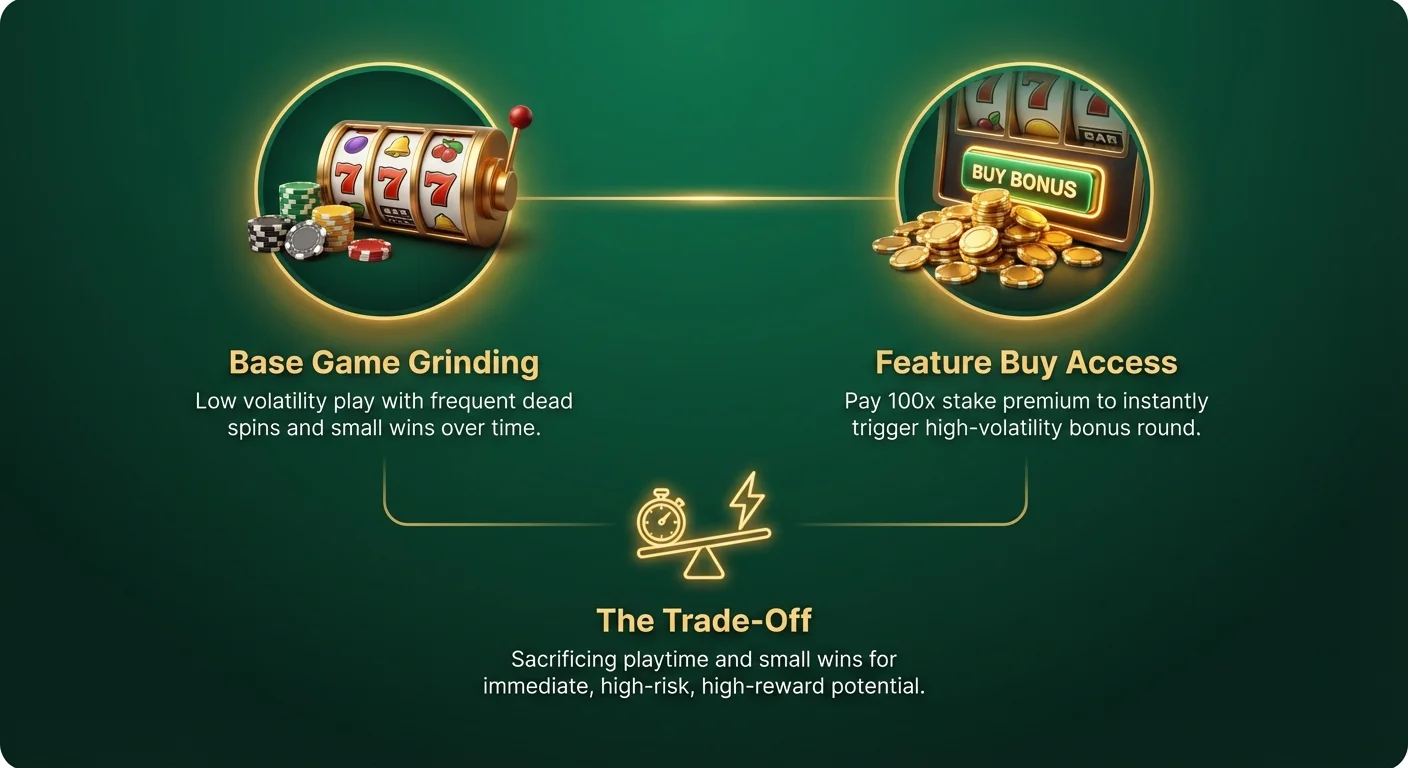
To understand the economics, we must first define the transaction. In a standard video slot, the game is divided into two phases:
- The Base Game: Generally low volatility, frequent small wins, and "dead spins." This is where the casino makes the majority of its house edge.
- The Bonus Round: High volatility, multipliers, expanding wilds, and the potential for "max wins."
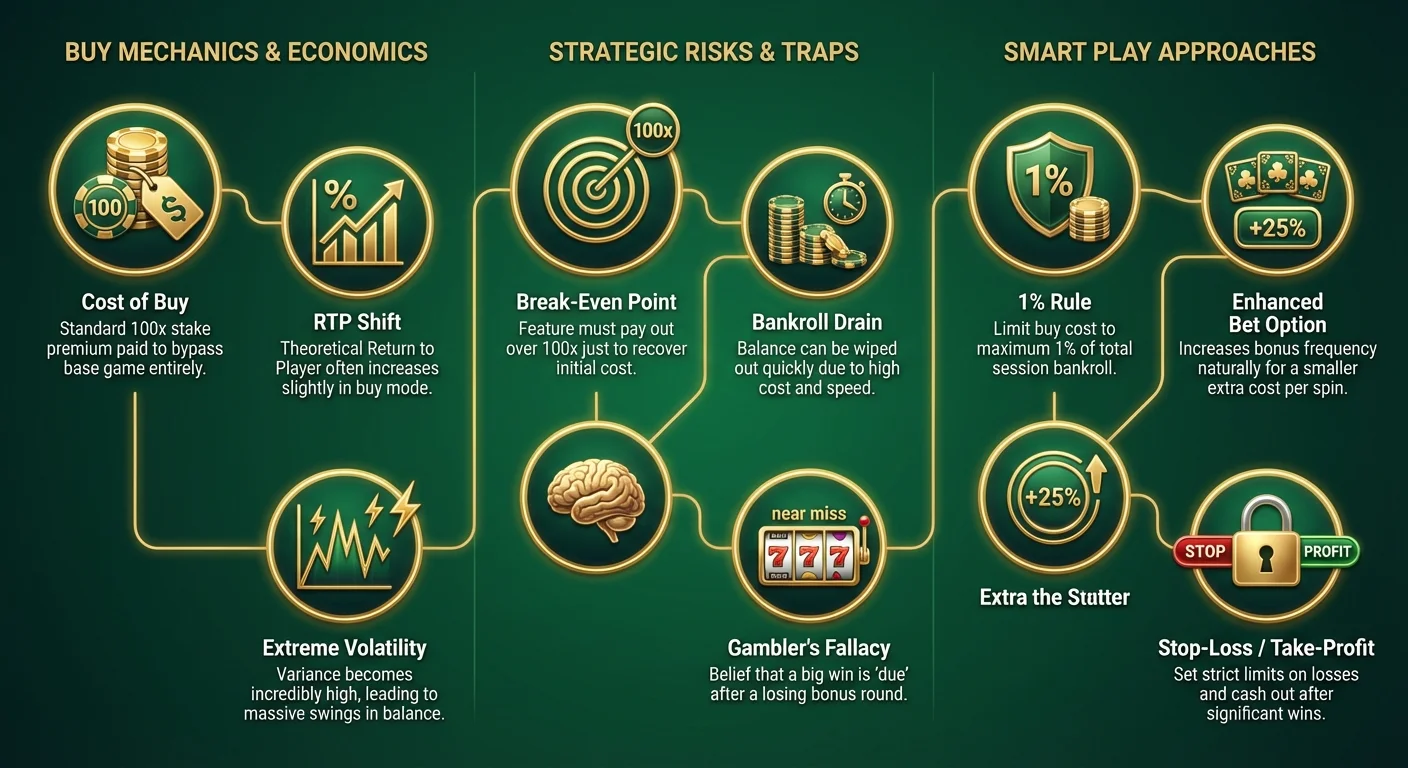
When you click the "Buy Feature" button, you are paying a premium to skip phase one. The standard industry rate is 100x your stake. This means if you are betting $1 equivalent in BTC, the bonus will cost you $100.
By paying this premium, the game's Random Number Generator (RNG) is forced to land the required scatter symbols on the very next spin.
The RTP Shift
Here is the most critical piece of data for advanced players: In almost every instance, buying the bonus increases the theoretical RTP (Return to Player) of the slot.
Most software providers program their slots to incentivize the buy. For example, a popular crypto slot might have a base game RTP of 96.20%, but if you utilize the Feature Buy, the RTP jumps to 96.70%.
Why does the casino do this? Two reasons:
- Turnover Velocity: A player buying bonuses will wager their balance hundreds of times faster than a player spinning manually. The casino accepts a slightly lower edge in exchange for vastly increased volume.
- Variance: The variance on a bonus buy is extreme. The increased RTP is an average over millions of buys; in the short term, the risk of ruin for the player is significantly higher.
The Mathematics of Volatility
While the RTP might be slightly higher, the volatility - or variance - changes drastically when you switch from spinning to buying.
In standard play, your bankroll graph usually looks like a slow downward slope with occasional spikes (wins). When exclusively buying features, your bankroll graph resembles a jagged EKG readout. You are concentrating all the game's volatility into single moments.
The "100x" Break-Even Point
The fundamental economic problem with a standard Feature Buy is the break-even requirement. If you pay 100x for a bonus, the feature must pay out 100x just to return your money.
In many high-volatility crypto slots, the average payout of a bonus round is actually lower than the buy price - often sitting around 60x to 80x. The math relies on the "long tail" distribution: most bonuses will lose money, but a rare few will pay 1,000x, 5,000x, or even 50,000x, dragging the average up to that 96%+ RTP figure.
Key Takeaway: When you buy a feature, you are statistically likely to lose money on that specific transaction. You are paying for the access to the top-end potential, not a guaranteed return.
Grinding vs. Buying: A Comparative Analysis
Let's look at the statistical differences between grinding the base game (hunting for scatters) and buying the entry.
| Metric | Base Game Grinding | Feature Buy Strategy |
|---|---|---|
| Cost per Event | 1x Bet | 50x - 100x+ Bet |
| RTP | Lower (e.g., 96.0%) | Higher (e.g., 96.5%) |
| Hit Frequency | 1 in 150-300 spins (avg) | Guaranteed |
| Time on Device | High (Hours of entertainment) | Low (Minutes/Seconds) |
| Bankroll Swing | Gradual | Extreme |
| Control | Passive | Aggressive |
The "Cost to Trigger" Fallacy
A common argument for buying is the "Cost to Trigger." If a slot has a bonus hit frequency of 1 in 300 spins, and you are betting $1, you will theoretically spend $300 to trigger the bonus naturally.
However, during those 300 spins, the base game pays out small wins to sustain your balance. You might spend $300 in wagers, but because of base game RTP, your actual loss might only be $20 or $30 by the time the bonus hits.
When you buy the bonus for $100, you are forfeiting the "sustain" of the base game. You are betting that the bonus payout will exceed the 100x cost, which is a much harder statistical hurdle than simply surviving 300 spins.
Crypto-Specific Considerations: Provably Fair and Speed
In the crypto gambling ecosystem, Feature Buys take on a unique dimension.
1. Provably Fair Verification
One of the advantages of playing proprietary crypto slots (often found on pure crypto casinos) is the Provably Fair system. When you buy a feature, you can often verify the seed and hash generation of that specific round. This transparency ensures that the "Buy" outcome wasn't manipulated to be a "dead bonus" just because you paid for it. The RNG remains consistent regardless of the stake.
2. Instant Payouts and High Limits
Crypto casinos often have much higher betting limits than fiat casinos. A "Whale" can buy bonuses for 0.1 BTC (thousands of dollars) per click. The mechanics of the blockchain allow for these massive swings to be paid out instantly. However, this lack of friction means a player can drain a Bitcoin wallet in minutes if they enter a losing streak on feature buys without a stop-loss strategy.
Strategic Approaches: When to Buy and When to Spin
If you decide to engage with Feature Buy slots, you cannot treat them like standard slot play. You need a dedicated strategy to manage the intense economic pressure they place on your bankroll.
The 1% Rule (Bankroll Management)
Never buy a feature that costs more than 1% to 2% of your total session bankroll.
- Example: If you deposit 0.01 BTC, your maximum buy cost should be 0.0001 BTC.
- Why? Feature buys have high variance. It is mathematically common to have 10 or 15 "dead bonuses" (paying <30x) in a row. If your buy cost is 10% of your balance, you will bust before realizing the statistical equity of the game.
The "Discounted" Buy Strategy
Some modern slots offer different tiers of feature buys.
- Standard Buy (100x): Normal free spins.
- Enhanced Bet (Antialias/Double Chance): Usually costs 25% more per spin but doubles the chance of landing scatters.
- Super Bonus Buy (200x - 500x): Guarantees a bonus with high-value symbols or multipliers active.
Strategy Tip: Mathematically, the Enhanced Bet often provides the best balance between RTP and play-time. It increases the frequency of the bonus naturally without subjecting your bankroll to the massive shock of a 100x deduction.
Stop-Loss and Take-Profit
Because feature buys are so fast, "tilt" is a major danger.
- Set a specific number of buys: "I will buy 5 features. If I don't profit, I stop."
- The "Hit and Run": If you buy a feature for $100 and win $500, stop buying. Switch to base game spins or withdraw. The math suggests that continuing to buy will eventually pull you back down to the RTP mean (a loss).
Understanding Feature Buy "Gamble" Options
Many slots now include a secondary mechanic: the ability to gamble your purchased spins.
- Scenario: You buy 10 Free Spins for 100x. The game offers a wheel spin to upgrade to 15 spins or lose them all.
The Economics: Generally, do not take this gamble.While the potential reward is high, the "Lose All" wedge on the wheel introduces a risk of ruin of 100%. You have paid 100x your stake and received 0 return. This destroys your implied RTP. Unless the gamble wheel is provably fair and shows a clear 50/50 statistical advantage (which is rare), the math favors collecting the spins you paid for.
Psychological Traps: The "Near Miss" in Buys
Slot machines are designed with psychology in mind. In a bought bonus, you might see massive multipliers land on the reels but fail to connect with a symbol. This is a "near miss."
In a standard game, a near miss costs you $1. In a feature buy, that near miss might be part of a round that cost you $100. The psychological urge to "buy again to catch it next time" is significantly stronger. This is known as the Gambler's Fallacy - the belief that a big win is "due" because you just had a bad bonus.
Fact: The RNG has no memory. Buying a losing bonus does not increase the probability that the next buy will be a winner. Each transaction is an independent event with negative expected value (-EV).
Summary: To Buy or Not to Buy?
The decision to utilize Feature Buys should be based on your bankroll depth and your goal for the session.
You Should BUY If:
- You have a high bankroll: You can sustain 20+ consecutive losses without busting.
- You are short on time: You want the thrill of the "main event" without the hour-long grind.
- You are playing a high-RTP Buy slot: You have verified that the Buy RTP is significantly higher (e.g., >96.8%) than the base game.
- You seek maximum variance: You are willing to lose your entire deposit quickly for the small chance of a 5,000x multiplier.
You Should SPIN (Grind) If:
- You are wagering a bonus: Most casinos forbid Feature Buys when playing with bonus funds.
- You have a limited bankroll: You want to extend your playtime and entertainment value.
- You are risk-averse: You prefer smaller, more frequent wins over "all or nothing" scenarios.
The Expert Verdict
From a purely mathematical standpoint, buying the feature often offers a higher theoretical return (RTP). However, it drastically lowers your "Time on Device" and increases your "Risk of Ruin."
The economics of Feature Buys are designed to accelerate the game. They accelerate the wins, but they accelerate the losses just as fast. If you choose to buy, treat it like a high-risk trade: enter with a plan, manage your exposure, and never chase a bad buy with a desperate one.