Stepping onto the virtual casino floor to play craps can feel like walking into a cockpit without flight training. The table layout is chaotic, the jargon is confusing (Hardways? Yo? Horn High?), and the pace of play in crypto casinos is significantly faster than the physical tables of Las Vegas.
While the fundamental rules of craps remain the same whether you are tossing dice at the Bellagio or clicking a "Roll" button using Bitcoin, the speed and accessibility of online play can amplify bad habits. For a beginner, the difference between a sustainable session and a wiped-out bankroll often comes down to five specific errors.
This guide identifies the most common rookie mistakes that drain crypto wallets, explains the mathematics behind why they fail, and offers strategic alternatives to keep your bankroll healthy.
The allure of Crypto Craps: Speed vs. Strategy
Before diving into the mistakes, it is vital to understand the environment you are playing in. Crypto craps offers distinct advantages: instant payouts, anonymity, and often "Provably Fair" algorithms that allow you to verify game integrity of every roll. However, there is a catch. In a physical casino, the game moves slowly. Dealers have to pay out bets, collect chips, and manage the stick.
In online crypto craps, the software handles payouts instantly. A game that takes five minutes in real life takes five seconds online. If you are making mathematically poor bets, the negative House Edge (HE) will grind your balance down at a terrifying speed. To survive, you must eliminate the following unforced errors.
Mistake #1: Ignoring the Pass Line and "Free Odds"
The single biggest crime a rookie can commit is skipping the Pass Line to bet on random numbers, or playing the Pass Line but failing to take the Odds.
The Rookie Move
Many beginners look at the Pass Line (paying 1:1) and find it boring. They see the "Any 7" paying 4:1 or the "12" paying 30:1 and immediately throw their chips there. Alternatively, they bet the Pass Line but never back it up, leaving money on the table.
The Math
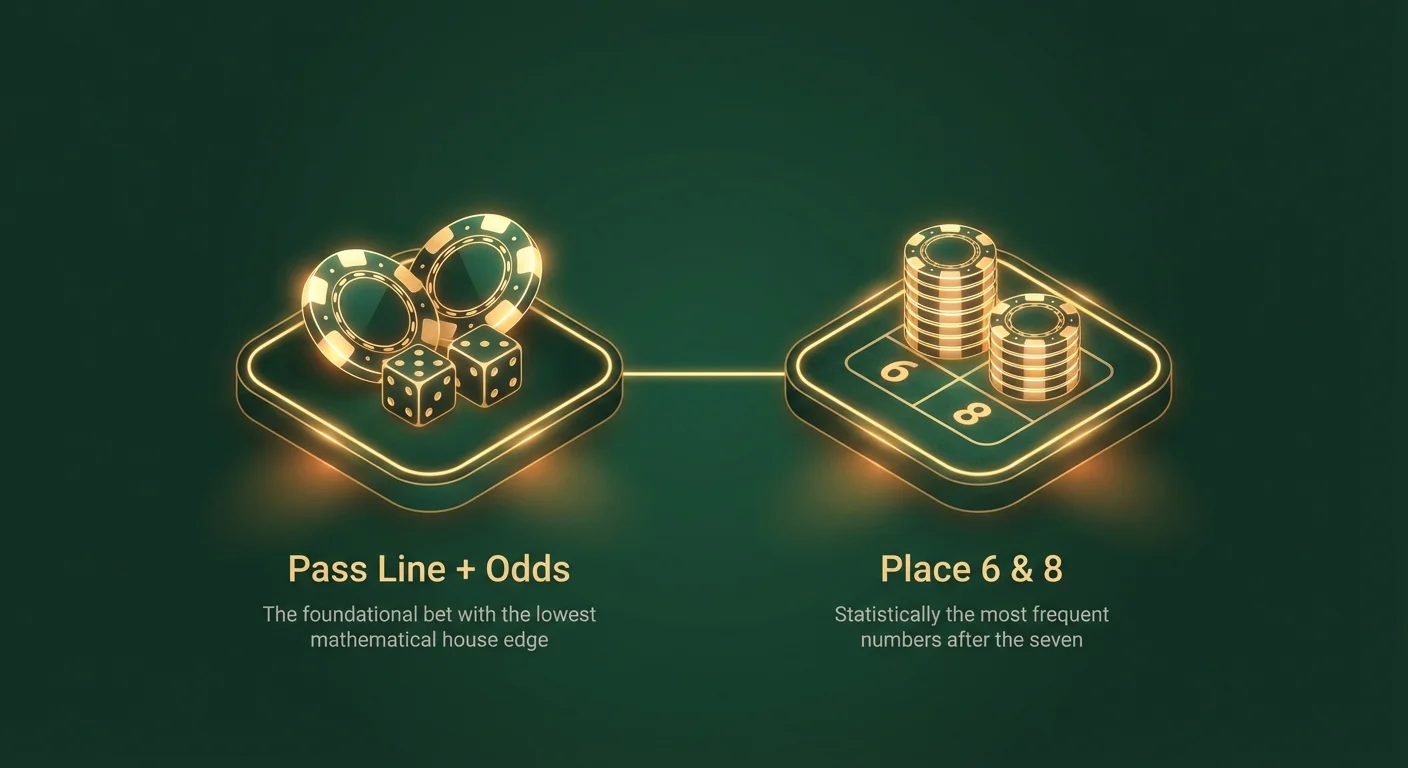
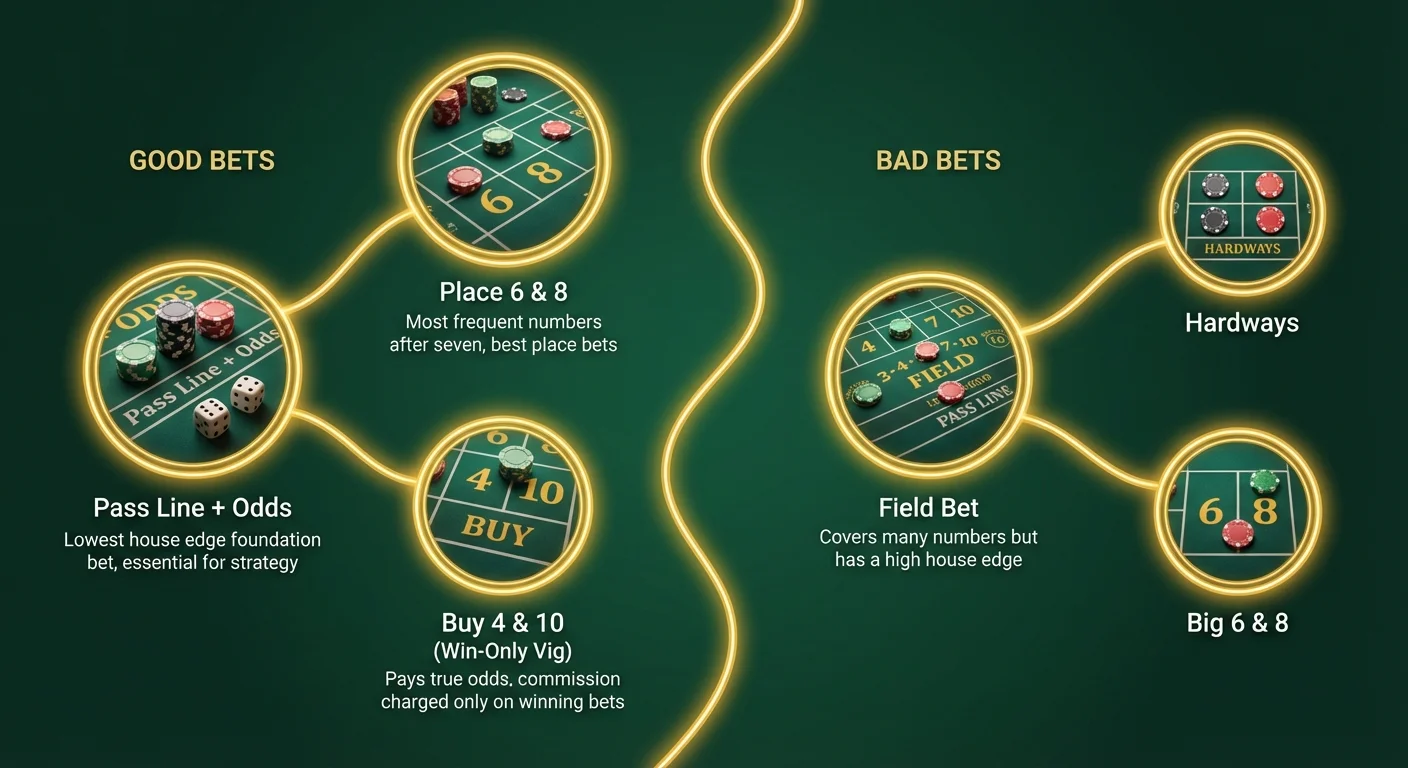
The Pass Line is the heartbeat of the game. With a House Edge of just 1.41%, it is statistically one of the best bets in the casino.
- Come-Out Roll: You win on 7 or 11. You lose on 2, 3, or 12.
- Point Phase: If a point is established (4, 5, 6, 8, 9, 10), you win if that number rolls again before a 7.
However, the real secret weapon of craps is the Odds Bet. Once a point is established, you can place an additional bet behind your Pass Line wager. This is the only bet in the entire casino - online or offline - that has zero house edge. The casino pays you the true mathematical probability of the roll.
The Fix
Always start with the Pass Line. Once the point is established, take the maximum odds your bankroll allows (usually 3x, 4x, or 5x the original bet). By combining the Pass Line with the Odds bet, you drastically reduce the casino's advantage over you.
House Edge Reduction with Odds:
| Bet Type | House Edge |
|---|---|
| Pass Line (No Odds) | 1.41% |
| Pass Line + 1x Odds | 0.85% |
| Pass Line + 2x Odds | 0.61% |
| Pass Line + 10x Odds | 0.18% |
Pro Tip: If you are playing with a limited bankroll, lower your initial Pass Line bet so you have enough chips left to back it up with full odds. A $5 Pass Line with $15 Odds is mathematically superior to a $20 Pass Line with no Odds.
Mistake #2: Falling for the "Field" Trap
The "Field" is a massive area on the layout that screams "Bet Here!" It is a one-roll bet that covers a lot of numbers: 2, 3, 4, 9, 10, 11, and 12.
The Rookie Move
New players love the Field because it feels like you are covering half the board. "I have 7 winning numbers and only 4 losing numbers (5, 6, 7, 8)," the rookie thinks. "The odds must be in my favor!"
The Reality
This is a classic case of quantity vs. quality. While you have more winning numbers, the losing numbers (5, 6, 7, 8) are the most frequently rolled combinations in the game.
- There are 16 ways to roll a winning Field number.
- There are 20 ways to roll a losing number.
The Cost
The standard House Edge on a Field bet is 5.56% (if the 2 and 12 pay double). Some generous crypto casinos pay triple on the 12, which lowers the edge to 2.78%, but this is still nearly double the edge of the Pass Line.
While strategies like the "Iron Cross" utilize the Field bet to cover every number except the 7, this increases volatility. In the long run, consistently betting the Field is a slow leak in your fuel tank.
Mistake #3: Betting the "Big 6" and "Big 8"
If you look at the corners of the craps layout, you will often see a large red "6" and "8." These are separate from the standard place numbers.
The Rookie Move
You want to bet on the 6 or 8 because they are the most common numbers after the 7. You see the big red box and drop your chips there.
The Math (Why this is a "Sucker Bet")
The "Big 6/8" bet pays 1:1 (Even Money) if the number hits.
However, you can make a "Place Bet" on the 6 or 8 by clicking on the smaller number box near the top of the layout (or asking the dealer in a live game).
- Place Bet 6 or 8: Pays 7:6.
- Big 6 or 8: Pays 1:1.
To put this in perspective, if you bet $6 on the "Big 6" and win, you get $6 profit. If you Place the 6 for $6 and win, you get $7 profit. You are betting on the exact same outcome, with the exact same risk, but voluntarily accepting a lower payout.
Comparison of Payouts:
| Bet Selection | Payout | House Edge |
|---|---|---|
| Big 6 / Big 8 | 1 to 1 | 9.09% |
| Place 6 / Place 8 | 7 to 6 | 1.52% |
The Fix
Pretend the Big 6 and Big 8 boxes do not exist. If you want to bet on these numbers (and you should, they are great numbers), always use the Place bets.
Mistake #4: Mismanaging "Buy" Bets and Commissions
As you graduate from the Pass Line, you will likely want to bet on specific numbers (4, 5, 6, 8, 9, 10). You can "Place" them or "Buy" them. This distinction confuses almost every beginner.
The Rookie Move
A rookie might "Buy" the 6 or 8, or "Place" the 4 or 10, not realizing that the mathematics of payouts shift depending on the number. Furthermore, in crypto gambling where you might be betting small fractions of Bitcoin (Satoshis), understanding the "Vig" (commission) is essential, particularly when choosing between Buy vs Place bets.
The Concept
- Place Bets: The casino gives you lower odds than true math to keep their edge. (e.g., The 4 pays 9:5).
- Buy Bets: The casino pays you true odds (e.g., The 4 pays 2:1), but charges a 5% commission on the wager.
The Strategy
Because of the 5% commission, Buying is only profitable on the "outside" numbers (4 and 10) because their payout variance is high enough to justify the fee.
- 4 and 10: Always BUY (if the casino allows). The House Edge drops from 6.67% (Place) to roughly 4.76% or lower (Buy).
- 5 and 9: Usually better to PLACE.
- 6 and 8: Always PLACE.
The Crypto Caveat
Many crypto casinos automatically deduct the commission on Buy bets. However, check the rules:
- Vig on Win Only: The best casinos only charge the 5% commission if the bet wins. This reduces the House Edge on the 4 and 10 to around 1.67%.
- Upfront Vig: If the casino charges commission just for making the bet, avoid Buy bets entirely and stick to Place bets.
Mistake #5: Chasing Losses with Hardways
We have all been there. You are down 0.05 BTC. You are frustrated. You see the "Hard 8" paying 9:1 (or 10 for 1 depending on the table wording). You think, "One lucky hit and I'm back to even."
The Rookie Move
Throwing value chips on the center-table "Proposition Bets" (Hardways, Horns, Any 7).
The Math
Hardways are bets that a double will roll (e.g., 4-4 for a Hard 8) before a 7 or an "Easy 8" (e.g., 5-3, 6-2).
- The Risk: There are multiple ways to lose (rolling a 7 OR rolling the easy version of the number) and only one way to win.
- The Edge: The House Edge on Hardways ranges from 9.09% (Hard 6/8) to 11.11% (Hard 4/10). The "Any 7" bet is the worst on the table with a 16.67% edge.
The Psychology
In crypto gambling, where the numbers on the screen can sometimes feel like "points" rather than real money, the temptation to make high-variance "lottery ticket" bets is high. This type of high-risk gambling is the fastest way to deplete a bankroll, especially when relying on center-table proposition bets.
The Fix
If you must play Hardways for the thrill, treat them as a "tipping" bet or a fun side wager with the absolute minimum unit size. Never rely on them to recover losses.
Practical Strategy: The Modified "Three Point Molly"
Now that we have stripped away the bad habits, what should a rookie actually do? The safest, most mathematically sound strategy for a beginner is a simplified version of the Three Point Molly. This strategy ensures you have coverage on the board with the lowest possible house edge.
Step-by-Step Execution:
- The Foundation: Bet the Pass Line.
- The Odds: Once the point is established, take 2x Odds (or whatever your bankroll allows).
- Expansion: Make a Come Bet.
- The Come Bet works exactly like the Pass Line but happens during the round.
- If the next roll is a 7 or 11, the Come Bet wins immediately.
- If a number rolls (e.g., a 5), your Come Bet moves to the 5.
- Back it Up: Add Odds to your Come Bet on the 5.
- Repeat (Optional): You can make one more Come Bet to have three numbers working for you (The Point + Two Come numbers).
Why this works: You are only making bets with the lowest House Edge (Pass/Come + Odds). If a shooter gets "hot" and rolls many numbers without hitting a 7, you will capitalize on all of them. If a 7 hits, you lose your bets, but you haven't wasted money on high-risk props.
Summary: The Crypto Craps Checklist
Before you deposit your next ETH or LTC into a craps table, run through this mental checklist:
- Am I playing the Pass Line? (Yes = Good).
- Did I take the Odds? (This is mandatory for serious play).
- Am I betting the Field? (Stop immediately unless you are an advanced player running a hedge strategy).
- Is my money on the Big 6/8 box? (Move it to the Place 6/8 box immediately).
- Am I Buying the 4/10? (Check if the casino charges vig only on wins. If so, do it. If not, Place them).
Craps is a game of streaks and swings. By eliminating these five rookie mistakes, you stop beating yourself and force the casino to rely on luck rather than your errors to win. Keep your head cool, your house edge low, and your bankroll managed.